
Wits & Weights Podcast
All Episodes
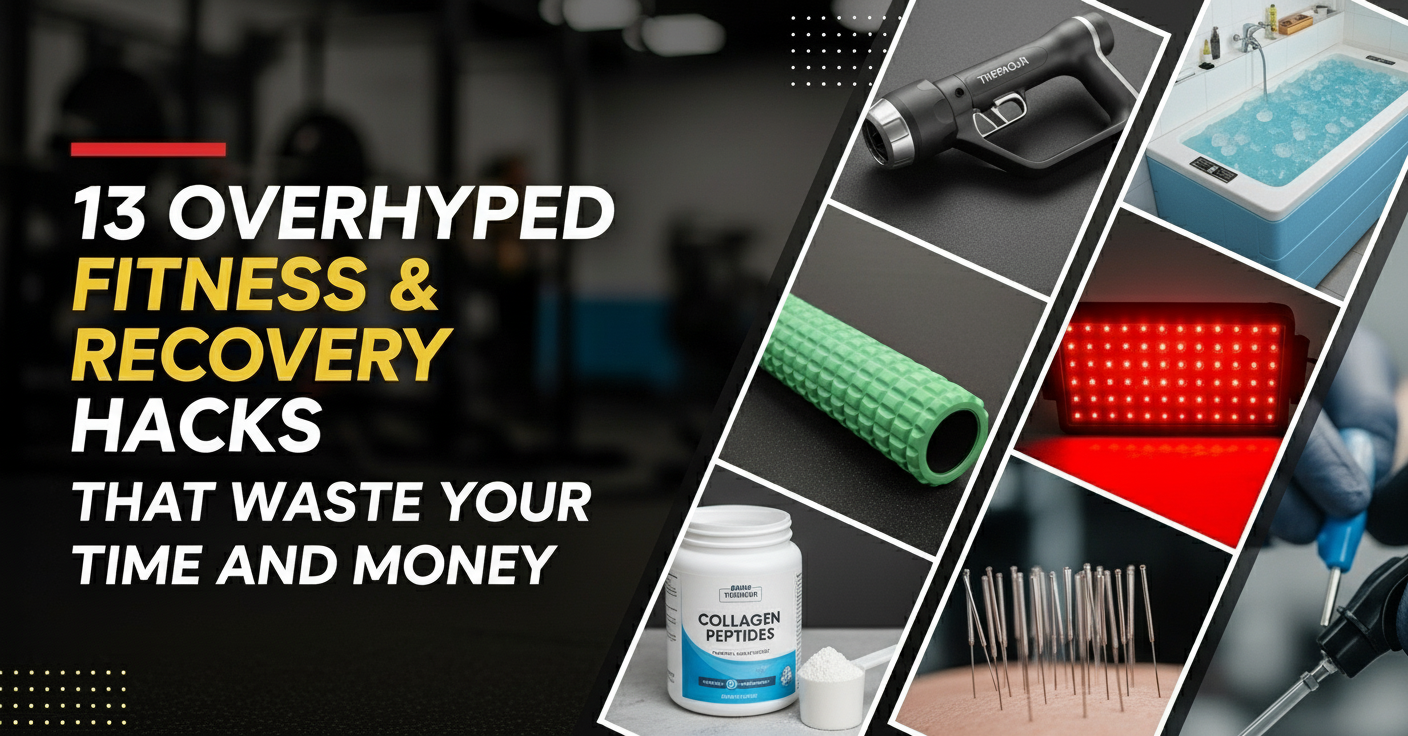
13 Overhyped Fitness & Recovery Hacks That Waste Your Time and Money | Ep 383
Tired of being told a gadget will fix your recovery and finally unlock your gains? In this episode’s article, I rank 13 of the most overhyped fitness and recovery hacks from least to most overhyped, explain what they really do, when they make sense, and when they are just burning cash. If you want results without wasting money, start here and put your effort into the few things that consistently move the needle.
Review the podcast by October 15 for a chance to win 3 months free in Physique University Mastery Track ($261 value). Leave a review at Apple Podcasts... EVERYONE who leaves a review will get a gift from me :)
Get 20% off Cozy Earth temperature-cooling sheets (with code WITSANDWEIGHTS) at witsandweights.com/cozyearth
--
Confused about which fitness and recovery tools actually work?
Ice baths, red light therapy, massage guns, collagen supplements, and more! The marketing makes them all sound like you NEED THEM NOW.
Learn about 13 overhyped tools ranked from least to most overhyped based on what the science actually says, when they might help in specific situations, and how to avoid wasting money on gadgets that don't move the needle.
1 recovery tool that DOES actually work:
Cozy Earth temperature-cooling sheets. Go to witsandweights.com/cozyearth and use code WITSANDWEIGHTS for 20% off
Timestamps:
0:01 - Are these fitness tools worth it?
2:47 - Review giveaway!
5:55 - How I'm ranking these fitness and recovery tools
7:15 - #13: Ice baths
8:22 - #12: Cryotherapy
9:02 - #11: Compression garments
9:48 - #10: Massage therapy and foam rolling
11:43 - #9: Percussion guns
13:11 - #8: Tart cherry juice
14:26 - #7: Heat therapy and sauna
17:42 - #6: Dry needling
18:49 - #5: Red light therapy
20:00 - #4: BCAAs and EAAs
21:51 - #3: Collagen supplements
23:11 - #2: Electrical stimulation (TENS and EMS)
24:20 - #1: Glutamine/supplements
25:28 - What these tools have in common and 3 questions to ask
Stop Chasing “Shiny Objects” for Fitness & Recovery
If your feed looks anything like mine, you have probably been served a steady stream of cold plunges, red light panels, massage guns, collagen powders, and miracle patches promising faster recovery and better gains. Some of these have a place. Most are overhyped for the average lifter trying to build muscle, lose fat, and feel better.
Below is a clear, ROI-first breakdown of 13 popular fitness and recovery hacks, ranked from least to most overhyped, with what they actually do, when they might be useful, and when they are just draining your wallet.
The ROI framework I use to judge these tools
Does research show a meaningful benefit for strength, hypertrophy, performance, or adherence?
Is the benefit context-specific rather than a universal fix?
What is the cost vs. benefit compared to basics like training, sleep, protein, steps, and stress management?
13) Cold water immersion and ice baths
They reduce acute soreness and can help you rebound between back-to-back competitive efforts. They also blunt hypertrophy signaling if used immediately post-lift. If you enjoy them, place well away from lifting sessions. Helpful in narrow scenarios, not a daily muscle builder.
12) Whole-body cryotherapy chambers
Same mechanism as cold water with a higher price tag and more friction to use. You get similar effects to an ice bath with less convenience and more cost. If your goal is hypertrophy, keep exposure separate from training or skip it.
11) Compression garments and pneumatic boots
Small, short-lived reductions in soreness and swelling. Comparable benefits to a 10-minute walk or easy cycling. If you love how they feel, fine. Just recognize the marginal return relative to price and time.
10) Massage therapy and foam rolling
Short-term improvements in range of motion and soreness relief. Great for comfort and a pre-lift movement boost. Effects fade quickly and do not build capacity by themselves. Massage can be a worthwhile luxury. Foam rollers are the budget option with similar acute effects.
9) Percussion guns
Theragun, Hypervolt, and similar tools offer transient relief and a small ROM bump. Useful as a quick primer before lifting or to relax tight areas. Benefits are similar to a lacrosse ball or basic soft-tissue work at a much higher cost.
8) Tart cherry juice and polyphenol supplements
Occasional studies show reduced soreness. Chronic anti-inflammatory stacking may interfere with adaptations, just like routine NSAID use. If you like the taste, enjoy it as food. Do not expect it to be a major recovery driver.
7) Heat therapy and sauna
Promising for endurance adaptations and general relaxation. Infrared units are convenient at home and traditional sauna can be a solid habit for well-being. For lifting outcomes, think modest at best. Prioritize sleep and training quality before investing thousands in a box that makes you sweaty.
6) Dry needling
Can reduce pain and improve short-term mobility in targeted clinical cases. Not a general recovery tool. If your PT uses it to address a specific issue, fine. As a recurring performance strategy for healthy lifters, it is oversold.
5) Red light therapy
Mixed evidence with lots of marketing. Some small signals for soreness, little for strength or hypertrophy. Expensive hardware, inconsistent results. Spend the money on a quality program, better sleep environment, and protein.
4) BCAAs and EAAs
If you hit daily protein targets, you already have the amino acids you need. The narrow use case is fasted training with a long delay before eating, which you can also solve with whey or a simple pre-workout snack. Dollars per useful gram is poor.
3) Collagen for muscle recovery
Collagen is an incomplete protein. It is not a replacement for complete protein sources when the goal is muscle. There may be a role for tendon health when combined with vitamin C timed around training. For hypertrophy or general protein intake, choose complete proteins first.
2) Electrical stimulation devices
TENS can help short-term pain. EMS marketed as a muscle builder without lifting is pure fantasy. Good rehab tool in some cases, not a shortcut to strength or size. If an ad claims you can skip training, close the tab.
1) Glutamine for muscle and recovery
Heavily marketed for decades, not effective for muscle growth or performance in healthy lifters. Potential clinical use in illness does not translate to hypertrophy. Your protein foods already provide what you need.
What these tools have in common
They are sold as solutions to problems most lifters do not actually have. If you consistently lift, hit protein, sleep enough, walk more, and manage stress, you have already solved 95 percent of recovery. Add optional tools for comfort or enjoyment, knowing they are the 1 percent.
The recovery hierarchy that actually moves the needle
Training quality and progression: well-designed programming, smart volume, good exercise selection, technique, and effort
Sleep: 7 to 9 hours, cooler room, consistent schedule, dark and quiet environment
Nutrition: adequate calories for your phase, protein 0.7 to 1.0 g per pound of goal body weight, carbs to support training
Movement: steps and low-intensity activity to drive blood flow and recovery
Stress management: breath work, walks, sunlight, boundaries with tech and work
How to pressure-test any new gadget or supplement
Am I already nailing the big rocks for at least 8 to 12 weeks?
Is there meaningful evidence for my goal and context, not just general claims?
What is the opportunity cost? If I spend money and time here, what am I not doing that would have a bigger payoff?
Practical substitutions that save money
Instead of percussion guns and compression boots, do 10 minutes of easy walking after training and again in the evening.
Instead of BCAAs or EAAs, drink whey plus fruit pre or post-workout to cover protein and carbs.
Instead of a red light panel, get morning sunlight and protect a regular bedtime.
Instead of chronic cold exposure post-lift, use contrast showers or save cold for non-training days if you simply enjoy it.
Gadgets can be fun, and some have narrow uses, but they are not multipliers unless the foundations are already tight. If you have discretionary budget and everything else is dialed in, enjoy whatever adds comfort or compliance. If not, skip the hype and invest in the boring winners that keep working year after year.
Have you followed the podcast?
Get notified of new episodes. Listen on Apple, Spotify, or all other platforms.
Then hit “Follow” and you’re good to go!


Transcript
Philip Pape: 0:01
I don't know if your feed looks like mine, but I keep seeing ads and influencers talking about cold plunges and ice baths and red light therapy boxes, massage guns, collagen supplements, all the things. And I'm wondering how many people are thinking, do these work? Or are they hype? And I don't want to waste my money, but it looks so attractive, it looks like it's gonna do this amazing thing that I really need right now. If that's you, then this episode is for you because we are gonna rank 13 of the most overhyped fitness and recovery tools based on what the science actually says. You're gonna discover which ones might help in specific situations, which ones are a complete waste of money, and how to think about these tools so you don't fall for any of these claims and do what actually works. I'm your host, Philip Pape, and today we're gonna look at overhyped fitness tools. Because the fitness industry runs on hype, doesn't it? You've got new devices every day for recovery, for supplements, you know, miracle cures, high-tech gadgets, all promising faster results, better performance, easier gains. Anyone ever heard of vibration plates? Yes, they are still around. The problem is that most of these tools range from barely helpful to completely useless, but they are marketed so slickly that we all keep buying them. I've bought plenty of different devices over the years. Some of them are on this list. Am I ashamed? No, because I didn't, you know, I thought I was getting what I was getting, and then now it's collecting dust. Well, you're probably gonna relate to this when we get into this list. We all want an edge, but these aren't it. So today I'm gonna rank 13 of the most overhyped fitness and recovery tools from least to most overhyped. From eh, this might actually work in some context to don't waste your money. We're gonna look at what the research says at a very high level, because it's a lot. It's a lot, it's a big list, so I don't want it to take too long. We're gonna talk about when they might make sense and then when they are just uh emptying your wallet, let's say. If anybody uses wallets these days, you know what I mean. So before we get into the ranking, I did want to share just a couple of reviews that came in from listeners lately and then talk about a little giveaway we're running if you submit a review. So a couple of my favorite reviews that have come in. One is from Travis Roden. He said, This man makes nutrition and strength training clear and actionable. Each episode cuts through the noise with great tips and real world advice. Check it out if you're serious about lifting and long-term results. I love that review because it kind of says it all, right? Actionable, strength training cuts through the noise, practical, etc. And then another one I got is a bit longer, but I really love it. It's from Kaniac Fan 14. Yeah, I said that right. Wits and weights is a game changer. I discovered wits and weights in early 2023 and have been a follower ever since. So this is a longtime listener. Thank you so much. I'm grateful. Phillips engineering mind crunches numbers like a computer. He has the ability to analyze data and present solutions to his clients in a no-nonsense yet compassionate way. I've witnessed him grow his brand and reach a broader audience, as is evident by his growing community of podcast followers. The interviews are carefully curated and up to date with current trends. Philip is passionate about his work and is so approachable, providing plenty of free resources as well as guided one-on-one coaching. The podcast, as well as the wits and weights community, are valuable resources anyone should have in their health and wellness toolbox. And I wanted to highlight that one just to make known that I do have an entire ecosystem here I try to develop to make things accessible to as many of you as possible. And this podcast is a great entry point because it's free. It's 100% free. You can take the information, you can apply it. And, you know, I might not get it right all the time. I'm always learning myself. I try to have whatever tiny bit of humility I can possibly have in this space and keep learning and bringing that to you. But the cool thing is, if you do enjoy the show, if you want to help others discover it, and you leave a review on Apple by October 15, you'll be entered to win three months of our mastery track level of physique university. That's the more personalized level of service that we have. So this is almost a $300 value that you can win. I mean, essentially, I don't want to say raffle because I don't know if that passes the uh the legal test here, but you know, one reviewer will be selected for three months of free coaching. And then I'll give you some more details at the end of the episode if that sounds interesting to you. All right, let's talk about these tools that I'm gonna rank. I'm gonna look at three things. First of all, does the research show any meaningful benefit, right? Not just statistically significant, which is the technical term in the literature, but really meaningful to you for your training, for your physique? The things that we're scoping for our discussion. Second, is the benefit specific to certain situations, or is it marketed as this big catch-all universally helpful thing when it is not? I think it's important to separate those. And then third, what is the cost versus benefit? What is the return on investment? A cheap tool that provides a small benefit actually might be worth it. An expensive tool that provides a small benefit, probably not, right? So with that framework, let's get into it. Let's get into the ranking. We're gonna go from least overhyped to most overhyped. So least overhyped is gonna be number 13 on the list: cold water immersion and ice baths. All right. So I was not I was not even sure if I should have this on the list because ice baths actually do something. You know, they reduce muscle soreness, they can help with recovery between, say, events in a tournament or competition context where you have to perform multiple times in a short period. The problem is that they can blunt hypertrophy adaptation. So that's the adaptation from your lifting if you use them right after lifting, because the cold interferes with the inflammatory response that signals muscle growth. So ice baths work as intended. They reduce acute soreness, but they kind of get misused if you're using them right after you lift. Now, if you're in a competition right now, today, and you have multiple events, you want to take ice baths in between to reduce soreness, that makes total sense. But if you're trying to get bigger and stronger over time, skip them after your workout and do them completely separate from your workout, mainly to reduce just general soreness or to relax or because you're crazy. Any of those work. All right, number 12, moving up the list from least to most overhyped. Number 12 is cryotherapy chambers. I yeah, I know all of you are going out to use cryotherapy right now, but seriously, I do see these a lot, especially with kind of higher-end influencers. You know, and I I my feed is weird because of I look at the whole spectrum as a coach, as a fitness enthusiast, as a business owner, you know, as a person with other interests, I have nothing to do with this. But it's the same mechanism, same benefits, same drawbacks as ice baths. The difference is you pay more and you have to go to somewhere and you have to stand in a chamber instead of filling your bathtub with ice. So, whatever that makes sense to you. If you don't want to get in the ice, maybe that's why you want to do it. But uh, I would say it's not necessarily overhyped in terms of what it does. It's overhyped in terms of the convenience and the cost because you're paying this big premium for not really any additional benefit. So that's what I would put on number 12. Number 11 is compression garments and pneumatic boots. And I would say these have small effects on your soreness and swelling. They're about the same as walking or light movement. If you like how they feel, that's fine. I'm not telling anybody not to do anything today. It's your choice. But if you're not getting anything that you couldn't get from a 10-minute walk and then you're paying lots of money for special boots or special clothing, you know, which are hard to put on and all this, then you know, it's it's a thing to consider. The benefit exists, but it's not worth the cost for most people. Now, I'm not talking about knee sleeves and shoulder sleeves for lifting. I'm not talking about if you have varicose veins or some medical issue, none of that. Purely talking about in the context here of, you know, lifting, recovery, fitness, and and that such and that whatever. I can't use proper grammar right now. Okay, number 10, massage therapy and foam rolling. Okay, now, interesting, right? Because I get a massage once a month. I do it because it feels great. And if I ask my massage therapist to focus in one area, like my shoulder capsule, it will probably give me a day or two of benefit in my lifting, maybe. Okay. I will I have to personally use a lacrosse ball and dig into my shoulder pretty much every day for to have a more sustained benefit when it comes to reducing, let's say, scar tissue. This is for me personally with my history. So, what do you get from massage therapy and foam rolling? Well, you get some modest reductions in DOMS, delayed onset muscle soreness and stiffness, some short-term improvements in range of motion. It feels great, right? Foam rolling before a workout can help you move better sometimes, and they can make you comfortable, give you some acute relief, but they don't help beyond that. Now, I've talked to some experts who are physical therapists who are huge advocates of foam rolling, but I would say they're not going to really help with your training capacity over time or your performance as much as maybe they claim to, is my point. They're more temporary relief. Maybe they reduce soreness. And you could argue that reducing soreness helps improve performance. This is why I put it lower on my list. It's not like super, super overhyped. Now, massage therapy is expensive for most people, right? It is pretty expensive. I mean, I've had the same therapist for for years, and I'm locked into her rate from several years ago. Otherwise, it'd be, you know, way more expensive than I might even want to pay right now. And maybe that's maybe that's on me to uh, you know, give her more. I don't know. But uh foam rollers are cheap, of course. So we've got massage therapy and foam rollers. And if you want that temporary relief, if you think foam rollers are the B's knees, go for it. I'm just saying that they're a little bit overhyped. That's all. They're just a little bit overhyped. Okay. Number nine, moving up the list here, is percussion guns, massage guns like Theragun, Hypervolt. Again, I think any of these massage gadgets, and these are probably the better ones, that's why I put them on the list, will give you a little bit of a relief with your short-term range of motion and soreness, but they they fade quickly. I mean, you know this, right? You've used these massage devices, whether it's the ones with the rotating spheres that you put on your neck, the ones that you could put on your back, right? The massage guns, of course, these have become massively popular, right? They they're super high tech. They feel good in the moment. I used to use them a lot during CrossFit, like right after a session, they feel good, but it's really temporary relief, kind of like getting a massage. It's the vibration, it's the percussion. The research shows that these effects just don't last. You're not improving your recovery capacity or building more muscle or improving your performance. You're just getting temporary relief. And they're expensive, right? Two to six hundred dollars. And it's probably the same effect as a foam roller or lacrosse paul. So that's something to consider. All right. Moving up the list to number eight, tart cherry juice, and polyphenol-rich supplements. Okay. So this is an interesting one I put on the list because I don't know, there's so much marketing about it. Tart cherry juice, which seems like ridiculous. And you just, if you were an alien that came in and saw that people were pushing tart cherry juice, you'd wonder like how that fit into the spectrum here. Is it anti-inflammatory? Sure, but that could be a downside when it comes to your training adaptation, kind of like the ice baths. And if you're always suppressing inflammation, kind of like taking ibuprofen, that could be actually a negative. Some research shows it reduces soreness, some shows it maybe interferes with what you're trying to do, right? The juice is fine. I have nothing wrong with fruit juice, but if you're buying it for recovery benefits or something like that, I would say probably wasting your money. That's just the long and short of it. All right, number seven, heat therapy and sauna. Okay, now I put this kind of in the middle of the list as slightly overhyped. Not that I don't think there are benefits, right? There is some promising research here for heat on endurance adaptations, and of course, on being relaxed. I mean, that's for time immemorium. There's been some form of sauna, you know, heat baths going back to the Roman Empire for relaxation. We know it can feel good. Infrared sauna actually does show potential results in, I think they've studied trained women. So that's that would be the kind that I would have in my house if I bought one at all, just because it's probably more practical. So the benefits are real, but they're they're narrow. And I would say if you are, if you want to relax, if you're training for endurance, it might help. Um, it might help you because you adapt to heat. For that's that's why it helps the most, believe it or not. But it's not gonna help you, you know, recover better so that you grow more muscle or lose fat faster or anything like that. And if it does, it's you know, a tiny, tiny thing. It's like if you're buying it for yourself, you're spending thousands and thousands of dollars. If you want to go do it, just think of it as it's the 1% because it's this extra time you could be spending walking or sleeping or whatever that might be more impactful than the sauna itself. I'm not trying to discourage you from using sauna. I'm just putting on the list of things that are overhyped, guys. Okay, so don't take it personally. Hey, this is Philip, and you know that one spot in your home you were thinking about all day, the place where you can finally unwind and relax? For me, that's my bed. I have a really good mattress, but I was still having trouble with getting too hot at night and not feeling fully rested. You know that feeling where you have your seven or eight hours, but you still feel tired in the morning? Well, it turns out that the missing piece was my sheets. So I tried some different brands and I finally settled on a really comfortable sheet set from Cozy Earth made from viscos from bamboo. They're temperature regulating, so they naturally wick away heat and moisture, which has made my sleep way more restful. So if you run hot at night like I do, or your partner's always stealing the covers because they're cold, this could be a game changer for your sleep quality and recovery. Cozy Earth also gives you a 100-night sleep trial and a 10-year warranty, so you can literally try them for three months with your routine and still return them if you don't love them. Now think about this you spend 2,500 hours a year in bed and you're already investing in training and nutrition. So why not optimize your sleep as well? Head over to witsandweights.com slash cozy earth and use my code Wits and Weights for 20% off to try these for yourself. Because sometimes it's the small upgrades that make the biggest difference. Again, go to witsandweights.com slash cozy earth. Now back to the show. All right, let's keep going on number to number six, right? We have 13 on the list. We're up to number six, moving our weight up to number one. Dry needling. So dry needling reduces pain and stiffness in clinical settings. It's sometimes helpful for movement restrictions or chronic pain. And I had dry needling myself on my shoulder. I had straight up dry needling and I had one combined with a TENS device, which is going to be on my list a little bit later. So, and it didn't help me too much. And I'm not giving you anecdotal evidence here. I'm telling you just it didn't help me that too much. For some people, it does help, though, a little bit with pain and movement restrictions. So if you're doing it in like a PT setting, but it's not something you necessarily have to do on a regular basis. That's where, again, I think it's overhyped as an ongoing thing you go in and get, like a massage, right? It's not a recovery tool. It's not gonna make you stronger or leaner. It's for very specific purposes that can be helpful. And if you have a legitimate issue that it can address, fine. But people are getting it done regularly, thinking it's gonna improve their training. So I put it in that whole bucket of like wellness and spa practices that people are wasting their time on when they're not focusing on enough on the big rocks first. All right, moving up to number five, red light therapy. Oh no, yes, red light therapy. I know it gets gets pushed on social media so hard. There's some influencers, there's people that I follow that I like who, you know, they have an affiliate code and they they push their red light boxes and stuff, but the evidence is mixed. Studies, some studies show relief with DOMs, others show no effect on performance. The research isn't really there, and they're very expensive. They're hundreds to thousands of dollars with these wild marketing claims of, you know, it's gonna just just get your energy going for the day. You're gonna recover, have better performance, improved skin, better sleep. It's just not supported by the research. There are some promising results coming out, but there's they're very inconsistent. And again, I'm comparing it to the cost and thinking of ROI, and I don't see it there. All right, number four, BCAAs and EAAs, all right. Bryant's chain amino acids and essential amino acids have been pushed for years. The only benefit, if there is one at all, might be if you train fasted and you're not gonna eat for a long time and you're worried a little bit that you're not gonna have as much protein synthesis. That's it. I think they're a waste of money for almost everybody, even if you train fasted. Because even if you train fasted, you could either sip something during your workout that has carbs and protein, or eat right after and recover. And and training fasted is not the biggest problem, honestly, because we know that if you get used to it, you can have similar results. We we see that I'll admit that, right? I don't recommend it for people because most people are going to perform better if they just have that banana and whey protein before their workout. And there's no, I will say this there's no reason to train fasted intentionally because you're trying to get some extra benefit. It's it's mainly for practical reasons, for schedule reasons, and things like that. You are getting plenty of amino acids if you eat enough protein, period. You don't need to waste money on EAAs or BCAAs. I used to take these myself, followed the lean gains protocol for years. I did CrossFit training fasted for years. But they're they cost so much for what you get. You are just and you're peeing out most of the benefits. Sorry to be crass, but just eat food. Eat protein. Even whey protein or plant-based protein powder, that's a whole protein. And that takes me to number three, which is related, and that is collagen supplements. All right. Collagen is an incomplete protein. It is just low quality. It doesn't have the amino acid needed profile needed when you could just eat whole sources of protein from animal products or mixed plant products. The only benefit for collagen may be for tendon and joint health when combined with vitamin C, when timed around training. And even then, I would take like Fortify, which is from Legion Athletics, which has type 2 collagen and curcumin extract, right? It's much more efficient, bioavailable source to help with your tendons and joint health. But when it comes to like recovery with protein, with muscle, maybe even skin and hair nails, it's it's probably a waste of money. And if you're doing it as part of your protein regimen, just eat regular protein from food or complete source. That's all I'm saying. All right, now we get to number two, which is electrical stimulation. That's tens. I think this is one of the most overhyped things of all, only because they they help with acute pain management for some people, but they're marketed as these big recovery muscle building tools. And they are particularly overhyped, the EMS devices, especially, when marketed as shocking your muscles and not having to lift weights. That's the part I'm talking about. That really frustrates me. That and the vibrating plates and put put anything in that category where you're trying to stop training. Okay, where you just, where you're like, I don't have to train, I don't have to lift weights, I'll just put some electrical stimulation on me and I'll build muscle. No, no, no, no, no, no, no, no, no, no. And then number one is glutamine. So I wanted to get a supplement on this list. Well, I had collagen, but like a non-food, I don't know what I'm trying to say. I guess I've had a few, right? EAAs might fall in there, but glutamine is a very specific, targeted supplement that is one of the most heavily marketed in the fitness industry. It's been around for a long time. I think it's getting marketed less and less, but it's been also researched a lot and it doesn't work for what people think thinks it does. It does nothing for muscle growth, for recovery, for porn, for performance. The only people that might benefit is people who are critically ill or immunocompromised. And yet they still get pushed. People still buy it. It's still marketed with no substance. And you know what? I picked glutamine, I could have picked fat burners, I could have picked a whole bunch of other supplements that go on this list. Just got to do your research, is what I'm saying. Because if you think you're taking all these things, it's gonna help you, and then you don't have to do other things, that's really where the problem is. So those are the 13. Maybe you want something else on the list, message me at wits and weights. Maybe you disagree with somebody on here. I would love to hear your perspective. Again, put it in the context of where I'm coming from today, return on investment, up cost, convenience, how effective it is relative to other things that you could be doing instead or aren't doing yet, et cetera. Right? What these tools have in common is that they are marketed as solutions to problems that most people don't actually have. Right? If you're sleeping enough and moving regularly, you probably don't need a percussion gun. There's ways to recover properly at the root cause level, that then doesn't mean you need all these other tools. You don't have to have certain supplements like glutamine if you're eating enough, or glutamine or EAAs, or collagen if you're eating enough protein. You don't need red light therapy if you're training nutrition, sunlight exposure, walking or dialed in. All right. The fitness industry profits from convincing you that you're missing something, that there is a tool or supplement that you haven't found yet. And voila, here it is. It's going to unlock your results. Buy now for the low, low price of, and here's your discount code. Okay. And I'm an affiliate, by the way, but the research is pretty clear on most of these tools that I talked about today, because there are some tools that do give you the secrets to longevity and fitness. It's called sleep protein training consistency. Okay. And a few more that probably fall into those same buckets. Everything else is optional at best, counterproductive at worst. So if we want to bring it back to what does matter, if you're looking at any of these and wondering if you should buy them, I want you to ask yourself a qualifying question first. Actually, three questions. Number one, am I strength training? Number two, am I getting enough sleep? And number three, am I eating right? Am I eating enough food and enough protein? Ask yourself those three questions. If you're not even doing those things, forget about the rest. And then second, when you do want to go down that path, does the research show a meaningful benefit for my situation? Right? Not just general claims, but really what I'm trying to do specifically. Third, is it worth the cost of that benefit? So if there is a benefit, and I'm not arguing that these things don't have some benefit, is it worth the money and the time and the opportunity cost compared to other things, other investments, other uses of time? Right? Because most of the time the answer, if you take time to think about it instead of just pulling out the credit card, is no, which means don't buy it. Right? Now, the tools that I rank today, they're not all terrible. Some of them work in specific contexts. Some of them I use myself, like massage. I love massage. I just don't do it for the reason that is often claimed that it's good for, right? I think they're everything on this list is overhyped to some extent because they're marketed as more important than they are. And your money and effort are better spent on sleep, food, training, even coaching. Yes, I'm a coach. Full disclosure, yep, conflict of interest, but I still think that's more important than many of these tools and gadgets. All right. So I mentioned before we go that I was gonna talk quickly again about the review giveaway. Anyone who leaves a review for the podcast on Apple by October 15 is gonna be entered to win three months of coaching in the Mastery Track of Physique University. That's a $261 value. And everyone who everyone who submits a review is gonna get a surprise bonus for me. So here's how to enter, go to Apple Podcasts on your iPhone or iPad, search for the show, or if you're already listening right now, just go to the show page, scroll down, tap write a review, leave a star rating, write a short review, and that's it. If you're not sure what to say, talk about the latest episode and your takeaway or what you like about the show. And then the winner is gonna be announced in our Facebook group and by email shortly after the deadline. So probably by the end of October. And again, if you don't know what to write, just say what your favorite recent episode was, and it's gonna help me learn what you love. And maybe I'll give you a shout on the show, and it'll help others discover the show. All right, until next time, keep using your wits, lifting those weights, and remember the best tools for building your physique are the ones you already have consistency, effort, and smart training.

The Metabolic Storm of Menopause and HRT Timing for Fat Loss & Muscle (Karen Martel) | Ep 382
Doing everything right but still gaining midsection fat and sleeping worse? Menopause changes how your body handles energy, appetite, muscle, and fat. Hormone specialist Karen Martel reveals the menopause “metabolic storm,” the critical window for HRT, and simple steps to protect muscle and curb visceral fat.
Register for the Live Q&A with Karen Martel on Tuesday October 14, only in Physique University (replay included). Use code FREEPLAN to get a free custom nutrition plan when you join ($97 value) at physique.witsandweights.com
Get hormone creams and oils without a prescription at witsandweights.com/karenmartel (use code WITSANDWEIGHTS for 10% off)
—
What if waiting too long for hormone therapy meant more than hot flashes? What if it set you up for stubborn weight gain, bone loss, and low energy?
I talk with hormone specialist Karen Martel about why timing matters for HRT, how hormone shifts impact metabolism, muscle, and mood, and why lifestyle alone isn’t always enough. We cover genetics, trauma, and the latest tools, from HRT to GLP-1s—that can help women reclaim vitality in midlife and beyond.
Karen Martel is the host of The Hormone Solution Podcast, where she helps women thrive through perimenopause and menopause with practical, science-backed solutions.
Today, you’ll learn all about:
6:35 – How hormones trigger a metabolic storm
12:56 – The rise of belly fat and insulin resistance
19:11 – Muscle, bone, and recovery challenges
23:51 – Life without hormone therapy
28:55 – Key tests to watch in your 40s
44:12 – GLP-1s as a new tool
59:17 – A positive future for women’s health
Episode resources:
Karen’s Bioidentical Hormone Products (Creams & Oils) - use code WITSANDWEIGHTS for 10% off
The Metabolic Storm of Menopause
Menopause is not just hot flashes and sleep troubles. It is a shift in the body’s control systems that changes how you process energy, store fat, recover from training, and maintain muscle and bone. The storm often builds for years before the final period, which is why timing matters. Waiting until symptoms are severe can mean fighting an uphill battle with visceral fat, insulin resistance, and accelerated loss of lean mass.
Perimenopause Lasts Longer Than You Think
Perimenopause commonly lasts eight to ten years, often beginning in the late 30s or early 40s. Many women try to outrun the early signs with stricter dieting or more exercise. Helpful habits still matter, yet hormonal shifts are part of the foundation. Addressing them early prevents the storm instead of chasing it.
What Changes First: Progesterone
Ovulation becomes less reliable, progesterone drops, and downstream effects begin.
Less GABA support in the brain can increase anxiety and reduce sleep quality. Poor sleep raises next day insulin resistance and appetite.
Progesterone normally lifts resting metabolic rate and supports thyroid function. As it falls, weight control becomes harder even with the same habits.
Heavier periods and shorter cycles are common signals that ovulation is sporadic and progesterone is low.
Strategic progesterone in the luteal phase can restore sleep, calm, and cycle control for many women while buying time before bigger changes hit.
The Estradiol Pivot: Appetite, Glucose and Fat Distribution
Estradiol from the ovaries is the master regulator for female metabolism.
Appetite regulation: declining estradiol disrupts leptin and ghrelin, which blunts fullness signals and increases cravings.
Glucose handling: cells become less responsive to insulin, so blood sugar runs higher on the same meals.
Fat distribution: as estradiol falls, the body increases estrone production in fat tissue. Estrone is more inflammatory, which encourages more fat gain, especially centrally.
This is the classic menobelly pattern, with visceral fat that is metabolically active and more dangerous.
Testosterone, Muscle, Bone and Recovery
Women produce testosterone too, and midlife levels often drift downward.
Lower testosterone and estradiol reduce muscle protein synthesis, satellite cell activity, and neuromuscular efficiency.
Collagen production and tissue lubrication decline, so joints may ache and recovery feels slower.
Muscle is the body’s biggest sink for glucose. Lose muscle and blood sugar control worsens, which feeds fat gain.
Strength training and protein are essential, yet hormones set the ceiling for how well those inputs work.
Cortisol and the Belly Fat Loop
Estradiol helps regulate cortisol by raising cortisol binding globulin. When estradiol drops, free cortisol tends to rise. More cortisol means more blood sugar swings and more central fat storage, especially if life already involves high stress and low sleep.
Who Gets Hit Hardest
Severity varies. Genetics, early life stress, environmental exposures, and current lifestyle all play a role. Healthy habits still help, and they often limit the damage. Yet even diligent lifters and careful eaters can see rapid changes if hormone loss is ignored.
The Timing Window for HRT
The common advice to wait until symptoms are extreme leaves many women trying to reverse years of metabolic drift. A better approach is to monitor, support, and intervene earlier.
Pay attention to symptoms: new anxiety, sleep fragmentation, heavier or shorter cycles, hot flashes, night sweats, skin and hair changes, rising belly fat, or stubborn weight despite solid habits.
Watch FSH and LH: these pituitary signals rise as the brain works harder to push the ovaries. In a regularly cycling woman, FSH under about 10 is typical on day 3 of the cycle. A consistent move above the teens suggests strain. Persistent values above roughly 20 often coincide with weight gain and worsening symptoms.
Use estradiol readings cautiously: levels can swing from week to week in perimenopause. Trends and symptoms matter more than a single normal value within a wide reference range.
The practical takeaway is simple. If sleep, mood, cycles, and belly fat are moving the wrong way and lifestyle is in order, consider hormone therapy sooner rather than later, ideally with a practitioner who individualizes dose and delivery.
A Simple, Phased Plan
Lock the basics. Lift with progression, eat adequate protein, walk daily, and protect sleep. These raise the floor for metabolism at any age.
Support progesterone when ovulation falters. Luteal phase progesterone often calms sleep and anxiety and stabilizes cycles.
Add estradiol when symptoms and markers indicate need. Small, well timed doses can steady appetite, insulin sensitivity, recovery, and body composition.
Address androgen support if appropriate. Thoughtful testosterone therapy can protect muscle, bone, and libido in select cases.
Recheck, adjust, and keep training. Personalization is a process, not a one time decision.
GLP-1 Medications as a Tool, Not a Crutch
When weight will not budge despite training, protein, sleep, and appropriate HRT, GLP-1 agonists can help. They reduce appetite and may improve glycemic control and inflammation for some users. Used at conservative doses alongside strength training and protein, they can help remove regained midlife weight without losing muscle. Early evidence and clinic experience suggest women already on HRT may lose more, likely because hormones and appetite signals are aligned. These drugs are optional tools, not first lines, and they work best inside a structured plan.
Safety, Not Fear
Much of the fear around menopausal hormone therapy comes from outdated interpretations. Bioidentical estradiol and progesterone, appropriately dosed and timed, are not the same as older preparations that drove past headlines. Remember, these hormones were present for decades of your life. The question is how to replace what is missing in a way that restores function while you continue to train and live well.
Bottom Line
Perimenopause is long, and metabolism can shift quickly when progesterone and estradiol drop. If you wait until everything unravels, fat loss becomes harder and muscle maintenance takes more effort. Use symptoms, training response, and a few smart labs to time hormone therapy, support recovery, and keep glucose control and appetite on your side. Paired with lifting, protein, sleep, and walking, well timed HRT can turn a metabolic storm into manageable weather.
Have you followed the podcast?
Get notified of new episodes. Listen on Apple, Spotify, or all other platforms.
Then hit “Follow” and you’re good to go!
Transcript
Philip Pape: 0:01
If you're a woman approaching or experiencing menopause, your doctor may have told you to tough it out that hormone therapy is risky or that you can start at any time if symptoms or labs get bad enough. But what if waiting too long to begin menopausal hormone therapy doesn't just mean suffering through hot flashes and sleep disruption? What if it means missing a critical window that could determine your metabolic health for the rest of your life? Today, my guest reveals why the timing of hormone therapy is about preventing a metabolic storm that fundamentally changes how your body processes energy, stores fat, and maintains muscle and bone. You'll discover why the conventional advice to delay therapy could be setting you up for visceral belly fat accumulation, insulin resistance, and accelerated bone loss. And if you think you can simply overcome these changes with more exercise and stricter dieting, you're about to learn why that approach falls short and what to do instead. Welcome to Wits and Weights, the show that helps you build a strong, healthy physique using evidence, engineering, and efficiency. I'm your host, Philip Pate, and today we're gonna look at one of the most critical but misunderstood aspects of women's health, and that is the timing of hormone replacement therapy and the very profound impact it has on your metabolism. Now you are gonna love my guest today as she returns for the third time, the wonderful, knowledgeable, and always friendly Karen Martell. Karen is a certified hormone specialist. She's a weight loss coach, she's host of the hormone solution podcast. I can't believe you're not following that by now if you're not. And she's helped thousands of women navigate that fine dance between hormones and metabolism. She's here today to discuss the cue the thunder metabolic storm of menopause and why the timing of starting HRT may be more important than you think. Karen, always an honor, always a pleasure to talk to you here on Wits and Weights.
Karen Martel: 1:59
Thank you, Philip. It's so good to be here. I love coming on your show. I love talking to you. It's always good.
Philip Pape: 2:05
Likewise, likewise, because we I think we have a lot of overlap. And then there are also things that are just like totally in your wheelhouse that I love to learn. I learn something new every day, 10 things when we talk. And so does the listener, and they're always asking for you as well. So it's going to be exciting. And it all you're also going to be coming into our group to do a live Q ⁇ A very soon after this comes out. So look for that, everybody. But you've had a lot of interesting guests on your show, like Bill Campbell, who I know very well. Um, you've been talking a lot about the menopause transition, which is roughly a, I think, three and a half year phase on average for a lot of women. You've been talking about how hormone uh changes, especially hormone loss of the key reproductive hormones, can drive fat distribution, changes in insulin sensitivity, bone health, muscle mass, metabolism, and weight, all the things. What is the latest we know about all this specifically with what you call the metabolic storm? Because we want to focus on that and how we can get ahead of it.
Karen Martel: 3:03
So I will correct you on something there. It's not just three years, Phil.
Philip Pape: 3:08
Okay. It's okay.
Karen Martel: 3:09
We're we're looking, it's average now for women, the perimenopausal phase is typically eight to ten years, and it can go on longer. And and I think that that's an important thing to recognize because a lot of women don't realize what's happening to them when they're in their late 30s and early 40s, and they're like, hmm, what's happening here? My I'm getting a heavier period, or I've gained a little bit of weight, or my hair's falling out, or my joints starting to hurt. I'm got suddenly a whole bunch of new wrinkles that I didn't have a year ago. You know, these little things that just like this can for someone they can slowly creep in, and they typically start to do all of the other things besides look at their hormones. They're like, oh, I better start, I better change my diet, I better exercise more, I better do this, I better do that, which you kind of have to do those things. But you should also be looking at the hormones because the earlier you can catch the hormonal loss that starts to happen, the better off you're gonna be. And then the less of that metabolic storm, it's gonna be sunny skies. It's not gonna be a storm. And this is where so many practitioners are going wrong, and doctors are going wrong, is that they wait until a woman is a hot mess way into her 40s, even into her 50s and post-menopausal. Then they're like, oh, okay, now we'll give you hormones because you are still suffering so badly. And it's like at that point, many of these women are 10, 20, 30 pounds overweight. And these are women that are coming from a background of exercising and healthy eating and listening to our podcasts, and they're like health-conscious women, and they're going, what just happened to my body? And then it's so hard to reverse once it happens. So it's easier to prevent.
Philip Pape: 5:08
Yeah. So there's two things that are big takeaways from what you said that I got. The first is the education on the timing, which is what we're talking about. I'm glad you mentioned the, you know, the three and a half years that I was referring to is the MT from the literature, right? It's that tiny period right before the final end and end of menopause, right? When you haven't had a period for a year and you're at menopause. And what you're saying is really, we have to back this thing up and look at the whole spectrum that goes from as early as potentially your late 30s, I understand, but mainly through your 40s and in your 50s. We were talking about Zora Benamu, right? Who's she's been on my show and vice versa, and you you're good friends with her. Um, and she talks about all the misconceptions that not just, you know, people, but women specifically have with menopause. And so that that's part of the discussion. The second thing you mentioned is how a lot of these women are doing the things, right? And and this is this is my population too. And those who listen to this podcast of like, you know, I know to track food or macros or whatever, you know, I know to, you know, eat the right portions, I know to eat protein, I know I should be lifting weights. Now, maybe they're not all doing that, but even the ones who are, and they're still frustrated and like, what's going on? And like you said, a little bit of gaslighting, whatever you want to call it, maybe it's more ignorance than anything, lack of training in the healthcare industry. And it's like, no, you gotta be a hot mess, you've got to be totally like begging for, you know, hormone therapy before you do it. So those are two huge takeaways that I think set the stage for like, okay, what is happening, Karen? Yes. And what do we do about it? Let's unravel the mystery.
Karen Martel: 6:35
Yes. And so let's get into like the meta, like what's happening to the metabolism through these phases, because that is like the so important. And and it starts when we start to lose our our progesterone. So that's usually the first to go. And that's in our late 30s, early 40s. We run out of eggs, we come into this world with a certain amount of eggs, we start running out of them. And when we no longer ovulate, we are no longer producing the bulk of our progesterone. Well, second half of your cycle, progesterone is supposed to come on the scene, which raises our metabolic rate, it raises the basal metabolic temperature in the body. It also helps your thyroid to function properly. And so that is the first thing that starts to happen to the metabolism, is that is we don't get that rise in body temperature in the second half of the cycle. Progesterone is also super key for GABA production in the brain. It influences the GABA receptors in the brain, which GABA helps us, helps us all to sleep. It induces sleep. We know that when people do not get a good night of sleep, if you have, if you've ever worn a CGM, you will see that your blood checkers will be spiked when you wake up in the morning. Because it's like instant insulin resistance the next day when you don't sleep well. So without that progesterone, which is helping you sleep, that starts to go. So now we're not sleeping as well. So now we're getting more insulin resistant, right? Every time we, you know, especially if we're going for longer and longer stretches and if not good sleep, that's gonna start to really impact your body composition, your blood sugar regulation, etc. The other thing is GABA is an anti-anxiety neurotransmitter. So GABA helps you to be calm. So now we don't have as much of this GABA response happening in the second half of the cycle. So we hear from so many women that anxiety starts to go up. And if you're not sleeping and you're so you're tired, you're slightly insulin resistant, but not only that, you're you've got anxiety, a little bit of, you know, just that like low-level anxiety feeling all the time. I'm sorry, but do we want to eat really well when we feel that way? Typically not. Typically, your body goes, give me the sugar, I need that dopamine hit, I need something to give me some energy, I need something to, you know, up my blood sugar here a little bit because it's wonky. And so you so this is the metabolic storm is now starting. As this continues on, you get less and less ovulation, less and less progesterone. Now we're bleeding heavier, all these things start to compound. Then, typically around mid-40s to late 40s, estradiol starts to kind of go up and down, but slowly starts to go down. So it'll have times where it goes high, but then it'll drop back down. And then, but it's slowly it just goes lower and lower. And it's estrogen, oddly enough. And I think this surprises a lot of women because women tend to associate estrogen with weight gain because of estrogen dominance. And we've got so much estrogen in our environment right now that acts like estrogen in the body, but it's a lot stronger. And so, yeah, estrogen, too much estrogen and too much xenoestrogens absolutely will make you gain weight, but too little estrogen makes you gain even more weight than too much, which is very surprising. But estradiol, so there's three estrogens. Estradiol is the one that we produce in our ovaries. That is the one that is like the master of our metabolism. And so as it starts to go down, many things start to happen. Number one, we have estradiol receptors in the hunger centers of our brain, right? So it helps regulate your eating patterns as well as how much you're eating. So people, women will become more leptin resistant, they'll have dysregulation with ghrelin levels. And so these are the hormones, these are our appetite hormones that tell us when to stop eating, gives us the signal to the brain, like, hey, I'm done, I'm full, and then as well as hunger, right? So just drives hunger sensations in the stomach. And so that becomes dysregulated as estradiol starts to go down. So we start eating more and we start craving more sugar and we start becoming more insulin resistant. It also helps us just to process glucose. Estradiol helps you to process it. So now we're becoming more insulin resistant as the estradiol is dropping, and that is not good either. And then as estradiol is dropping, another estrogen starts to come up because your body's super smart and it's like, oh my god, we need estradiol. This is the most important hormone for this body because it is. We have estrogen receptors on every organ, it helps every organ to function properly with in our brain, bones, skin. I mean, it is so crucial. It is not just about fertility. And so your body goes, we need to get estrogen somehow. And you can make estrogen from fat cells. And that kind of estrogen is called estrone. But that's an inflammatory estrogen. And so, and and it's terrible because it's a vicious cycle. The more fat you put on, the more estrone you're gonna make, and the more estrone you make, the more fat you're gonna make. So it's just this vicious circle that feeds into each other and makes you gain more and more weight. So we have this inflammatory storm happening, which is not good for weight or metabolism. And then our esterdiols dropping, we're getting more hungry, getting more insulin resistant. Where do we see, you know, you look at somebody that has type 2 diabetes or insulin resistance, where do they carry the weight in their gut?
Philip Pape: 12:54
In their visceral, yeah.
Karen Martel: 12:56
In their visceral, which is the worst kind of fat and most dangerous kind of fat is visceral fat. And this is the classic menobelly that happens. And I will tell you that you can be the healthiest woman in the world, and I really want everybody to hear this. And this can still happen to you, and it's an awful thing. It happened to me. I had been, you know, this Puritan paleo 10 years. I had kept at the same weight for 10 years. I thought I had this in the bag. I was like, oh, perimenopause, menopause, yeah, not gonna touch me. This is gonna be like a couple days of some hot flashes. I'll lose my period, and that'll be it. I'll be in menopause. Well, in my early 40s, I went into early menopause, which my health status didn't help with that, right? Like I'm very healthy, and yet I still was losing ovarian function early, earlier than I should have. And I gained about 15 pounds within a few months. And I lost my period, I was losing my period, I had itchy skin, I was hot flashing and night sweats like crazy. I was in the metabolic storm. And I'm like, how is it? Like, I didn't drink, I didn't smoke, I ate so clean, I didn't have sugar addiction, I was working out, I did everything, I was in this industry. This is what I did for a living, and I practiced what I preached, and it still happened. And so I I want women to hear that because they tend to blame themselves and they think, oh, I'm not doing XYZ hard enough.
Philip Pape: 14:38
Yep.
Karen Martel: 14:39
And it could purely be from the drop of hormones.
Philip Pape: 14:43
And that's why I wanted to have you on, because there's two big aspects here. There's lifestyle, which we talk to death on this show, of course. And then there's hormones. And I mean, I know just from men talking to all every day in my communities about why can't I sleep over 40? Why can't why does this get hard over 40? You know what I mean? And it's like, take that times 10 for some of the women I speak to, not all. And that leads me to my question, though, Karen, because I want to get into even more of like the mechanisms of this because I know people love that, but it sounds like pretty much everything in the body is affected at some level. It's in the population, how would you break down women that are like affected by this severely versus kind of it's noticeable, but it's surmountable versus like they don't even notice it? You know, how would you categorize just in general?
Karen Martel: 15:32
That is a tough question. And I've thought a lot about it. Like, why is it that some women just sail through this? And they could be women that are overweight, eating McDonald's every day, you know, like that don't exercise and they're like, Yeah, hop flash. Oh, I think maybe I had one hopflash, you know. Like, it's like, what? How is this possible? You know, so sometimes there's no rhyme or reason. I think that there's a genetic piece for sure. Uh there is some research that kind of shows, like, if your mom had a bad menopause or an early menopause, then you might as well. And that was definitely like my mom had a horrible menopause, and she went into it really early as well. And she was really prone to hot flashes, like me. And you know, so there we there is a genetic component and how you process those hormones. It is also what were you exposed to? You could be really healthy, but if you had exposure to some of these very common toxins that are in our environment, I mean, none of us are free from the toxins right now. Like we're we're all overloaded with them. So did you have a lot of heavy metal exposure? Did you have mold exposure? These things really mess with the hormones. Did you have trauma? There's a lot of really cool new research coming out that's showing that if you had PTSD or you've had early childhood trauma, that this affects how the hormone receptors work. And so when you're losing those hormones, you can be affected by it a lot more than the average person because you're more sensitive to these hormonal drops. So there's many different things that can go into this. And of course, of course, eating healthy, managing your stress, all of these lifestyle pieces, sleeping, et cetera, et cetera, they have to be part of this picture. And I'm not saying that that's a waste of your time because no matter what, that's gonna like maybe I would have gained 30 pounds instead of 15 had I not been such a great eater and a good in exercising, et cetera, right? So there's these are tools. HRT, it's like it gives the body the tools to allow it to lose weight so that if the efforts are put in, it's gonna be a lot easier for that woman to let go of that extra fat that she may have gained. And I think that that's a that's important to hear.
Philip Pape: 18:00
You're right. I mean, that tools is the way to think about it, just like with GLP ones, which can get so emotionally charged. And as a coach myself, like I don't want to be the one saying, well, you have to do it this one way, and I'm gonna help you white knuckle through a lifestyle change when that's not gonna, that's gonna look great for me either. When you all of a sudden your metabolism keeps tanking and tanking and taking, and we're doing everything. I'm like, yeah, but we're following the science, something else is going on. Well, the body's complex, there's physiology and there's chemistry involved, and that's what we're hitting on today. So, okay, you can't do anything about your childhood. You can't go back in time and change any of this stuff. Well, you can.
Karen Martel: 18:35
You can work on your traumas and stuff if you have not. Yes, you're right.
Philip Pape: 18:39
You're you can work on who you are today as a result of your childhood. Um, but so you've mentioned a lot of cascades, right? Related to thyroid and then sleep and insulin resistance and anxiety. You mentioned um fat distribution and inflammation from which can probably be measured in blood markers from something like estrone and glycemic control, you also mentioned. Now, what about the bone density and muscle side of this musculoskeletal piece? Where does that, how does that get affected by all this?
Karen Martel: 19:11
Yeah. Testosterone starts to go too, which is a very important hormone for women. And that, of course, has lots to do with, you know, increasing protein synthesis, muscle building, bone formation. It's great. It's great for many, many different things. And so we do see that coming down as well in women in perimenopause. So that starts to affect muscle. But estradiol is also extremely important for muscle. It helps the the uh the satellite cells to work better. It they influence the satellite cells. Now, satellite cells, they're like muscle stem cells, it just helps your body to repair and after working out and helps to grow with the grow the muscles, etc. So without the estradiol, you can actually have more muscle loss and start lacking in that repair. So women will say, Oh, I don't recover the same anymore. Estrogen is really important for lubrication, lubrication of everything. Your vagina, your eyes. Like women will say, I'm getting dry eyes, dry skin, joints. So women will say, my joints are sore all the time, my back is sore all the time, suddenly. And this can be because of that estradiol loss. It also helps your body to make collagen. So all of these things really important when you're lifting weights and trying to put muscle on. And so we need the estradiol. It's also really important. This is kind of an odd one, but neuromuscular health. And that's like how your brain speaks to the muscles, and vice versa. And so that starts to go down when estradiol starts to go down. And so we have this once again, this perfect storm happening at the same time that all this other metabolic stuff is happening, your cholesterol starts going up, the blood sugar starts going up. Estrogen helps to raise cortisol binding globulin. Now, this is a uh binding globulin that binds up your cortisol, which you want the perfect amount, you want the Goldilocks amount. We don't want too much cortisol, we also don't want too little, right? Astradiol, as it drops, it actually makes it so that we have more free cortisol around. But in this day and age, women, we we tend to have a little too much cortisol in most cases already because we're stressed out, right? We're running around, we're doing all the artificial lighting and all these things that are coming at us all the time. And so now we get this increase in cortisol. Well, cortisol is catabolic, it's not anabolic, it's catabolic. It also raises your blood sugar. So this is all going up. Cortisol also, like you, if you have too much cortisol, guess where you put the belly, the belly fat on because of the blood sugar dysregulation. So now we've got more fat going to our belly because of the cortisol going up, and cortisol can affect, of course, then the muscle tissue. And muscle is the biggest processor of glucose that we have. And I know you talk about this all the time, fellow. This is huge. So as the estrogen is going down, our muscle can be going down as well. It's gonna impact all of these things on how your body functions, how it repairs, how it recovers from your workouts. So why we would deny women estrogen during perimenopause, during this 10 years, is just it's mind-blowing that we say, no, you can't have it because all of these things are gonna start to compound on top of each other. And like it is, it's the metabolic storm.
Philip Pape: 23:05
Yeah, and does that storm, because I want to I want to talk about labs and markers and some of the things we've we've discussed on the other two times you were on, which for the listener, if they're curious, we did talk about testosterone in detail last time, and then ages ago for first time you were on, was just more general hormone and weight loss. But um, this storm, right? Is there an eye of the storm? Does it calm down? Does is there a fierce part of it? And the reason I ask is, you know, I hear this narrative of, okay, it's things accelerate, right, into the what I was calling the menopause transition, which was more of the short period right at the end. And then after that, are you, you know, do things calm down or are you kind of at a new baseline that's just suppressed all of this stuff for good? You know, like what exactly does that curve look like if you don't do anything?
Karen Martel: 23:51
The curve typically looks like it is the worst during perimenopause and during the first few years post-menopause. That is where we see the biggest impact on weight, on our metabolism, on our uh brain function, all of the things that start to be impacted by the loss of that estrogen and progesterone and testosterone really hits hard during those years. And then there is a somewhat of a plateau for most women where they come out the other side of it, they don't lose the weight. And you can look, you can see this, and it's unfortunate. You know, you look around, I can see the women that are on HRT, and I can see the women that aren't on HRT. And I people get really angry when I say this. They do, because then then they think that I'm insinuating that everybody's needs to be on HRT. That's not what I'm insinuating. But look at the average woman that's in her 60s, and it is a very common body type, which is once again the insulin resistant, the belly fat, you know, it starts to affect your vocal cords, your skin starts to age a lot faster without the estrogen on board and the progesterone and testosterone. You know, the hair thins, you know, the body starts to go down, like as far as like posture goes, because the bones, we need estrogen, test, we need all three hormones for bone health and bone regeneration. So bone health starts to go down, hearts, heart problems start to go up, things like this. So all of this, it stays with you. So what we'll see on labs is women that aren't on estrogen or have never been on HRT or little too too little HRT, their LDL will be up and usually out of range. Triglycerides will sometimes be up as well. Hemoglobin A1C and blood sugar are all up, and they tend to stay up. And you can look at this if you have older clients that are you know in their 60s, 70s, and this goes for men as well. And you look at their labs, most of them are insulin resistant to some degree, and then many go on to get type 2 diabetes. And it's not all from hormonal loss, of course, right? There's so many factors in this, but that is just typically what we see. But the emotional roller coaster, the hot flashes, night sweats, the continual weight gain, that seems to chill in once they get through to menopause a couple years in. It's not such a wild ride, and things can stabilize, but that's not for everybody. I mean, my mom is 70 and she still gets hot flashes. And you'll and I've talked to many women that have felt the same way. Um, a lot of the urigen, like the you know, women will get uh vaginal dryness, atrophy, uh chronic UTIs, like all of the the genocuritant. I always get it mixed up.
Philip Pape: 26:58
GSM will call it genital related uh diseases. I'll just go with that.
Karen Martel: 27:08
It's always a mouthful for me. Uh, but that is in 50% of women, that doesn't go away. You know, you you know, I've women will say like, no, my vagina's dried up. There's no it's it's not getting better as I age, it's staying the same. And it gets thinner, the skin gets thinner and thinner, and and that's a horrific thing to for women to go through. And it's it's absolutely terrible. I've talked to women that have said that they've torn, you know, through when they have sex, they tear, they have micro-tears, that they can't even have sex anymore. There, I had one woman early, oh, it's closed, like there's nothing getting in there. You know, and this is real all of this is reversible. A lot of it's reversible, which is nice to hear. But yeah, so I would say that for some women, yeah, it plateaus and it gets a little bit easier for sure.
Philip Pape: 27:58
So it's reversible. That's kind of the silver lining, but what if we just don't have the storm cloud at all? That's what we want to talk about now. How do we get ahead of the storm based on this bleak picture of the future that you don't want to have and decide I'm gonna take control of my health? Because I think that's what it comes down to is you're empowering yourself, listening to you know, your podcasts and others like it, that the healthcare industry may not be the one doing it. And I see that on my end. You and I were talking before we got on about performance-based blood work. You know, if you go to your doctor and you get just any old labs for whether it's cholesterol or testosterone or it's um blood markers or inflammatory markers, they have their ranges and it's based on sickness and disease. It's based on the population, it's not based on optimality, performance, and being proactive, right? So, and I know you you talk about this stuff all the time on your show. So, at what age should women start to do what to get ahead of it and at least understand, maybe I don't have to do anything, but I've got the knowledge, or hey, this is giving me the indicator that I need to think about that, you know, taking action.
Karen Martel: 28:55
Yeah. So embrace that you can't diet, you can't supplement, you can't intermittent fast and cold plunge your way out of hormonal loss. It's gonna happen to every single one of you. Whether you have symptoms or not, you know, it doesn't matter because what's going on on the inside happens to all of us, right? So you will lose bone. You are gonna lose cognitive function to some degree. Uh, you're gonna lose skin elasticity, you're gonna lose vaginal elasticity. Like these are things that just they depend so much on hormones that I don't know of any woman that isn't impacted by this. Like we start losing bone in our 30s, I do believe. Like it or even earlier. So this is happening across the board. And so it's really good to go, okay, I'm losing ovarian function, changing my diet is not going to bring back ovarian function. There's nothing that can. We're not there yet. One day I think we will be, but right now, no. There's nothing that's going to bring that back. And I think that that gives a big relief for women because this is the time to start looking now at your hormones. And now there are many things that they could do at that point. Like if you're in your late 30s, early 40s, and you're just starting to notice some of these things, oh my gosh, there's some great supplements that can really help with, you know, helping with the production of progesterone when you ovulate, helps with ovulation, helps helps with the hot flashes and night sweats. And so for sure, if you don't want to go to the HRT thing yet and you're still cycling regularly and your periods seem to be okay, for sure, support your system through the diet lifestyle and supplementation. But then when it starts to get to the point where those things are no longer working, you're getting up there in your age in your 40s, and then you go, okay, let's go in and test. We want to see what's your glutenizing hormone, what's your follicular stimulating hormone? These are brain hormones that are telling your ovaries what to do. And those signals and those levels of FSH and LH start to go up the harder they're having to work to get your ovaries to ovulate. And so that can be a really good sign for women to go, oh, I'm struggling here. I have a regular period. I would not have thought that my FSH was up. And so that's one of the markers that I always want to see is the FSH, because that really tells us a lot about estrogen because women can have regular periods, but their FSH can start to elevate, which is just telling us, once again, the brain is going, ovaries, come on, what are you doing? Like, like let's wake this up a little bit. Like, and so FSH in a fertile woman ideally is below 10. When and it fluctuates, there's a different range throughout the cycle. You're supposed to test it on day three is the ideal day to test it. So if uh you're a cycling woman, you're usually going to be around three to five on your the first, you know, within the first three days of your cycle. As you get older and you stop ovulating as often and your ovaries are starting to quit, then once it gets above 10, that's that's like okay, start watching. But if it gets above 20, I would say that is your like, oop, now I've got to really look at HRT because there's nothing else that's gonna bring that down except for HRT. And there's actually a little bit of research that shows like women that the FSH, when it gets above 23, is when they start to see the weight gain happen. So this can be a really good like indicator of what's coming down the pipeline and when to start intervening. And so for some women, it's just like baby baby dose of that estrogen during if they see that their FSH is 15, 20, and it's like, okay, maybe I need a little bit of estrogen, even at just certain times of my cycle. You know, this is when you want to work with a hormone practitioner. Progesterone for sure, like as you stop ovulating, your periods are getting heavier and they're getting maybe closer together, and your sex drive has gone out the window, you're not ovulating anymore. Because sex drive goes up for women when the when they ovulate, obviously. It takes and it tells us, go out and have sex, right? So women will say, like, my libido just is like gone and I'm bleeding super heavy and my periods are getting shorter. Progesterone. Because remember, if you don't ovulate, you're not producing progesterone, and that's your signs. And so putting in some progesterone in the second half of your cycle can be a lifesaver for women and fast, like where they start using it and they're like, oh, like this is amazing. I sleep, my mood's better, I don't have anxiety anymore, I feel so good, I lost five pounds. And they can ride that out, they can ride the progesterone train by itself for a while, typically. And then, like I said, mid to late 40s. Now we're gonna watch that estradiol. And as that FSH goes up and the estradiol goes down, which is very hard to test at this point because, like I said, it's a roller coaster ride. So you'll sometimes test it and it looks great, and it's like, well, that looks okay, that's enough. And then, you know, suddenly you're getting hot flashes and night sweats, and you're like, what? But my estrogen was fine. So really go on symptoms, right? So estrogen, once again, really important for libido. People think it's all testosterone. Heck no, we want estrogen for libido too. And so if you're getting these little symptoms like the hot flashes, night sweats, a little bit, you know, a lot of weight gain or a little bit of weight gain in the belly weight gain, dry skin, dry hair, itchy ears, all of this is signs that your estrogen is not high enough for you. So it could look okay on paper, and your doctor could be like, you're great, you're in, you're well within your range. Well, the freaking range is like if you're between 20 and 400, you're good. So for you, and every woman's different. Me, I'm very estrogen driven. So when my estrogen even drops a little bit, and I have a high SHBG, which means I have a lot of my estrogens getting bound up and not being used. And so for me, if my estrogen drops even a tiny bit, it's a I get every symptom in the book. And so I'm very sensitive. So I have to keep my estrogen up. And I've talked to other women, they didn't even notice anything. They're like, it just gets lower and lower and lower. And then they're like, Well, do I need the estrogen? I don't have hot flashes, I feel good, I don't have vaginal dryness. I'm like, I feel awesome. Can you feel your bones going? Can you feel the muscle going? You know, like there's things that you can't see. What about your brain? You know, you may not think that you you or you may think that you're fine, but maybe you're not with your cognition. You know, it impacts your sleep, it impacts your mood, it helps to estrogen helps us to make serotonin. So it's, you know, if you're a little bit more depressed, if you don't have the energy, it helps with dopamine, it helps with glutamate, it's like oxytocin. So it's like help even thyroid sensitivity. So these things women don't maybe realize are from estrogen loss. And so you just you want to monitor, you want to tune into yourself and go, you know what? I am a little, I'm not how I was five years ago. So maybe we, you know, biohack ourselves, put in a little baby dose of estrogen, and just see how it makes us feel. The beauty of hormones is you stop them, it's a it's gone in a day. So it's not like you're gonna have this like lasting impact. So if you don't feel well when you start taking HRT, then that's your sign that either you don't need it, or you need a different delivery form, or you need a different dosage.
Philip Pape: 37:26
So anybody listening might be thinking, well, that's really great information and it's overwhelming, uh, Karen. Because I was thinking when I try to communicate anything in this optimization realm or performance realm or health. You mentioned biohacking. I love the idea of experimentation, right? Especially when you can get a quick feedback like that. You mentioned several buckets, and I just want to like reframe them from what you said to me for the audience. The first one is the first one is the biomarkers, which which I'm categorizing as your labs, you know, it could be urine tests, could be saliva. Like there's different forms of this, and you're the expert in that. And go check out Karen's podcast for like deep dives on you know specific labs and tests and all that. Um, so there's that, but then understanding how to interpret that, which is where the real trick is in terms of optimal ranges, but also your range and your trend over time and understanding what you should be, plus cycle to cycle, which for women is an extra wrinkle that you know, men don't have to deal with that. So that's kind of the blood work optimization or biomarker piece. The second piece you mentioned is symptoms, which I'll I'll label as part of biofeedback, right? That is just your body's telling you something. And it could be in a so many different ways. Like you said, it could be physical manifestation, it could be mental, it could be uh emotional anxiety, and um, it could be just things that aren't what they used to be for you, like like you said, you know, libido and vaginal dryness or whatever. And then the, I guess the last bucket I heard, and maybe I'm missing something, is self-experimentation of you've got to do something at some point to at least understand this beyond just the data and trying the progesterone cream or trying the estrogen. And a lot of these are safe. And like, you know, the Women's Health Initiative did did horrible things for our understanding of safety in this world. But understanding that means you could approach it with a little more freedom and flexibility to try things, get off of them, and not worry if it's gonna like grow a third arm or something. Um, and I'm just just joking, but you know, or it's gonna give you cancer, which is the real serious thing people are worried about. Did I kind of paraphrase like the big buckets, Karen, that we just talked about?
Karen Martel: 39:33
Yeah, I think that that's a great way to put them all into the buckets like that. And and and I don't want to overwhelm, like I I always try really hard not to overwhelm the woman, right? Because you get so much information out there, menopause is a real hot topic right now. There's all these different opinions. And the bottom line is when we look at the research, we know we see that they're very safe. And you always have to remind yourself you had these hormones for the majority of your life. And so when you question, like, oh, like maybe I'm not a good candidate, or maybe I shouldn't do research here. Is this dangerous? Is it gonna cause cancer? Is this blah, blah, blah, blah? Did you think like that when you were 16 years old, when you were flooded with these hormones? No. And so hormones are part of our physiology. And yes, menopause is natural and all of that. And people will say, Yeah, but this is natural for us to lose our hormones. Well, it's natural for us to also get heart disease and die early. Like that's the this is the thing. And it's like, well, what's the alternative? You know, we we are trying as a species to live longer and longer, and we are grabbing on to anything and everything that helps us do that. We're taking the supplements, the medication, the everything, the diets, and so hormones are in those categories where it's like at least these are bioidentical. This is something your body's produced in your whole majority of your life, and they impact our wellness. And without them, we do start to age much faster. And they've done their research on this. They did one study that showed that women within like six months of being in menopause biologically aged nine years. So biological ages, how fast are you aging on the inside? That's insane. And so hormones are one solution to this life of ours, that we want to live an optimal life. We want to stay as healthy as we possibly can. Then hormones should be something to be looked at and don't get dogmatic about it. Don't think like, I'm not gonna do hormones, and so I'm gonna, I see this all the time, right? I'm better than all of you, basically, because I don't need to take hormones, or I'm not going to, and I'm going to get through this without them. And it's not a badge of honor to do that. It to me, that's stupidity. It's like, why would you say that? You know, like because what are you saying to all the women that are suffering immensely? Do you know that women, the highest rate of suicide is women in menopause and perimenopause? So to say that, what you're saying to some woman who, you know, is on the brink of taking her own life because of the loss of these hormones. You're saying to her that she is weak and that oh, she should be able to get through this. And we don't want that. Like if you're cho if you're choosing not to do hormones, great, that's your choice. Awesome. But don't make it sound like it's that oh, some other woman for choosing to do hormones is in the wrong and is less than you. Yeah. And I think that that's like really important to get across.
Philip Pape: 43:08
It is because you see that a lot, that kind of messaging a lot in the fitness industry on Instagram with a lot of things, especially by younger people who haven't experienced it yet. Let's be honest, who are like, yes, like I'm gonna do it now.
Karen Martel: 43:21
People that didn't have it bad, and they're like, oh, it's that bad.
Philip Pape: 43:24
Different experiences. Same thing with GLP1s, like having talked to like I was a little bit a little bit intransigally when it came out, just for a brief moment. And then I shaped up after talking to just a couple human beings who like have experiences, right? Which is what happens in that um, yeah, it's a tool, and you choose to do it, and nobody should judge you, and you shouldn't judge them, and whatever. So speaking of actually speaking of the GLP1s, GOP1 agonists and all the new ones coming out, where does that play into the hormone situation? You know, I'm not we talk a lot about appetite and weight loss and all that, but specifically with HRT and GLP1, like what's the overlap or interaction? And what should people be aware of if they're gonna do one or both potentially? Um, yeah, because that's kind of a new new thing now.
Karen Martel: 44:12
It is. And we we started using GLP1s a couple years ago in our clinic. I also took them. Um it and it was a lifesaver for me. Like it really was. It it changed, it literally changed my life. And and I hear this all the time from women. And there's some women that, you know, no matter what they do, no matter what, they can't get off the weight that they gained from menopause. And it's and we don't know why, because these women will replace their hormones, they'll they'll be lifting weights, they're prioritizing protein, they're doing all the right things, myself included, and they still can't get it off. Like I got some of mine off through prioritizing more protein and lifting heavier with with my trainer, Pam Sherman, who you know. And she really helped me out, and I was able to get off quite a bit of weight, but I still was left with probably about 10 pounds that I just couldn't shake. And I was like, okay, well, I guess this is it. Like, this is my body now. I'm gonna accept it. And then the GOP1s came out, and I'm like, hmm, I'll try that. Yeah, why not? I've been waiting for this my whole life. It's a medication that actually works for weight loss that doesn't make you suffer. And I I did very small doses, I never went very high. I got off that 10 pounds plus another five, which you can see I'm not too skinny. I don't have wasempic face. I didn't take it too far, which for sure some people do. And I just take a very micro dose now, and it's really helped all my markers, it's really helped with my menopause. I don't get night sweats anymore. You know, I can keep my body at a really good weight, which is awesome. Like to be. I'm 40, I'm turning 50 in a couple months. And I'm like, oh my God, I look better now than I did at 40. And this has helped from hormones, it's helped from my lifestyle for sure, but also from the GLP ones because, and it's like, that's such a nice thing to be able to have that as a tool for menopausal women that you know, all else fails. We could have, you know, a micro dose of these GLP ones, get off that weight that we gain, go back to ourselves. And that's a it's it's glorious. Like it's just a huge relief. And we get a lot of the that's what we get for in our peptide program, is we get that midlife woman that and you uh you get the stories all day long in the community of I hit perimenopause, I hit menopause, I I hit 52, I'm 55, I gained 20 pounds, I cannot shake it. I've been trying to lose this 20 pounds for the last five years. It will not budge. I don't know what else to do. And then they go on these and they lose the weight, and they're just like, they're so grateful. And the research shows that women that are on hormone replacement therapy and do and go on a GLP one, that they'll lose 45% more weight than a woman that's not on HRT. So that just goes to show that you know it's really important to have those tools in place, even though you're doing even though you're doing a GLP one, which is a quick fix, but it is important to have the diet in place, the HRT in place, the weightlifting in place so you don't lose the muscle. Do it right. Like I really, really I what I promote the most is we can do these and we can do them in a way that is safe and that is right for the body. And what what we're seeing and all the fear-mongering, a lot of it is because it's not being done right and they they're being overdosed and they're not eating well, they're not being taught how to eat properly and work out, you know, and take the proper supplements and stuff like that while you're doing it. So it is important to do that.
Philip Pape: 48:05
Yeah, and by the time this episode comes out, the one with Jamie Sells or would have come out, or we get into some of those exact topics. But it's funny because I think of some of my very earliest clients before any of this stuff existed, where they were consistent, they were training, they were controlling for their calories, they were eating protein. Some of them were even on HRT, and something was just keeping that metabolism lower. And I wonder, so with the GLP ones, I mean, it really is just the appetite that it affects. I mean, that we know that's basically all it does. The the dual agonist does a little bit more, and then there's new ones in the pipeline. Like Eli Lilly has a triple agonist that affects your like liver fat and glucagon, right?
Karen Martel: 48:45
I think it's way more than the appetite.
Philip Pape: 48:47
Oh, well, you mean just the semaglitide? Yeah, you're right. It's like addiction and everything else. Is that where you're gonna go?
Karen Martel: 48:53
But not even like it is. Yes, I do. But number one.
Philip Pape: 48:59
I was gonna actually ask that. I was gonna, I was setting that up. I was setting up the question, not like saying it as truth. I was gonna say, so what worked for you then? Like, were you controlling, were you monitoring your calories and did you eat less, or did you eat roughly the same and you just actually started losing?
Karen Martel: 49:13
I definitely ate less.
Philip Pape: 49:15
Yeah, yeah, yeah.
Karen Martel: 49:16
I definitely ate less, and that the appetite suppression is definitely a real thing. And it's like, oh my god, it's so it can be really hard to eat. And sometimes that's actually a sign that you need to lower the dose because you still want to be able to put in the calories, and because the weight loss isn't dependent only on the appetite suppression, which is a very weird thing, but so I'm two years out since I've lost the weight. Okay. So I went on it, I lost the weight, and then I've been maintaining since. And I'm at such a low dose that my hunger is the same. I'm eating the same amount of calories as I did pre-GLP one, and I'm not gaining any weight back. And even the pre my practitioner, she's like my peptide hormone coach that does all of our coaching. She's jacked. She should see her. She's shredded. Like you've never seen a woman like this. It's just she's crazy, huge guns on her. And she's been on the GLP ones for she had total weight loss resistance, could not, no matter how much she worked out, could not lose the weight. And like me, it was maybe like a 15-pound extra weight on her, but she didn't like that, right? Like maybe 15-20 pounds. Anyway, so she loses it on GLP ones. She now, she was just telling me the other day, she averages, I think she said 2300 calories a day. She's maintained the weight loss, and she she eats a hundred, I think she said 150 grams of protein a day. So she's not having any problems. And she is not, she has not gained any weight back. My thyroid, I had to lower my thyroid medication, which I'd been on the same dose of thyroid for seven years. I had to lower it because my thyroid started to function better and my levels went over range. So that's metabolism. My metabolism got better. My friend Dr. Amy Horneman, she's a the thyroid doctor. Same thing with her. She's been on the same dose for 10 years, and she had to lower her medication because she's she was my redosing GLP1. Lowers inflammation, it does something to the metabolism. It's so it's like the appetite suppression that tends to go away after a couple of months or lighten up for most people. And everybody freaks out, oh, my hunger's coming back. Should I increase my dose? And we're always like, no, don't increase. Like, don't increase unless you've been stalled out for a while. You know, if you're not losing weight and you still have more to lose, okay, slightly increase the dose then. But in most cases, hunger starts to come back and the weight still continues to come off.
Philip Pape: 52:08
You need to eat more. It's like you do need to eat more in that case, right? To maintain the same. Yeah, I've heard it's gonna be interesting because I it's too early for any long-term studies to tell us exactly what's going on. It will be fascinating to see. By the way, Amy Horneman's coming on not till next year, though. So I didn't know your friends are there. I would have reached out. Yeah, no, she's very busy. Oh, it's amazing. I try not to, you know, you know, take too much advantage of our contacts.
Heather: 52:36
Yeah. Hello, my name is Heather, and I am a client of Philip Pape's. Just six days after I started this cut, my family and I were in a 7.9 magnitude earthquake here in Adana, Turkey. As I tried to process the stress and trauma, my first instinct was to say, oh, you've been through something hard. This is not a good time. But instead, I reached out to my coach and he got me under the bar that day, and he helped me keep my macros that day. And not only did I realize that I was doing something fantastic for my body, but I realized that I was doing something fantastic for my mind, and that it was going to help me keep the mental clarity that I was gonna need to get my family through what really has been a very difficult two months. Here I am on the other side of eight weeks. Got my kids through all the things that we have been through. And I weigh 12 pounds less than I did, and I got a new PR on my bench press. I have a long way to go, and there are still things that I really want to accomplish, but now I know that I can, and I'm really grateful. Thank you, Philip.
Philip Pape: 53:38
Yeah, it's just it's a whole thing. I mean, there's we're gonna be talking about this stuff for ages, and there's still gonna be lots of controversies about it. But look, if from a medical and a health and a metabolism standpoint, there are other benefits that we start to see, it'll be fascinating. Not to mention, I did mention addiction, like people who have addictive, get more addictive brain chemistry are helped tremendously to the point where they may need to be on it for the rest of their life, so to speak. But yeah, no, I I guess that that's all that's all I wanted to cover on that.
Karen Martel: 54:04
Well, and well, and women have so much, like, I mean, so do men, of course, but you talk to these women and myself included, where their whole life uh was spent watching everything they put in their mouth: calorie counting, exercising, doing the math, like freaking out about, oh my God, I ate the cupcake. Oh no, okay, I'm gonna have to like intermittent fast tomorrow. I'm gonna have to like go low carb, I'm gonna have to go keto, I'm gonna have like we as women drive ourselves insane. I have been thinking that way since I was 13 years old. I have been fighting my weight and I've been fighting with everything that I put in my mouth. It was always a constant tally in my brain. I'm not proud of this, but it's just the way it was because I was so I could so easily gain weight that if I if I wasn't that strict, I would immediately start to gain weight. So I had to be so careful of everything that I ate. And I had to stay eating like paleo and grain-free and low carb and watch my blood sugar and make sure I exercised and all of these things. Not to have to worry about that for the first time since I was 13 is like I can't believe how much uh space I have in my brain to think of other things. It's just a huge mental relief. And I hear this all the time from women that have had the same struggles where they've fought this their whole life, and maybe they had food addiction and sugar addiction, and they've were obese their whole life, and then suddenly they can lose the weight. It is like, how can some I just don't understand how people judge that? How do people judge that somebody wants to take this medication?
Philip Pape: 55:52
Right.
Karen Martel: 55:53
Food addiction is is just as harsh as cocaine addiction, for heaven's sakes, but yet people don't see it like that. It's like, well, you chose that, you you could choose to exercise, you could choose to eat better, and it's like, screw you, you don't know what it's like to be overweight and not to have the energy to work out or the mental capacity to eat well, and maybe you've got sugar addiction or food addiction, like it's a disease.
Philip Pape: 56:20
Yeah, and everything you kind of alluded to when you said talked about stress and addiction in the brain, and makes me think of the um some of the work that like Stephen Guillonet talks about, uh you know, he's about about brain-related genes and how um, you know, the genetic component, there's such a difference between people. Um, there's another guy I want to get on the show, I forget his name, that he's like 19 or 20, and he's like a genius when it comes to appetite research. And he talks about this stuff all the time. There's such a wide spectrum that what if, Karen, it's just the fact that you're reducing that anxiety and that brain, that cognitive load and all that stress. And that's why your metabolism's approving. I don't know, right? Like so many things that cascade.
Karen Martel: 56:59
And a lot of people will say that. They'll say, I don't have anxiety anymore, I don't have the the hamster brain anymore. And they don't know what it's what it's doing, but they're like, I've I have so much relief in my brain from taking GLP1s. People that have inflammation, they're like, My inflammation's gone, my gut's better. Like all of these things can start to improve. And I think, you know, would we ever say to the person that's been depressed their whole life or been riddled with anxiety and they choose to go on an antidepressant or they choose to go on an anti-anxiety? Would we sit there? Would we attack them the way people are being attacked for taking a GLP one? Right. Never. And would we start to do you see all over social media the side effects of SSRIs? Hello. The side effects are they're long lists. So, yes, GLP ones, yes, they can have side effects for sure. And we don't want those side effects. However, the the like, do does the good outweigh the bad? I think so.
Philip Pape: 58:03
Yeah, yeah. Is that and it's all individual. It it's funny you mentioned the um, well, not the SSRs, but I did an episode called Osempic Envy or something. I came up with this term called Osempic Envy. It was the idea that there's this like weight loss wars that are war that are waged in public on social media, just like there's political wars waged in public where if you were in a room with human beings, you would not be talking like that or treating each other that way because it's on such a point. We do this. So it's like imagine you're in the room with the person, how would that conversation go, you know? Um I wanna the I guess the last thought I have about all this, because we're I know we're barely scratching the surface, but it's going back to the complexity of some of this is our healthcare industry is inadequate, in my opinion. I think I think in yours as well, to address this. And if, you know, unless you get lucky and there's an individual here or there, what does the future hold? Like, I this is more of an optimism side of me trying to and trying to pull this out of you too, Karen. Like, what does the future hold as the different industries change, as maybe there's more practitioners like you, as maybe technology like AI or and more advanced like labs and genetic testing comes into play? Like, how do you see all this coming together like 20 years from now? What are women gonna have as their resources? What is your vision for the future?
Karen Martel: 59:17
I have a really positive vision. Like, I really see a lot of change happening, and there's you'll get the naysayers on social media, they're like, oh, menopause is just becoming a money grab and blah, blah, blah. And it's like, you know what, you guys, stop. Like, we need to be talking about it. Even like the good, the bad, all of it. We need to be talking about it. And it's finally getting talked about. So it's like, let us let us talk about it, let us scream it from the mountaintops, because only four to seven, I think it went went from four to seven percent of women are on HRT. So the majority of the public, the women, then there's millions and millions of women that are in menopause. So majority are not on HRT and are not getting. This information, so we may see it because we're in social media and in the field in this field, but majority of women still don't get have that information. Doctors don't have that information, and they're trying to change that. And I see that change coming. I mean, we just had a big panel at the FDA where they're working on getting rid of the black box warning off of the estrogen package packages because right now it says estrogen causes cancer. And they have zero, zero research to back that up. And so they're like, why is this on here? Like this just is unnecessarily scaring women that they something that could really benefit them. Like, take this off. And so that's gonna happen, I think. I think that they're gonna start. There was another woman that was at Congress that was trying to get so that um in med school that doctors that there was more on education on menopause. Because right now, less than 7% of doctors are taught anything about menopause. And if they are taught something, it's like, you know, a couple hours basically, and that is it. But none of them are taught anything about perimenopause, none of them are taught about bioidentical hormones. They actually have to go get extra training for that. So I think more doctors are going to start to be educated in this. Public is starting to be more educated in this as we're becoming, you know, more and more, we're taking our health into our own hands. And so it's all about finding the right information out there with podcasts and blogs and all of this. And so I see that women are becoming more and more empowered. They're seeing that, hey, you can be 50 and you can rock your 50s, 60s, 70s, and beyond. And like you can do it in a way that is super healthy. You can use hormones, you can work out, you can lift weights, you can take the right cell phones, all these amazing biohacks, peptides, peptides are exploding. And these can be incredible, not just weight loss. I'm not talking weight loss peptides, I'm talking about all the other peptides. There's hundreds, if not thousands, of them at this point. And they can be this amazing like therapy that, you know, working with somebody that understands peptides, it they can enhance everything. I've tried, I've tried so many different ones, like growth hormones and uh mitochondrial stuff. And like, I love it. I love being my own like little biohacker and taking my health into my own hands and being like, how good can I feel? And so I just think we're gonna start seeing more and more of this. And women are gonna start taking more and more in charge of their own health and go, oh, I can, I can feel amazing. It doesn't matter what age I'm at.
Philip Pape: 1:02:40
That's great. So it's like uh it's like a perfect storm the other direction, the way we want it to go, right? Maybe a little regulation over here, education for doctors over here, controlling your health, lots of choices, lots of options. Who knows what amazing technology is going to come down the bike path. I I tend to go to that first as my engineering brain of like, oh, we can get AI and clone Karen's brain, and then we can, you know, get everybody the hormone help they need, you know?
Karen Martel: 1:03:05
I think that's all coming. I do. And I think there's lots of like cool at-home testing that's happening right now where women are able to test their hormones from home, like by just peeing on a stick, and they have these little devices now, and we're gonna start seeing like stem cell transplants for the ovaries that's happening right now in Mexico where they're rejuvenating the ovaries. You know, it's not legal here, but it's legal that they do. Well, let them try it out first. Yeah, it's like ridiculous expensive. I'm like, why wouldn't I just take hormones? I'm like, I asked the guy, I met the guy that owns the clinic, and I'm like, it's like $30,000 for treatment of the ovaries, and you might get a couple more years before you hit menopause. And I'm like, nah, just take the hormones. It's cheaper. But these are all things that are happening, and I think that we're demanding that more research is done on women and on women's bodies. And I think that that's starting to happen. We're starting to see some really cool stuff coming out of different uh, like Felice Gersh is coming out. She's come out with some great research papers on hormone replacement therapy. Um, Louise Newson, these are like the menopause like gurus in social media. The Newsom Clinic, she just came out with some new research. Uh, mental health stuff is coming out, like being brought more awareness is being brought to it. So I think that it's going in the right direction. Of course, you're always gonna get the shit with it. Sorry if you don't swear on your podcast, but you're always gonna get the garbage going along with the good. And that's all gonna be part of it. You're gonna get the people that are out just trying to make money. It's like, well, whatever. Like, just who cares? You know, it's just do what's right for you and your health and educate yourself on it.
Philip Pape: 1:04:48
Totally agree, totally agree. And that's what we're trying to do, right? So people need to connect with you. I'm sure a lot of our listeners already know you, Karen, but I want you to connect with them even more. So I'm gonna mention one thing and then I want to turn over to you to send them the best place. For those of you who are already in physique university, um, you're gonna get to see Karen in there on the 14th of October for a live QA. You can ask her anything you want.
Karen Martel: 1:05:10
I love it.
Philip Pape: 1:05:10
Yeah, there you go. So if you're in there and you're listening, you get it included. If you're not, I'll have a link to register. Yes, just full transparency. It's a paid coaching program, but it's very accessible. And so if you want to see Karen in there, that's your chance. Karen, where would you like people to go right now and check you out? All right.
Karen Martel: 1:05:28
So I got something for everybody, which I'm so happy I get to offer that. But we can prescribe in every state. So I run and own a telemedicine clinic where we focus on women in midlife. We do not deny the woman that's in her perimetopausal years hormones. Uh, and so we take a very functional approach to HRT, which I feel is is missing and is lacking a little bit right now. And so we look at every, we look at the lifestyle, and and Phil's gonna come into my group as well and do a QA. And so we focus a lot on, you know, all the lifestyle aspects and then as well the HRT, and we really try and look at everyone from an individual standpoint. We don't, we're not, you know, set on one type of protocol or delivery form. It's like, what is gonna work for you? And we will work for you with you until we find what is gonna make you feel your best and to give you that protection, the heart, the brain, bone protection that these hormones can give you. And if you choose not to do hormones, well, we've got a whole arsenal of other stuff that we can help you with that well, if you're choosing not to do hormones, that we can still do all of these other things that would it's gonna help you to age better. And then on top of that, I also have a membership group for those that can't afford the private coaching. Um, we also have this very affordable group where we have an amazing community of women. We've it's been going for like seven or eight years now. And uh, and then I also just came out with my own line of over-the-counter hormone creams and oils, which is amazing. Um, and I'd love to give your audience a coupon for them. So these are creams and oils that contain bioidentical USP grade hormones. These are no different than the hormones that are in them are no different than what you would get from a pharmacy. That's the grade they're at. We do all sort of like third-party certificate of analysis and purity of the hormones. They're very clean products, and they are marketed as beauty cosmetic hormones and creams. That's how we can promote them and how we can sell them online without a prescription. And many, many women buy these. We have an incredible estrogen face cream that has been shown to just do absolute wonders for the face, um, shrinks your pores, helps with your fine lines, etc. Uh, just came out with a vaginal moisturizer. Uh, we've got a progesterone melatonin oil that's amazing for sleep. So that's, you know, I'll pump up my own stuff here, but it's it's such an awesome thing to be able to offer women because it's so affordable. It's way more affordable than prescription hormones. And you don't need you don't need the actual prescription.
Philip Pape: 1:08:22
What's the name of the line? What is like what's the brand? Or what do you call it?
Karen Martel: 1:08:25
Hormone solutions.
Philip Pape: 1:08:26
Hormone solutions. Okay, just like you. So if everybody wants to grab that, you can go to witsandweights.com slash Karen Martell and you'll get uh 10% off with my code Wits and Waits. Um, I'm gonna be checking those out myself. I know we have a lot of women in the community that would be interested. And then Karen's uh hormone coaching, which I hear nothing but great things about over the years that I've known her. And then this new telemedicine clinic is awesome. I love that uh direct approach to healthcare in a way that's individualized and functional. So thank you, Karen, so much again for doing this with me. I'm excited for our upcoming collaborations, and I hope everybody listening really enjoyed and got a lot of this episode. I know they did. Thank you so much, Karen. Thanks for having me.

Is Personalized Health a Luxury or a Necessity? (Fishbone Diagram) | Ep 381
Personalized health is not a shopping spree. Scan the few big influences on your goal, change one thing on the most likely branch, and spend on clarity only when you are stuck. That is how simple habits outcompete wellness theater.
Take our free 2-minute Metabolic Quiz and get a 15-page assessment and body recomposition road map
Book your Performance Bloodwork Analysis at witsandweights.com/bloodwork to identify your biggest constraints and get a personalized plan based on your hormone levels and metabolic markers. Podcast listeners get 20% off with code VITALITY20.
--
We've been conditioned to think that spending money directly on coaching, guidance, accountability, and taking ownership of our own healthcare is indulgent, while spending on products, equipment, and supplements feels responsible.
The average American spends $13,000 annually treating preventable conditions, while personalizing your health might cost $2,000.
Learn how an engineering tool called the Fishbone Diagram helps you prioritize where your resources (time, money, effort) should best be spent.
Investing in your health isn't selfish. When you have more energy, you show up better for your family. When you're strong and confident, you're more effective at work. When you feel good in your body, you're more present in relationships. Taking care of yourself doesn't take away from others, it's what allows you to give more.
Main Takeaways:
5 high-ROI interventions that actually move the needle for personalized health
How to separate evidence-based health optimization from expensive wellness theater
Investing in your health isn't selfish, it's foundational for showing up for others
Episode Mentioned:
Timestamps:
0:00 - The personal spending paradox
5:13 - The privilege narrative
8:03 - Wellness "theater" vs. what works
11:50 - What personalized health actually means
17:23 - The real cost of prevention vs. treatment
22:22 - Permission to invest in yourself
23:37 - What is the Fishbone Diagram?
28:34 - 5 high-ROI health interventions
41:03 - Addressing the "selfish investment" mindset
44:29 - Accessibility doesn't mean compromise
The True Cost of Neglecting Personalized Health
People routinely spend on dinners, subscriptions, gadgets and premium groceries, yet hesitate to fund the thing that makes all of those more enjoyable and sustainable: their own health. The hesitation makes sense if you have been trained to see coaching, testing and accountability as indulgent. It also makes sense if your feed is full of wellness theater that looks futuristic but does very little. When you group those under one mental label, it is easy to conclude that personalized health is a luxury.
The truth is simpler. Personalized health is not a shopping list. It is a way of noticing, learning and adjusting that lets you put limited money and time where they have the most effect.
What Personalized Really Means
Personalized does not mean bespoke everything. It means you treat your body like a system that responds to inputs. You look at a few signals you can measure, you make a small change, then you watch what happens. You keep the pieces that move you forward and discard the rest. This is less glamorous than a new device, but it is efficient and repeatable. Most of the return you will see comes from ordinary behaviors done with intent.
The Fishbone Idea, Minus the Homework
Engineers use a simple picture called a fishbone to think about root causes. Imagine your main problem written at the head. Along the spine you sketch a few broad influences such as sleep, training, stress, nutrition, environment and hormones. That picture reminds you to stop fixating on a single fix and to look across the system.
You do not need a template to use the idea. Glance across those influences, choose the single branch that is most likely to explain your issue today, and run one small experiment there. Keep notes for a couple of weeks, then reassess. The value is not the drawing. The value is the habit of asking where the bottleneck really is before you spend more effort.
Spend Where It Counts
If you want a rule of thumb for directing resources, start with the durable basics that help almost everyone, then buy clarity only when you are stuck.
Strength training with progression pays off for decades. You can do this with simple equipment and a log. Adequate protein helps you keep and build muscle, and you can get most of it from regular food. Consistent sleep and daily movement stabilize appetite, energy and recovery. None of these require a cart full of products.
When you have done those things and still feel stuck, spend on clarity rather than novelty. A targeted lab panel timed a couple of times per year can show whether thyroid, iron status, vitamin D or inflammation are working against you. A short coaching engagement can shorten the learning curve and prevent months of trial and error. Those are not luxuries. They are maintenance for the machine you live in.
A Simple Way to Start
Pick one problem you actually feel, not a vague goal. For example, mid afternoon crashes, stubborn belly fat or stalled lifts. Look across the few big influences. Choose the branch that seems most plausible for you right now. Make one change that is small enough to execute on your hardest week. Examples include moving training earlier, adding a real pre workout meal, setting a bedtime alarm, walking after lunch, or raising daily protein to a clear target.
Track only what you will use. Jot weights and reps, rough protein totals, bed and wake times, and two or three words about energy or mood. Review once a week. If the change helps, keep it. If not, pick the next most promising branch. This is personalization without clutter.
Bottom Line
You do not need more things. You need better choices. Use the fishbone idea to stop solving the wrong problem, then direct effort and money to the lever that matters most right now. Over time, a few well chosen habits and the occasional purchase of clarity will beat an entire closet of wellness gear.
Have you followed the podcast?
Get notified of new episodes. Listen on Apple, Spotify, or all other platforms.
Then hit “Follow” and you’re good to go!
Transcript
Philip Pape: 0:00
You'll spend $200 on a nice dinner out without thinking twice, but you hesitate for months before hiring a trainer or coach. Or you'll drop $150 a month on organic groceries and premium supplements, but investing in yourself feels like too much of a splurge. Here's what's happening. You've been trained to think that spending money directly on guidance or accountability is indulgent or maybe unnecessary, while spending spending on products or, let's be honest, the next shiny thing feels responsible. Today, I'm showing you an engineering tool called the fishbone diagram that flips this thinking around. You'll see why the money you're already spending, the time you're investing, might be solving the wrong problem entirely, and how to redirect it toward what actually creates results.
Philip Pape: 0:59
Welcome to Wits and Weights, the show that helps you build a strong, healthy physique using evidence, engineering and efficiency. I'm your host certified nutrition coach, philip Pape, and today we're going to answer a question that comes up quite a bit. Is personalized health, that is, tracking your data, testing your blood work, measuring your progress really just for people that have a lot of money to invest this includes coaching, hiring a trainer or is it something that we all should prioritize and just find a very efficient way to do it, especially with all the technology and resources that are available. Today, we're going to explore this through the lens of a tool that I really like, called the fishbone diagram. You'll understand why it's called that in a second. It's an engineering tool that I've used in my career to solve complex problems systematically, usually to find one or more root causes or connections between different things, to find patterns, and it's something that you can do for free on a piece of paper, and it's a really helpful, mindful, intentional thing to see how to transform your health and what to focus on and where you can put your resources most efficiently so that the barrier to entry is much lower. Because the title of this episode related to personal health. Whether it's a luxury or not, it is an important question.
Philip Pape: 2:08
A lot of you are thinking I don't really need to hire a coach, I don't need to hire a trainer. I'm not here to convince you one way or the other. Obviously, I have what might seem like a conflict of interest, because I myself am a coach and we have a program. It's more of the perspective of how can you best use the resources that you do have, and that might not be hiring a coach. That's my point Now when, having said that, uh, just to get the sort of full disclosure out of the way.
Philip Pape: 2:32
We do have something called physique university where part of the process is accelerating this for you, and my hope is that you actually save money and save time longterm. And so one of the things I'm offering right now is a free custom nutrition plan. Now, normally that's included as an add on for the mastery track, but for the basic signature track I shouldn't say basic. It's full of tons of value of physique university. You're going to get it for free If you use the special link for you guys in the show notes. I have a special code. It's free plan link in the show notes. Go to witsandweightscom slash physique.
Philip Pape: 3:04
As soon as you join, you're going to go into an onboarding process that gives you the exact steps to start setting up your habit systems, learning about nutrition, learning about training, in a very accelerated way, much more accelerated than just listening to random podcast episodes. And the reason I'm throwing in the custom nutrition plan for free and telling you this early in the episode again is to make this as accessible as possible, because that's then going to give you the roadmap for your macros, your meal timing, your training, your movement, the whole philosophy of flexible eating to kind of reduce that stress and understand what my next steps are. Many people who join you know they stick around for two or three months and they get a really clear roadmap of what to do and then they'll decide. Okay, you know, do I want to keep doing this and getting the accountability and support which I know is going to keep me successful long-term, or do I want to go it on my own, because now I have a really good plan and direction and either way, it's up to you to make that decision. But I'm tying that into today's topic because I think it's really important to do things as efficiently as you can also understand when you need to invest in yourself, just like when I decided I needed to invest a little bit more in my barbell that can handle a little bit more weight, knowing that there was a safety issue, right, and we make these decisions all the time.
Philip Pape: 4:13
Now, something I hear a lot from people in the audience, from you guys as listeners, is that you think about these things a lot, right, you think about okay, should I get blood work? Should I invest in coaching? Should I go get a trainer? Should I join this gym? Should I buy a food scale Should I use macro factor right? And a lot of these things come with a price tag and I get it. And there's a whole industry out there. There's the fitness industry that is pushing these messages in your face. Now I sell as much as the next guy or man or woman. I market my services, I do, but I also feel honestly and truly, that they're aligned with what I'm telling you. You're going to get to the point where I probably don't pitch them well enough, because what happens is people will join my program, kind of hoping and praying it's going to do what they think it's going to do, because they follow the podcast and they're not quite sure because I didn't message it well. Then they join and they're like whoa, I didn't know it had all this stuff. So hopefully we've done a better job of conveying that message and showing you the whole process. And again, if you go to witsandweightscom slash physique, you'll actually see a demo video on there of exactly what's included.
Philip Pape: 5:13
But people, rightly, are asking themselves is this necessary? Is it worth the money? Does it feel a little bit indulgent? Am I being selfish? Should I be putting my physical health before a lot of other things that I think are also important in my life, especially when you might have a little bit of guilt to realize that plenty of people you know can't afford certain things. Maybe it's a privilege, right. There's all these narratives going on. You also see influencers online that are doing all these crazy things, whether it's hyperbaric chambers, all the peptides.
Philip Pape: 5:41
Now, like you can go down the peptide rabbit hole, you know. Obviously there's the GLP ones, things like that. There's concierge medicine and all the out of pocket healthcare services that not everybody can afford. And you're like, well, you know I can't do all these things. Do I need all these things? Do I need the cold plunge and the red light therapy? I heard this guy, you know, plugging some red light therapy thing that goes on your wall but that's hundreds of dollars right there, like I'm just going to spend all my money on this stuff and it's not going to do anything for me. And so you know I can't really biohack myself to health and so I'm just going to try to just do what I think I need to do listen to Philip's podcast and be done with it.
Philip Pape: 6:16
And I want to challenge all of these assumptions because I think the fundamentals of personalized health, the things that move the needle for you as an individual, understanding that there's an empirical scientific basis for what we do with training, nutrition, et cetera. But there's also a highly personalized piece to it that makes it optimal for you that these things need to be really accessible. And I don't mean in a I'm not in a, what am I trying to say? I'm not getting on a soapbox and saying, like the government has to make policy, that all this stuff is cheap and free and accessible. What I mean is I think investing in your health should be to any of us just as important as investing in just eating food, right, like investing in shelter.
Philip Pape: 6:59
And many of us think of a car as a necessity or, heck, even a smartphone today as a quote, unquote necessity. And we invest in those things. Why are we not investing in our health in the same way? And I've always wondered about that. And then I realized well, turn the mirror on yourself, buddy. Think of all the times you've said I'm not going to spend money on that, I'm not going to go hire a trainer because I can figure it out on my own. And then I, months or years later, I finally said let me pay for that trainer for an hour and I got a whole bunch of things fixed and I started lifting more safely, as, as one example, right or in my business.
Philip Pape: 7:33
You know not wanting to hire people and spend money to make money, but that's often what you have to do. It's not all about money, okay, but I think money is a source of a lot of this consternation, and we have to separate what works in the personal health space from what the quote unquote wellness industry is trying to sell you. There's a lot of junk. There's a lot of junk. And how do you separate the wheat from the chaff? All right, so let's talk about why personalized health gets this reputation in the first place.
Philip Pape: 8:03
The wellness industry is a marketing machine. They have done a great job of convincing people that, to quote unquote optimize requires you to buy lots and lots of things. Now, it may be very expensive things like an infrared sauna for $5,000. It might be the red light therapy panel I mentioned for $500, but it might just be. You know hiring coaches, spending money on programs, spending money on supplements, especially functional medicine clinics. You know hormone clinics that are questionable right Versus the ones that are legitimate, all sorts of products like fat burners and whatnot that have no, you know, efficacy or evidence-based support behind them, and pretty soon you could be spending several, at least hundreds, if not thousands, of dollars a month on things that are not effective or it looks like such a barrier to entry that you just don't do anything and the evidence for a vast majority of the stuff you see pushed, especially if it's an ad is weak at best in general. Right, in general, it depends on who you follow and what kind of stuff you're seeing, but a lot of the most accessible things are not the stuff that's marketed on social media, right?
Philip Pape: 9:10
Okay, let's pick a sauna, for example. There's a lot of like sauna ads and there's a lot of expensive things and you know saunas are great, but they they they're in the top, I'll say, 1% or less of things that actually move the needle. The same thing with like cold plunges and red light therapy and all this stuff with, I don't want to say quantum biology, but like there's a lot of questionable products out there and creams and food supplements, whatever. Okay, I think the reason, it the root cause of all this, is people want shortcuts, right? You see the laser surgery billboard and it says you know, drop all your belly fat literally with one procedure and then walk out the door. That is going to be a much more appealing than spend six months to I don't know three or four years working on your body composition by improving your lifestyle and your nutrition and your movement, right. And so the pattern is the industry sells these interventions because they're just easy to market and they're very appealing, and people aren't getting rich.
Philip Pape: 10:09
Telling you to track your protein or beyond, you know what's what the price is, my goal being that you have an easy entry point and then you can continue getting the support as you build this, because I know it takes time. I know it takes time, right. So there's a scale component. How can I help more and more people, how can I afford to even run that business but also make it accessible to you? And I'm talking to you guys from a business perspective in this episode. I know it's a little different than my usual usual thing, but it's kind of a behind the scenes look and I hope I haven't lost you by now because this is important. This is your wallets, right? This is your pocketbook, this is your, your checking account and this is your long-term investment. And all of this biohacking stuff is pretty cool, but you have to be able to separate the confusion out and find what works right.
Philip Pape: 11:06
And this is where I think the health as privilege narratives and some of these come up, where it's not about personalized health, it's about expensive wellness theater. It's theater that is masquerading as optimization. You know, I have on my in my notes that I want to do a whole episode just about all the junk and the traps and the nonsense in the wellness industry. Even the word wellness kind of makes me cringe a little bit, but that's beyond the scope of today. We're not going to go down that rabbit hole. I wanted to just kind of give you the layout of the issue of what's making me so heated and passionate to be able to make today's episode. So let's define what I mean by personal health so we can jump from that into using this tool to comparing things and finding what works.
Philip Pape: 11:50
Now I'm not talking about when I say personalized health. I'm not talking about the boutique wellness, the clinics, functional medicine either. You know I have nothing against some of those folks who are really good and they're kind of like play detective at helping you figure out what works, but a lot of them cost thousands per month, and I know people are spending money on, you know, chiropractic and lots of things like that. Look, I get massages every month. I do it because it feels great and there might be a little bit of a benefit beyond that for recovery. But I'm not fooling myself into thinking that if I just did massages, all my mobility and, you know, flexibility would be improved. No, I know that I need to lift weights to do that right. So I'm talking about something more simple and powerful when I say personalized health Using data, using measurement and using feedback loops to understand your body and optimize your results.
Philip Pape: 12:39
Ah, okay, simple, right. That is the essence of wits and weights. That's our philosophy, and so, at its core, personalized health is about tracking your progression, progression with whatever you're trying to improve. But specifically, that would be something like your strength, knowing whether you're actually getting stronger or just going through the motions and working out and exercising, right. That's a specific example. You know, measuring the right things. Measuring your nutrition is a very important piece, where you're measuring the protein, maybe the macros and calories, right, there's different levels of precision. Not all of them are necessary for every person.
Philip Pape: 13:14
We have lots of great technology coming out now. In fact, we are working on an app launching soon that may actually use AI based, photo based tracking of your food where you don't even have to think very much about calories or macros and I know that sounds crazy coming from me, but imagine a world where you're not stressed about this stuff. You're just kind of tracking, lightly tracking and adjusting and really thinking about the skills themselves and not so much the data, like getting obsessed with the data for its own sake, as much as we love the data, but it's really not guessing right, not hoping, but actually knowing. And that way, whatever you're doing today, you know how to nudge next week and then the week after that. It's also monitoring your body and what's going in and out and what it's doing, and that's your biofeedback, your sleep quality, recovery markers, your energy, how your body responds to training, right All those important things so that you know you're not overdoing it, that your metabolism is supported, that you can lose the fat, that you can focus on dropping belly fat if that's your goal, that you could build strength and muscle and feel great and energized.
Philip Pape: 14:20
It's also testing, actual testing with technology that we have, for example, getting blood work to understand what's happening inside your body in a more complex level than you can tell just by simple biofeedback or what you see in the mirror. And then it's using all of this data and that's just scratching the surface using this data to iterate, to self-experiment, to treat your body like the unique system. It is not a special snowflake, and I'm sorry if that's a trigger phrase for you, but there's a difference between being unique because you're complex and the way your variables interact are a little different than the next person, and being a special snowflake where somehow the principles of physics and nature don't apply to you. The principles of biology don't apply to you. No, if you're an empiricist, like I am, and you believe in the objective truth and what the science shows us, we can have a really good starting point, a premise to say it generally should work like this and now I'm gonna try it out for myself and see how I uniquely fit within that range, if that makes sense, right, and then figure out what works for you. That's what personalization means.
Philip Pape: 15:23
It doesn't mean you have to have a trainer creating some weird cockamamie program just for you that they've never written for anybody else. That's super special. No, you don't need that. I tell most people they can grab just about any decent template online for strength training and follow it and get great results and then bounce off of that. Or I should say, pivot from that into a little bit more customization for yourself. Or you know where the trainer comes in is they can help customize that for you, or start with one of their templates that they know are very effective and then say, okay, let's work around mobility issues. You know injury preferences, equipment, days, days per week, recovery. So all of this is I've used the term physique engineering in the past.
Philip Pape: 16:03
It's the scientific method Applied to your physiology, and the barrier to entry to that is just a notebook or maybe a food scale, but tends to be the less expensive tools. Maybe not always right, like if you want to have a barbell at home, you've got to make some investments. But again, this is part of living life as a human being and prioritizing your health. If you're going to prioritize your, if you're going to pay for a smartphone so that you can watch Netflix and you're going to pay for a Netflix subscription, then you have no excuses not to pay for your health. That's kind of where I'm coming from. If, if you are, if someone has lower income. If we're talking about people who are poor, right, that's a different situation. We're not really addressing that, we're not solving the problems of the world today, but I do think there's a place for trainers and coaches and you know, I hate to call myself an influencer, but people who have some, a platform right, like this podcast, to be able to help in some way for people who can't afford these things and make them more and more and more and more accessible, right, and I think that I think the future is bright there because of technology, and I think I'm I'm not a cynic, I'm more of an optimist in that respect and so if somebody doesn't have access to a coach, for example, they might be able to have access to an ai version of a human coach that does very similar things. That'll help you move the ball forward, be consistent and get a result anyway. Right, and that's you know I that that's where all this stuff starts to come together now.
Philip Pape: 17:23
Now let's talk about money, because I have done that already several times and it might sound crass Money is how we exchange value in the world. That is what it is. So this is where a lot of people get stuck and then they don't invest in the things they need and then they invest in a lot of junk that they don't. The average American spends about $13,000 per year on healthcare, and that is after insurance. So that's just out of pocket on anything related to healthcare, and the vast majority of that average spending is to treat things, to treat preventable chronic conditions diabetes, heart disease, obesity-related complications. So for sure it is biased toward the older, sicker population when we look at those averages. Right, most people in their 20s are not spending 13,000 a year on healthcare. I get it, but we are trying to save ourselves these pains into the future as we get older. Right? These are conditions that develop over years of neglecting your health and your fundamentals, and that is a true cost that also hits your money, your retirement, your, you know.
Philip Pape: 18:28
You know there's nursing care, what do you call it? Long-term care involved. Then it just goes. It's balloons. It's a burden on the rest of your family, right? Like, do you want to be a burden on your family? I don't when I get older. And compare that to investing today in something like a gym membership and tracking your nutrition and getting the occasional blood work to check your hormones, to check your other markers, maybe 2,000 to 3 to 3000 a year, maybe on the top end.
Philip Pape: 18:55
Okay, now if you have a one-on-one nutrition coach like me and you work with me for six months or a year or I have some that go longer Now you're talking anywhere between, say, 250 and 500 a month, and that is inaccessible to a lot of people. Right, it is. That's why I have physique university. It's a group program. Now it drops to as low as 27 a month. So do the math. You know. You know what it costs to have a planet fitness or whatever your gym membership is. You know what it costs generally to hire a trainer. Actually, it's usually quite expensive to hire a trainer versus doing like an online program where you can get form checks and work with, say, a coach like myself, or in a program like ours, which is again technology online scaling. A coach like myself or in a program like ours, which is again technology, online scaling the ability to do these things in the modern environment is pretty cool. It's pretty cool. It actually saves you a lot of money.
Philip Pape: 19:42
But you still have to make that choice and pick the thing that's going to actually help you and I get it because you don't want to throw money away, right? If a coach is coming to you saying join my program and pay ahead for six months or 12 months already, to me it's a red flag. It's why I do month to month only, unless somebody begs to pay me more money to get a long-term contract, I will potentially negotiate with somebody who is, you know, completely in their own volition about it and for the right reasons, but I don't offer it. I don't offer it If coaches out there are saying we only have six month packages. It's a money grab. You've got to be careful, because then what if you do pay and then it doesn't work out like you expected? Right? This is just smart managing of your money.
Philip Pape: 20:20
So maybe $2,000 to $3,000 a year for most people, and that's once you've invested in, say, a home gym, if you even need it Many of you don't you just go to the gym. But even investing in a home gym is a one-time thing and every dollar spent on prevention is probably going to save five to 10 X at least in future healthcare costs. And and it probably doesn't even cover the whole picture, to be honest, right, because what is the cost of? What is the intangible or the opportunity costs. Or if you had to convert your own life into money, what is the cost of having low energy every day, feeling like you're operating at 60% capacity? How does that affect your career, your relationships? How does that affect your ability excuse me to show up for your family? Right? When you think about health as a massive investment in you as a person, as a human, in your mental health, in your physical health and, yes, in the savings of future dollars because of the decline into rapid sickness and a long lifespan. Without a long health span, right, the math then changes completely because you're really not just spending money. You're buying back tons and tons hours, weeks, months, years of productivity, longevity and quality of life.
Philip Pape: 21:31
And here's what's important. The fundamentals that create 80% of these results are pretty close to free or highly accessible to anyone who chooses to prioritize them, and there's always a creative way to do it. There is always a creative way. I want to get to a point in my business where I'm scaled enough to be able to offer a donation type service, right, like. I don't want to say scholarships, because those have a bad rap in this industry. There's this whole scholarship bracket that people use to basically make everybody. It's kind of like a raffle system. I'm not talking about that. I'm talking about legit charity, right, either nonprofit or donating to a nonprofit. But I'd rather have some control over how the money is spent to help people. I would love to get there one day, but I have to. I have to make sure the fundamentals are healthy in my business first. Anyway, enough about me.
Philip Pape: 22:22
The question I think you should be asking is not, you know, can I afford it? It's, can I afford not to prioritize this? And remember the word prioritize doesn't imply spending lots of money. It doesn't have to apply spending a lot. I'm not going to be the person that that 25 year old coach. It's like just put it on your credit card. Of course not. Please don't do that. Please don't do that. I really do care. I've been in debt in the past. I've made some terrible mistakes when I was younger. That took me a long time to claw out of and I don't want anybody to do that. Okay, so I get. I get the financial stress piece of this.
Philip Pape: 22:49
So, having said all that, the teaser, or the spoiler, of this episode was about a fishbone diagram. You're like Philip, you haven't even talked about it. Where does this come in. I'm going to show you how can you approach this systematically and make an equalizer here so that your resources go to where they need to go. So in engineering, quality control, root cause analysis, we use something called a fishbone diagram. It's also called an Ishikawa diagram. A lot of these tools come from Japan. There's a book called the Toyota Way, where you learned about Six Sigma. They had some amazingly efficient manufacturing processes that we've learned from. So it's called the Ishikawa diagram or the fishbone diagram, and it's to identify root causes of problems. Now you're like oh, philip, you've been talking a lot about constraints and root causes. It's because it's really important. All right.
Philip Pape: 23:37
Now what is a fish bone diagram? Picture a fish skeleton. All right, a big fillet of fish, an entire fish that's been filleted, and all you have left is the skeleton. Kind of like. Kind of like in cartoons, when they represent a bunch of trash and there's like a bunch of fish bones in there. Okay, you have the head, and then you have the spine. You have all the. I don't even know if it's called a spine. No, it must be, because it's vertebrate. You have all the bones sticking out of the spine, right? So the head is like the main problem or symptom that we're trying to diagnose, and then the bones branching off represent different categories of potential causes. And why I say categories is because what you're going to do we're going to talk details is each bone is a category and then off that bone you can have small labels with actual causes within that category. So the reason I like the fishbone diagram is it, instead of just treating symptoms, you're forced to think systematically about the multiple things that could be driving your issues. You know, we just talked I just did an episode on performance blood work about how the blood work itself can be analyzed in that way via patterns and correlations and relationships.
Philip Pape: 24:43
Well, you're kind of doing this yourself, manually in a simple, accessible way. So let's say, your main system is you're constantly tired, you have constant, persistent fatigue, right, and a lot of times when we do that, we say, okay, I need, I need to take a break from my training, or I need more coffee, or maybe I'm gonna start drinking more energy drinks. I mean, a lot of people will just put a bandaid on it in that way, right, it's like well, every day at 3 PM I have a crash. I'm going to go grab that diet soda or that coffee going to perk me up and you kind of suppress what's really going on. Well, that's treating the head of the fish that's the symptom right, without understanding what's feeding into it. And I say fatigue and energy because that is a problem with a lot of people, especially for those of us in our forties and fifties with the kind of lives we have, how hectic things are.
Philip Pape: 25:26
Now, if you map this out using a fishbone diagram, you're going to have the different bones coming off the center spine and you're going to write in different categories. And if you listen to Wits and Weights or you reach out to me on Instagram at Wits and Weights, I'm happy to give you a list of the big categories that we care about, but those would be nutrition, sleep training, stress, and then maybe something like hormones If that's, let's say, you're pre-menopausal woman in your 40s or 50s, maybe hormones is. If that's, let's say, you're pre-menopausal woman in your 40s or 50s, maybe hormones is a big one. But even men it could be. And maybe environment, right, those are just some examples. I'm sure you can come up with others.
Philip Pape: 26:02
And then, under or next to each bone, which is a category, you're going to list specific factors so you can draw little lines that go off of them, or you can just write them next to the bone. So maybe under the nutrition bone, you write them next to the bone. So maybe under the nutrition bone you would say protein and meal timing. And you could be very specific. You could say like insufficient protein, right, and erratic meal timing Under sleep. You might say, you know, get up three times a night and late night screen time. And then, if you had a hormone one, you might say vitamin D deficiency or low testosterone.
Philip Pape: 26:31
If you know specifically what it is, maybe you don't, maybe it's lack of blood work and you don't know. Okay, and now, granted, that's not necessarily a root cause per se, but it can help you get to the root cause. So the power here is it can help you reveal potential bottlenecks, the single immediate constraint that creates cascading improvements across the entire system. Right, and yes, there might be multiple things that seem important, but it's up to you and it's your privilege to be able to prioritize them the way you need to. And, of course, this is where tracking and measuring and data and all the things we already talked about, as well as blood work, can help you pinpoint where to start that, and so you don't need any tests to do this.
Philip Pape: 27:16
You don't need to take a DEXA or do an InBody, you don't have to take my intake assessment or anything like that, although we do have a free two-minute quiz that might help. If you go to witsandweightscom slash quiz I think it is or quizwitsandweightscom I or quizwitsandweightscom I think you could use either witsandweightscom slash quiz or you can go to witsandweightscom. Click the button in the top for metabolic quiz. That actually will help you identify some things that are important. That then can feed back to your fishbone diagram. If you just want some more ideas, it all comes to you automatically. There's a PDF report. It's like a 15-page report about all the important things you might want to do. That quizwitsandweightscom, totally free, takes two minutes.
Philip Pape: 27:54
Okay, but you don't need to spend a dime to do this exercise and start pointing yourself in the right direction. Now, most of the time, you need some time spent with some basic tracking and self-monitoring first, like you can do the fishbone. Right now. It's going to seem kind of mysterious because you'll have all these potential reasons but you have no idea where to start. I would say that's fine, but you also want to be tracking, use something like just a basic log or notebook or journal. Obviously, if you're willing to invest a little bit and you want to try Macrofactor for a couple weeks, it's free for two weeks. Use my code, wits and Weights. It's free for two weeks and then it's a paid app, but there's lots of ways you can do this without paying for things.
Philip Pape: 28:34
So that's the basic fishbone diagram, just to kind of put it on paper and help you visualize it. And the challenge here and I think also the biggest opportunity is that everyone's fishbone diagram looks different. Right, I could give you a template fishbone, but it's going to be so complicated because it's going to have 50 potential categories and 500 root causes. I mean, I have diagrams like this. You're like yeah, I know you do, philip, I know you have it. I can show you a spreadsheet I have that has this massive what would you call it Decision tree for fat loss. Right, I don't even use it anymore because it's so personalized that it makes more sense to just deal with the person individually and kind of narrow it down from there, and a fishbone is a nice tool to do that.
Philip Pape: 29:20
So what's causing my fatigue might be completely different from what's causing your fatigue, right. If I'm drinking caffeine at 6 pm every day and you're not drinking any caffeine, then caffeine is not going to be an issue for you in, you know, in terms of, let's say, disrupting your sleep and then making you tired the next day and causing your fatigue, right. But if I have an autoimmune condition and you don't right that again that's a different potential constraint that's involved there. You know, my constraint might be I'm not recovering enough between training sessions because I'm in fat loss. You just might have a micronutrient deficiency, someone else it might be chronic stress and their cortisol is always elevated.
Philip Pape: 30:00
And that is where the personalization piece comes in, not as a luxury but a necessity to be efficient. I'd rather be efficient because to me that saves more time and money down the road anyway, even if it requires a little bit of investment upfront. I can't tell you how many tools I've invested in for my business that another coach would say, oh, I can't spend 50 bucks on that. And it's like you go immediately to thinking about the cost rather than thinking about the return. Right, thinking about the return, now you have to have the money first, or the time, or the resource or whatever. So, pick the thing that you have. That's my point. Pick the thing that you do have.
Philip Pape: 30:34
Okay, now, if you don't do this, you're just guessing and you're going to spend months optimizing something that isn't the issue, if you optimize it at all, and it might actually make it worse, or it's simply just not going to produce a result and you're going to be frustrated and then think none of this stuff works. Or you do something silly like cutting carbs when you probably need more carbs. Okay, just, you know carbs are a boogeyman of mine. Cutting carbs is, I should say, just you know carbs are a boogeyman of mine. Cutting carbs is, I should say, you know you end up solving for the wrong variable, and then that wastes time and money. And now I want you to be honest with yourself right now.
Philip Pape: 31:06
Think about your history. Okay, if you're 45, if you're 40, if you're 60 right now and you're listening to the show, it's because you want to learn something and you want to get better when it comes to your health and fitness. It also probably, it's also probably true that you've struggled your whole life in some way with the health and fitness, and there's a reason for that, and usually that is because you're not sure what to do. And, of course, if you do know what to do, you're not applying it consistently right. And there's a root cause. There's a constraint somewhere. The constraint could have to do with your mindset and your system for making yourself do it and I say making normally I don't use that word, but sometimes getting a habit going does require us to put in place some mistake-proofing elements that it's inevitable that we do it right.
Philip Pape: 31:51
It kind of it forces you into it, no matter what right. And it could be a little thing like packing your gym bag before the night, before you go to the gym in the morning. So it's one less piece of friction, right? Little things like that. So it requires intentionality and attention. Not just intention, but attention. You have to pay attention to this stuff, folks. You can't just binge my podcast and move on with your day. Now. Maybe if you listen to me over and over and over and over again, it'll suck in your brain through osmosis, through your cerebral spinal fluid, and then you'll like like an automaton. You'll just start doing this and you'll get jacked and swollen. You know lean and strong, but I doubt it. It requires some volition on your part and obviously I'm being sarcastic but seriously, some people go about their life that way, thinking that just the information coming in is enough to get them going. It's not. You have to take the action, you have to be intentional.
Philip Pape: 32:40
Most people can just do that by starting tracking the basics your training performance, your nutrition intake, your subjective levels of whatever you care about energy recovery. Is your digestion not great? I tried taking fiber gummies recently. I stopped taking them and there's a reason I did because I'm tracking my digestion and how I feel and because of that alone I knew I should not be taking these gummies let's just put it that way, okay, and it's probably some other ingredient in there besides the fiber. That's not so great for me. And these things cost nothing. Tracking things cost nothing a little bit of time. But the time is going to pay back immediately because if a pattern emerges, great. If not, then great too, because you know it's not in that data. Right, that data is not going to tell you what you need to know.
Philip Pape: 33:23
And there's something else that does, and this is where you can go into higher levels of return on investment activities, like, like I mentioned, macro factor before. Right, that's a paid app. You can get very precise. You can get workout apps. You can hire a coach. You can hire a trainer. You can get targeted precise. You can get workout apps. You can hire a coach. You can hire a trainer. You can get targeted blood work any of those things.
Philip Pape: 33:41
I don't want you to do all of them right now. I want you to pick kind of narrow in with the fishbone on the thing that would make the most sense. If you're not sure, send me a message on Instagram at what's in wait, say hey, philip, I listened to your fishbone diagram is a really powerful tool. It works no matter what your budget is. It's a universal method. It's find the constraint, address it, move to the next one and what changes is just how much data you have to work with and how quickly you can identify that bottleneck.
Philip Pape: 34:14
So, given that, what are the high ROI or the high return on investment interventions that I would say constitute the real meat of personalized health? Okay, and I'm going to give you five. I'm going to give you five interventions. The first one is, of course, strength training, strength training with progressive overload, where you are tracking your lifts, you're writing them down or putting them in a log. I personally use Boost Camp right now. Obviously, we're developing an app and it may have workout tracking. I'm not 100% sure yet if it makes sense, but you're going to make sure that the weight or the reps are increasing over time primarily those two variables.
Philip Pape: 34:51
There's other, more complicated, periodized approaches to training. Don't worry about it. If you're getting started with this, it's the weight going up and or the reps. This single practice, tracking your progression in the gym, is probably more valuable than any other supplement or recovery modality and really just requires your attention. You can do this in a physical notebook and, of course, you have to go to the gym and work out. Okay, that goes without saying, but seriously, that's more accessible than ever today. That's the first one.
Philip Pape: 35:22
The second high ROI is eating plenty of protein. Now you're like oh no, philip, I know what you're doing. Now You're just going to list the normal things you talk about all the time. Yeah, you know why. Because they work, and I already said earlier that I'm not trying to sell you some amazing shiny object secret to everything you know lose 20 pounds in 20 days, cockamamie, bs. I'm just trying to sell you what actually works, based on the evidence that you can find for free, and hopefully just reinforce these things so you don't go off on a different path. Please don't do that. Don't listen to the gym bro talking about the latest and greatest weird intervention or supplement.
Philip Pape: 35:56
Okay, so protein requires that you track, measure and or weigh your food in some way, and again, we have new technology like AI doing it with a photo. That can make it super, super easy. It might not be perfectly accurate, but you know what it doesn't really have to be. It just needs to be in the ballpark. 10 to 30%, close enough is actually close enough, versus not tracking at all. And then you say, okay, this is what I am doing, this is where I'd like to be. Here's the gap. Okay, here's what I've measured as the gap. Really, the only investment is probably a food scale at that point, which is like 10 bucks, five bucks, 10 bucks. You know, lightning deal on Amazon, seven bucks, whatever. That'll last you the next five, 10 years and that's it. Okay, that's so. The second one is protein. So I think protein is super, super important, along with training.
Philip Pape: 36:42
Third is monitoring your sleep. Now here's where you're like oh, no, I need to get an aura ring or whoop or something like that. No, just track when you go to bed and wake up, on average, how long is your sleep and how do you feel, and then notice the patterns between that and stuff you're doing in your routine. And come on, you guys know some of this right. I know that when I'm watching TV before I go to sleep, I have way worse sleep than when I don't, even if the hours are the same. I mean, lately I've been doing a great job of just reading a book in bed with my blue blockers on. I naturally just get kind of you know, tired. I fall asleep and I feel great the next morning. In fact, sometimes I wake up a half hour earlier than I intended to because I'm just so well rested and it yes, it shows in my aura ring and my sleep stages. But it doesn't mean you have to track that, those levels. I'm sorry. You know wearable device makers, I love technology as much as the next person, but you don't have to do that. How long when you go to bed and wake up? How do you feel? What is the pattern? All right, number four out of five. High intervention, high ROI inventions Okay, and I'm a big fan of this right now, and that is strategic labs blood work at the appropriate intervals and the right kind of blood work for you.
Philip Pape: 37:54
This topic gets a little bit complicated. I just came out with an episode about performance blood work. Go listen to that. It's specifically on this topic. You don't need every hormone panel. You don't need every autoimmune lab marker lab. You don't need hundreds and hundreds of markers. You need the ones that are important to inform your training and nutrition decisions. So I'm not necessarily talking about your normal physical labs, although those tend to come for the ride right Blood count and lipids and things like that. I'm talking about hormones and vitamins and nutrient deficiencies. You know albumin, like. There's a whole bunch of markers. I'm not going to actually list them here, but there's some things a lot of people are just deficient in generally, like vitamin D or magnesium. Some people have thyroid dysfunction and it's just nice to know that. You know everything's pretty optimal, so I'm good, I don't have to worry about that. Or hey, you know what these things are sticking out. Let me see what the interventions are for them and, of course, full disclosure.
Philip Pape: 38:53
We offer a performance blood work analysis Now. If you go to witsandweightscom slash blood work, you can get that analysis Now. Again, I will file this under. It's going to cost more than a typical intervention because it's a performance-based lab and it's out of pocket. It's not covered by insurance. Insurance won't cover these sorts of things unless you can somehow convince your doctor that you have all these potential issues. Therefore, you need to check these exact labs. Even then, all you're going to get are the numbers. What we do is take those numbers, compare them against 20,000 plus calculations, 4,000 plus patterns to identify the relationships between them and what that means for your root causes. Those exact labels in the fish bone that are causing the head of the fish to express those blood values for you, based on performance ranges, not sickness ranges, not population or normal ranges, but performance or optimal ranges. And this could honestly be your biggest single expense this year if you do it. I'm going to be totally honest, right, but we're talking about information that could save you years and years and years of figuring it out, and you only have to do it once, or maybe twice if you want a follow-up, you know, and then it's up to you as far as you see how valuable it is to you. So go to whatsaweightscom. Slash bloodwork.
Philip Pape: 40:05
I do think bloodwork is very high ROI because of how scientific and objective it is. It's incredible to be able to do that. And then the fifth thing here is, as far as high ROI inventions. It's kind of a trick question. It's kind of a what am I trying to say? It's kind of a tricky item, and that is the feedback loop. Okay, the feedback loop itself, where you test, you measure, you iterate, self-experimentation. It costs you nothing. It does cost a little bit of discipline and intention. It does, but that is actually one of the biggest ROI interventions you can do. And notice again, it's not a cop-out, because that will then lead to all the other things that might work for you as a person. Okay, and I added up the numbers for all these things, if you do them efficiently, it costs less than what you spend for your streaming services and for your coffee at Starbucks on an annualized basis. But think about what the return is. That's all I'm going to say about that, okay.
Philip Pape: 41:03
So again, out of all these things, the one we can help with that you have to throw a little moolah at is probably the performance, blood work, analysis. And I don't get most of that money. Most of that goes toward the lab, because the lab is included and they do great work and you know I have. I had this done myself at a lab corp. Go to witsandweightscom slash blood work to find out what constraint potentially is holding you back. I want to address something directly as we close out here. Right, Maybe you're someone who can afford a lot of these things the blood work, the coaching, very high quality nutrition. Maybe you can't afford all this. Maybe you're listening You're like, yeah, phillip, why do you keep talking about money? It's fine, you know I get it, and I don't know how many of you listening are in that category versus. You know it's a tough decision that you have to figure out. Or even you know you're getting by paycheck to paycheck. I don't know, you know, I don't know.
Philip Pape: 41:50
I think health is important to everyone and everyone has to approach it from where they are today. But some of you feel like this is self-indulgent, selfish, Like why am I prioritizing all this stuff when I've got a family to take care of? And should I be going to the gym? Should I be doing all these things? I've got my kids' retirement. I'm trying to save for kids' activities throughout the week. This is my brain going ahead of myself. Maybe you are saving for retirement. Maybe you are helping other family members and you're like should I be spending this kind of money on myself for this stuff?
Philip Pape: 42:24
All right, and what I want you to understand is that investing in your health is not selfish. It's not it's in your self-interest, but it's also in the interest of everyone around you everyone you support, everyone you love for you to be the best version of yourself. Everyone around you, everyone you support, everyone you love for you to be the best version of yourself. And it could also be extremely selfless to future versions of these people who would otherwise have to take care of you and spend money on you because you've gotten very sick and diseased in old age, which you don't have to do. When you have more energy today, you show up better for your family. When you're strong and healthy, you're more productive at work and you're confident. When you feel good in your body, you're more present in your relationships.
Philip Pape: 43:03
Taking care of yourself is not taking away from others. It's what allows you to give more to others. The alternative is ignoring your health until you're forced to deal with it reactively, and that is way more expensive. You know it is. How many times have you had an issue that came up because you neglected something over the years and now it costs way more expensive to deal with it and this goes for physical things too, like not taking care of your car or your house or you know whatever and then it's far more disruptive. It's annoying at a minimum, it's highly disruptive and costly to you and other people at its worst worse sorry, not worst. So if, if you've been holding back on some of these investments that you can afford right and it feels like a luxury, you've got the permission right now to reframe it, however, you need to reframe it. That this is me maintaining myself. This has been preventing, you know, sickness in the future. It's preventative care. This is investing in the infrastructure and the system that supports everything else I want to do in life.
Philip Pape: 44:04
Now, when we talk about making personalized health accessible, I do want to be clear about something important. Accessibility does not mean compromising on quality or effectiveness. It doesn't mean cheap, cheap and ineffective. It means removing the artificial barriers that this industry fitness industry, wellness industry, whatever you want to call it has erected. They've put up these huge barriers around something that should be very straightforward.
Philip Pape: 44:29
How do I know this? Well, not only do I see it online. I talk to real people every day whose friends and family members are telling them crazy stuff. So I don't swear on this podcast. I'm sorry, guys, but just imagine what I would have said. Crazy stuff every day. They send me messages like so-and-so, said well, they're, you know, they're just going to cook carbs now and go on carnivore or whatever to get that because it's not working for them. And they're like I wish they could just listen to your show or I wish I could just connect them with you. And you know what? I'm not going to be the one to reach out to them and say hey, this, your, your friend, said they're concerned about you because you decided to cut carbs. You know how great carbs are. Of course I'm not going to do that. How do I? I'm not going to convince people right, they need to be ready to make that choice and unfortunately the wellness industry has just put out of smoke.
Philip Pape: 45:16
But the evidence-based approach to optimizing your health is naturally more accessible because it focuses on what works, per science, per cause and effect. It's not profitable, at least it's not the most profitable. It can be profitable if you're a really good provider who is helpful to people and provides value and the people get a result. Of course people are willing to pay for that. I pay really good money for the business coaches that really help me with my business and I'm happy to do it because the return is there. It's not about the cost, it's about the return right, and we can dumb this down, not dumb this down. We can reduce this down to little day to day decisions.
Philip Pape: 45:50
When someone says, oh yes, I get a lot of my protein through collagen supplements, I'm like my first question is assuming they've given me permission to ask them questions is why are you taking collagen? And they're like wondering why I asked. But I have a legitimate reason and they say, well, I'm taking it because I don't know. It's a way to get protein through supplements. Or they say I like it because of skin, hair, nails, the fact that collagen protein is very inefficient and it's expensive. So you're kind of wasting your money and you're not getting very much protein. You're better off eating food or using whey protein and those little decisions will actually save you money, even though you think you're doing something that is helping right. Or same thing with EAAs. If you're not training fasted, you don't need EAAs essential amino acids they're a waste of money. Stop taking them, right, if you're taking 20 supplements, maybe five or 10 of those are unnecessary for you right now. I don't know. We'd have to look at them.
Philip Pape: 46:47
You know people invest in like really fancy equipment and I have nothing against things like tonal or Bowflex or whatever. But I had a Bowflex years ago and I did it just because of the fancy infomercial. It really made me think, oh, this is like the easy way to get jacked, you know, in a small footprint, and it's not that money, it's only, you know, for the low, low price of whatever. But what's more important is the principle of progressive overload. Even if you have mediocre equipment and gym access, you can actually make really good progress. You know sleep, going to bed and waking up at the same time is going to matter far more than any biohacking or measurement device for sleep until you've dialed that in.
Philip Pape: 47:24
So the tools that move the needle are pretty much free Tracking measurement. Some tools are a little more expensive that also move the needle, like blood work, like certain apps that you have to pay for, like trainers and coaches. So it depends on what's within reach. But if you focus on the right thing, you can then decide what to prioritize right, and this is why structured coaching at a reasonable price point can exist right, and it's why something like the blood work service we provide I think it saves money in the long run when it comes to healthcare and lab work.
Philip Pape: 47:51
I really do, because you're able to address the things that actually matter rather than wondering, and so it's not so much a compromise or trade-off, it's focusing on the best signal right now and going after that, and whatever decisions you can make today, those are going to compound over time. Better health leads to better decisions, better decisions lead to better outcomes, and that leads to more opportunities in all these other things outside of your health as well. It's not linear, it's exponential, it's abundance, and to me that's not elitist, that is not self-indulgent, that's just very, very smart, very intelligent. So if you're intelligent, which I think you are you're listening to this podcast Go out and do the fishbone diagram To find out some of your constraints that you might focus on, to think about it, at least be intentional about it, and then take the next step and, of course, if you're ready, to start building a Very systematic data-driven approach and build that system together with help and you can afford it and it makes sense for you as an investment. Come check us out at Physique University. Don't even join until you've checked it out.
Philip Pape: 48:47
Go to winstonweightscom slash physique. We have a lot of information on there, including a demo video of me walking through the platform, which keeps getting better and better every day. I can't even keep up with it. I need to make these demos like every other week because we keep adding new features. Use my code free plan all one word free plan and you're going to get the custom nutrition plan included. So when you go to checkout, check the box that says add the nutrition plan for $97, put the code free plan and it's going to drop to zero. All right, go, take advantage of that. That structured coaching, evidence-based training, support, accountability, acceleration Very accessible, very affordable. All right, until next time. Keep using your wits while lifting those weights and remember your health isn't a luxury. It is the foundation of everything else you want to build. Talk to you next time here on Wits and Weights.
Drop Belly Fat Without Dieting or Ab Exercises (7 Root Causes and Solutions) | Ep 380
Still carrying belly fat despite eating less and doing more crunches? The real issue is not calories or ab workouts but seven root causes that shift fat to your midsection, from stress and poor sleep to hormones, insulin resistance, inactivity, muscle loss, and alcohol. Learn what drives yours and use targeted fixes so your waist finally responds.
Book your Performance Bloodwork Analysis at witsandweights.com/bloodwork to identify your biggest constraints and get a personalized plan based on your hormone levels and metabolic markers. Podcast listeners get 20% off with code VITALITY20.
Get 20% off Cozy Earth temperature-cooling sheets (with code WITSANDWEIGHTS) at witsandweights.com/cozyearth
--
Are you gaining belly fat with age and frustrated that restricting calories and ab exercises aren't working any more (if they ever did)?
Discover the 7 root causes of midlife belly fat, most having nothing to do with what you're eating or how you're training.
Understanding these physiological mechanisms helps create targeted solutions that address the real reasons fat is being stored around your midsection rather than simply doing more of the same.
Main Takeaways:
Root cause #1 tells your body to store fat centrally, even in a calorie deficit
Root cause #2 disrupts hunger hormones and directly raises insulin resistance
Root cause #3 shifts fat distribution to the abdomen with age
Root cause #4 promotes belly fat storage, especially liver and visceral fat
Root cause #5 suppresses fat-burning enzymes independent of exercise
Root cause #6 slows metabolism and favors central fat storage
Root cause #7 suppresses fat oxidation while raising cortisol and lowering testosterone
Episode Resources:
Get 20% off Cozy Earth bamboo-derived sheets (use code WITSANDWEIGHTS) at witsandweights.com/cozyearth
Get 20% off a Performance Bloodwork Analysis (use code VITALITY20) at witsandweights.com/bloodwork
Timestamps:
0:00 - Why you gain more belly fat with age
5:06 - The 7 root causes
41:13 - Why belly fat responds fastest when you fix the right things
42:17 - How to get deeper answers about the 7 root causes
How to Drop Belly Fat Without Dieting or Exercise
Belly fat is not just about calories or crunches. Your body often shifts fat to the waist because of specific signals from stress, sleep, hormones, insulin, daily movement, muscle status, and alcohol. Fix the signal and your waist responds.
What belly fat really is
Belly fat includes visceral fat around your organs and subcutaneous fat under the skin. Visceral fat is more harmful and more responsive to lifestyle signals. Improve the signals and it often comes off first.
The 7 root causes and what to do
1) Chronic stress and high cortisol
Why it drives belly fat: persistent stress elevates cortisol, which promotes central fat storage and can slow fat loss even during a calorie deficit.
How to fix it:
Strength train 2 to 5 days per week with progressive overload.
Build brief daily stress breaks, such as 5 minutes of box breathing or a 10 minute walk without your phone.
Keep consistent anchor times for meals, training, and sleep to help regulate cortisol.
2) Poor sleep quantity or quality
Why it drives belly fat: short or low quality sleep raises hunger signals, increases insulin resistance, and disrupts recovery.
How to fix it:
Aim for 7 to 9 hours, set a fixed bedtime and wake time.
Dim lights at night, limit screens after sunset, consider blue light blocking glasses, keep your room dark, cool, and quiet.
Train earlier in the day when possible.
3) Hormone changes
Why it drives belly fat: shifts in estrogen, testosterone, and thyroid change fat distribution toward the abdomen and make muscle maintenance harder.
How to fix it:
Lift weights and eat sufficient protein to support lean mass.
Discuss hormone and thyroid testing with a qualified clinician. Consider evidence based therapy if needed.
Ensure vitamin D sufficiency and address clear nutrient gaps.
4) Insulin resistance and hyperinsulinemia
Why it drives belly fat: lower insulin sensitivity pushes more energy toward liver and visceral fat.
How to fix it:
Strength train and walk after meals to boost glucose uptake without large insulin spikes.
Build balanced meals that include protein, fiber rich carbs, and some fat.
Spread carbs around training when you can use them best.
5) Sedentary days and low NEAT
Why it drives belly fat: long sitting suppresses enzymes that help clear circulating fat, which promotes central storage.
How to fix it:
Move at least 2 minutes every 30 minutes of sitting.
Target 7,000 to 10,000 steps most days.
Add a purposeful 10 minute walk after one or two meals.
6) Aging and muscle loss
Why it drives belly fat: less muscle lowers resting energy use and glucose disposal, which makes central fat gain more likely.
How to fix it:
Train all major muscle groups 2 to 3 times per week.
Get about 0.7 to 1.0 grams of protein per pound of goal body weight daily.
Consider creatine monohydrate, 3 to 5 grams per day, if appropriate.
7) Alcohol
Why it drives belly fat: alcohol pauses fat burning while it is metabolized, raises cortisol, can lower testosterone, and increases appetite.
How to fix it:
Reduce number of drinking days or drinks per occasion.
Start the evening with sparkling water or diet soda, then decide on any drink.
Keep high protein meals on drinking nights.
Simple action plan
Pick the single biggest cause above that fits your life right now.
Choose one change that directly targets it, for example a bedtime routine or a post dinner walk.
Track it for 14 days and note waist, sleep, energy, and training performance.
Keep what works, then address the next cause.
Have you followed the podcast?
Get notified of new episodes. Listen on Apple, Spotify, or all other platforms.
Then hit “Follow” and you’re good to go!
Transcript
Philip Pape: 0:01
If you've hit a plateau in fat loss or gaining muscle, the problem isn't always training harder or eating less. It could be a hidden constraint in your physiology that no amount of willpower can overcome. Today, I'm showing you how to use performance blood work to identify and fix the one thing that's actually holding you back. You'll learn why your body is a system that has a weakest link, how to find that constraint using blood markers, and the exact process I use to prioritize interventions that move multiple systems at once. Most people chase symptoms while ignoring the root cause, but by the end of this episode, you'll know exactly where to focus your efforts for maximum impact. Welcome to Wits and Weights, the show that helps you build a strong, healthy physique using evidence, engineering and efficiency. I'm your host, certified nutrition coach, philip Pape, and today we're talking about something that could change how you approach your plateaus when you hit a wall with your fat loss, with your muscle gain, even with your health and fitness. Before we continue, though, I do wanna share some recent client testimonials from Inside Physique University. The first one is from Nadine. She says the program has helped me reframe how I look at weight loss. Instead of fighting the process and suffering through it. I am embracing it with less judgment each day, thank you. And then Michelle says I feel strong, seeing a lot of muscle, got PRs every lifting day. The biggest win is that I finally feel more in control. My AC1 is back in the normal low range. And then the last one I wanted to share is more about education. Catherine said I learned how much I love learning, is back in the normal low range. And then the last one I wanted to share is more about education. Catherine said I learned how much I love learning. It has become some time since I had the opportunity to take the time to learn something outside my profession as well as reinforce what I learned through my profession. As always, I thank the and I'm grateful for everyone who has submitted a question, a testimonial, a review, anything like that. That motivates me to continue creating this content for you.
Philip Pape: 2:08
All right, so we're gonna get into blood work analysis soon, but of course, before we do, I do wanna mention that I am offering a performance blood work analysis now, which is a service that uses advanced pattern recognition and performance ranges again, performance ranges, not sick care ranges, not disease ranges, but optimal ranges to identify your biggest constraints and create targeted intervention plans. If you want to learn more about how this could help you break through those plateaus, click the link in my show notes or go to witsandweightscom slash bloodwork. That's witsandweightscom slash bloodwork for performance bloodwork analysis. All right, let's talk about what your body does and why. I believe that we can look at it in terms of constraints, and let me start with a question that might change things for you.
Philip Pape: 2:55
What if your physiology works like a system? Okay, if that is the premise, and if you think like an engineer, we have something called the theory of constraints, where any system, whether it's a manufacturing line, a computer network and, of course, your body, which is a great analogy or metaphor for a system it's only going to perform to the level of its most limiting factor. That's like a bottleneck. That is your weakest link. Remember that. Show back man, it might be the 90s by now. You are the weakest link, goodbye. So that's going to determine your physical ceiling right now, and those weakest links can evolve over time, and it's not always the same thing. Think about it this way you could have perfect training, you could have your nutrition all dialed in, you could have optimal sleep, but if your thyroid function is physically compromised it's, you know, physiologically compromised then your metabolic rate is going to be much lower than it could be and your fat loss is going to stall. And you're going to wonder what the heck am I doing wrong, when it's not anything you're doing wrong. It's your thyroid. Now you could be eating enough protein, lifting consistently. But if you have chronic inflammation right, which is indicated by your inflammatory markers in your blood, if that is tanking and feeding back to your recovery, you're feeling sluggish, fatigued, tired. Your muscle growth is going to hit a massive wall because that affects muscle protein synthesis. Your body doesn't want to build muscle when it's being highly stressed and inflamed.
Philip Pape: 4:19
A lot of you out there are trying to optimize everything at once and this is one of the biggest problems I see when people listen to the podcast and they want to take action. I love action takers. The problem is you try to change everything. Not only does that create potential potential all in one. What am I trying to say? All or nothing thinking, or it's very hard to do that. It might also prevent you from identifying where you truly need to focus, if that makes sense. You're putting the cart before the horse. You're fixing 10 things when you might need to fix one and that'll give you 90% of the results. And then that's more efficient and less stressful on you and your body and your mind. So you might be adding more cardio and cutting calories, going to a calorie deficit right away, adding new supplements, creatine, switching programs around right, and people are like well, I know what to do. I listen to Winston Wade, so I'm going to do it all right now.
Philip Pape: 5:07
But if the real constraint is something like low vitamin D that's affecting your hormones, let's say, a lot of these surface level changes are going to hit walls rather quickly and you're not going to know why. And that is why I'm a big fan now of blood not now, but blood work has always been something on the periphery of what I've talked about and done with clients and I finally decided to take the plunge and say let's get this into the system itself of the tracking and measuring in the before and after, because blood work isn't, it's not just a useful tool, it's actually essential because it can tell you things that are your constraints, that have nothing to do with the lifestyle and behavior. Right, and this goes for hormones as well. You've heard me talk to hormone experts a lot of times on the show, like Karen Martell and others, and we say how, even if your lifestyle is fully in check, something could be off, genetically or physically, due to age, due to, you know, hormonal decline. Whatever that you have to address or else you're not going to get the full results. You're going to feel frustrated.
Philip Pape: 6:09
Now, most blood work that you get through a doctor or through even through a clinic is going to be the, you know, let's check to see if you're dying right now blood work and if it's in the, if you're not, if it's in the quote, unquote normal range, you're good. Right? We know there's controversies here with hormones, right? Testosterone oh, if your testosterone is between, you know, 250 and a thousand, you're good. When we know, in reality, you know, optimal testosterone is up in the, you know, at least four or five hundreds for most men, if not higher, depending on the individual.
Philip Pape: 6:37
And so we talk about sick ranges or disease ranges, or normal population ranges versus performance, or optimal ranges, or normal population ranges versus performance, or optimal ranges, and those are based on looking at your physiology, not as a bunch of separate data points and markers in your blood, but how everything works together at the system level. We're going to get into that a little more so you know what I mean. Because, again, going to your doctor and getting a lab for your physical is not going to tell you that, it's just going to tell you each marker and where it stands. Working with a functional doctor may get you a little closer to that, but even then, a lot of times they are missing out on a lot of the things that require machine learning and AI and lots of studies and lots of research to kind of pull together, and an individual in the functional space may not have all of that. And so this is where I'm going with the labs and the blood work.
Philip Pape: 7:25
Standard lab ranges were designed for one thing catching disease. If you're not actively dying, you're normal right. But normal doesn't mean optimal. So performance ranges identify where you need to be for peak function, for thriving, for doing your best, for not hitting those walls right. I mentioned vitamin D. It might be normal at 35 nanograms per milliliter, but for optimal hormone production and muscle protein synthesis you might want it higher, between, say, 50 to 80. Your thyroid right, that's a big one.
Philip Pape: 7:56
Today Everybody's concerned about their thyroid, and for good reason. Your thyroid markers might all fall within range individually, but when you look at it as a pattern or as ratios right and again, some functional doctors do this quite well when it comes to hormones you have to look at multiple biomarkers, how they connect together, and then you can spot suboptimal function before it becomes a clinical problem. And that's the key before it becomes a problem. So even if we are concerned about sickness and disease, why wait till you have all these symptoms and things are just feeling terrible in your 50s or 60s or 70s, when you could get way ahead of the issue? And that's where most people get stuck. Their blood work looks fine, the doctor says you're good, they're relying purely on the healthcare industry, but then they might have symptoms. They healthcare industry, but then they might have symptoms. They might feel terrible, or they simply might not be making progress. Like your metabolism is not as high as you think it should be, or it drops fast when you go into fat loss phase, or there's some other dysfunction. You know having to do with various symptoms.
Philip Pape: 8:57
So the performance approach is it uses what's called impact scoring. So instead of flagging high or low markers like you would in a normal blood test, it's going to identify the interventions that are going to move the needle, the most kind of like your low-hanging fruit on multiple systems simultaneously. Let me put it a different way it's going to identify that if you fix this one thing here, it's going to fix these five different areas of your physiology over here. Now that's powerful. You don't get that in a normal blood pattern and even in many functional workups right. Most functional workups go like one degree or two degrees in, but they don't necessarily connect you know five or six different, seemingly unrelated blood markers to a pattern where they might have a common root cause.
Philip Pape: 9:48
And hasn't that always bothered you Like those of you listening, not in your head? Think about it. Hasn't it bothered you that we have all these separate blood markers and we get the result and we have them in our loaded in our app, or we go to quest or lab corp or whatever. You look at the result and you have to, like, start Googling what these all mean and still it doesn't make sense. You're like, okay, my erythrocyte pattern is high and my you know albumin is low. How does it all connect Right? And so this is this is the next thing I want to talk about is these hidden constraints that standard blood work misses. That we're going to address. We're going to address that. So, individual markers again, they tell you part of the story. Patterns are what tell you the actual story, the whole story. So I'll give you an example.
Philip Pape: 10:28
I mentioned albumin. Albumin is a protein made by your liver, but it's also what we call an acute phase reactant. So when you have inflammation, albumin gets pulled down. When you're dehydrated, albumin gets pushed up. Well, what? If you are both inflamed and dehydrated, the markers are going to cancel each other out. Albumin will come back normal, even though you have two significant constraints affecting your recovery, your performance, your body composition. This is why pattern analysis changes the game here.
Philip Pape: 11:06
Every blood panel, when it comes to performance analysis, what we are doing now in partnership with Vitality Blueprint, undergoes thousands of calculations that are looking at the relationships between the biomarkers, not just the individual values. Somebody asked me hey, when I sent them information on the blood work analysis, because they were wondering what was some things weren't feeling well for their energy, for their sleep and also for their metabolism. That used to be working fine. And they say you know, I already get blood work and work at a functional doctor and I get like 80, 90, 100 different blood markers. But those blood markers are being looked at in isolation and I said, well, are you able to spot the clues that are invisible to those based on the relationships between the biomarkers? They're like no, I didn't know that even existed.
Philip Pape: 11:55
So the platform that I use runs over 20,000 calculations on top of 4,000 scientific references for every single blood draw. So when you get a blood draw and I've done it myself for me, I did the standard version of this, which is 85 plus markers, which was like five vials it was three big vials and two small vials and the phlebotomist was really good, very experienced, simple pinch in and out. It was good. But I've done this myself and, based on the 20,000 calculations and the 4,000 references, you're looking at biomarker ratios, you're looking at calculations, multi, multi-factor patterns, and you're trying to find the hidden constraints. So really, this all is about constraints and that's the level of analysis that I provide through our new performance blood work analysis, which I'm so excited to bring to you guys because I'm again, I'm doing it myself. It's, it's incredible.
Philip Pape: 12:38
You get a comprehensive performance plan that I put together for you based on what the data is telling me, and this is not just me figuring it out. This is built on a system that has already done all the heavy lifting, the calculations and the patterns that I mentioned, and then what I'm able to do is take a smaller choice set of interventions for you and, with my you know nutrition coaching hat on, identify the most effective ones that are going to give you the widest distribution of fixes and improvements in your constraints, and so that's a targeted plan that has lifestyle nutrition supplements. All that and you know, wink wink. I like to supplement that with some extra recommendations that you wouldn't even get from anyone else using this platform. So if you want to do that, witsandweightscom slash bloodwork, at least check out what it's about.
Philip Pape: 13:25
We just launched this. We have a couple of different plans. There's a higher elite plan that has way more blood markers, but that's more for elite athletes. I would say that most people are going to be fine with the standard plan with 85 markers. We do take HSA and FSA payments, but it is out of pocket versus it's not covered by insurance. So cause again, this is not a healthcare service. This is performance blood work analysis. There are medical professionals who actually look at your data and if there's anything out of range from a, from a, a what am I trying to say? A health or medical perspective? Uh, they will intervene cause. That is outside my scope of practice, but you can go to witsandweightscom slash bloodwork for that performance bloodwork analysis.
Philip Pape: 14:05
All right, so I want to talk about these interventions and how this all works, because once you identify the constraints, you have to address them efficiently, and this is where the impact scoring is important. I mentioned impact scoring before. Not every intervention is created equal, right, some changes are going to improve one thing, others, like strength training. All right, spoiler alert strength training is probably at the almost, if not, top of the list for improving blood markers in general. But, of course, if you're already doing that many of you are you're already lifting weights. Well, that may not move the needle at all for you because you're already doing it. But by definition, you know some other mark, some other intervention over here that you hadn't even considered, like, say, a nutrient deficiency, might improve five, six, seven markers, and you didn't even realize that would happen because of the cascade and the relationships. Right, the cascading impact Built on Vitality Blueprint, which is from Dr Andy Galpin, and it's in association with him and a few others it uses.
Philip Pape: 15:08
It grades every recommendation as accurate medium, high or maximum impact, based on how many markers it addresses in your specific case, based on your blood work. So I'm able to use that to even further optimize your performance plan. And, by the way, this is not coaching or anything. I mean. It is coaching in a sense that I'm giving you a plan to act on, but it's not like an ongoing coaching contract or anything like that. It's a one-time thing. Obviously, we could do a before and after or we can talk about an ongoing thing if you need it, but it's a one-time thing. So if you are, for example, busy, if you're a busy person, like many of you are, you don't have a lot of time and I give you your plan and it says okay, here are the six interventions that make the biggest impact. If you listen to this podcast, you know I don't want you to go out and do all six tomorrow. I want you to focus on the maximum one first, which is your biggest immediate constraint.
Philip Pape: 16:00
Now, if you're motivated to optimize everything which I hope you are you can slowly work through the full list and you know that you're prioritizing correctly and that at any point you can get a follow-up blood panel to see how much you've moved the needle in each of those and, by the way, you will move the needle. And how do I know that confidently? Because, again, the interventions are based on decades of established science, which there's a lot of science when it comes to blood markers. It's a much more objective, empirical type of research than a lot of the other things that we hang our hats on in the fitness industry, and you're going to hear a conversation coming up with Dr Eric Helms where we talk about how you evaluate all of these things. So I'm very, very confident in the use of blood markers. I'm less confident in the use of, for example, genetics, right, because that's a little more ambiguous today given the state of the science. But blood markers are pretty solid.
Philip Pape: 16:53
So you can prioritize your list and then you create what I call the engineering feedback loop, right? The test. Identify the constraint. Apply a targeted intervention, retest, identify the next constraint. Now you don't you know if the constraint takes you three weeks to implement. You're not going to just wait for months, get blood work before going to the next constraint, necessarily, although for some people who are super into this and have a lot of things they want to work on. You could get blood panels, say, every three months or so. That's probably enough time to go by. Many, many people, myself included, are going to do it like semi annually or maybe even once a year.
Philip Pape: 17:30
And remember, this is totally different than your what do you call it? Physical labs. However, however, I do want to mention this If you go to winstonweightscom slash bloodwork, you'll see a plan that will save you some money if you already have labs that you could upload. If they're recent labs, you could actually upload them and actually save money. But if you don't have them, the plan includes the script and the instructions for the blood draw and how to schedule the blood draw through one of a couple very common labs that are near everybody. I'm not going to name names here, but you'll find out if you go ahead and sign up. You know when I got my blood work, I went 15 minutes away on a Monday morning and got it done at a lab corp nearby. So we want this loop of continuous improvement.
Philip Pape: 18:13
You test, you identify the constraint, apply the intervention, retest, identify the next constraint. It's the one variable at a time philosophy. Now, of course, if you go ahead and you apply multiple interventions at once. Well, good on you. It is probably going to speed up the process in some ways, but it's going to maybe muddy a little bit, like what you did versus what the outcome was.
Philip Pape: 18:33
But for many of you are like I don't care, I just need to improve my lifestyle and I'm going to go ahead and do these things and if my blood work looks great next time, great, I've done it. If not, you can drill down from there. So as you fix one constraint, the cool thing is another constraint is going to emerge. So if you fix a constraint that was connected to six biomarkers and then you get follow-up blood work and three of those six biomarkers are now cool or they're good, they're optimal, and the other three are not, what's going to happen is the new analysis is going to now pick a different constraint that's affecting those three. So you can definitely have multifactorial issues in your body. In fact, most people who are not living an optimal lifestyle are having multiple causes, affect multiple results, and that's where it gets so confusing. So if we can figure out the likely causes, address those and then reduce what's left, that's going to help you make a lot of progress because you're systematically removing the bottlenecks that limit your performance.
Philip Pape: 19:32
Very, very important and powerful way to do this using something so objective at blood work, which seems like magic, but it's really just looking at everything that is in your body right now, signaling and screaming as to what is happening. All right, now let me walk you through how this works with some examples in practice. Let's say you have a fat loss plateau, you're trying to lose weight, you're trying to lose fat and let's say you're strength training. Okay, if you're not even strength training, I can tell you right now don't waste your money on the blood work and start lifting weights for about I don't know six weeks and then get the blood work. Like, I don't want your money if you're not lifting weights, cause, right there, that that kind of is a high signal among the noise. If you will right, I think I'm going to do a whole episode about how, like, not lifting weights is the worst thing for your health. It just really is. It's way up there. Let's just put it that way. So how does this work? If you have a fat loss plateau?
Philip Pape: 20:31
A lot of people think it's really that you're just not eating enough, or you're not eating few enough calories. You're not in a big enough deficit, right? That's what a lot of fit fluencers will say oh it's you probably just don't know you're eating more than you think. You got to track your food you got, okay. Yeah, the basic principle is if you're not even tracking, if you don't know how much you're eating, why are you even in fat loss If you can't induce the proper deficit? Okay, right now, with this discussion, you want to go back to the basics of track your food, use macro factor, identify where your metabolism is, go into the proper deficit at the proper intake you know, see what happens and then you'll. You'll have already eliminated one constraint, but most people think it's about calories or moving Like they're not moving enough. Even if you've heard me talk over and over again how you can lose weight and you can lose fat successfully lifting weights and walking, with no other cardio, many of you are going to want to incorporate some strategic cardio.
Philip Pape: 21:24
But if your blood work shows your thyroid markers trending quite low and your inflammation is elevated, the constraint is it's not about the energy balance per se, it's about the metabolism side, which is part of energy balance, for sure, but you're not being as efficient. We literally just talked about this on the last episode about recovery, and we do know that thyroid declines in a fat loss phase no matter what. So it's not a bad thing in and of itself. But if your thyroid has tanked a lot which again, I have some clients who came to me with much lower thyroid Even when they go on medication and they bring it up, they want to improve the lifestyle and then they can reduce or potentially go off that medication.
Philip Pape: 22:06
So if your inflammation is high, if your thyroid is low and there's a way to address that besides the strength training, which again is a very important way to do it strength training, which again is a very important way to do it the intervention might be you're doing too much and you need to tone it down and find a way to reduce that stress right and get more sleep. I don't know, it's going to depend on, again, you, your individual intake and your blood work, but I'm going to be able to identify the very things that might help you reverse that. Now, of course, not dieting is always going to increase in general increase your thyroid, naturally, but then you're not going to get the fat loss you want. So we want to be able to do it in a healthy way, so that the fat loss resumes, without you having to go cut calories way low or to feel like you have to move a whole bunch more, which you shouldn't.
Philip Pape: 22:52
Growth like muscle gain, and I don't just mean a calorie surplus, I mean just in general, gaining muscle. You may be doing that as a body recomp, where you're trying to build muscle and lose fat at the same time, something we help a lot of people with. If you go to Physique University and check out what we're about, go to physiquewitsandweightscom, you'll see that you know that is what we are targeting. We're trying to help you learn to build muscle the right way while losing fat, and for many of you, that means not doing a calorie deficit and getting all the negative consequences that come with that. For some of you, though, you want to go the extra mile and go into a surplus and build muscle.
Philip Pape: 23:25
Either way, your strength training is a necessity. It's dialed in. You've got to be eating sufficient protein right, and again, if you come to me for blood work analysis, I'm going to want to know what you're already doing right now, to see if there isn't just an easy low-hanging fruit to the point where I might convince you not even to do blood work just yet, like I mentioned earlier, and just deal with a couple of these things first. But it doesn't hurt to do them both at the same time. It's fine, because you still may have some issue you want to address. Now let's say you get your blood work and your testosterone is suboptimal and your vitamin D is really really low. Well, the constraint here is probably not the training stimulus. It may not even be your nutrition, other than the vitamin D piece, which is kind of a debate of how much can you address that through nutrition and through sunlight exposure versus supplementation?
Philip Pape: 24:16
I personally supplement vitamin D. I live in the North. I don't get nearly as much sun as I would like, especially in the winter. I'm a white guy, favorite pale skin. All of those factors hit against me and my vitamin D was low, and so I supplement with vitamin D. I take what is it? I take 10, 5,000 IU a day. I think yeah. So it's a moderate amount, it's not super high, it's not super low and when I get my blood checked, vitamin D is right in the range it needs to be, you know the optimal range, not just the non-sick range.
Philip Pape: 24:44
So if your hormonal environment for muscle growth is stunted due to a lot of factors like your hormones, with testosterone, but also the vitamin D, which is technically a hormone. I don't know if a lot of people realize that then addressing these is going to translate into the muscle gain you want, because it's just going to jack up the pun intended, jack up the efficiency of what you're trying to do. There's so many little things besides your movement and your training and your sleep and your recovery in your blood that can tell us that you don't have the right environment for muscle growth, regardless of whether you're in a surplus, just in general. And then you could be frustrated because you, you know you do deficits. Then you get out of a deficit, you maintain and you're in the gym, but things are not progressing like you expect.
Philip Pape: 25:26
What about energy and recovery? Okay, our last episode talked about recovery and let's say you're doing all the things. I know people are like I sleep eight hours, I'm well-rested, or I feel generally well-rested through my sleep, but then I feel sluggish in the gym or throughout the day my energy crashes or I feel like just my overall recovery isn't where it needs to be and you do your blood work and the inflammatory markers are high. Okay, there's specific markers of inflammation in your blood that tell us that your cells are high. Okay, there's, there's specific markers of inflammation in your blood that tell us that your cells are stressed. We're not talking about the boogie word inflammation in the fitness industry. That's meaningless. We're talking about measurable, objective inflammation markers. And let's say they're really high.
Philip Pape: 26:08
Right, I have an autoimmune condition, so if I weren't treating it, my inflammatory markers start to shoot way up. Well, I know that that's what I have, so I treat it and therefore my inflammatory markers are just a little bit on the high end, but manageable, right, and you might have these higher than you realize, not even due to a condition, but just because, for example, your micronutrients are deficient. I mean, a lot of it does come down to that People aren't eating quality enough food and they're probably not supplementing, and all of a sudden, you have some of these issues, and so it may not be your sleep, it's the quality of your recovery, because it's held back by the inflammation in your body and the gaps in your nutrition, and then, once you fix those, the sleep now becomes a huge complement to what you're trying to do and it makes sense to, you know, makes you more rested and recovered. So this is also, by the way, why adherence matters so much. Let me explain what I mean. Adherence meaning sticking with and being consistent with your lifestyle plan, you know, your training, your nutrition, all of those things. Not perfectly, but just being consistent.
Philip Pape: 27:12
Well, the system here, your body and your multiple blood markers, as they relate to each other, will provide multiple pathways to address each constraint. I mentioned this earlier. It's not as easy as okay. These five things are a problem in your blood work. Therefore, here's your one root cause. No, it's. These five things are a problem. You have three potential root causes that could overlap with those five things. Which one is the most likely? Let's address that Now. Once you address it, maybe you still have one of those five things. That's an issue. That's what I mean is there's multiple pathways to address each and then there's multiple causes of each pathway. If you know what I mean, like it goes both ways. So if you and I guess the power of all of that as well is that you have multiple choices you can make based on what you can achieve, what's doable, what's in your budget, you know those sorts of things where I'm not going to be the guy that says don't make excuses, do this.
Philip Pape: 28:12
It's more like, hey, there could be three things that are going to be helpful. Let's start with the one that's the most accessible to you. That helps with your adherence as well. You know, if you prefer lifestyle changes, there are lifestyle solutions. If supplements are convenient, I'm not going to knock you for that. I mean, magnesium is something I tell everybody to take, right? I just pretty much do only because everybody's deficient in it. So why not? And maybe you're not, maybe you're not. But supplements can be convenient. They're not a shortcut, but they can definitely help with things like nutrient deficiencies. And then, of course, nutrition. There's so many dietary interventions that you can do for nutrition. Some of them are more extreme than others, and I say that not from the lens of don't do restrictive diets for fat loss, but from the lens of you may need to eliminate some things, to identify a root cause before you add those foods back. You know what I mean. So there's lots of ways to get to it.
Philip Pape: 29:06
And then the most powerful part of all of this is what happens over time. A lot of people are just chasing symptoms. They're going in circles. You know they have low energy so they fix it with more caffeine or a stimulant and that just is a band-aid. They have poor recovery, so they just think, okay, instead of working five days a week, I'm going to work out three days a week. And they find it didn't really help, or the fat loss is slowing down. So people do all sorts of things for that. The simple things people try are just more cardio or cutting calories, but they also might try fat burners or, let's be honest, the GLP-1 weight loss drugs, which I've talked to. Some amazing people lately, including Jamie Seltzer was on the show recently. He was our last interview about how powerful and beneficial of a tool that is for some people.
Philip Pape: 29:52
But my point is people will chase a fix for something without fixing the root cause and, like Jamie did, address the root cause right, his root cause. Well, one root cause was food noise, which the GLP-1 helped, but then the other root causes where he wasn't moving, he wasn't lifting weights, he wasn't doing something sustainable. Now he has all those in place, so he's good to go. So when you can identify and address your constraints, your biggest immediate constraint, okay, you are going to create the upward spiral, right, there's that term again for positive psychology an upward spiral, because you're going to fix one thing and it's going to boom, boom, boom like whack-a-mole, but it's going to knock some things out and those moles never come up. And then there's two moles left. Now you boom, boom, get Like.
Philip Pape: 30:40
Lifting weights is the first big one. That's going to help a lot of these other things. Better hormone function is going to improve your recovery. Better recovery is going to improve how you adapt to your training and build muscle. And then better training and adaptation gives you what Adaptation sorry, I'm slurring my words gives you what Improved physique and body composition and health, which is all you want. Because what does that do? It gives you more confidence and it helps. You want to do this for the rest of your life because it's fun and helps you look good and feel good, and that is what we all want, isn't it All right?
Philip Pape: 31:11
You're going to stop fighting your physiology and just optimize it a piece at a time, but with some clarity and confidence, which I know a lot of us are lacking and we don't know what to do. I get it. That's why you're listening to this show. Instead of being reactive, you're going to be proactive. Instead of guessing and, I'll say, blindly experimenting, you're going to measure and then intentionally experiment. Instead of the classic phrase spinning your wheels, you're going to actually have progress. Systematic progress is the way I like to think it, one thing at a time.
Philip Pape: 31:42
The constraint theory approach we're talking about today treats your body as a system that can be finely tuned, where all the components support all the other components, and that's when these breakthrough results that you might be seeing other people get and you're not. Therefore, you are going to become inevitable. Instead of accidental, blind luck or never, and I think we want that to be the case. We want to be intentional guys. We want to make it happen through our choices. It doesn't have to be super difficult, though, and it can be done with confidence. Right, your body is not.
Philip Pape: 32:16
I don't want to think of your body as a mystery to be solved through trial and error. Now, I might have used that analogy here and there, but it's not a mystery. It's actually something that can be fairly well understood. You don't have to understand everything. I'll give you an example. You don't have to understand all the things happening inside your body that cause you to burn calories. You just need to know that when I eat this much and my body weight changes like this, I must be burning this. It's a black box approach.
Philip Pape: 32:45
I don't know if I've talked about that term, the idea that you can simplify or use a proxy for what's happening in your body. Well, I'm going to break that rule a little bit and say that blood work is actually a very precise, objective way to measure what is going on in your body. The problem is, even then, it doesn't really tell you how it got there unless you look at multiple blood markers, look at the patterns and the relationships, use all of this data and machine learning that Vitality has already put into it Only company I'm aware of that has done it like that so far and then you can abstract it up to the level of, okay, five issues, potential issues, because of these 10 markers in my blood telling me something. Now I can focus my efforts right, I can optimize, I can measure and have a targeted intervention.
Philip Pape: 33:34
And the difference between people who break through the plateaus and those who stay stuck, it's not their willpower, commitment or discipline or genetics. It's identifying and addressing the right constraints at the right time. The right constraints at the right time. So stop guessing. Stop working with coaches who want you to try this and then try that, and then try this, and you go months and months and then you're frustrated and you don't even get anywhere near the result you're looking for. Right, stop trying to do it on your own, blindly.
Philip Pape: 34:04
You know, even if you are doing a lot of what we talk about here, which is okay I'm lifting, I'm training, I'm tracking my food, I'm tracking my biofeedback that's not necessarily everything. You want to measure all the things that will tell you what you need. Not necessarily to the level of biohacking where it's like two and three degrees of measurement that don't really matter, but at the very basic level, which blood work is an important part of. That is what I've finally come around to realize. That's why I'm doing this myself with clients, with anybody who wants to do it, and then you can get the results you've been working for, knowing there aren't any other constraints going on, because you've objectively measured it right.
Philip Pape: 34:42
So if you want to find out what is constraining your progress right now at the physiological level, I'm offering performance blood work analysis with this comprehensive performance plan, personalized interventions that I put together for you. I'm also going to give you full access to the platform yourself, because you guys are like me. You want to nerd out and go in and look at all the data and graphs, you want to see how everything connects, and that's going to give you the power to even put together your own plan. That's different than the one that I put together for you, but you get both, and so that's that's my gift to you, to say I want you to have all the power of the tool possible. So, wits and weights listeners, get 20% off the public price with the code vitality20. This is the only place you're going to hear that, okay, in the show notes and here Vitality20,.
Philip Pape: 35:30
Go to whitsandweightscom slash bloodwork and use code vitality20, you know, because it's not the cheapest thing, right, like getting blood work, getting the labs, getting the performance and analysis, all that. It isn't, you know, the cheapest thing in the world. I get it Right, but it's the amount that it's going to save you down the road, because you're going to know what to do is pretty much priceless, and I'm trying to make it more accessible. So, for those of you who listen to the podcast, I'm giving you this code vitality 20,. Go to Winston weightscom slash blood work or click the link, It'll be in the show notes and let's identify your constraints so you can break through the plateaus, and I could just see you soaring in the future and getting that result that you want, whether it's fat loss, building muscle, improving your health and blood markers. All of it, all right. Until next time, keep using your wits, lifting those weights, and remember your body is a system waiting to be optimized. I'll talk to you next time here on the Wits and Weights podcast.

This Former Athlete Ditched Low Carb to Stay Shredded After 40 | Ep 379
Getting lean after 40 isn’t about grinding harder or cutting carbs to the floor—it’s about fueling the work. In this episode I break down how targeted pre- and post-workout carbs, smart macro balance, progressive overload, and a calmer mindset turn “dieting” into an upward spiral of better training, better recovery, and easier leanness. If you’ve been low-carb, fasted, and frustrated, this is the blueprint to feel and look your best—without white-knuckling your way there.
Want to build muscle, lose fat, balance hormones, and enjoy life? Join Physique University and get a FREE custom nutrition plan using code FREEPLAN. Go to witsandweights.com/physique
—
Think you’re too old to transform your body? Brian Kopka proves otherwise.
At 46, Brian, a medical professional and former athlete, was stuck in the low-carb trap, feeling drained and frustrated. Six months later, he’s stronger, leaner, and more energized than ever.
Brian joins me today to share how reintroducing carbs supercharged his workouts, why logging every rep reignited progress, and how coaching gave him the push he didn’t know he needed. We also talk openly about the struggles men rarely admit: scale obsession, restrictive eating, and the mental toll of chasing fitness alone.
Today, you’ll learn all about:
3:07 - Why Brian hired a coach
6:09 - Tracking workouts and progressive overload
8:08 - How carbs transformed performance
15:12 - Using data to cut through fitness myths
18:43 - The truth about aging and decline
25:00 - Coaching as an accelerator for growth
Episode resources:
Brian’s email: mdkicker17 [at] yahoo.com
Fuel To Stay Shredded After 40
If “eat less, move more” used to work but now feels like pushing a rope, you’re not broken—and you don’t need to fear carbs. In your 40s and beyond, the winning play is strategic fueling that keeps training quality high, biofeedback steady, and adherence effortless. Today’s lesson: adding back carbohydrates (especially around training), tracking what matters, and treating this like an engineering problem can deliver a leaner, stronger physique with better energy than your 20s.
The problem with low carb after 40
Dropping carbs often “works” the first time because you shed water and eat fewer total calories. Then performance dips, cravings rise, and NEAT falls. Over time you’re doing more work for worse returns. If fasted coffee with added fats is your pre-workout, you’re leaving reps—and results—on the table. For lifters over 40, carbs are performance nutrition: they drive better sessions, faster recovery, and easier fat loss because you can maintain a consistent deficit without tanking output.
Fuel timing that actually works
Think carbs where they count. You don’t need a high-carb diet; you need well-placed carbs.
Pre-workout (30–90 min): 30–60 g easy-to-digest carbs (banana, rice cereal, fruit, rice cakes with a smear of jam). Add 15–25 g protein if it doesn’t upset your stomach.
Post-workout (0–2 hr): Protein first (25–50 g), then a sensible carb serving to refill glycogen and calm the nervous system.
Evening: If late-night hunger is a problem, a protein-forward snack with some slow carbs can improve sleep and adherence.
This is the simplest fix for flat sessions, poor pumps, and “why am I so wiped?” training days. Keywords: pre-workout carbs, carbs after 40, strength training.
Progressive overload needs data, not vibes
Progress stalls when workouts become “I’ll do a little of this.” Track your lifts. Log sets, reps, RIR, and rest periods. Aim to beat one metric (load, reps, or quality) each session. Data gives you the feedback loop you need for progressive overload—and the confidence to eat for performance because you can see it working. Keywords: progressive overload, tracking app, evidence-based training.
Macros that fit real life
Protein: Most lifters do best around 0.7–1.0 g per pound of goal body weight. More isn’t always better if it crowds out carbs you need to train hard.
Carbs: Place the majority near training. If you’re already lean, carbs support thyroid health, training intensity, and recovery.
Fiber: High-fiber diets increase satiety and can lower the effective calories of your carbs because some fiber isn’t fully digested. Translation: if you eat lots of fruits, veggies, and whole grains, your gram count of carbs may look high while calories stay on target. Keywords: fiber and satiety, insulin sensitivity, macros after 40.
High-volume staples I love: berries, apples, oranges, potatoes/sweet potatoes, oats, rice puffs, Greek yogurt, cottage cheese, eggs, lean meats, legumes, leafy greens. A nightly protein “ice cream” (yes, a Ninja Creami style) can keep you full for ~250–350 calories. You’ll feel like you’re eating 2,000 when you’re at 1,600–1,800.
Make it sustainable with skills, not willpower
Acquire the simple skills that make “dieting” unnecessary:
Cook 5 go-to meals that hit protein and give you an auto-serving of produce and slow carbs.
Batch prep carbs (rice, potatoes, oats) so performance fuel is always ready.
Season like a chef: acid (citrus/vinegar), fresh herbs, salt-to-taste. Great food equals easy adherence.
Sustainability keywords: high-volume foods, meal prep, evidence-based nutrition.
Your mindset is the real multiplier
Shift from “have to” to “get to”. Track because it makes progress visible, not because you’re obsessed. And yes—coaching is a force multiplier, not a weakness. A good coach or mentor collapses years of trial-and-error into weeks by focusing you on the right levers (training quality, recovery, fueling, constraint removal). Think of it as time-efficiency engineering.
Interpreting the scale without losing your mind
Day-to-day weight is noisy. Glycogen binds water, creatine pulls water into muscle, salt swings add more. You didn’t gain fat unless you overshot maintenance by ~3,500 calories per pound.
Weigh daily, average weekly. Look for trendlines, not blips.
Pin big spikes to obvious causes (late sodium, new creatine, high-carb refeed).
Judge fat loss by 3–4 week trend + performance + waist measurements.
Keywords: glycogen water weight, creatine water weight, daily weigh-ins.
A two-week experiment to prove it to yourself
Run this exactly, collect data, then decide:
Fuel with 40–60 g pre-workout carbs (plus 15–25 g protein if tolerated).
Protein at 0.8 g/lb of goal body weight. Fill the rest with mostly carbs around training and enough fat for taste/satiety.
Log every lift. Beat one performance metric each session.
Walk 7–10k steps daily.
Sleep 7–9 hours.
Weigh daily, average weekly, note biofeedback (energy, hunger, mood, libido, soreness).
Keep one high-volume dessert (e.g., protein ice cream with fruit) to curb evening munchies.
If energy, pumps, and reps rise while average scale weight trends flat-to-down and biofeedback improves, you just proved that strategic carbs + data + recovery are the combo that keeps you shredded after 40.
What to remember
Carbs aren’t the enemy; poorly timed carbs and untracked training are.
Performance drives physique. Fuel the work and the work changes your body.
Data and simple cooking skills make adherence automatic.
The goal isn’t suffering; it’s repeatable wins that compound.
Have you followed the podcast?
Get notified of new episodes. Listen on Apple, Spotify, or all other platforms.
Then hit “Follow” and you’re good to go!
Transcript
Philip Pape: 0:01
If you're in your 30s, 40s or beyond and think your best physical days are behind you, think again. My guest, brian, is a 46-year-old medical professional and former college athlete who was stuck in the low-carb trap watching his performance decline while everyone told him this was just getting older. After six months of us working together, he's not only transformed his physique but discovered that things like adding back the carbs everyone told him to avoid were keys to feeling and performing better than he had in years. You'll learn why the eat less, move more mentality that works in your 20s fails you after 40, how to use your analytical mind to cut through fitness industry nonsense, and why getting a coach for something you're passionate about isn't weakness, it's wisdom. Plus, brian gets raw about the struggles men don't usually discuss Scale obsession, restrictive eating habits, and how physical transformation became part of his improved mental health.
Philip Pape: 0:59
Welcome to Wits and Weights, the show that helps you build a strong, healthy physique using evidence, engineering and efficiency. I'm your host, philip Pape, and today I'm very excited to bring you what is an incredible transformation story that I think is going to challenge a lot of what you've been told about fitness after 30. Now my guest is Brian Kopka. He's a 46-year-old medical professional and former college athlete who found himself trapped in that same cycle that many people and many men face in their 40s and beyond Declining performance, restrictive eating, the false belief that physical decline is inevitable with age. And after working together for six months, brian has really transformed not just his physique but his entire relationship with food and fitness.
Philip Pape: 1:42
What makes Brian's experience very compelling is he has an analytical approach very much like mine. We love to get into the weeds and we also like to step to the big picture and discuss those struggles that many people, many men, won't admit to having, and his discovery that a lot of what he thought he knew about nutrition especially carbs potentially was holding him back, and he recognized that and he sought out the information so that he could improve. Today you're going to learn why your assumptions about nutrition and training might be sabotaging your goals right now, how to use data to better guide your fitness decisions, and why investing in coaching for something you're passionate about and trying to improve is one of the smartest moves you can make. Brian, thanks so much for doing this man, thanks for being a client and thanks for coming on the show.
Brian Kopka: 2:27
Philip, it's great to be here and it's been an incredible experience with you so far and I really learned a lot from you, so it's really great to be here, thank you.
Philip Pape: 2:35
Yeah, man, people are always asking for these case studies. They're like I want to hear from real people. You talk a lot, philip, but let's hear from the people that you've been helping and it's been fun working with you because your background is very unique. You've been an athlete, you've been a fitness enthusiast your whole life. You know a lot about this stuff. When we started, I was very impressed. I could tell you're really smart and been following podcasts and all that, and yet you still decided to hire a coach. So let's start there. What made you realize that what got you to where you were wasn't all that you needed to get where you wanted to go?
Brian Kopka: 3:07
So you know, I feel like I made really good progress and I got to the point to where I started to question things and wonder, like you know, okay, so I got to where I am, does that mean that this is what I'm going to do forever? I started to wonder, maybe there is a better approach. And I knew, based on my biofeedback, that, you know, while my results I was happy with, I wasn't very happy with how I was feeling and my energy level. And you know, a big part of my life is challenging things and when I started to work with you, you know I remember sometimes I would make comments and sometimes you would stop me there and you say well, wait a second, where does that come from? You know, have you tried this? And you know being able to challenge, you know this societal idea that you know carbs make you fat and this internal fear of consuming carbs. This was a big part of, I think, some of the changes you know that we made together.
Philip Pape: 3:59
So you're saying that we have a lot of assumptions, not just assumptions. There's something they call the illusion of obviousness, I think it's called, where we just hold something that's true for years and that's all we hear, and then all of a sudden something challenges it, would you say, it falls in that bucket of, or it's more of you know? This is not quite right, and Philip seems to be one of the guys that may have an answer, so let me talk to him. Which is it?
Brian Kopka: 4:21
I think it's a little bit both and. And I think when you, you know, when you, when you realize that you know, maybe things could be more optimal, and then you seek out somebody who's an expert in it, you know, I think part of it is being vulnerable and listening to new information, and then part of it is have to be willing to look at yourself and say you know what I don't know, that you know, while things are good, are they optimized? Could they be better? Could I feel better? Could I get better results? And those are some of the questions I was asking myself. And that's a big part of my life is looking at different areas of my life, wondering if it could get better and then asking myself how am I going to do this?
Philip Pape: 4:56
Yeah, and so rewind the clock. Try to understand how you got there right, because we all have different backgrounds. I was not from an athletic background. You were, you were. You have an athletic background, a different identity that's yours. That shaped your approach to fitness and how you saw all of this. So, maybe just 30,000 foot level. How did that identity evolve through your life and shape what you thought you knew up to the point we started working together?
Brian Kopka: 5:18
Yeah.
Brian Kopka: 5:18
So, you know, what I discovered early on in life is that, you know, basically through sports is there's a threshold that I was able to push myself and some of it was being self-driven and some of it was, you know, from coaching and I found it to be very rewarding and fun to be able to experience that process of achieving, you know, physical accomplishments, whether that's on the field or the weight room, and that's, you know, one of the things that I didn't want to stop once I stopped sports.
Brian Kopka: 5:49
So what I did is I transitioned that desire to continue to, you know, achieve things physically into my fitness, into my 20s, my 30s and now my late 40s, and that's kind of how I got here, you know, and I think one of the things that I've taken from this experience is look as a college athlete, or you know, and I think one of the things that I've taken from this experience is look as a college athlete or, you know, even a professional athlete.
Brian Kopka: 6:09
One of the things you do in the weight room is you track everything Like there's no walking in and saying you know, I think I'll do a little this, a little of that. I think I did this last time. I'm not feeling that good today and one thing you got me back to, which I think has transformed my fitness, is tracking everything and getting back to progressive overload and whether that's, you know, two and a half more pounds, one more rep with better form, like that's the proper way to train, and getting away from that, I think, was something that I regret, because you spend a lot of time in the weight room. You might as well make it as profitable you know as possible. So you know, and that, for getting back to tracking, help bring back that satisfaction of those, you know, those physical accomplishments that I felt earlier on in life.
Philip Pape: 6:57
Yeah, because you can see what's happening, and this is part of the surprise, even for me when we started working together. I want the listener to pay really close attention, right? So when I met Brian, it was already really shredded. Okay, Like if you just saw him, you'd say, okay, 8% body fat, for sure, plenty of muscle mass.
Philip Pape: 7:14
Like, obviously he's doing something quote, unquote, right and yet Brian's telling you here it wasn't necessarily optimal or efficient, or maybe the way that he got there could have been done a different way, or it's even not as much as he wants. There's all these things going through your head. Also, we're going to talk about nutrition in a bit. But there's a lot of things that he was doing unoptimally, non-optimally when it came to nutrition as well, that we've since worked on together and made things, I'll say, a lot easier for him to feel like, hey, I can sustain and grow this. But it's really important to understand, like you joke, cause you hear me talk about you on a podcast and you know it's you, but I don't necessarily say it to you all the time and I'm like well, I have this client who you know, who's really shredded, and people are like well, I want that, but you know the way he got to, the way you got to it. Brian wasn want to be on the inside. You know, in however you get there.
Brian Kopka: 8:08
Yeah.
Brian Kopka: 8:08
So you know. Well, let me give you a specific example. And you know, when I started working with Philip, you know my my pre-workout was some black coffee with some MCT oil. And Philip made the joke. He's like, well, what is this like a holdover from? You know the bulletproof days? Is this like a holdover from you know the bulletproof days? And I said yeah. And then I thought to myself I'm like, well, what is the evidence that is supporting this and could there be something better?
Brian Kopka: 8:32
So Philip challenged me. He said I want you to have a half of a banana. I had a half of banana and my eyes lit up during the workout. And so you know what that led to is having a full banana. And so you know what that led to is having a full banana. What that led to is having a big bowl of rice, puff cereal and some fruit and 250 calories and usually 45 carbs before a workout. And I'll never go back to fasted workouts. And what I realized is I was continuing to do something, without questioning it, and when new information came, I mean it's something that I brought in and changed my workouts. It absolutely changed my work. I don't see myself doing fasted workouts unless I was on a desert island for some reason. But so that's an example of, you know, one of the things that's really changed for me.
Philip Pape: 9:18
Yeah, you know, I laugh because you got used to asking me questions over our chat and usually if you said how much should I, whatever, or ask for a specific number, what was my answer usually?
Brian Kopka: 9:29
Yeah.
Philip Pape: 9:30
What was my answer usually when you asked me like how many grams of carbs should I eat, or how big of a banana, or whatever?
Brian Kopka: 9:35
And I love this answer. It's self-experimentation, try it out, start with something, and you know what I love about this and I I think in in this field, you know of fitness and nutrition. Sometimes it could be a little bit and I say that joking a little bit dogmatically like you gotta have this, but what works for you, brian and that's one of the things that I learned from you, phillip, that I'm going to continue to bring into my fitness and my workouts is I'm going to tinker things, and what works for me might be different from you or different from somebody else. So your answer was usually like try it and assess. You know which is good science and uh, and so you know I've done quite a bit of that and we've done quite a bit of that, so I've enjoyed that process as well.
Philip Pape: 10:21
Yeah, yeah, and I will say, like every client's different as well at the way I communicate to client, right? Because another client, let's say, I have a female client who's really uncertain and maybe not as confident about things and she's never been through before I might literally say, hey, eat this many grams and do that, and then not even tell her she's experimenting, and then a week later I'll be like how did that feel, right? So it's the same process just through different ways. So another one of those is training, which this was even a bigger surprise for me with you, I think, was again, if somebody just saw you visually they'd be like, okay, this guy knows how to work out, he knows how to build weights and we know that at least beginners can do anything in the gym and they're going to build muscle.
Philip Pape: 10:59
And then intermediates can do some things and others are going to be less efficient and the more advanced you get, the harder it becomes. But if you're like you, a guy who likes to go to the gym and is consistent and committed to it, you could still have a pretty good result, even when it's not optimal, which is, I guess, heartening to a lot of people. It's more about the consistency than necessarily the approach, but you wanted both. So when we said hey, when I said I just want you to log your workouts, and this was like, did you say this is something you got back to, that you used to do, or was this kind of new in the way we were doing?
Brian Kopka: 11:29
it. No, it's a. It's a great question and I, for anybody listening, I think logging workouts is absolutely transforming, and so this is something that we did in college. As an athlete I mean, look, college sports, you don't just walk in the weight room. You know you're given a program you're given, you know how many reps, you know what to do and then where they want you to be and you've got to. You know you want to show progress and you just got away from it.
Brian Kopka: 11:53
As you know, I say this in quotes, like as a civilian, you know, and so this is something I got back to and you know what I took from it is that you know this changes workouts, this changes results, this changes accountability and you know what it's enjoyable. You know depending on. You know which app you're using to see that little. You know PR, you know sticker come up or you know to see how many you got at the end of the workout. It's showing you a, an indicator that what you're doing is helping you progress, and that could be your biometrics with your sleep, it could be your nutrition, it could be. You know what you're doing in the weight room, but it's actually data that's showing you that you're getting better, so I I love that I will probably. I'm always careful about using the words always, but I will probably always be tracking my workouts in some fashion.
Philip Pape: 12:41
Yeah, I agree, I love tracking and the fact that you said it can be fun because of the result you get, but even the process. Like you, and I use Boost Camp, which I tell people about all the time and almost every workout. Right now I'm in a six week bodybuilding cycle, so I'm always when I start a new six week cycle, I start with some fresh lifts and I'm always pushing PRs too, and you're right, the little sticker comes up it's orange, it's like Zoom PR and you're like man that feels good that gamification. So if you're listening, you're like well, I'm not very data-driven, I'm not very analytical. It can still be a fun way to learn about yourself. What are your thoughts on that, brian? We're going to get into your analytical mindset, which is very much aligned with me. What if somebody's just not like that? What would you say to them?
Brian Kopka: 13:28
You know, what I'd say is try it. If you hate it, guess what? You could erase the app. You may, and you know, one of the many things I learned in this process is to be open to the things you haven't experienced yet. And you may be. When I say you, it's the person that's trying tracking. You may enjoy it, you might. Maybe you'll be having a bad day and you know you'll hit. You know, two PRs in the gym and it'll. It'll boost your confidence and you know, you'll feel better about yourself.
Brian Kopka: 13:48
I'd also challenge somebody and to me this is very connected to other things in my life when, when you start seeing physical accomplishments in games, I intrinsically ask myself where else in my life can I put together a plan, track something and do that as well? And tracking is more of a process that I reinforce in the gym, that I'm looking to bring in other parts of my life, to better other parts of my life, because I think this is a foundational part of making lifestyle and life changes. So, even working in corporate America, like nobody puts together a plan and doesn't track it, or they put it on a cocktail napkin, like you put together a plan and you come up with you know smart and measurable and actionable things to track it over time so you know whether it's working. And so what I challenge somebody in the gym is just try it for a day or a week, see what you think.
Philip Pape: 14:45
Yeah, yeah, and there's different levels that you can do it at, cause, I agree, like in the corporate world, it always frustrates me when people aren't tracking. Or if they are tracking, I'm like are you tracking in a way that is objective, or is it kind of a thumb suck, you know guess, because that also is not going to be very helpful.
Brian Kopka: 15:12
So because you're in the medical field, right, you're trained to kind of look at data and evidence. I suspect I don't know we haven't talked too much about the details of your career, but how has that influenced how you to fitness? Very much so, and this is one of the reasons why you know I wanted to work with you specifically. I listen to so much of your content. So look, in the medical field, if you're talking to a medical professional and you say something as definitive as a claim like this is this you know most astute medical professionals want to understand. Well, could you tell me you know what it is you read or heard that makes you feel that way? You know what's the data behind that, what? What's the key value? What's the statistical significance? How many people are we talking about?
Brian Kopka: 15:51
And I think, when bringing it to the fitness field is when we see some information, we hear some bro science, we see something on a magazine, our neighbor tells us something. You know, I kind of take that same approach sometimes and I wonder so what does the data say? And so so to me it's kind of a combination. In fitness it's like what does the data say? But also there's some self-experimentation, and so what I've learned in this process is to kind of combine them both. But I do weigh heavily on the, the analytical mindset of evaluating things based on data. And you and I have had a lot of these conversations, you know, like I mean, I know that when we started, you know, I told you I said, philip, I want to learn 10 new things from you a week. And you're like, oh my God, this guy's crazy.
Philip Pape: 16:36
But you know, did I say that, I said yeah, let's do it.
Brian Kopka: 17:00
But you know, but, even one of them.
Philip Pape: 17:00
You know we talked about the role of collagen. You know we talked about the role of meal timing. You know, and, and so you know, and then you know. One of the things that I really get out of this is you say, hey, look, this is what the data shows. So to me there's a big crossover between, you know, my, my work life and my fitness life. That makes sense, yeah, it does, and my brain goes a million miles an hour here Thinking of tangents that are relevant.
Philip Pape: 17:08
I thought of two that you might be interested as a listener of the podcast as well, and anyone listening. The first is Alan Lazarus. He's one of the two guys at Next Level University Shout out to them because they're behind the podcast team that edits the podcast Kevin Palmieri as well, who's been on the show a couple of times. Alan Alan is a very much numbers driven analytical business guy to almost to a I don't want to say to a fault, but like to an extreme where he's he's a utilitarian right Like if it doesn't have the maximum utility, it's not worth it. So he goes all out. He's going to be on the show, it's gonna be a lot of fun, but I think about that because you know there.
Philip Pape: 17:39
There we talk about the hierarchy of evidence. The evidence about yourself is the best evidence, because that's the one now that checks you on whatever the science says. And then the other guy is coming back, dr Eric Helms. We all love Dr Eric Helms. He's going to come on to talk about epistemology, which is the philosophy of knowledge. How do we know that? We know something and I know you're going to eat that up, brian, because that's really important.
Philip Pape: 18:04
I hope everybody listens to that podcast we're going to get into in the fitness world how do we make sense of all of that and know that what we're saying is true, which is relevant to what you just said? So, yeah, that's good. So how about this then? What's another truth that everybody accepts? You get old and stuff declines, and aging is the cause of all our problems, cause of our metabolic decline. We lose muscle mass. You're never really going to be bent over and frail, get to a nursing home and then die with a short health span. That's like the dire outlook of a lot of millions of people in the world. What are your thoughts on that truth?
Philip Pape: 18:43
And I got to tell you that is one.
Brian Kopka: 18:45
Well, first of all, when you say truth, we both have to laugh. It's a joke. Yeah, of course it's fantastic. That is one of my main drivers and passions is that, you know, guys, our age late 40s, you know 50s, you know 30s this idea that you get to this age and you have to have a dad bod, you can't be in shape, you can't look like you did in your twenties, these are all things that just, you know, people say. So I would question that.
Brian Kopka: 19:09
Well, you know, why do we accept that? You know, why do we think that that's bad? You know, why do I see so many guys our age that are not like that? Why do we see guys like like Mark Sisson and even like I, like I look at Joseph Pilates, like this guy was an incredible Jack Lane? There's so many guys.
Brian Kopka: 19:27
You can go on and on. You look around the gym. This is not. This is not. You know, have to be, you know destiny. So I asked myself you know, why can't I do that? You know what approaches, techniques and lifestyle am I going to do? That will support that.
Brian Kopka: 19:41
And you know, and I and I shared this, you know, and I have it kind of on the wall when I walk in my house. It's, you know, it's it. Basically, it says right, fucking at it. And and the the? The story behind it is anything in life that that's hard, that's challenging, that you're scared of go right into it, not away from it. And so, when it comes to fitness, I think that this idea that we inevitably have to age, not look good, not feel good this is just things that people say, and I think if we go right at it and dive into it and invest in it and make it part of our life and surround ourselves with people and circumstances and coaches that support that, that we can look and feel the way that we want to, even into our fifties. So that's something I'm real passionate about.
Philip Pape: 20:29
Yeah, and not that we judge people by looks, but if anybody's watching YouTube and seeing you here, I know they're not thinking you're 46, you know I don't even see gray hairs, but besides that, you know, and we've had a lot of guests, like you said, surrounding yourself with people. You know, I just talked to Zora Benamu. I think she's in her fifties. I've talked to a bodybuilder who's in his 80s. Every time I see one of these people I'm surprised that they're 20 years older than I thought they were. It's because they're living this fit, healthy lifestyle. There's something to be said there, because physical expression is an expression of what's inside and our overall health. But guys might be thinking okay, that's fine, brian, but where do you find the time? How about when I'm dealing with personal situations? What about if I've got kids or I'm going through divorce or this or that? I have the terrible boss? You've had some difficult personal transitions. What are your thoughts on the connection between physical and mental health and your personal life to make it all work?
Brian Kopka: 21:23
That's a great question and I think I'll tackle the first part, about physical and mental health, and then what my advice would be. First of all, I think these things are, are, are very much connected, and I think one of the things in my life that helped rededicate me to fitness is I went through a really, you know, really difficult breakup in my life. I wasn't showing up in life as as the person that I wanted to be. You know, I wasn't the partner I wanted to be. I wasn't, you know, I just just wasn't the person I wanted to be. And I'm very open about it because I think it's important. You know, I I got into therapy, which I think is, is, is life changing, because I don't think that our mental health and our physical health are separate, and I rededicated myself, you know, to my physical health and I think these things are, are, are, are very, you know, you know, synergistic. I don't think that you know one of these things can. I think they compliment themselves very well.
Brian Kopka: 22:20
And then you know the second part of the question. Look, it's hard and I get it. You know, in their circumstances, in life time, family stress, doubt, frustration, the slowness sometimes of gains or loss these things are hard and what I would encourage somebody to do is, you know, to find ways to incorporate in your life and for some people that's maybe waking up a little bit earlier. Some people it's doing air squats in between conference calls. Some people it's walking during conference calls. Some people it's, you know, doing meal prep half the time. You know, maybe you know working out, you know, you know, during, during lunch, whatever it is.
Brian Kopka: 22:57
But ultimately I think for most people that do this, it's not something they have to do. They learn that once they start to do it, they feel so damn good that they don't want to not do it. It's not I don't. I have to go to the gym. It's you know what I'm looking forward to doing this workout because I want to see where my body is. It's not I have to eat this food. It's you know what this food makes me feel so good and nourished. I can't wait for that meal. So I would try to find ways to make it a feel-good thing instead of a have to thing, and for everybody that's different. I don't know if that answers your question.
Philip Pape: 23:33
Man, this is great. You should do your own fitness podcast, like a mindset podcast, because the way you express things is spot on, because you're getting at the essence of sustainability and also not making the excuse but not that you have to make an excuse because you're not. It's not a hard thing to do, it's not a thing you have to do. It's a thing you want to do because that's who you are and ultimately, that you become that person. Right? It's also what I'm hearing from you.
Philip Pape: 23:54
When I go on a show and someone asks me hey, you know people who say they don't like to work out my first thought is, wow, is that possible? Right, Like? It's so far from my brain now, even though I know, working with clients every day that there's that mentality of this is hard, it's uncomfortable, it's new, it's different, and the way I've done it before in the past has maybe been some level of miserable, whether it's I've been doing cardio or lifting weights and didn't like it. There's a way to like it and get the result and then like it even more. Go ahead, say something.
Brian Kopka: 24:23
No, I totally agree, and I think there's a lot of internal dialogue here that it's really important. It's not I have to do it, but I get to do it. You know, back in the day when I was doing P90X and eating like crap, I felt like I had to do it. But now you know I know how to eat and I enjoy weight training. So you know it's something I get to do, even when I think about diet. Philip, I don't even like to me if somebody says oh well, what kind of diet are you? Wait a second, this is not a diet, this is a lifestyle. I don't feel deprived, I eat the foods that I really like and, for me, I don't feel like I'm missing out on anything at all.
Philip Pape: 25:00
Yeah, if anything, I've been forcing you to eat more of things, right? No, but let's talk about that, because you were doing a low-carb approach before, so there were aspects of that that we've changed. So let's go. Let's go down that path. What were you doing? What did you think was helping you? And then what changed? You already mentioned the pre-workout, but there's a lot more behind it.
Brian Kopka: 25:21
Yeah, so what I was doing which was, I would say, effective in building a physique and getting to a place where I wanted to do, wanted to be, but not where I wanted to feel was, you know, limiting carbs, having super high protein I mean, I was sometimes maybe double my body weight in protein, depending upon the day, even though I wasn't even tracking that much. You know, that's what I was doing. And then what we started to do is have a more balanced approach. I learned how to, you know, really strategize consumption of carbs around workouts and the different types of carbs used at different times. You know, based on how, you know, quickly, they would, you know, give me energy and what I found is that, overall, I felt better, my performance was better, and you know. So that's kind of the, the, the transition. You know. That I made. You know, and also, I'd add, and you know, and I think this was really important I'm thinking back to your previous question about you know somebody who's making this transition.
Brian Kopka: 26:21
But you know, for me, learning how to cook and I've always I've been, I've been a food network junkie for 30 years Like I've always loved food, I love good food, but learning how to cook to me is paramount with this, and if it's not you, then it's somebody in your house. But having that skillset and understanding macros to me is important, and the deal I made with myself is if anybody asked me, how did you become a good cook? I would say I've ruined thousands of meals, thousands. And the deal I make with myself and I to this day is I'm going to cook and if I ruin it, I'll go out to eat, no problem. And what I've learned is that I can find you know some of the most like fueling foods and I can season them and prepare them in a way to where I don't feel deprived. This is not a diet, so to me that's been a huge part of my physique. That makes sense.
Philip Pape: 27:16
It does it's. It's like it reminds me of a conversation I had with Dr Mickey Willidon I think our episode comes out right before this one talking about how this is all about skills. It's really it is about behavior change. It is about knowledge but ultimately it's skills because I mean, that's where the behavior sticks right Is through the skill and, like you said, the skill of cooking food, the skilled meal, skilled meal prep, even the skill of, like, balancing your macros, like they're all just little skills that add up and they take the knowledge, they take the application and experimentation and then see what works for you. And we're going to.
Philip Pape: 27:46
I want to get a little more into the cooking side of things because I know that's an area of expertise and maybe some entrepreneurship areas that you're looking at as well.
Philip Pape: 27:53
But let's set back to the carbs and the macros and things. So this is a source of a lot of our conversation over the months of your metabolism and your expenditure, how many, how much protein you should eat, how much, and these are important things. So the listener we I know they want to get into some of these details. Because you said you ate a lot of protein. I mean you ate a lot. You were up in like 300 grams or something right, of protein and very, very low carb and we were trying to shift that and it was like there was a little bit. I can sense a resistance from you of wanting to shift it, which makes sense that we all have our like the ceiling where we are now and like there's a step too far for some people and we had to make it manageable. So maybe tell us about that process of inching up the calories, inching down the protein and up the carbs, like kind of what that process was like for you.
Brian Kopka: 28:38
Yeah, and I think that process very important. I don't know that I would have gotten there without a coach. In fact, I wouldn't have gotten there without a coach because I would have done it a long time ago. So what that process was like is, anytime you do something in life that's new and that has a lot of, you know, fear mongering around it, like carbs make you fat, it could be a little bit scary, and so I think one of the things that we did really well together is, you know, we started with a banana and next thing, you know, I'm at the store and I'm looking at oatmeal. I'm like oatmeal I've never cooked oatmeal in my life. And then I started to have sweet potatoes and you smell the house when you're cooking sweet potatoes and you're like, oh, my God, this is like the holidays.
Brian Kopka: 29:28
And then I start thinking about fruit and rice puffs, like slowly bringing in more carbs and paying attention to biofeedback. What I realized is that there's a better way for me and there's another, more balanced approach. So that's one of the things you know that I took from it. But I think one of the things that worked for me as far as you know us working together is, you know, you were, you were very understanding in that. Hey, okay, this is where I'm at. You know, this is where we're trying to go, but we're going to go there in a way that that, you know, that makes sense for the person, like we didn't go from. Okay, you're eating a hundred carbs a day, we're going to go right to, you know, 300 immediately, like it was a process, and I think that's one of the things that worked for me here.
Philip Pape: 30:06
Yeah, cause in some cases I did sort of push you to a level that maybe you weren't ready for at the time and then you just told me you said, hey, I'm not eating that many calories, like you know. Or I want you to 20, 2300, you're at 2100. It feels good and, by the way, your expenditure seems lower than we expect. So it's okay. Like we don't want you to gain a bunch of weight unnecessarily and we don't want you to be under recovered. So it's this fine dance back and forth and you needed a coat and I'm not saying you had to have a coach, but you almost did, like anybody listening. That extra pair of eyes is going to give you that feedback and also challenge you and also support you and kind of hold you as you if you fall or whatever. You know what I mean. Like it's all of it pushing you, holding you. And so let's touch on a few of those specific areas.
Philip Pape: 30:53
Right, carbs, fiber. You eat a lot of fiber. So because you cook at home and because you eat a lot of whole foods, you have a lot of fiber. Like 60, 70 grams of fiber, which for most guys I'm asking them to get at least 30 or 35, right, so you're plenty in there. But we had this conversation about the macro math, how, like, a normal gram of carb is four calories but a gram of fiber is like two and a half or less. It could be zero depending on the type of fiber. And you're like, so you're telling me to eat more carbs than macro factors telling me, and how is that not going to go over the calories? And we had that conversation like it's because of all the fiber, you actually need more grams of carbs because it doesn't add up to as many calories. That's just one example because of my, I don't know if you want to comment on that.
Brian Kopka: 31:34
No, it's a great point. I remember looking at my macro factor one day and I said you know what? Let me just check the app. And I started to do the math and I thought to myself I think I found a glitch in the app, you know. But you know what? What I took from that is look, there's different kinds of carbs. And what I took from that is you know, pre and post workout there's certain carbs that work better for me. You know, at lunchtime and at dinnertime there's different, slower acting carbs, slower digesting carbs that work better for me.
Brian Kopka: 32:03
But I think one of the many things I got from you know tracking is you get to see. You know what you're eating. You know, and I think a lot of people could speculate, you know I'm definitely getting my body weight and protein. What? How do you know? I mean, do you weigh the chicken breasts, like, do you count? You know, do you count this stuff? If I went to a financial advisor and if he said to me he goes, you know, I think you're, you're probably going to be good to retire around this age. I'm just guessing tire around this age. I'm just guessing, I'm thinking I don't know, but I would be like, wait a second, how do we measure this? You know, I want to be really, you know, really specific about it. So, getting to your question, you know, when it comes to carbs, you know, you know, that's one of the things that I took from that.
Philip Pape: 32:42
Yeah, and then another one was weight gain.
Philip Pape: 32:45
Right, like we should talk about that, because I definitely have mentioned you on the podcast a few times again without saying your name, saying, like I have this client who's he's a guy, not a woman, because we always talk about women and weight gain and a bit afraid of gaining too much weight, and it makes sense.
Philip Pape: 32:59
You know you're lean, you worked hard for it, you don't want to, like just gain fat unnecessarily, and it's true that leaner folks have a different propensity for gaining fat, for example, than someone with more body fat who has the energy stores on their body. Well, we worked on that and we kind of had a bunch of variables changing at once. That's kind of what I wanted to talk about, and you're welcome to be open with whatever you're willing to share regarding any medications or whatever. But one of the things we did is we introduced creatine, which for most clients, when they do creatine, they might get a couple pound weight bump and then things level out in a few weeks and I feel like for you it just kept ballooning up your water retention and weight for like weeks and weeks and weeks, and so you went off of it and it kind of came back proving almost that that was what it was doing. Anyway, tell us your thoughts on all that.
Brian Kopka: 33:47
Yeah, you know. So, first of all, you know I want to acknowledge, you know I don't know how many guys are, you know, open about it, but you know when it comes to weight, you know sometimes it's it's it's not easy for people, especially if they have a family history of obesity or they have a history, you know, being heavier. And when you're making lifestyle changes and they're stacking each other and they're compounding, you could see variations in weight, especially when you're doing it daily. And variations in weight especially when you're doing it daily. And I know that if you ask most people about weighing themselves daily, they probably don't want to, because you know they don't want to see that number daily. And I think the big learning from it is that it's natural to have variations in weight daily based on a lot of things. So for me personally you know, philip, to answer your question you know when you're doing a low carb diet and you introduce carbs and one of the things that I got from you is you help you know me really understand the science behind what happens when you ingest carbs in terms of you know the water storage and the muscle and what that means in terms of weight, especially the next day and then you add on, you know, creatine, I mean you could see large fluctuations in weight and I think you know being able to, to understand the science behind it, and one of the things you always said that I loved and it always stick with me it's natural for somebody to step on a scale. It's not natural, it's very.
Brian Kopka: 35:05
I would say it's a. It's common for somebody to step on a scale in a day and have one, three pounds different. I've done it. And then you would say to me did you overeat by 7,000 calories yesterday? And obviously I didn't, you know. So what are the other factors? So this is the course of questions week. So what are some of the other factors that might contribute to this? And that's really helpful in understanding the fluctuations in weight, and I know a lot of guys might not talk about it. I'm sure it's important to you know a lot of people, including women, but it's important to know that for me. So that's one of the big learnings I got from this.
Philip Pape: 35:44
Yeah, yeah, exactly, I mean, otherwise you're. Even when you're measuring and tracking, you may misinterpret the data, which is important too. You got to understand why it's changing, and I do always love throwing that back at people of like. You know, a pound of fat is 3,500 calories, so unless you over-consume by that, you didn't gain a pound of fat.
Allan: 36:03
It's a pound of something else, something else that's not fat. Hi, my name is Alan and I just want to give a shout out to Philip, Pape of Wits and Weights, for being a huge part of the foundation for my continued health and well-being. Philip exemplifies a nutrition coach who demonstrates how much he cares. Philip works tirelessly and with dedication to provide coaching, support and major content for us to use. He creates a practical approach from research and Philip empowers all of us to use food as quality for our health. He is skilled in how to assess and direct nutrition. Philip creates a community full of wisdom, support and camaraderie. In summary, philip Pipe is the real deal. He knows how to assess and direct nutrition and he continues to steer me in the right direction. Thank you, philip All right.
Philip Pape: 36:56
So you know we can go all day about the details of that, but let's talk about the coaching philosophy in general, or your philosophy about coaches for things you're passionate about, because you've already mentioned something earlier, not about coaching, but you said the process that you use in physical fitness is the same process you can use anywhere else in your life, and I love that because I think people do need to think about always improving and always. Not 1% a day, but I was listening to a podcast today. They were talking about 0.1% a day because that's more achievable for most people. But, regardless, expand on that thought about your philosophy of getting coaches for things that you're passionate about.
Brian Kopka: 37:31
Yeah. So I'm a big believer in investing in oneself and I want to be the best employee, the best son, the best partner, the best friend. I want to be the best in the gym and for me, in order to do that, I got to surround myself with people that are supportive and that challenge me. I made a joke with my therapist. I'm know one of the things that really worked for me in the gym is progressive overload. I don't see any reason why that's not applicable in therapy. You know you keep pushing yourself, you keep digging, you keep, you know, do a little bit more than last time because it's going to yield. You know, personal development. You know. So like for me in my life, like I think about it, it's like I want to have this board of directors around me.
Brian Kopka: 38:11
You know I have a therapist for mental health. You know I decided to work with Phillip because I wanted to. You know, upskill myself in fitness and nutrition. You know most people you know might have some kind of financial person that they work with. They don't freelance that on a yellow notepad. I'm working on becoming a storyteller, so I'm reading a book and taking a course on storytelling. There's a mobility and a stretch coach at our gym. You know I'm going to do a session with him because I want to better incorporate that in. So I think the point is that you know, especially as, as you know, as I've gotten older is I want to surround myself with people that help me upskill myself in every aspect of my life, and I think some of it is just looking at myself saying you know what? I have a gap here. I need to know more, I need to know better, and that's part of the philosophy, if that makes sense.
Philip Pape: 39:04
No, it makes a lot of sense now that you say it, because I think about all the coaches in my life who aren't. They're not, like you know, coaches that I hire for a six month contract, necessarily, but they're a mentor, a coach, an expert, even if it's a friend who you know. I'm not paying them, but I can go to them because I know they know way more than I do, and talking to them for five minutes is going to teach me something that would have taken me five years. It's kind of like the joke about the guy who went to Picasso and Picasso drew the picture on the napkin and he said that'll be like $500.
Philip Pape: 39:32
I don't, I don't remember the exact deal. And he's like why is that $500? You just drew, took you two minutes on a napkin. He's like you're not paying for the napkin, you're paying for my entire. You know history of my experience, right? That kind of idea. So like when I learned to squat, I was stubborn about it for like a year and then I went to coach an hour away. I drove an hour, spent an hour, got an hour back home, paid him a hundred bucks and my squat was beautiful from that point on and just think about how much frustration I say. So, even if you don't have a lot of money, you can still find experts, help, support right.
Brian Kopka: 40:05
Totally. You can go online. I mean, you can learn how to cook online, you can do everything online and that's you know. The one thing I want to say about the gym, you know, in relation to this subject of coaching, you know most gyms, when a guy you know is in great shape and if you go up to him and I'm comfortable doing this hey man, you, you look great I'm curious. You know what's your workout routine, what do you eat? If you don't mind me asking what's your lifestyle, like you know, number one, they're going to be flattered that you're admiring them because it's true. But, number two, most people are really eager to share with you what's worked for them because they're really passionate about it. So I even encourage people, you know, to ask people at the gym. I've learned a lot from and look, some of it is you know things. I have to go home and fact check and Google, but a lot of stuff has been very helpful. So I think that's another avenue you know that people could use. You know that's free.
Philip Pape: 40:56
Yep, which is another form of surrounding yourself with the best and the knowledgeable. So all right For guys who are listening and women, because this is everything we're saying is relevant to human beings in general. But you know, they're in a similar position you were in. Maybe they don't have to be a former athlete, but maybe they're in their 40s and 50s. We have a lot of listeners who are kind of in that demographic and stuck in old patterns or listening to the show because they want to get inspired to take action. I talk all the time let's don't binge the content. As great as Wits and Weights is, you're now over 500 episodes. You'd have to binge. Take action now. What? Take action now? What would you tell them about making this kind of change like you've made?
Brian Kopka: 41:33
I would say get uncomfortable, you know, be vulnerable, be open to different information, think about how it's going to feel when you're able to achieve certain things and feel better, and what that might look like for you. And I think this you know, this subject we're talking about, about getting a coach, no matter what fitness level you're at. I mean, there's so much information out there that's constantly changing, and to have access to somebody who has a pulse on all that, I think is something you know life enhancing. And I think that when you enhance your physical life, think about you know how it bleeds over into everything else. A lot of people are so busy with kids and work they don't have the time to get into the fine nuances of all the fitness trends and what's real and what's not, and to be able to talk to somebody and be in an environment where you have access to that quickly or quicker than you have time for I think it's life-changing.
Philip Pape: 42:35
Yeah, yeah, I think it is. It's an accelerator. A time efficiency accelerator is what you're getting at, because you're a busy guy and I know you carve out the time for these kinds of things. You're very passionate about it. I've had clients who are like I just kind of want the result, I'm committed to it, but I really don't have the time to dig into the science and everything. They have curiosity, but they just don't have the time. And that's an accelerator, because you'd be like okay, here's your next two steps Go do those, report back. Now you have to do the work. You have to be committed. Step one is commitment. Step two is do the work. And then you have to do the tracking to see whether it's working or else a coach can't help you right, they're not going to know without the data. But I think everything you said today is tremendously valuable, brian. It really is like encapsulated into one conversation. I'm going to ask you my $60,000 question, which is is there anything you wished I had asked, and what is your answer?
Brian Kopka: 43:24
I guess the only thing is you know, when it comes to food, you know what are some of the things you've learned that have made, I guess, the physique building and fitness process easier for you.
Brian Kopka: 43:41
And the reason why I like that question is because I've spent a lot of time trying to find really good recipes or I don't like the word hacks, but things that help enhance our nutrition. So, like you know I've told you this I've eaten a pint of ice cream every night for three years, every night, unless I'm on vacation and I don't have it. You know, with my Ninja Creamy, I've learned, you know, that I dare somebody to eat 300 calories of strawberries because I've learned, you know what foods are high volume and tasty and fill you up and feel satisfied, you know. So you're not eating six almonds and then feeling deprived. So I think this, this subject around, you know food and what things and choices can make this process enjoyable. I you know. I really want people to know this doesn't have to be a a a difficult thing where you feel deprived. There's a lot of things out there that people can do and learn to make this fun, make it enjoyable.
Philip Pape: 44:41
Yeah, that's a good point, because people are in different situations with their metabolism.
Philip Pape: 44:46
And there's a lot of, for example, women or people who've had bariatric surgery, for example, who have lower metabolisms. Right, and Brian's is not exceptionally high at the moment. It's not like 3,000 calories, but some people's might be 1,500, and they feel like they're dieting even when they're not. And what you're talking about is there's a way to eat based on volume, based on whole foods, based on cooking your own meals and making things delicious that you would normally avoid because they're like well, that's nice and filling and healthy, but it's kind of boring. Now you can make it delicious. That will go a long way toward feeling like you're eating 2000 calories when you're only eating 1500. And your 60 gram fiber is a good example of that. Brian, If somebody literally adopted your diet right now, they probably would feel a lot fuller. I just know it.
Brian Kopka: 45:30
Yeah, cool man, and that's one of those things that you know I've learned has helped me in different ways, and I've learned when to use fiber, how to use fiber, so, yeah, yeah, but you know people on Carnivore say you don't need fiber, but that's a different topic for another day.
Philip Pape: 45:44
Brian, where do you want folks to look you up? I know lot of things happening. What do you want people to connect with you personally?
Brian Kopka: 45:50
So I'm going to, I'll share with you my email and I'm always I'm a big proponent of helping others. I would have never got to where I am in life professionally or personally or or fitness wise without the help of others. So I'll give you my email and they can reach out to me directly via email for help or in any way I could support somebody with any of the subjects we talked about. I'd always be happy to.
Philip Pape: 46:11
Cool. Yeah, we'll throw the email in the show notes. We'll make it so that it's not clickable in the show notes to avoid the spammers and get people reaching out to you, brian. So, man, this has been fun. Again, people love these case studies and we really covered a lot of the interesting things we did together and, honestly, we scratched the surface. There's a lot we didn't cover today, but thanks again, man, for doing this and coming on the show. Thanks for having me, phil.
Brian Kopka: 46:33
Appreciate it.
How Performance Bloodwork Reveals What's Really Blocking Your Fat Loss (Constraint Theory) | Ep 378
You do not need more willpower to break a plateau. You need the one fix that unlocks your entire system. In this episode I show how performance bloodwork reveals the true bottleneck behind slow fat loss or stalled muscle gain, why “normal” lab ranges are not enough, and how to use impact scoring to choose the single change that moves multiple markers at once. If you want steady results on higher calories with better energy, this is your playbook.
Get your Performance Bloodwork Analysis - Use code VITALITY20 for 20% off and discover what's really constraining your progress at witsandweights.com/bloodwork
--
Stop guessing what's holding back your metabolism, fat loss, or muscle gains.
Learn how to use performance bloodwork analysis to identify your body's biggest constraint and fix it using the engineering principle of Constraint Theory.
Main Takeaways:
Your body is an engineering system limited by its weakest link
Performance bloodwork uses optimal ranges (not just "normal" disease-prevention ranges) to identify constraints
Pattern recognition reveals hidden issues that standard bloodwork misses (like being both inflamed and dehydrated)
Max impact interventions can improve 5-7 biomarkers at once instead of chasing individual symptoms
The most efficient improvement comes from using a feedback loop to identify your constraints
Episode Resources:
Performance Bloodwork Analysis - Code VITALITY20 for 20% off at witsandweights.com/bloodwork
Timestamps:
0:00 - The hidden constraint blocking your progress
2:08 - Introduction to Performance Bloodwork Analysis
2:55 - Your body as an engineering system (Constraint Theory)
7:25 - Performance vs. "normal" lab ranges
11:06 - Pattern recognition and hidden constraints missed by standard bloodwork
13:25 - How Performance Bloodwork Analysis works
16:53 - Max impact interventions and the engineering feedback loop
20:31 - Real-world application examples (fat loss, muscle growth, recovery)
29:06 - Why most people chase symptoms in circles
31:42 - Your body is a system to be optimized, not a mystery
Break Fat-Loss Plateaus by Fixing Your One Biggest Constraint
If you have been tracking, lifting, and staying “on plan” yet progress still feels like you are pushing a rope, you are probably not missing effort. You are missing the constraint that limits your entire system. Your body behaves like any engineered system with a throughput limit. Improve the bottleneck and everything else starts working better. Performance bloodwork is how we find that bottleneck quickly so you can stop guessing and start making measurable progress.
Your body is a system with a bottleneck
The Theory of Constraints says output is capped by the weakest link. In physique terms, that could be suboptimal thyroid function, chronically elevated inflammation, a micronutrient deficiency that blunts hormone production, or impaired glucose control that makes cuts feel like quicksand. You can dial training and macros perfectly, but if the constraint lives upstream in your physiology, results will stall until you resolve it.
Why performance bloodwork beats “normal” labs
Most doctor-ordered labs are designed to screen for disease. If you are not actively sick, you get a thumbs up. Normal is not the target. Optimal is. Performance analysis looks at patterns, ratios, and relationships across markers and compares them to performance ranges that align with energy, recovery, body composition, and training response.
Patterns over single markers
Albumin can look “normal” while dehydration and inflammation cancel each other out. Ferritin can be fine while transferrin saturation and CBC flags suggest poor iron availability. A TSH inside range can coexist with sluggish free T3 conversion. Patterns tell the real story.
Performance ranges that drive results
Vitamin D at 35 ng/mL is “normal,” yet many lifters feel and perform better with levels closer to 50 to 80. Testosterone inside population range can still be suboptimal for muscle retention if binding proteins and downstream ratios are off. Performance ranges translate to real-world outcomes like easier fat loss on more food and stronger training sessions.
From data to action with impact scoring
Once constraints show up in the pattern analysis, the next step is impact scoring. Not every change moves the needle equally. The goal is to choose one intervention that improves many markers at once. Strength training often ranks high, but if you are already lifting, your maximum-impact move might be sleep normalization, targeted micronutrients, or managing a hidden inflammatory load. Start with the highest-impact item, then retest and reassess.
Examples of constraints you can uncover and fix
Thyroid pattern trending low: Prioritize recovery, ensure adequate protein and iodine/selenium intake, adjust training volume to a recoverable dose, and recheck conversion markers rather than chasing more cardio.
Inflammatory pattern elevated: Address sleep quality and total stress load, shore up omega-3 intake, tighten up nutrient density, and consider elimination-and-reintroduction if food triggers are suspected.
Low vitamin D with soft androgen profile: Sensible sunlight where possible and an appropriate D3+K2 supplement, then recheck. Improving D often moves multiple systems at once.
Glucose control wobbly: Front-load protein, place carbs around training, walk daily, and lift consistently to improve insulin sensitivity.
Hydration versus inflammation “masking”: Use electrolytes, set a daily fluid target, and reassess markers that were likely offset.
Build the engineering loop
Test. Identify the immediate constraint. Apply a targeted intervention. Retest. Repeat. This is the same control-loop thinking we use in engineering: change one variable, confirm the effect, move to the next constraint. Over time the system gets cleaner, more resilient, and more predictable. Fat loss gets steadier on higher calories. Muscle gain responds better to the same training stimulus. You feel the difference before you even see it on the chart.
Who benefits most right now
You are stuck on the scale or in the gym despite consistent logging and lifting
Your recovery feels “okay,” yet energy and focus dip in the afternoon
Biofeedback suggests stress is winning even though sleep looks decent
You have done “all the basics” and want objective data to guide the next move
How my Performance Bloodwork Analysis works
I use a performance platform that runs thousands of calculations on your panel and compares patterns to performance ranges, not just disease screens. You get a personalized plan that prioritizes maximum-impact interventions across lifestyle, training, and nutrition, plus access to your dashboard so you can dig into the data yourself. We accept HSA and FSA, and you can upload recent labs to save time and money if you already have them.
What you get
A constraint map that explains what is limiting progress right now
A ranked action list so you start with the single highest-impact fix
Clear nutrition, recovery, and training adjustments you can implement this week
A retest cadence so you can verify that the constraint was removed
If you are ready to stop guessing and start optimizing, check out Performance Bloodwork Analysis at witsandweights.com/bloodwork and use code VITALITY20 for listeners. Identify the constraint, apply the fix, and watch the entire system improve.
Have you followed the podcast?
Get notified of new episodes. Listen on Apple, Spotify, or all other platforms.
Then hit “Follow” and you’re good to go!
Transcript
Philip Pape: 0:01
If you've hit a plateau in fat loss or gaining muscle, the problem isn't always training harder or eating less. It could be a hidden constraint in your physiology that no amount of willpower can overcome. Today, I'm showing you how to use performance blood work to identify and fix the one thing that's actually holding you back. You'll learn why your body is a system that has a weakest link, how to find that constraint using blood markers, and the exact process I use to prioritize interventions that move multiple systems at once. Most people chase symptoms while ignoring the root cause, but by the end of this episode, you'll know exactly where to focus your efforts for maximum impact. Welcome to Wits and Weights, the show that helps you build a strong, healthy physique using evidence, engineering and efficiency. I'm your host, certified nutrition coach, philip Pape, and today we're talking about something that could change how you approach your plateaus when you hit a wall with your fat loss, with your muscle gain, even with your health and fitness. Before we continue, though, I do wanna share some recent client testimonials from Inside Physique University. The first one is from Nadine. She says the program has helped me reframe how I look at weight loss. Instead of fighting the process and suffering through it. I am embracing it with less judgment each day, thank you. And then Michelle says I feel strong, seeing a lot of muscle, got PRs every lifting day. The biggest win is that I finally feel more in control. My AC1 is back in the normal low range. And then the last one I wanted to share is more about education. Catherine said I learned how much I love learning, is back in the normal low range. And then the last one I wanted to share is more about education. Catherine said I learned how much I love learning. It has become some time since I had the opportunity to take the time to learn something outside my profession as well as reinforce what I learned through my profession. As always, I thank the and I'm grateful for everyone who has submitted a question, a testimonial, a review, anything like that. That motivates me to continue creating this content for you.
Philip Pape: 2:08
All right, so we're gonna get into blood work analysis soon, but of course, before we do, I do wanna mention that I am offering a performance blood work analysis now, which is a service that uses advanced pattern recognition and performance ranges again, performance ranges, not sick care ranges, not disease ranges, but optimal ranges to identify your biggest constraints and create targeted intervention plans. If you want to learn more about how this could help you break through those plateaus, click the link in my show notes or go to witsandweightscom slash bloodwork. That's witsandweightscom slash bloodwork for performance bloodwork analysis. All right, let's talk about what your body does and why. I believe that we can look at it in terms of constraints, and let me start with a question that might change things for you.
Philip Pape: 2:55
What if your physiology works like a system? Okay, if that is the premise, and if you think like an engineer, we have something called the theory of constraints, where any system, whether it's a manufacturing line, a computer network and, of course, your body, which is a great analogy or metaphor for a system it's only going to perform to the level of its most limiting factor. That's like a bottleneck. That is your weakest link. Remember that. Show back man, it might be the 90s by now. You are the weakest link, goodbye. So that's going to determine your physical ceiling right now, and those weakest links can evolve over time, and it's not always the same thing. Think about it this way you could have perfect training, you could have your nutrition all dialed in, you could have optimal sleep, but if your thyroid function is physically compromised it's, you know, physiologically compromised then your metabolic rate is going to be much lower than it could be and your fat loss is going to stall. And you're going to wonder what the heck am I doing wrong, when it's not anything you're doing wrong. It's your thyroid. Now you could be eating enough protein, lifting consistently. But if you have chronic inflammation right, which is indicated by your inflammatory markers in your blood, if that is tanking and feeding back to your recovery, you're feeling sluggish, fatigued, tired. Your muscle growth is going to hit a massive wall because that affects muscle protein synthesis. Your body doesn't want to build muscle when it's being highly stressed and inflamed.
Philip Pape: 4:19
A lot of you out there are trying to optimize everything at once and this is one of the biggest problems I see when people listen to the podcast and they want to take action. I love action takers. The problem is you try to change everything. Not only does that create potential potential all in one. What am I trying to say? All or nothing thinking, or it's very hard to do that. It might also prevent you from identifying where you truly need to focus, if that makes sense. You're putting the cart before the horse. You're fixing 10 things when you might need to fix one and that'll give you 90% of the results. And then that's more efficient and less stressful on you and your body and your mind. So you might be adding more cardio and cutting calories, going to a calorie deficit right away, adding new supplements, creatine, switching programs around right, and people are like well, I know what to do. I listen to Winston Wade, so I'm going to do it all right now.
Philip Pape: 5:07
But if the real constraint is something like low vitamin D that's affecting your hormones, let's say, a lot of these surface level changes are going to hit walls rather quickly and you're not going to know why. And that is why I'm a big fan now of blood not now, but blood work has always been something on the periphery of what I've talked about and done with clients and I finally decided to take the plunge and say let's get this into the system itself of the tracking and measuring in the before and after, because blood work isn't, it's not just a useful tool, it's actually essential because it can tell you things that are your constraints, that have nothing to do with the lifestyle and behavior. Right, and this goes for hormones as well. You've heard me talk to hormone experts a lot of times on the show, like Karen Martell and others, and we say how, even if your lifestyle is fully in check, something could be off, genetically or physically, due to age, due to, you know, hormonal decline. Whatever that you have to address or else you're not going to get the full results. You're going to feel frustrated.
Philip Pape: 6:09
Now, most blood work that you get through a doctor or through even through a clinic is going to be the, you know, let's check to see if you're dying right now blood work and if it's in the, if you're not, if it's in the quote, unquote normal range, you're good. Right? We know there's controversies here with hormones, right? Testosterone oh, if your testosterone is between, you know, 250 and a thousand, you're good. When we know, in reality, you know, optimal testosterone is up in the, you know, at least four or five hundreds for most men, if not higher, depending on the individual.
Philip Pape: 6:37
And so we talk about sick ranges or disease ranges, or normal population ranges versus performance, or optimal ranges, or normal population ranges versus performance, or optimal ranges, and those are based on looking at your physiology, not as a bunch of separate data points and markers in your blood, but how everything works together at the system level. We're going to get into that a little more so you know what I mean. Because, again, going to your doctor and getting a lab for your physical is not going to tell you that, it's just going to tell you each marker and where it stands. Working with a functional doctor may get you a little closer to that, but even then, a lot of times they are missing out on a lot of the things that require machine learning and AI and lots of studies and lots of research to kind of pull together, and an individual in the functional space may not have all of that. And so this is where I'm going with the labs and the blood work.
Philip Pape: 7:25
Standard lab ranges were designed for one thing catching disease. If you're not actively dying, you're normal right. But normal doesn't mean optimal. So performance ranges identify where you need to be for peak function, for thriving, for doing your best, for not hitting those walls right. I mentioned vitamin D. It might be normal at 35 nanograms per milliliter, but for optimal hormone production and muscle protein synthesis you might want it higher, between, say, 50 to 80. Your thyroid right, that's a big one.
Philip Pape: 7:56
Today Everybody's concerned about their thyroid, and for good reason. Your thyroid markers might all fall within range individually, but when you look at it as a pattern or as ratios right and again, some functional doctors do this quite well when it comes to hormones you have to look at multiple biomarkers, how they connect together, and then you can spot suboptimal function before it becomes a clinical problem. And that's the key before it becomes a problem. So even if we are concerned about sickness and disease, why wait till you have all these symptoms and things are just feeling terrible in your 50s or 60s or 70s, when you could get way ahead of the issue? And that's where most people get stuck. Their blood work looks fine, the doctor says you're good, they're relying purely on the healthcare industry, but then they might have symptoms. They healthcare industry, but then they might have symptoms. They might feel terrible, or they simply might not be making progress. Like your metabolism is not as high as you think it should be, or it drops fast when you go into fat loss phase, or there's some other dysfunction. You know having to do with various symptoms.
Philip Pape: 8:57
So the performance approach is it uses what's called impact scoring. So instead of flagging high or low markers like you would in a normal blood test, it's going to identify the interventions that are going to move the needle, the most kind of like your low-hanging fruit on multiple systems simultaneously. Let me put it a different way it's going to identify that if you fix this one thing here, it's going to fix these five different areas of your physiology over here. Now that's powerful. You don't get that in a normal blood pattern and even in many functional workups right. Most functional workups go like one degree or two degrees in, but they don't necessarily connect you know five or six different, seemingly unrelated blood markers to a pattern where they might have a common root cause.
Philip Pape: 9:48
And hasn't that always bothered you Like those of you listening, not in your head? Think about it. Hasn't it bothered you that we have all these separate blood markers and we get the result and we have them in our loaded in our app, or we go to quest or lab corp or whatever. You look at the result and you have to, like, start Googling what these all mean and still it doesn't make sense. You're like, okay, my erythrocyte pattern is high and my you know albumin is low. How does it all connect Right? And so this is this is the next thing I want to talk about is these hidden constraints that standard blood work misses. That we're going to address. We're going to address that. So, individual markers again, they tell you part of the story. Patterns are what tell you the actual story, the whole story. So I'll give you an example.
Philip Pape: 10:28
I mentioned albumin. Albumin is a protein made by your liver, but it's also what we call an acute phase reactant. So when you have inflammation, albumin gets pulled down. When you're dehydrated, albumin gets pushed up. Well, what? If you are both inflamed and dehydrated, the markers are going to cancel each other out. Albumin will come back normal, even though you have two significant constraints affecting your recovery, your performance, your body composition. This is why pattern analysis changes the game here.
Philip Pape: 11:06
Every blood panel, when it comes to performance analysis, what we are doing now in partnership with Vitality Blueprint, undergoes thousands of calculations that are looking at the relationships between the biomarkers, not just the individual values. Somebody asked me hey, when I sent them information on the blood work analysis, because they were wondering what was some things weren't feeling well for their energy, for their sleep and also for their metabolism. That used to be working fine. And they say you know, I already get blood work and work at a functional doctor and I get like 80, 90, 100 different blood markers. But those blood markers are being looked at in isolation and I said, well, are you able to spot the clues that are invisible to those based on the relationships between the biomarkers? They're like no, I didn't know that even existed.
Philip Pape: 11:55
So the platform that I use runs over 20,000 calculations on top of 4,000 scientific references for every single blood draw. So when you get a blood draw and I've done it myself for me, I did the standard version of this, which is 85 plus markers, which was like five vials it was three big vials and two small vials and the phlebotomist was really good, very experienced, simple pinch in and out. It was good. But I've done this myself and, based on the 20,000 calculations and the 4,000 references, you're looking at biomarker ratios, you're looking at calculations, multi, multi-factor patterns, and you're trying to find the hidden constraints. So really, this all is about constraints and that's the level of analysis that I provide through our new performance blood work analysis, which I'm so excited to bring to you guys because I'm again, I'm doing it myself. It's, it's incredible.
Philip Pape: 12:38
You get a comprehensive performance plan that I put together for you based on what the data is telling me, and this is not just me figuring it out. This is built on a system that has already done all the heavy lifting, the calculations and the patterns that I mentioned, and then what I'm able to do is take a smaller choice set of interventions for you and, with my you know nutrition coaching hat on, identify the most effective ones that are going to give you the widest distribution of fixes and improvements in your constraints, and so that's a targeted plan that has lifestyle nutrition supplements. All that and you know, wink wink. I like to supplement that with some extra recommendations that you wouldn't even get from anyone else using this platform. So if you want to do that, witsandweightscom slash bloodwork, at least check out what it's about.
Philip Pape: 13:25
We just launched this. We have a couple of different plans. There's a higher elite plan that has way more blood markers, but that's more for elite athletes. I would say that most people are going to be fine with the standard plan with 85 markers. We do take HSA and FSA payments, but it is out of pocket versus it's not covered by insurance. So cause again, this is not a healthcare service. This is performance blood work analysis. There are medical professionals who actually look at your data and if there's anything out of range from a, from a, a what am I trying to say? A health or medical perspective? Uh, they will intervene cause. That is outside my scope of practice, but you can go to witsandweightscom slash bloodwork for that performance bloodwork analysis.
Philip Pape: 14:05
All right, so I want to talk about these interventions and how this all works, because once you identify the constraints, you have to address them efficiently, and this is where the impact scoring is important. I mentioned impact scoring before. Not every intervention is created equal, right, some changes are going to improve one thing, others, like strength training. All right, spoiler alert strength training is probably at the almost, if not, top of the list for improving blood markers in general. But, of course, if you're already doing that many of you are you're already lifting weights. Well, that may not move the needle at all for you because you're already doing it. But by definition, you know some other mark, some other intervention over here that you hadn't even considered, like, say, a nutrient deficiency, might improve five, six, seven markers, and you didn't even realize that would happen because of the cascade and the relationships. Right, the cascading impact Built on Vitality Blueprint, which is from Dr Andy Galpin, and it's in association with him and a few others it uses.
Philip Pape: 15:08
It grades every recommendation as accurate medium, high or maximum impact, based on how many markers it addresses in your specific case, based on your blood work. So I'm able to use that to even further optimize your performance plan. And, by the way, this is not coaching or anything. I mean. It is coaching in a sense that I'm giving you a plan to act on, but it's not like an ongoing coaching contract or anything like that. It's a one-time thing. Obviously, we could do a before and after or we can talk about an ongoing thing if you need it, but it's a one-time thing. So if you are, for example, busy, if you're a busy person, like many of you are, you don't have a lot of time and I give you your plan and it says okay, here are the six interventions that make the biggest impact. If you listen to this podcast, you know I don't want you to go out and do all six tomorrow. I want you to focus on the maximum one first, which is your biggest immediate constraint.
Philip Pape: 16:00
Now, if you're motivated to optimize everything which I hope you are you can slowly work through the full list and you know that you're prioritizing correctly and that at any point you can get a follow-up blood panel to see how much you've moved the needle in each of those and, by the way, you will move the needle. And how do I know that confidently? Because, again, the interventions are based on decades of established science, which there's a lot of science when it comes to blood markers. It's a much more objective, empirical type of research than a lot of the other things that we hang our hats on in the fitness industry, and you're going to hear a conversation coming up with Dr Eric Helms where we talk about how you evaluate all of these things. So I'm very, very confident in the use of blood markers. I'm less confident in the use of, for example, genetics, right, because that's a little more ambiguous today given the state of the science. But blood markers are pretty solid.
Philip Pape: 16:53
So you can prioritize your list and then you create what I call the engineering feedback loop, right? The test. Identify the constraint. Apply a targeted intervention, retest, identify the next constraint. Now you don't you know if the constraint takes you three weeks to implement. You're not going to just wait for months, get blood work before going to the next constraint, necessarily, although for some people who are super into this and have a lot of things they want to work on. You could get blood panels, say, every three months or so. That's probably enough time to go by. Many, many people, myself included, are going to do it like semi annually or maybe even once a year.
Philip Pape: 17:30
And remember, this is totally different than your what do you call it? Physical labs. However, however, I do want to mention this If you go to winstonweightscom slash bloodwork, you'll see a plan that will save you some money if you already have labs that you could upload. If they're recent labs, you could actually upload them and actually save money. But if you don't have them, the plan includes the script and the instructions for the blood draw and how to schedule the blood draw through one of a couple very common labs that are near everybody. I'm not going to name names here, but you'll find out if you go ahead and sign up. You know when I got my blood work, I went 15 minutes away on a Monday morning and got it done at a lab corp nearby. So we want this loop of continuous improvement.
Philip Pape: 18:13
You test, you identify the constraint, apply the intervention, retest, identify the next constraint. It's the one variable at a time philosophy. Now, of course, if you go ahead and you apply multiple interventions at once. Well, good on you. It is probably going to speed up the process in some ways, but it's going to maybe muddy a little bit, like what you did versus what the outcome was.
Philip Pape: 18:33
But for many of you are like I don't care, I just need to improve my lifestyle and I'm going to go ahead and do these things and if my blood work looks great next time, great, I've done it. If not, you can drill down from there. So as you fix one constraint, the cool thing is another constraint is going to emerge. So if you fix a constraint that was connected to six biomarkers and then you get follow-up blood work and three of those six biomarkers are now cool or they're good, they're optimal, and the other three are not, what's going to happen is the new analysis is going to now pick a different constraint that's affecting those three. So you can definitely have multifactorial issues in your body. In fact, most people who are not living an optimal lifestyle are having multiple causes, affect multiple results, and that's where it gets so confusing. So if we can figure out the likely causes, address those and then reduce what's left, that's going to help you make a lot of progress because you're systematically removing the bottlenecks that limit your performance.
Philip Pape: 19:32
Very, very important and powerful way to do this using something so objective at blood work, which seems like magic, but it's really just looking at everything that is in your body right now, signaling and screaming as to what is happening. All right, now let me walk you through how this works with some examples in practice. Let's say you have a fat loss plateau, you're trying to lose weight, you're trying to lose fat and let's say you're strength training. Okay, if you're not even strength training, I can tell you right now don't waste your money on the blood work and start lifting weights for about I don't know six weeks and then get the blood work. Like, I don't want your money if you're not lifting weights, cause, right there, that that kind of is a high signal among the noise. If you will right, I think I'm going to do a whole episode about how, like, not lifting weights is the worst thing for your health. It just really is. It's way up there. Let's just put it that way. So how does this work? If you have a fat loss plateau?
Philip Pape: 20:31
A lot of people think it's really that you're just not eating enough, or you're not eating few enough calories. You're not in a big enough deficit, right? That's what a lot of fit fluencers will say oh it's you probably just don't know you're eating more than you think. You got to track your food you got, okay. Yeah, the basic principle is if you're not even tracking, if you don't know how much you're eating, why are you even in fat loss If you can't induce the proper deficit? Okay, right now, with this discussion, you want to go back to the basics of track your food, use macro factor, identify where your metabolism is, go into the proper deficit at the proper intake you know, see what happens and then you'll. You'll have already eliminated one constraint, but most people think it's about calories or moving Like they're not moving enough. Even if you've heard me talk over and over again how you can lose weight and you can lose fat successfully lifting weights and walking, with no other cardio, many of you are going to want to incorporate some strategic cardio.
Philip Pape: 21:24
But if your blood work shows your thyroid markers trending quite low and your inflammation is elevated, the constraint is it's not about the energy balance per se, it's about the metabolism side, which is part of energy balance, for sure, but you're not being as efficient. We literally just talked about this on the last episode about recovery, and we do know that thyroid declines in a fat loss phase no matter what. So it's not a bad thing in and of itself. But if your thyroid has tanked a lot which again, I have some clients who came to me with much lower thyroid Even when they go on medication and they bring it up, they want to improve the lifestyle and then they can reduce or potentially go off that medication.
Philip Pape: 22:06
So if your inflammation is high, if your thyroid is low and there's a way to address that besides the strength training, which again is a very important way to do it strength training, which again is a very important way to do it the intervention might be you're doing too much and you need to tone it down and find a way to reduce that stress right and get more sleep. I don't know, it's going to depend on, again, you, your individual intake and your blood work, but I'm going to be able to identify the very things that might help you reverse that. Now, of course, not dieting is always going to increase in general increase your thyroid, naturally, but then you're not going to get the fat loss you want. So we want to be able to do it in a healthy way, so that the fat loss resumes, without you having to go cut calories way low or to feel like you have to move a whole bunch more, which you shouldn't.
Philip Pape: 22:52
Growth like muscle gain, and I don't just mean a calorie surplus, I mean just in general, gaining muscle. You may be doing that as a body recomp, where you're trying to build muscle and lose fat at the same time, something we help a lot of people with. If you go to Physique University and check out what we're about, go to physiquewitsandweightscom, you'll see that you know that is what we are targeting. We're trying to help you learn to build muscle the right way while losing fat, and for many of you, that means not doing a calorie deficit and getting all the negative consequences that come with that. For some of you, though, you want to go the extra mile and go into a surplus and build muscle.
Philip Pape: 23:25
Either way, your strength training is a necessity. It's dialed in. You've got to be eating sufficient protein right, and again, if you come to me for blood work analysis, I'm going to want to know what you're already doing right now, to see if there isn't just an easy low-hanging fruit to the point where I might convince you not even to do blood work just yet, like I mentioned earlier, and just deal with a couple of these things first. But it doesn't hurt to do them both at the same time. It's fine, because you still may have some issue you want to address. Now let's say you get your blood work and your testosterone is suboptimal and your vitamin D is really really low. Well, the constraint here is probably not the training stimulus. It may not even be your nutrition, other than the vitamin D piece, which is kind of a debate of how much can you address that through nutrition and through sunlight exposure versus supplementation?
Philip Pape: 24:16
I personally supplement vitamin D. I live in the North. I don't get nearly as much sun as I would like, especially in the winter. I'm a white guy, favorite pale skin. All of those factors hit against me and my vitamin D was low, and so I supplement with vitamin D. I take what is it? I take 10, 5,000 IU a day. I think yeah. So it's a moderate amount, it's not super high, it's not super low and when I get my blood checked, vitamin D is right in the range it needs to be, you know the optimal range, not just the non-sick range.
Philip Pape: 24:44
So if your hormonal environment for muscle growth is stunted due to a lot of factors like your hormones, with testosterone, but also the vitamin D, which is technically a hormone. I don't know if a lot of people realize that then addressing these is going to translate into the muscle gain you want, because it's just going to jack up the pun intended, jack up the efficiency of what you're trying to do. There's so many little things besides your movement and your training and your sleep and your recovery in your blood that can tell us that you don't have the right environment for muscle growth, regardless of whether you're in a surplus, just in general. And then you could be frustrated because you, you know you do deficits. Then you get out of a deficit, you maintain and you're in the gym, but things are not progressing like you expect.
Philip Pape: 25:26
What about energy and recovery? Okay, our last episode talked about recovery and let's say you're doing all the things. I know people are like I sleep eight hours, I'm well-rested, or I feel generally well-rested through my sleep, but then I feel sluggish in the gym or throughout the day my energy crashes or I feel like just my overall recovery isn't where it needs to be and you do your blood work and the inflammatory markers are high. Okay, there's specific markers of inflammation in your blood that tell us that your cells are high. Okay, there's, there's specific markers of inflammation in your blood that tell us that your cells are stressed. We're not talking about the boogie word inflammation in the fitness industry. That's meaningless. We're talking about measurable, objective inflammation markers. And let's say they're really high.
Philip Pape: 26:08
Right, I have an autoimmune condition, so if I weren't treating it, my inflammatory markers start to shoot way up. Well, I know that that's what I have, so I treat it and therefore my inflammatory markers are just a little bit on the high end, but manageable, right, and you might have these higher than you realize, not even due to a condition, but just because, for example, your micronutrients are deficient. I mean, a lot of it does come down to that People aren't eating quality enough food and they're probably not supplementing, and all of a sudden, you have some of these issues, and so it may not be your sleep, it's the quality of your recovery, because it's held back by the inflammation in your body and the gaps in your nutrition, and then, once you fix those, the sleep now becomes a huge complement to what you're trying to do and it makes sense to, you know, makes you more rested and recovered. So this is also, by the way, why adherence matters so much. Let me explain what I mean. Adherence meaning sticking with and being consistent with your lifestyle plan, you know, your training, your nutrition, all of those things. Not perfectly, but just being consistent.
Philip Pape: 27:12
Well, the system here, your body and your multiple blood markers, as they relate to each other, will provide multiple pathways to address each constraint. I mentioned this earlier. It's not as easy as okay. These five things are a problem in your blood work. Therefore, here's your one root cause. No, it's. These five things are a problem. You have three potential root causes that could overlap with those five things. Which one is the most likely? Let's address that Now. Once you address it, maybe you still have one of those five things. That's an issue. That's what I mean is there's multiple pathways to address each and then there's multiple causes of each pathway. If you know what I mean, like it goes both ways. So if you and I guess the power of all of that as well is that you have multiple choices you can make based on what you can achieve, what's doable, what's in your budget, you know those sorts of things where I'm not going to be the guy that says don't make excuses, do this.
Philip Pape: 28:12
It's more like, hey, there could be three things that are going to be helpful. Let's start with the one that's the most accessible to you. That helps with your adherence as well. You know, if you prefer lifestyle changes, there are lifestyle solutions. If supplements are convenient, I'm not going to knock you for that. I mean, magnesium is something I tell everybody to take, right? I just pretty much do only because everybody's deficient in it. So why not? And maybe you're not, maybe you're not. But supplements can be convenient. They're not a shortcut, but they can definitely help with things like nutrient deficiencies. And then, of course, nutrition. There's so many dietary interventions that you can do for nutrition. Some of them are more extreme than others, and I say that not from the lens of don't do restrictive diets for fat loss, but from the lens of you may need to eliminate some things, to identify a root cause before you add those foods back. You know what I mean. So there's lots of ways to get to it.
Philip Pape: 29:06
And then the most powerful part of all of this is what happens over time. A lot of people are just chasing symptoms. They're going in circles. You know they have low energy so they fix it with more caffeine or a stimulant and that just is a band-aid. They have poor recovery, so they just think, okay, instead of working five days a week, I'm going to work out three days a week. And they find it didn't really help, or the fat loss is slowing down. So people do all sorts of things for that. The simple things people try are just more cardio or cutting calories, but they also might try fat burners or, let's be honest, the GLP-1 weight loss drugs, which I've talked to. Some amazing people lately, including Jamie Seltzer was on the show recently. He was our last interview about how powerful and beneficial of a tool that is for some people.
Philip Pape: 29:52
But my point is people will chase a fix for something without fixing the root cause and, like Jamie did, address the root cause right, his root cause. Well, one root cause was food noise, which the GLP-1 helped, but then the other root causes where he wasn't moving, he wasn't lifting weights, he wasn't doing something sustainable. Now he has all those in place, so he's good to go. So when you can identify and address your constraints, your biggest immediate constraint, okay, you are going to create the upward spiral, right, there's that term again for positive psychology an upward spiral, because you're going to fix one thing and it's going to boom, boom, boom like whack-a-mole, but it's going to knock some things out and those moles never come up. And then there's two moles left. Now you boom, boom, get Like.
Philip Pape: 30:40
Lifting weights is the first big one. That's going to help a lot of these other things. Better hormone function is going to improve your recovery. Better recovery is going to improve how you adapt to your training and build muscle. And then better training and adaptation gives you what Adaptation sorry, I'm slurring my words gives you what Improved physique and body composition and health, which is all you want. Because what does that do? It gives you more confidence and it helps. You want to do this for the rest of your life because it's fun and helps you look good and feel good, and that is what we all want, isn't it All right?
Philip Pape: 31:11
You're going to stop fighting your physiology and just optimize it a piece at a time, but with some clarity and confidence, which I know a lot of us are lacking and we don't know what to do. I get it. That's why you're listening to this show. Instead of being reactive, you're going to be proactive. Instead of guessing and, I'll say, blindly experimenting, you're going to measure and then intentionally experiment. Instead of the classic phrase spinning your wheels, you're going to actually have progress. Systematic progress is the way I like to think it, one thing at a time.
Philip Pape: 31:42
The constraint theory approach we're talking about today treats your body as a system that can be finely tuned, where all the components support all the other components, and that's when these breakthrough results that you might be seeing other people get and you're not. Therefore, you are going to become inevitable. Instead of accidental, blind luck or never, and I think we want that to be the case. We want to be intentional guys. We want to make it happen through our choices. It doesn't have to be super difficult, though, and it can be done with confidence. Right, your body is not.
Philip Pape: 32:16
I don't want to think of your body as a mystery to be solved through trial and error. Now, I might have used that analogy here and there, but it's not a mystery. It's actually something that can be fairly well understood. You don't have to understand everything. I'll give you an example. You don't have to understand all the things happening inside your body that cause you to burn calories. You just need to know that when I eat this much and my body weight changes like this, I must be burning this. It's a black box approach.
Philip Pape: 32:45
I don't know if I've talked about that term, the idea that you can simplify or use a proxy for what's happening in your body. Well, I'm going to break that rule a little bit and say that blood work is actually a very precise, objective way to measure what is going on in your body. The problem is, even then, it doesn't really tell you how it got there unless you look at multiple blood markers, look at the patterns and the relationships, use all of this data and machine learning that Vitality has already put into it Only company I'm aware of that has done it like that so far and then you can abstract it up to the level of, okay, five issues, potential issues, because of these 10 markers in my blood telling me something. Now I can focus my efforts right, I can optimize, I can measure and have a targeted intervention.
Philip Pape: 33:34
And the difference between people who break through the plateaus and those who stay stuck, it's not their willpower, commitment or discipline or genetics. It's identifying and addressing the right constraints at the right time. The right constraints at the right time. So stop guessing. Stop working with coaches who want you to try this and then try that, and then try this, and you go months and months and then you're frustrated and you don't even get anywhere near the result you're looking for. Right, stop trying to do it on your own, blindly.
Philip Pape: 34:04
You know, even if you are doing a lot of what we talk about here, which is okay I'm lifting, I'm training, I'm tracking my food, I'm tracking my biofeedback that's not necessarily everything. You want to measure all the things that will tell you what you need. Not necessarily to the level of biohacking where it's like two and three degrees of measurement that don't really matter, but at the very basic level, which blood work is an important part of. That is what I've finally come around to realize. That's why I'm doing this myself with clients, with anybody who wants to do it, and then you can get the results you've been working for, knowing there aren't any other constraints going on, because you've objectively measured it right.
Philip Pape: 34:42
So if you want to find out what is constraining your progress right now at the physiological level, I'm offering performance blood work analysis with this comprehensive performance plan, personalized interventions that I put together for you. I'm also going to give you full access to the platform yourself, because you guys are like me. You want to nerd out and go in and look at all the data and graphs, you want to see how everything connects, and that's going to give you the power to even put together your own plan. That's different than the one that I put together for you, but you get both, and so that's that's my gift to you, to say I want you to have all the power of the tool possible. So, wits and weights listeners, get 20% off the public price with the code vitality20. This is the only place you're going to hear that, okay, in the show notes and here Vitality20,.
Philip Pape: 35:30
Go to whitsandweightscom slash bloodwork and use code vitality20, you know, because it's not the cheapest thing, right, like getting blood work, getting the labs, getting the performance and analysis, all that. It isn't, you know, the cheapest thing in the world. I get it Right, but it's the amount that it's going to save you down the road, because you're going to know what to do is pretty much priceless, and I'm trying to make it more accessible. So, for those of you who listen to the podcast, I'm giving you this code vitality 20,. Go to Winston weightscom slash blood work or click the link, It'll be in the show notes and let's identify your constraints so you can break through the plateaus, and I could just see you soaring in the future and getting that result that you want, whether it's fat loss, building muscle, improving your health and blood markers. All of it, all right. Until next time, keep using your wits, lifting those weights, and remember your body is a system waiting to be optimized. I'll talk to you next time here on the Wits and Weights podcast.
Lose Fat Faster with THIS One Thing (Hint: It's Not Cardio or Eating Less) | Ep 377
If you keep cutting calories and adding cardio but the scale does not budge, you are solving the wrong problem. Recovery is the hidden driver that keeps hunger in check, training sharp, and metabolism higher so you can lose fat on more food with better energy. In this episode, I break down how sleep, stress, and smart rest days create an upward spiral of performance and adherence, plus a simple checklist to start recovering like an athlete and finally see consistent fat loss.
Get Cozy Earth temperature-cooling sheets and use code WITSANDWEIGHTS for 20% off: witsandweights.com/cozyearth
--
Tracking every calorie, hitting your workouts consistently, staying in that deficit... but the scale isn't budging? Your energy is tanking and you're obsessing about food despite all your effort?
This ONE thing is the often-overlooked catalyst that determines whether you can lose fat efficiently with good energy and minimal cravings, or find yourself stuck in a miserable cycle of extremely low calories and poor results.
It's... recovery!
Rest and recovery acts as your body's operating system, controlling whether you can lose fat eating plenty of calories with good energy, or get stuck at very low calories feeling miserable with terrible biofeedback.
Main Takeaways:
Recovery determines how much you can eat while still losing fat consistently by supporting higher energy expenditure
Sleep restriction can reduce fat loss by 55% compared to adequate sleep in the same caloric deficit
Chronic stress elevates cortisol, promoting visceral fat storage and water retention that masks progress
Poor recovery creates a downward spiral: decreased performance → lower calorie burn → harsher deficits → worse recovery
Strategic recovery practices support higher NEAT, better training performance, and optimal metabolic function
Episode Resources:
Adaptive Cardio Workshop Replay at live.witsandweights.com/replay
Submit a question for the podcast (and get a personal reply plus a shoutout). Just go to witsandweights.com/question
Timestamps:
0:00 - Why your deficit isn't working
3:29 - Why traditional weight loss approaches fail
7:41 - The master controller of fat loss efficiency
11:53 - The #1 saboteur of fat loss even in a reasonable deficit
16:04 - Recovery-performance feedback loop
19:33 - Autonomic nervous system and measurable recovery markers
22:29 - Metabolic adaptation and why recovery acts as a buffer
23:45 - How recovery creates an upward spiral
26:42 - Recovery is NOT the opposite of intensity
Recover More to Lose Fat Faster
Most people try to diet harder or do more cardio when progress slows. The faster fix is usually invisible on the surface. Recovery is the lever that keeps your energy up, your cravings down, and your metabolism humming so you can lose fat on higher calories with better biofeedback. Think of it as the operating system underneath your training and nutrition. When recovery is solid, every other input works better.
Why your deficit stalls even with “perfect” tracking
A calorie deficit works on paper, but your body does not care about your timeline. If the brain reads your day as stress on top of stress, it turns down total daily energy expenditure. NEAT drops without you noticing. Training quality dips. Hunger hormones shift in the wrong direction. You end up chasing the same weekly loss on far fewer calories, which feels like grinding gears. The fix is not to press the gas harder. It is to cool the engine so it can run efficiently.
Sleep is your highest ROI fat loss tool
Sleep is not just time horizontal. It is when growth hormone peaks, tissues repair, and hunger signals reset. Chronic short sleep shifts energy loss away from fat and toward lean mass, and it spikes cravings for calorie dense foods that sabotage adherence. Aim for 7 to 9 hours with meaningful deep and REM sleep. Deep sleep protects muscle and supports fat oxidation. REM sleep helps with glucose control, which improves nutrient partitioning when you are dieting. Treat sleep like you treat protein. It is a non-negotiable macro for recovery.
Simple sleep upgrades that move the needle
Consistent lights-out and wake times within a 60-minute window
A cool, dark, quiet room and a breathable sleep surface to manage temperature
Last caffeine at least 8 hours before bed and last large meal 2 to 3 hours before bed
A wind-down routine that lowers arousal, like reading or breath work for 10 minutes
Stress management keeps your metabolism from clamping down
Calories are not the only stressor. Training, work pressure, poor sleep, and life load all add to allostatic load. When stress is high and chronic, cortisol stays elevated, NEAT dives, water retention masks fat loss on the scale, and adherence gets harder. You do not need a monk’s routine. You need a daily practice that reliably nudges your nervous system toward parasympathetic dominance.
Practical stress resets you will actually use
A 10-minute brisk walk outdoors between meetings
4-7-8 or box breathing for 3 to 5 minutes after training and before bed
Micro-breaks every 90 minutes to stand, sip water, and soft focus your eyes
Boundaries around training volume when sleep or life stress is high
The recovery to performance to expenditure loop
Poor recovery lowers performance. Lower performance reduces stimulus and total work. Less stimulus means fewer reps near true proximity to failure and less muscle retention. Fatigue also strips hundreds of calories per week from NEAT because you simply move less. That smaller energy flux forces you to eat even lower to keep the same deficit. Recovery breaks this loop. With better sleep and stress control, you train harder, you move more without trying, and you can eat more while still losing fat at the same rate or faster.
Train recovery like a lift
Recovery is a skill. Program it.
Rest day cadence: Most lifters thrive on 3 to 4 strength days with at least 1 complete rest day and 1 low-stress movement day.
Walking baseline: 7k to 10k steps from mostly incidental movement supports fat loss without taxing recovery.
Volume guardrails: Keep hard sets per muscle in a recoverable range for your schedule and sleep. Add sets only when recovery and performance support it.
Cardio that cooperates: Use low to moderate intensity zones that you finish feeling better than you started. Save high intensity for phases that warrant it.
Nutrition supports recovery: Hit protein, spread it across the day, and place a protein-centric meal after training. Use carbs to fuel hard sessions and to calm the system at night.
How to know recovery is doing its job
You do not need a lab to see the signal.
Training numbers hold or rise week to week during a fat loss phase
Hunger is present but predictable, with fewer late-night raids on the pantry
Average steps stay steady without forcing them
Waking heart rate trends slightly down and HRV trends up over rolling weeks
MacroFactor shows a steadier energy expenditure line and more consistent weekly losses on a bit more food
The mindset shift that unlocks faster fat loss
Recovery is not the opposite of intensity. It is what makes intensity possible. If you are tempted to slash calories, add cardio, and skip rest days when progress slows, invert the instinct. Sleep more, walk a little, reduce noise, and protect training quality. That upward spiral lifts performance, raises energy flux, and makes the same deficit feel easier. Do this well and you will lose fat faster with better biofeedback and far less frustration.
Keywords to support discoverability: recovery for fat loss, sleep and weight loss, stress management for metabolism, NEAT, metabolic adaptation, strength training during a cut, evidence based nutrition, lose fat without more cardio
Quick start checklist
Commit to a 14-day sleep focus with consistent bed and wake times
Cap hard lifts at a recoverable volume and add one true rest day
Walk daily and keep it conversational
Use one stress reset you enjoy every day for at least 5 minutes
Track biofeedback alongside weight and trends to confirm progress
Have you followed the podcast?
Get notified of new episodes. Listen on Apple, Spotify, or all other platforms.
Then hit “Follow” and you’re good to go!
Transcript
Philip Pape: 0:00
Let's say you're tracking your calories and macros, you're hitting your training consistently, you're even trying to stay in that calorie deficit, but somehow the scale isn't really budging or it's slowing down. Maybe your energy is tanking, maybe you're thinking a lot about food and maybe even your physical results aren't coming along despite all of your effort. This one factor controls whether you can lose fat eating 2,000 calories with good energy and minimal cravings, or whether you're stuck at 1,200 calories, feeling miserable, with terrible biofeedback. It governs your hunger hormones, your total daily energy expenditure and your ability to stick to the plan. And today you'll discover why. The R word, recovery, is the catalyst that makes all of this work, and we're going to talk about how to implement recovery so you get the best fat loss results possible.
Philip Pape: 0:55
Welcome to Wits and Weights, the show that helps you build a strong, healthy physique using evidence, engineering and efficiency. I'm your host, certified nutrition coach, philip Pape, and today we're talking about the possibly most overlooked variable in fat loss. It is not meal timing, it is not exercise selection or programming, it is not even the calories and the deficit. We are talking about recovery and why it might be the difference between losing fat efficiently and why it might be the difference between losing fat efficiently versus grinding away, losing muscle, seeing your metabolism tank and adapt really quickly and just being completely frustrated with getting the result you're looking for. Now. If you've ever wondered why some people seem to lose fat much more easily while others struggle, despite perfect adherence, this episode is going to connect the dots for you. We're going to look at how sleep, stress management, strategic rest days they don't get in the way. They actually are very supportive of higher energy expenditure, a greater metabolism, and that is what's going to help you maintain that appropriate calorie deficit, but without crashing, crushing your metabolism, feeling terrible, all the things where you feel like you have to white knuckle it through.
Philip Pape: 2:08
Now I wanted to share some recent five-star reviews on Apple. If you ever have a moment to go into Apple and submit a review and tell us what you think about the show, that would be amazing, because that is how other people learn about the show. The first one is from AF listener always relevant, highly relevant, educational and inspirational. Keeps the compass pointed in the right direction with tons of information, suggestions for implementation and positivity. Thank you, philip. I love the last one especially. Positivity is what we are going for. Another one is Just A Dude Podcast.
Philip Pape: 2:39
Be informed about your health Great show revolving around overall health and training. Great research and allows the listener to take it in and make informed decisions about their life Great show Again. Informed decisions Another great keyword that I love. And finally, I'm hooked. This is from I think it's Chem ZI heart emoji. I listened to the recent episodes on walking and inflammation. Philip, I'm hooked. I love your personalized, yet yet science-backed approach to health and I think everyone should give this podcast a listen. All right, so I always like to give shout-outs to folks. Again, if you send in a question at whitsandweightscom slash question or you go give us a five-star rating and review, you are very likely to hear yourself mentioned on the show in the future.
Philip Pape: 3:29
All right, let's talk about this whole thing with recovery, and I want to start by talking about why your deficit isn't working right now, like that's the premise of this episode and your body doesn't care about your fat loss timeline, okay, the schedule and your date that you have you know, three months from now or six months from now to be X pounds or lose X weight. Your body doesn't care. It cares about being and surviving and hopefully thriving and performing. And when you create an energy deficit but don't support the recovery, that's like half of the equation, and so your body is going to start interpreting that as some sort of crisis. It is not going to like that and this is why recovery is so important. But it is so underspoken about the traditional fat loss equation energy balance right, where we eat less to get into a calorie deficit and we, in many people's minds, move more. Now, you know, if you've ever listened to me, there's a backfire that occurs when you try to move more the wrong way. We want to be lifting weights, of course, to hold on to our muscle. We want to be walking using low-grade movement, but the pure fact of energy balance while it's true, right, you need to be in a calorie deficit and depends on how many calories you're eating versus how many calories you're burning, it's incomplete because it's completely taken out of context of how you drive those two variables Now, the input variables, of course, driven by calories, but you might've heard us talk about how you can eat more volume of food and have the same amount of calories, and so that's a way to eat more without eating more energy.
Philip Pape: 4:51
On the other side of the equation, we have our metabolism, which today is going to focus more on that side. But they're all interconnected because sometimes the things you do that support your metabolism also contribute to the calories you bring in, including the say, for example, lower cravings, which means you're going to just naturally want to eat less. That's one example. So I know you want to drive faster and faster. I know you want to get the result as quickly and efficiently as possible.
Philip Pape: 5:16
But if you were doing this in a car and you're like I'm going to keep pressing the gas pedal harder and harder, I have this little you know sedan, that max speed 130 or something and that's being generous and I just crank the pedal down. It's on a hot day and the radiator hose has a hole in it and your engine starts to overheat and you're not giving it any chance to recover. And maybe you forgot to change the oil, right? This is what we're doing to our bodies. We're pressing that gas pedal and kind of forgetting everything else. So recovery is your body's machinery, your body's operating system that regulates all of this and without recovery, your, for example, metabolism, your total daily energy expenditure, is going to take a big hit and that's going to make all of this harder, and I really want to bring it down to that.
Philip Pape: 6:00
When we talk about metabolism in the short term, that's what we're talking about how many calories you burn a day. We're not really talking about metabolic health and longevity and all that, which is great stuff that we care about and, by the way, all the practices we talk about support those but we're talking about a short term situation where you're just trying to get a reasonable calorie deficit, drop some energy from your body and get a little bit leaner, right, that's what we're trying to do. And so what happens is, if your metabolism isn't supported, well, you have to make up for it on the eating side and you're going to eat impossibly low calories. Most likely, it's just going to be a struggle and it's going to feel like every other crash that you've had in the past. And what's going on behind the scenes are a lot of things. With your body right, your hormones, such as your thyroid, right, your hormones, such as your thyroid, are going to get downregulated and these all control how many calories you burn. Down to the cellular level, your non-exercise activity thermogenesis might even drop unconsciously right, and those contribute significantly to the calories you burn just moving through your life. So, with proper recovery, you're going to be able to maintain a higher energy expenditure and then you're going to eat more calories and still be in an appropriate deficit. Your metabolism will stay reasonably high. Right, it's still going to drop during fat loss, but it's not going to drop as much. It might even be higher than it would have been in the past. Your energy this is important, guys. Your energy is going to feel a lot more stable. So your biofeedback, your digestion, your hunger, sleep and stress are better regulated, and all of this affects how much you can eat, how it feels to eat what you eat, and then whether you can lose fat consistently. Hence the title of this episode about losing fat faster, meaning you can go into either a greater deficit or at least be consistent with the deficit you're trying to maintain.
Philip Pape: 7:41
Now I want you to consider two different people this will make it pretty crystal clear and both want to lose fat. They want to lose it at the same rate. Person A is sleeping just five hours, stressed out of their mind. They're skipping rest days because they quote unquote love to train and go to the gym. They love to work out every day. Their expenditure is crashing. It's crashing because they're too stressed, they have too much load allostatic load on their body. Allostatic meaning your body is using allostasis to try to get back to homeostasis and you're not letting it. And there is always some level of this during fat loss. But the more you push it, the more it's going to push back. So they have to eat a lot less calories let's say 1,200, to maintain the deficit. Now, person B same size person, prioritizes their sleep, they're managing their stress, they're taking these strategic breaks right, they're not training every day, they're not exercising necessarily every day, or they're doing it the right way, like walking, and so their expenditure doesn't drop nearly as much. And so over the course of the fat loss, they're eating an average of several hundreds of calories more and able to lose fat at the same rate, but with better biofeedback. So they could either lose it at the same rate as the stressed out person, but it's easier, or they could even crank it up and lose fat even faster because they can handle the biofeedback, because they're recovering. So that's why the deficit might feel like it's not or not feel is not working for you right now. It comes down to all of the factors that push back against recovery and recoverability.
Philip Pape: 9:13
So let's get into some of the key pillars here. Let's talk about sleep. We just have to talk about sleep, all right, sleep is not just time in bed and time for rest. It is when your body does things that are quite magical, like repairing your muscle or actually breaking down muscle. If you don't get enough sleep or restful sleep, believe it or not, whether to regulate your hunger hormones or crank them up and make you feel like you can eat an elephant. And the data shows us something important when you are vastly sleep restricted, we're talking about four to five hours a night.
Philip Pape: 9:51
Consistently, people in a calorie deficit lose 55% less fat compared to someone getting adequate sleep in the same deficit. So it actually shifts the distribution of energy loss from losing fat to losing muscle and different fluids, for example, but mainly muscle. Whereas during quality sleep your growth hormone peaks, especially during deep sleep, and that's crucial for oxidizing fat and preserving muscle. Cortisol, your stress hormone, naturally dips, but again, only if you're getting enough deep sleep. For those of you who track your sleep stages, deep sleep is the one I'm talking about. Your hunger hormones also regulate, you know, ghrelin, the one that makes you hungry. It drops to normal levels. Leptin that's what signals fullness. It goes up. So if you don't have adequate sleep, the opposite happens right Grelin stays high, leptin crashes and now you're gonna have intense cravings, especially for calorie-dense foods, and that's gonna make adhering to the fat loss nearly impossible.
Philip Pape: 10:53
Now, what about REM sleep? So we talked about deep sleep. What about REM sleep? That regulates glucose, control, blood sugar. So if you have poor sleep and REM sleep, you're going to have a little more insulin resistance. Now, chronically, over time, it can actually be a big contributor to overall insulin resistance, and so your body's going to have harder time accessing your fat stores for energy. You become what somebody might call metabolically inefficient, which basically just means your metabolism's gonna drop.
Philip Pape: 11:19
And the practical takeaway here is that sleep the biggest thing you do outside the gym to support your metabolism is really a non-negotiable right. Getting that sufficient seven to nine hours of sleep that's high quality, with high, deep and REM sleep should be just as important to you as trying to hit your protein, for example. And then stress is the other big pillar here sleep and stress. Chronic stress is a big, big metabolic factor, more than a lot of people realize, because even if you're in a calorie deficit, having elevated cortisol beyond normal right. And cortisol is not a bad guy.
Philip Pape: 11:53
Cortisol is just a hormone responding to the signaling in your body, responding to the conditions you put it in, the stress that you put it in. But cortisol, what does it do? It elevates your blood glucose Again. That reduces insulin sensitivity and probably one of the worst things that we're all concerned about promotes visceral fat storage. That's dangerous and we don't like how it looks either. You know, kind of a double whammy, right? That's the fat around your midsection, that's your belly fat. Cortisol increases water retention and so that could cause weird things to happen on the scale as well. It might mask fat loss in the scale and create an illusion that things are not working. And remember, stress doesn't just come from those life causes like your job and your relationships and your money.
Philip Pape: 12:32
The deficit itself is a stressor, right? Things you do like training are stressors too, but those are good acute stressors, right. Hard training is a stressor, but too much of it could go beyond the line. Poor sleep that we just talked about compounds the stressor. You know the allostatic load, and so if you're not recovering from that stress, you're just layering it on top, one on top of the other and your system is like slowly breaking down and the fact that you're in a calorie deficit just means it's never going to recover, and I hate to put it that way, but it's effectively what it is.
Philip Pape: 13:00
Some people get to such a state of this. You can see it in their numbers. You can see that they've hit, you know, this massive weight loss resistance. Their metabolism has gone down hundreds of calories and it's just not going to recover until you get out of it. And they a calorie deficit because they want to lose fat.
Philip Pape: 13:23
Well, guess what? You're not going to unless you spend time recovering and or go in an even bigger, not deficit, but even lower calories, which is the thing we don't want to do. It's just a vicious cycle and you've probably heard how your nervous system has two modes. Right, you're sympathetic, which is fight or flight, and parasympathetic, which is rest and digest. Sympathetic dominance is a necessary thing as a human being. Right, it helps us when we train, it helps us in daily life, but the oxidation of fat actually happens primarily during parasympathetic dominance. So if you're always in the sympathetic mode because you have a lack of sleep and high stress and no rest days and these extreme deficits. Right. Again, the same things we've been talking about. Then what's going to happen? Your metabolism, your total daily energy expenditure, is going to drop and you're going to be forced into unsustainably low calories. You're going to have terrible feedback and you're trying to lose fat, but your metabolism is tanky. Right, this is all temporary, this is all recoverable, but the fact is, you're not spending time on recovery, and so recovery practices, incorporated into your plan as a part of your training, are going to actively support a higher metabolism through better performance when you train, through higher NEAT and, of course, your metabolism functioning optimally. Again, I always say down to the cellular level, because it really comes down to your mitochondria and your cells clamping down to save energy or not, and we want them not to. We want them to burn energy like a gas guzzler. We want to be that.
Philip Pape: 14:43
Hey, this is Philip, and you know that one spot in your home you were thinking about all day, the place where you can finally unwind and relax For me, that's my bed. I have a really good mattress, but I was still having trouble with getting too hot at night and not feeling fully rested. You know that feeling where you have your seven or eight hours, but you still feel tired in the morning. Well, it turns out that the missing piece was my sheets. So I tried some different brands and I finally settled on a really comfortable sheet set from Cozy Earth, made from viscose, from bamboo. They're temperature regulating, so they naturally wick away heat and moisture, which has made my sleep way more restful. So if you run hot at night, like I do, or your partner's always stealing the covers because they're cold, this could be a game changer for your sleep quality and recovery. Cozy Earth also gives you a 100-night sleep trial and a 10-year warranty, so you can literally try them for three months with your routine and still return them if you don't love them. Now think about this you spend 2,500 hours a year in bed and you're already investing in training and nutrition, so why not optimize your sleep as well? Head over to witsandweightscom slash Cozy Earth and use my code WITSANDWEIGHTS for 20% off to try these for yourself, because sometimes it's the small upgrades that make the biggest difference. Again, go to witsandweightscom slash Cozy Earth.
Philip Pape: 16:04
Now back to the show. So now let's talk about the recovery performance loop. I'm a big fan of understanding feedback systems, and our body is a feedback system. Poor recovery leads to decreased performance. Recovery leads to decreased performance. Decreased performance means less stimulus on your muscles when you train and lower calorie burn because you have lower quality training. And then this forces you into even bigger deficits to maintain I shouldn't say bigger deficits, but lower calories to maintain the deficit for fat loss. And then that further erodes your recovery. And so it's a vicious cycle. It's a downward spiral.
Philip Pape: 16:40
Recovery is the thing that's going to break it in a good way. It's going to break the loop right. With recovery you're going to be able to maintain intensity in the gym, higher energy expenditure, keep your deficit moderate, and then it's sustainable, and then you can eat more while still losing fat consistently. So let's say, for example, let's put it in the context of calories, believe it or not, we can do this. Let's say you normally burn 300 calories in a strength training session. Now, we don't care about the calories burned. That's not why we do it.
Philip Pape: 17:08
But it's an interesting proxy because with when you don't have recovery, when you're fatigued, you know, when you're sluggish, you know what this feels like. When you're like already going to the gym. I'm not sure about this now, I'm not. I'm not talking about when you just kind of feel that way and it's not. It's more perception I'm talking about when you really truly lack recovery and you've got this accumulated fatigue and now you're you're probably more or less going through the motions of trying to do your training session, but you're not really be able to perform optimally and so you're not going to get the stimulus, you're not gonna be able to train as close to failure, you're not going to get as many reps and you're not going to burn as many calories, all of those things. So you might burn, say, two thirds as many calories and that alone is going to cut out, you know, 500 to 700 calories from for the week just because you couldn't train as hard. I mean, it's just an interesting thought experiment I want to put in your head, at the risk of you thinking, oh, I should be tracking how many calories I burn. No, no, that's not what I'm saying.
Philip Pape: 18:04
Now, factor in a much bigger piece of your metabolism that burns calories NEAT, non-exercise activity, thermogenesis, all the unconscious movement throughout your day. Well, poor recovery usually drops your neat in many, many ways, a lot of unconscious ways, but even cautious, because you're just too tired to do all the walks and do all the moving and really just stay spry and on your feet and bouncing around and active. Right, we know, you know you just want to sit and watch Netflix, let alone potentially eat more than you should. So suddenly your planned deficit based on your calorie intake if you're using macro factor, it says okay, you need to eat this it becomes an effective, real deficit of much less of, say, two or 300, because you're burning way fewer calories that week because your lack of recovery and because of your lower NEAT. And that's not even to get into how all of this probably shifts and biases the tissue your body uses more toward taking it from muscle, which is absolutely what we don't want. Now, if you're lifting weights consistently, you're blunting that effect. But we know a lack of sleep, high stress, all of these things can cause you to burn, to lose a little bit more muscle instead of fat as your body tries to protect it, protect that fat. So recovery essentially boosts your energy flux. The idea of moving more to eat more while still being in a deficit for fat loss, that's what we want. All right.
Philip Pape: 19:33
So now let's connect this to the nervous system. I mentioned briefly the autonomic nervous system and it's like running the entire show behind the scenes, the things you don't think about, the unconscious, involuntary things your heart rate variability, your vagal tone, your parasympathetic activity right, these can be measured with different things, like we know. We can measure our HRV with wearables and they're indicators of your recovery state, your resilience, your fat loss potential and I know this is the first time I dropped the word resilience, I feel like I should do a whole episode about that but your ability, resilience is your ability to get pushed off of your homostasis via stress and then get back fairly quickly. But you are actually hampering that when you don't have enough recovery. So, for example, when your HRV is consistently low, your heart rate variability right, that's an indicator that your system is under stress and stuck in that sympathetic dominance, and then that's gonna directly correlate with the poorer outcomes that we've been talking about today.
Philip Pape: 20:32
Right, strategic recovery practices need to be part of your plan. We talked about quality sleep and stress reduction, but we also have things like your rest days. Truly, looking at the number of days a week you're going to the gym for your programming that make the most sense given your recovery capacity, it might be only three days, so that you get extra rest days extra, sleep right, extra, you know, focus on your nutrition and quality nutrition and not feeling like you're starved or having to eat, you know, lower quality or calorie dense foods, and if you can measure all of these things in some way. There's different biomarkers. Yes, there's blood markers too, but in the short term, we have biomarkers, we have biofeedback and do the things you need to shift toward parasympathetic dominance. That's where you're going to have improved results. These markers will improve and you should notice your metabolism climb and also your ability to lose fat increase. So that's just the connection with your nervous system I wanted to mention. If you like to use those measures of tracking.
Philip Pape: 21:37
Now I do want to say I want to be totally clear your body's very adaptable. Okay, it adapts and it can adapt the other way, and none of this is permanent. Your body adapts to the deficit, for example, by slowing your metabolism. Right, that's called metabolic adaptation, which gets compounded when you lose weight. But let's just focus on this piece of it where your thyroid hormones get downregulated, your metabolism gets downregulated, your NEAT goes down, your BMR even goes down because of all of this, and it's normal and expected. But if you're prioritizing recovery, I've seen that that can be a tremendous buffer with my clients, with our Physique University students who report really consistent recovery practices, whether that's just very solid, consistent sleep or they've incorporated something they really enjoy. Maybe it's yoga, maybe it's breath work, maybe it's something with their kids, a hobby, things like that, where they have not so ridiculously hectic lives.
Philip Pape: 22:29
And I know we can't control everything, but there are things we can control. And you've got to get to a point where your body is trusting that you are supporting it rather than attacking it all the time with everything going, all the stimulus that's out of your control in your life. Otherwise you will pay the consequence with your metabolism and it's going to be hard to lose fat. Now, if you're in that state and you still want to lose fat, could you do it? Sure, you could do it with a little more commitment and discipline, I suppose, and you can also do it by just taking longer and using a much smaller deficit right Now.
Philip Pape: 23:00
Today's episode is titled Lose Fat Faster, and that's the point. But you could take you lose fat slower, and that's actually a option, albeit a less optimal one. You've got to tell your body that the resources coming in aren't scarce, other than the deficit so that you don't have a severe metabolic adaptation, you have an easier time of fat loss. So fat loss isn't going on a diet, overpowering your body white knuckling it through forcing yourself and restricting foods. It's not about pushing through, gritting through, grinding through fatigue all the time or pushing harder and harder and harder when things aren't working, thinking that's the thing that's going to help. Right, the definition of insanity is doing the same thing over again, expecting different result.
Philip Pape: 23:45
Effective, efficient fat loss is supported mostly on the energy expenditure side, the metabolism side, less so on the food side, although the food side's where you control the intake and your satiety. But once you've got that locked down which a lot of my clients and our physique university students they figure that out early. That's kind of the easy part. I think the harder part is what we're talking about today recovery, because it requires generally more discomfort in changing your behaviors and routines and sometimes your mindset right Of not doing so much. And you can tell this through your biofeedback. You could tell this because your expenditure's crashing when you use macrofactor and the orange line is going down and down right, and so you've got to be strategic. Every hour of sleep, every hour of quality sleep is going to compound here. Every rest day that you're strategic with your training schedule. For some people, that means training five or six days a week, but keeping them extremely short. Every stress management technique that you can practice to build the capacity.
Philip Pape: 24:45
For those of you that went to our adaptive cardio workshop recently, that's exactly what we talked about. How do we make cardio help you during fat loss but be recoverable? And if you missed that, you can still grab the replay. Go to livewitsandweightscom slash replay. But remember, this is all feedback loop. Better sleep leads to better workouts. Higher NEAT. Higher NEAT and daily expenditure means you can eat more calories and still lose fat. Better feedback means you're going to stick to that fat loss plan. That is the upward spiral of efficiency, right?
Philip Pape: 25:12
Most people out there are just fighting their biology. They're allowing their energy to crash. They're forcing themselves into unsustainably low calories with terrible feedback, despite everything I tell them, even when they reach out. Help, this is what I'm doing, but, but, but, and it's like well, all the buts are the things you probably need to be doing, right, but I only get five hours of sleep.
Philip Pape: 25:31
Okay, I think that's probably your priority and for a lot of you, the answer is not fat loss right now. It's taking the time to work on yourself right, and that's really important too For a lot of you. When you do that, you're going to find you're going to start to lose fat naturally, without trying. That's kind of the intuitive approach that a lot of people claim you can do. It's not that intuitive, though. You have to focus on it and develop the skill.
Philip Pape: 25:52
So here's one last kind of I don't know if this will blow your mind or this duh, but recovery is not the opposite of intensity, it's what makes intensity possible. Let me say that again Recovery is not the opposite of intensity, it's what makes intensity possible. It's an accelerator of targeted, efficient, purposeful intensity. It removes the friction, the resistance, the hidden barriers that have been sabotaging your progress all along. So the next time you're like, should I cut my calories further? Should I add more cardio? Should I skip another rest day because I need to move and burn those calories, remember the solution might not be, and is most likely not be, not doing more, but recovering more. All right, I hope that was helpful to you guys.
Philip Pape: 26:42
I know I didn't get into a lot of specifics because sometimes I don't want to get lost in those weeds. I really want to talk about the philosophy and the principles. There's many ways to get there, but it's more of getting that message in our head of this is what I need to do. Right, we have lots of other resources that tell you how to do it, but this is what you need to do Now.
Philip Pape: 26:59
If you're a new listener or new-ish, I'd love to hear how you found the show, and one cool way to do that is to leave a review on Apple Podcasts or Spotify. Spotify, you can leave a comment. Apple, you can leave a there, necessarily, but I can shout you out on the show and share your review, and it helps other people discover all the strategies and philosophies and principles we talk about today to be successful. So I hope that's why you're here. That's why I'm making this show. Until next time, keep using your wits lifting those weights and remember, sometimes the fastest way forward is making sure that your recovery matches that ambition. This is Philip Pape, and you've been listening to Wits and Weights. Talk to you next time.

How He Lost 340 Pounds with Lifting, Walking (No Cardio), & GLP-1 (Jamie Selzler) | Ep 376
Losing 340 pounds without surgery might sound impossible, but Jamie Selzler did exactly that using GLP-1 medication, walking, and lifting weights. His story proves that obesity is a disease that can be treated, but lasting results come from building discipline, protecting muscle, and shifting your mindset to keep promises to yourself. Whether you have 20 pounds or 200 to lose, you’ll take away simple, practical rules for sustainable change.
Want to build muscle, lose fat, and train smarter? Join the new Physique University for just $27/month and get a FREE custom nutrition plan using this special link.
—
Can you really lose 340 pounds without surgery? What if the secret isn’t dieting harder, but thinking differently?
I am joined by Jamie Selzler, who completely transformed his body and life using three tools: GLP-1 medication, walking, and lifting weights, and four simple rules that kept him consistent when motivation ran out.
Jamie reveals how he went from struggling to walk 20 feet to seeking out movement every day, why food noise nearly controlled his life, and how self-respect changed everything. Whether you want to lose 20 pounds or 200, Jamie’s story proves it can be done without extremes.
Today, you’ll learn all about:
3:06 – From avoiding movement to seeking it
6:07 – Facing mortality and fear of dying young
10:15 – Confidence versus true self-respect
14:25 – Keeping promises to yourself daily
18:03 – Food noise, GLP-1s, and relief
29:47 – Loose skin, body comp, and lifting
40:34 – Jamie’s four rules for sustainability
59:01 – Why lasting change takes years
Episode resources:
Website: jamieselzler.com
Instagram: @jselzler
Facebook Group: Jamie’s Wellness Circle
Tiktok: @jamselz
Youtube: @jselzler
How Jamie Selzler Lost 340 Pounds with GLP-1s, Walking, and Lifting (No Surgery Required)
Massive transformations often get pinned on extreme diets, endless cardio, or bariatric surgery. Jamie Selzler’s story blows that up. He peaked at ~652 pounds, eventually dropping 340+ pounds—without surgery—by combining three tools used the right way: GLP-1 medication, walking, and lifting weights. The physical change is huge, but the real breakthrough was mindset—learning to keep promises to himself and building an identity around movement and strength.
Below is what Jamie actually did (and still does), the rules he follows, and how you can apply the same approach at any starting point.
The Wake-Up Call
For most of his adult life, Jamie lived well north of 500 pounds. In his early 40s the consequences hit hard: walking 20–30 feet left him breathless, he needed a cane or walker to move around the apartment, and everyday logistics (like getting up from a toilet) became scary. A friend in his 70s pulled him aside: “I want you to attend my funeral, not the other way around.” That landed.
No one “chooses” to be 600+ pounds. It’s years of five or ten pounds at a time, a thousand “I’ll start Monday” plans, and the slow narrowing of your life. Jamie decided to act—before his options disappeared.
The Game-Changer: Silencing Food Noise with GLP-1s
Jamie didn’t just “like” food. He had food noise—the constant, intrusive chatter about eating. Mid-lunch, he’d be planning Friday’s pizza. Every emotion—celebration, boredom, sadness—routed through food.
He describes food noise like shopping with a kid throwing a tantrum for candy. You can resist for a while, but the noise eventually wins. For Jamie, GLP-1 medication (first semaglutide, now tirzepatide) quieted that noise for the first time in his life. It didn’t do the work for him—it made the work doable. With less mental static, he could execute the basics consistently.
Important nuance: he didn’t change nothing and let the drug “do its thing.” He built skills while the medication reduced the friction. That’s why his results stuck.
Will he stay on GLP-1s forever? That’s the plan. He considers obesity a chronic disease and GLP-1s an appropriate medical treatment. He’s also prepared if access changes (insurance, surgery pauses)—because he’s rebuilt his lifestyle independent of the drug.
Filling the Vacuum Without Cardio Hell
When food stopped filling emotional gaps, there was a hole. Jamie replaced it with walking and lifting, plus learning and sharing what he learns.
Walking: now 12,000–15,000 steps daily. He calls it movement, not “cardio.” Phone calls become walks. Errands become extra steps. Low stress, highly sustainable.
Lifting: 4 days/week, two years and counting. Despite a large calorie deficit, he’s preserved—and even added—muscle. Current stats: ~304 pounds, ~27% body fat, and noticeably muscular under the remaining fat and loose skin (skin-removal surgery planned).
Why it works:
Walking boosts daily energy expenditure (and mood) without trashing recovery.
Lifting protects (and builds) muscle so weight lost comes primarily from fat, not muscle. He’s seen the opposite happen to people who use GLP-1s without training, then say “the meds stopped working.” Often, they’ve lost so much muscle that hunger and fatigue roar back. Jamie avoided that trap.
The Four Rules Jamie Lives By
1) Keep the promises you make to yourself
Trust is built in small reps. Jamie picked promises he could keep and repeated them.
Micro-habit example: every time he stands up, he takes a sip of water. Small, repeatable, confidence-building.
2) Rely on discipline, not motivation
Motivation is a bonus. Discipline is the plan.
Two-minute rule: when he doesn’t want to move, he sets a 2-minute timer and starts doing something (walk, dishes, tidy). If, after two minutes, it still feels wrong, he can stop—he almost never does.
Five-minute gym rule: on low-mojo days, he promises five minutes inside. He’s never left early.
3) Celebrate every win (and write it down)
Jamie keeps a physical notebook with hundreds of “wins,” from the first time he walked from the garage to his door without stopping to hiking a long hill at ~550 pounds. Saying wins out loud and writing them down wires your brain to look for progress—critical during plateaus.
4) Set input goals, not output goals
He does not set goal weights or dates. You can’t control the scale directly. You can control:
Protein intake, calories, fiber
Training sessions and step counts
Sleep, hydration
He weighs daily for data (80% of days are “flat or up,” which he doesn’t sweat). He tracks meticulously (food, training, steps) because precision makes progress predictable. He’s essentially been in “maintenance of the lifestyle” from day one—weight loss was a consequence.
Nutrition and a Wild Metabolism
Jamie had his metabolism tested twice a month apart to confirm accuracy. Results:
Resting metabolic rate (RMR): ~3,900 kcal/day
With his activity, TDEE likely around ~5,000 kcal/day
He typically eats ~2,500–2,800 kcal/day—a big but sustainable deficit for him
He eats protein forward, doesn’t fear carbs (lifts + long walks need them), and avoids complicated, restrictive rules. The only “temporary” tool he occasionally uses is a 2–3 day PSMF (protein-sparing modified fast) a few times per year to manage water/bloat—not as a lifestyle.
Identity Shift: From Confidence to Self-Respect
Jamie was always confident—he could command a room. What changed was self-respect: treating his body as a tool to achieve his goals. That meant:
Admitting obesity was a disease for him and asking for help
Using medication and building skills
Forgiving past failures and choosing actions that future-Jamie would be proud of
He stopped being “someone on a diet” and became a person who walks and lifts. That identity doesn’t expire at a target weight.
What You Can Copy No Matter Where You’re Starting
Address food noise if it’s real for you. Medication can be a valid tool—paired with lifting and protein—to make lifestyle change stick.
Walk more, most days. Stack it onto life. Track steps and creep them up.
Lift 3–4 days/week. Protect muscle. It’s the insurance policy for long-term results on or off meds.
Set behavior goals. Protein, steps, training sessions, bedtime. Let the scale follow.
Use starter rules:
Two-minute move rule
Five-minute gym rule
Sip water every time you stand
Write down wins. Out loud + on paper. Train your brain to see progress.
Play the long game. True change takes years. The time passes anyway—make it count.
The Bottom Line
Jamie didn’t need punishment, perfection, or surgery. He needed the right tool to quiet food noise, a repeatable system of walking and lifting, and a mindset built on promises kept, not motivation felt. He’s gone from a body that felt like a prison to one that lets him do what he wants, when he wants.
Whether you have 20 pounds or 200 to lose, the path is the same: use tools wisely, protect your muscle, celebrate the smallest wins, and focus on what you can control—today.
Have you followed the podcast?
Get notified of new episodes. Listen on Apple, Spotify, or all other platforms.
Then hit “Follow” and you’re good to go!
Transcript
Philip Pape: 0:01
If you think massive weight loss requires extreme measures, surgery or giving up your favorite foods forever, this episode will challenge everything you believe about sustainable transformation. My guest today lost over 340 pounds, and he did it without bariatric surgery. Instead, he combined three simple tools that are now available to many but often used incorrectly GLP-1 medication, walking and lifting weights. But weight loss was just the beginning. You're going to discover why his shift in mindset might be more important than the 340 pounds he lost. You'll learn the four rules that kept him consistent when motivation failed and why lifting weights became his secret weapon for keeping the weight off. Whether you have 20 pounds or 200 pounds to lose, stick around and learn why transformation requires a different approach than you might think. Welcome to Wits and Weights, the show that helps you build a strong, healthy physique using evidence, engineering and efficiency.
Philip Pape: 1:06
I'm your host, philip Pape, and today we're going to talk about one of the most remarkable transformations that I've ever seen. My guest is Jamie Selsler, who struggled with obesity since childhood. He reached over 650 pounds before starting on a journey that would see him lose 340 of those pounds maybe more by now. We'll get into it through a combination of helpful tools, sustainable practices and a deeply meaningful shift in his mindset no surgery, no extreme diets and, in fact, no cardio. Instead, jamie built an approach based on his four rules for sustainable change. Today, you'll learn how Jamie went from feeling like his body was a prison to developing greater self-respect, automatic discipline and a better life, plus the exact next steps you can apply, regardless of where you're starting or how far you have to go. Jamie, I'm glad we can make this happen. Welcome to Wits and Weights.
Jamie Selzler: 2:00
Huge honor to be here. Philip. Love your show, love your content. It's really helped me a lot along this process. So kind of can't believe I'm here. It's especially weird hearing you do the introduction like live and in person. I'm so used to hearing it on the podcast. But it's awesome.
Philip Pape: 2:15
Oh man, that's humbling to me. That really makes my day, because I know you reach out to me and you're like I'm a fan of the show. I'm like I'm't have the show, no, and I loved it. You mentioned that you were on Mind Pump there's. For anybody listening who follows that show, which a lot of you do go check out his video in the episode there. It's phenomenal. And what we're going to do today is try to dig even deeper into the journey so that the listener can come away saying look, it's not that, there's no excuse I hate to use that like fit bro. There's no excuses, bro, it's more of no matter what situation you are in on this planet, there is a way to move forward, and I think that's what we want to come out here. So if you went back in time, you have the version of you that I think reached 652 pounds.
Jamie Selzler: 2:54
Yeah.
Philip Pape: 2:55
And they could just talk to the you now right, not just the physical but the mental you, because I suspect that's far more of a change than the physical. What would he be most surprised about?
Jamie Selzler: 3:06
I think that me, at 652 pounds, would be most surprised that I look for reasons to move my body as opposed to look for reasons not to move my body. I mean, that would be that's been the biggest change. I mean, other than the mental aspect, but something like you know my heavier weights I'm certainly my heaviest weight. Even walking 20 or 30 feet was difficult and now if I can walk an extra 30 feet, I do it. I mean, whatever the reason is, I mean I'll go to the law, I'll take the few extra steps to take a different door if it means a few extra steps. So that's the thing that I would probably be the most surprised about. That I've done.
Philip Pape: 3:48
It's apropos that you said that, because I literally got off of a group call in somebody else's group and it was a Q&A and everybody was really excited to talk about lifting weights and building muscle and there was one person I can tell she probably wouldn't have been in my group because there's a certain filter you have, like listening to the podcast coming in, you're excited, and she didn't quite get, like why should you even lift weights? Like, and she used terms like I'm a lazy person and I don't have much time and and I'm thinking of the framing behind all of this and how you just said like you look for reasons not to move, and I get that sense from folks. So maybe, just jumping off that point, if someone's thinking like, is it the why that I need to find? Is it the motivation? Is it what? Is it the why that I need to find? Is it the motivation? Is it what is it? That was the catalyst that got you from there to here.
Jamie Selzler: 4:27
In that respect, yeah, well, I'm, you know I've been, oh, I've been well over 500 pounds. I'm 47 right now. That's how you know you're old. You have to remember what your age is. I'm 47 now and I've been well over 500 pounds since I was 20 or 21 and was bigger before that as well.
Jamie Selzler: 4:45
And to be honest, for most of that time, well into my late 30s, my mobility wasn't actually a huge problem for me. I was certainly a little slower, a little weaker and I couldn't do all the things I wanted to do, but it never felt like a problem to me. But then, three or four years ago, when I got to about 43 years old, it's sort of like you go over a cliff when it comes to health, and that's why, when people say that you can be healthy at any weight or any size, it's like sure, at any moment in time you may be healthy. But the reality is, if you are carrying a lot of extra weight, it's not a matter of if something bad is going to happen to you, it is when something bad is going to happen to you. And so, over the course of just a couple of months, I started experiencing some major changes when I got north of 600 or 650. I suspect I was probably closer to 700, although I stopped weighing myself for a year at my heaviest, just because I didn't want to deal with what I saw on the scale.
Jamie Selzler: 5:38
But I realized that no one my size was alive in their 50s. I have a really good friend who's in his 70s and had dinner with him and his wife, and he pulled me aside afterwards and said Jamie, I want you to go to my funeral, I don't want to go to yours. And here's a guy who's in his 70s telling you that he's probably going to your funeral and you're just barely cracked 40 years old. It opened my eyes to realize that no one my size was still alive in their 50s.
Jamie Selzler: 6:07
And even worse than that for me is that my mobility became really a challenge. I couldn't walk more than 20 or 30 feet without being out of breath. I needed a walker or a cane to get around my apartment. It meant that I had so much pride. I didn't want anyone to see that, and so I stopped going out. I got stuck on a toilet once where I just couldn't physically get up, and so there were all these things that were happening about the same time, both external people saying things to me. Internal could barely move and just being aware that not only was I going to be dead early, but the years I had left were going to be terrible and realize that the motivation.
Jamie Selzler: 6:47
I think there's a difference between motivation and inspiration. I don't still have a lot of motivation. I'm usually not motivated to do the stuff I do now, when, if I am motivated, it's awesome, but it's more inspiration. And what inspired me is that I didn't want to die. I didn't want to die young and if I was going to die young, I didn't want the years I had left to be terrible.
Philip Pape: 7:06
And it sounds like you almost crossed the Rubicon, right, I would say, if you think of a normal curve in the population and all of our experiences, let's be honest, most people aren't that fit walking around right now in modern life. But also very few people have pushed to the level you did of risking your mortality. You know at a modestly young age to to be able to see it in your face and hear it from people what might happen, and I guess anybody listening, even if you are not where Jamie was at that point, you can forecast that kind of future as some type of it If you keep going down a certain path. So I'm totally going off script here, jamie, but like what should people be thinking of right now that they are or aren't doing that could lead down that path, even if it's not to that extreme, and maybe that's kind of a vague question. If you know what.
Jamie Selzler: 7:53
I'm getting at. Yeah, I mean, the truth is no, no one chooses to be my size. No one, I mean no one chooses to be 300 or 400 or five or 600 plus pounds. And I think sometimes when you see people like that, you think why would they do that to themselves? And the reality is no one wakes up and says, you know, I should say, hopefully people don't wake up one day and say I want to be 650 pounds one day. What happens over the course of time it's that 10 pounds a year, five pounds a year, 20 pounds a year that sort of adds on and builds on itself over and over. It's a lot of. You know, I'll start Monday and you have a great Monday and then by Tuesday you've fallen off your new plan and so that's how you get to be that big. And so part of why I'm doing this and talking about my story is, while it's unlikely that most people are going to get to my size, I am genetically gifted, probably genetically ungifted as well.
Jamie Selzler: 8:53
I'm genetically gifted in that I have not had any significant health issues along the way. I think many people would have had a heart attack or a stroke before they got my size, and so that's the wake up call for them. I'm very grateful I never had that wake up call, but my message is that you should start now, and if they're listening to your podcast, they have started, or maybe it's certainly possible that someone found this episode because they saw my story and like they've never considered it before, and I guess my message is you should start now. Do not wait until you get to be my size or anywhere even close to my size, because it is. I have empathy for people who got to lose 20 or 30 pounds. That's hard to do. Losing two or 300 or 400 pounds is beyond description difficult, and it's better to fix your problem now before it gets worse.
Philip Pape: 9:47
Yeah, I can imagine that would feel overwhelming, and that's, I guess, the other side of the coin is hey, you did it, and so of course it's possible. And now let's get into some of the ways that it was possible, because that's the optimism bias in me coming out always is like what can you do about it? That's in your control. So you've talked about that. You've said you're a confident guy, but you didn't really respect yourself until you started keeping the promises. What is that difference between confidence and self-respect?
Jamie Selzler: 10:15
Yeah, I mean confidence. To me, confidence feels like I can be in a room and command the room if I need to ensure that my opinion is heard. That's what confidence is to me. Confidence is that if I attempt to do something, I'm confident that I'll be able to accomplish it. That's different than self-respect and I don't think I was respecting myself with that size and I put self-respect in there with self-love and I've always thought that I've loved myself. I always thought that I respected myself.
Jamie Selzler: 10:51
But ensuring that your body becomes a tool for you that allows you to accomplish all your goals, that is a very high form of self-respect and it is a miracle that I have been able to do anything that I've done in my life professionally or whatnot, being at the size that I was, life professionally or whatnot, being at the size that I was, exhibiting that little amount of self-respect. Now I want to be clear Everyone is worthy of respect at whatever their size is. I constantly say you are worthy of love and respect and empathy and compassion, regardless of the size of your body. My obesity, I truly believe, is a disease. I needed to treat that disease medically in conjunction with lifestyle change and mindset change. But self-respect also means that you acknowledge if you are powerless over something and need help along the way, whether that be the help of a doctor or a dietician or a coach like yourself or someone. Asking for help is also a good way to show respect for yourself, and I was not asking for help for many, many years.
Philip Pape: 11:46
Yeah, I can see that, and the idea that self-respect is equivalent to self love is interesting, because if you didn't have for a while self-respect what you said ensuring your body becomes a tool for you to achieve your goals we're going to that's my drop moment, right there. That's, that's, that's really the epitome of it. Did you does that mean you didn't have self love, or did you always have have a love for yourself that wasn't manifested through your actions, or something like that?
Jamie Selzler: 12:13
Yeah, when I joke, you know, as sexy as hell at 652 pounds, I can't imagine a better looking 652 pound man out there. Granted, there are not that many of us so I can say that. But no, like I think the. I think I've always loved myself and I view the love as thinking that I'm worthy of love from others. I've always felt that I'm worthy of that and I'm grateful, you know, for having parents that have kind of instilled that in me when I was young. I never have hated myself, but, you know, doing what I do now.
Jamie Selzler: 12:43
Now I talk to a lot of people who are often are at the start of their weight loss journey and there's a lot of self-hatred there where they they feel like because of the size of their body, they're not worth loving themselves, they're not worth anyone else loving them and not worthy of loving themselves, and so this whole thing's a process. You know, none of this is just a switch. That's why mindset change is so important. My self-love improved, my self-respect improved over the course of time and, honestly, part of it starts with just sort of forgiving yourself for whatever condition or shape you're in now, wherever you are in life, it's okay to and not even okay, you really should forgive yourself and say I've done the best that I could with what I had, with the knowledge I had, and it got me here.
Jamie Selzler: 13:28
I've had lots of failures. I'm going to choose to your optimism mindset. I'm going to choose to be optimistic and say every single failure I had was just it taught me what doesn't work. Well, that's great. Over the course of years, I was able to whittle down all the stuff that didn't work for me until eventually I found something that did, and that's part of loving and respecting yourself. And giving yourself forgiveness is acknowledging the value of what got you to where you are.
Philip Pape: 13:51
So forgiving your past self then, where you've had this decades of, I guess, shame and things that have failed. Like you said, there are lessons and if it's not a switch, then where's the catalyst for that? Is it a concrete? We know affirmations go way back when and they get kind of poo-pooed right, but they could be powerful. What can somebody do right now? Who's like it's never worked for me, nothing's worked for me. I feel shame, I'm disgusted with myself. All of that. You're kind of saying what can they do right now as an exercise, potentially to change that?
Jamie Selzler: 14:25
Make one promise to yourself that you know you can absolutely keep. Great, and I think about this often If you love someone in your life, you don't demonstrate I mean you can say you love them, but you demonstrate your love to someone by keeping your word to them. We call them vows in marriage. You make a promise to someone and you keep it, and that's how you prove you love someone. If you continually break your promises to somebody, you're just saying I don't love you. Well, if you are breaking your promises to yourself, you're sending that exact same message to yourself. And so you know, I look back and have created this new mindset for myself.
Jamie Selzler: 15:01
It's not like I started at this process at six, six, 50 and said I'm going to start keeping all my promises to myself, like I didn't start that way. At some point I looked back to think like all right, I've had some success. What's changed in my life? That's how I came up with my mindset. And but the biggest thing was that anyone can start today is make a promise to yourself, and it could be something as basic and simple as like what I do every time I'm sitting down. Every time I get up, I take a drink of water, not a whole glass necessarily, unless I can, but I just take a drink of water that allows me to keep my hydration levels really high, like that's a I just gave you. If you're listening, I just gave you a promise you can make to yourself that you know you can keep.
Jamie Selzler: 15:40
The promises you make to yourself should be achievable. They shouldn't be easy necessarily, like I don't want to make a promise to myself, I'm going to drink one glass of water a day. That's not a challenge for most people. But make a promise to yourself that you know you can keep and just do that for a while. You don't have to make a whole bunch of them. Just prove to yourself that you can actually keep a promise to yourself and then do another and another, and another. All of us including myself, including you, philip, including you listening have probably you can probably count two or three promises that you've broken to yourself just in the last week, maybe even today, and so it's not like it's possible to just never break a promise to yourself, but just decide which promises are truly important and just and keep those promises. That really changed everything for me. I mean literally everything changed once I started doing that.
Philip Pape: 16:32
Yeah, that makes a lot of sense, especially when it's broken down to the micro level. Right, I was thinking, okay, I recently installed an app on my phone that reminds me every half an hour to get up, you know this is me, the fitness guy who lifts weights, who walks, and still I'm sitting in front of a computer for hours at a time and the promise to myself is you're going to get off your butt and the reminder comes up. And what do I do? Sometimes, remind me later, right?
Max: 16:54
Like it happens.
Philip Pape: 16:55
So you break your promises sometimes, but if it's achievable, at least it gives you the best chance of doing it, especially when combined, like you said, with habit stacking or with tools and help. And so that's a good segue into the things that you did have to overcome, some of which required tools and help. And why don't we just dive into the food side, because that's obviously very important to this discussion. One thing that I know affects a huge majority of people who've struggled over the years is the food noise.
Philip Pape: 17:24
We blame people for their actions of eating too much, and I always say that calories in, calories out is the end chain of a long chain of root causes, and then when you go back in that chain, it's like a fishbone where there's like 50 different possible causes going on. You've got to figure out the one that makes sense for you. Causes going on You've got to figure out the one that makes sense for you. You've talked about food noise, glp-1s and how that, I think, became part of all the emotions you had, right, positive and negative emotions, celebrations, sadness, boredom. So tell us about that journey and then how you got it quieted down, and then we can talk about like okay then, what did you fill that in with?
Jamie Selzler: 18:03
Because I know that's the next challenge and then we can talk about like okay then, what did you fill that in with? Because I know that's the next challenge. So food noise. I didn't know what food noise was. In my case, food noise was, and I have not had it for a few years now but food noise was thinking about food all the time, and so a few examples I can give you is let's say I'm eating lunch on a Tuesday, I'm thinking about ordering pizza on Friday, because that's one thing I always did, and so all the time as I'm eating, I'm thinking about that. I'm thinking about what my next meal is going to be. Before I even am done with my current meal, I am constantly plotting. My mind is thinking all the time about where will I get food next, and it's sort of an overwhelming feeling and an analogy that I use for folks.
Jamie Selzler: 18:50
If you're out there and don't experience this, if you just go throughout your life and you're not really thinking about food unless you're actually hungry, imagine that you have a kid and you go to the grocery store let's call him Timmy and Timmy's your son and you bring Timmy to the grocery store and you're picking up stuff for dinner that night and Timmy sees a candy bar and wants the candy bar as kids do you know, timmy? So Timmy says can I have this? And you say, no, timmy, you can't. We're going to have dinner soon. And Timmy starts throwing a temper tantrum. The kid is screaming, he's crying. We've all experienced this as a parent, or we've seen it in a grocery store. The kid is having a tantrum and you as a parent have a choice Give him the candy bar, even though you know it's wrong. You know it's encouraging behavior. But unless you do it you can't get anything else done. That's what food noise is. Food noise is Timmy screaming in your ear constantly till you just give in, even though you know it's not right, and then you can go about your day and get your stuff done. And you may think that it's possible to just ignore Timmy, because sometimes you do in the grocery store. But imagine if Timmy is doing that all of the time on the car ride home, at night, when you're trying to sleep, when you're waking up. That's food noise.
Jamie Selzler: 20:08
And in my case, the only thing that has ever solved the food noise is starting a GLP-1. And I used to joke that a GLP-1 is like giving Timmy up for adoption, but I realize now that's kind of a dark thing to say, so in this case it's just leaving Timmy at home when you go to the grocery store. And GLP-1 medication completely changed my life. It really has taught me that obesity is a disease. When that food noise went away and it didn't at first, it took a few months on a GLP-1 for it to work for me.
Jamie Selzler: 20:36
When it went away and I realized that I wasn't going about my life thinking about food constantly, it was really eye-opening. I didn't know that what I thought, that what I was experiencing was different. I thought everyone, I thought that was everyone all the time and I just figured the people who were thinner than me were just better at it. They just had more willpower or whatever. But it's an actual thing and I am a case study for what happens. One, the food noise exists and two, what can happen once it goes away. And so it's perfect. And I've used willpower and discipline and all that stuff to do this. I would not have done this without a GLP-1. I know I wouldn't have because I've tried it hundreds of times.
Philip Pape: 21:24
And do you have you done any genetic testing, like do you know if they're? Because I'm really curious now with all the research going on with these and the dual agonists and now we have triple agonists coming out of who's impacted the most and do they have any genetic differences? Like Stephen was on the show, you know, he talks about brain-related genes that affect appetite. We also know there's epigenetics right by living a certain lifestyle for long enough, it could potentially exacerbate things like food noise. So have you done any testing?
Jamie Selzler: 21:52
like that or I have not, but I would love to you know the DNA testing I've done is, like you know, through the the, you know the family stuff that you can look at kind of where you're, where you're from.
Philip Pape: 22:00
I would love to do some genetic testing though there's a few companies and I've had a couple on my show too I wonder. I just wonder if they look at those genes or if we even know what they are. You know what I mean.
Jamie Selzler: 22:11
The thing is, I'm always happy to be a test subject for anything. At this point, sure, sure, no, it's fascinating Because I'm just, I'm happy, I want, hopefully, I just want people to learn from in the process, and so that's what I'm trying to do for others.
Philip Pape: 22:25
Well, I'll say that the thinking in the fitness industry on JLP1s, which is a very nascent field other than the Ozempic you know people who worked with folks with diabetes. Obviously that's been around for I don't know, 15, maybe even 20 years. I had a client with on Ozempic before I even knew nobody. Anybody knew what it was. But there's definitely schools of thought and I had to come through my own journey of thinking and I think of epistemology, right, which is the science of knowing, or the philosophy of knowing, how, at any one era in time, humans think they know everything and it's obvious and then all of a sudden something shatters our beliefs and you have to rejigger your brain to that. And I try to be open-minded. You know that's the goal in this industry because things always change.
Philip Pape: 23:06
And you know my first thoughts, like many fitness people, were the willpower versus the obesity, versus the food noise thing, like, is this just a shortcut, right? You hear this narrative, of course, and I've come around to realize how powerful and positive a tool can be. I think I even did an episode or two about it. Powerful and positive a tool can be. I think I even did an episode or two about it and the food noise thing. Regarding GLP-1s, I don't think I have it. So when you mentioned you know if you have it or not did it start from a young age? That's my first question.
Jamie Selzler: 23:36
Yeah, I mean, I think I first started gaining weight when I was nine or 10 years old, went to my grandparents' place over Christmas break and they had a refrigerator full of soda and they're like. We never really drank soda as a kid. We were there for two or three weeks and they're like anytime you want something, go, and I became a sugar drink fiend in the course of a couple of weeks and so prior to that, I used to get my allowance money and I'd buy baseball cards and then after that, I'd use my allowance money to buy Mountain Dew, which became candy bars, and that's when my weight I really started to gain weight as a teenager and beyond, and so it had always been there, and so I don't know. That's why I'm curious about this. I don't know if the food noise began because I had gained weight or whatever, and reality is at this point I don't know that. It matters a whole lot.
Jamie Selzler: 24:25
When it comes to when it comes to coaches out there and I'm guessing you have a lot of fitness professionals who listen to your podcast I see this all the time on. So I am. I'm now on social media much more often, on a Tik TOK or Instagram, and there are a large number of coaches out there who and and I remember hearing this on your there are podcasts that I love, that like yours, where I will hear a message at some point, where it's the host of the podcast just basically say, well, it's the easy way out, or I don't believe in them, or they're bad, and I will just stop and I'm like, well, I guess this person not that someone out there has to be a huge fan of these things. But if you were a fitness professional out there, any tool that someone uses that allows them to get healthy is a good tool. For some it may be a bariatric surgery, for some it may be a GLP-1 medication. For others it may be a very specific way of eating or a certain diet. Whatever, whatever method someone uses, as long as it's a healthy method that they work with their doctor on, that's a good thing. Method that they work with their doctor on, that's a good thing.
Jamie Selzler: 25:34
And when you are a fitness professional trashing GLP-1, one, you are a really bad business person because people I think there was this perception out there among fitness professionals that, oh, people are just going to use the GLP-1 and then they're not going to need a coach anymore. They're not going to go to the gym anymore, and I think it's the opposite. I think GLP-1 is opening up a market, potentially millions of people who never would have gone to a gym or who never would have hired an online coach or never would have done any of this stuff. And so to just ignore or, even worse, trash GLP-1 makes no sense to me. Obesity is a disease. Glp-1 treats that disease, which allows a person to make changes in their life. Is everyone doing that? Probably not. Are there some people who are using it as just an appetite suppressant? Probably, but there are many people who actually want to make lifestyle changes and have not been able to until now.
Philip Pape: 26:30
Yeah, you hit it on the head and offline you can tell me if I've ever had the wrong message, because early on I did have a conversation. It was like the dark side of GOP once, and then later on it's like I'm talking about how do we preserve muscle on these things? How do we improve our lifestyle? How do we?
Jamie Selzler: 26:44
you want to come off of them. Your advice is too good for me to just stop. Okay, okay.
Philip Pape: 26:48
But hopefully more recently it's changed because I feel like I have also evolved with that and I leave all my old episodes up because why not? You know that's your truth, so that's interesting. I listened to a recent I think it was a news podcast, I don't know what it may be on Vox or something they're covering, like exercise more now, and they were talking about GOP ones, and this gentleman said look, he had an addictive personality. He was addicted to substances, you know, narcotics and alcohol and food, and for him it shut off all of that as well. We're seeing research that goes beyond food, which is powerful. Like you said, it's a tool, and then it raises not raises the question. It almost proves the idea that there is something else going on. That behavior alone doesn't seem to be able to be enough, which is awesome. So I'm all for tools. When the food noise quieted down and you started taking these, like, did you feel a vacuum of some sort that you missed, or was it just like hunky-dory?
Jamie Selzler: 27:42
No, I definitely did. I wasn't aware. I mean, it's hard to explain I was not aware how important food was in all of my emotions in my day-to-day life, like I, because it was just ingrained in my, my personality for so long. But you know, if I ever had a great day at work or I had good news, like food was the first thing I'd think about. Like what am I going to get some donuts or whatever ice cream to celebrate as a reward? If I was having a bad day, like I would use food, you know, to deal with that or more. And if I was bored or lonely or food was just, my initial reaction was the emotion. And then the immediate follow-up reaction is like what can I do to celebrate or mourn or whatever with food? So when the food noise went away, that also went away.
Jamie Selzler: 28:33
And now I realize that how do I reward myself now, because my rewards were all food related. If I'm dealing with some rough emotions from sadness or boredom or whatever, what do I fill that with? If I'm not and it really in many ways is like losing a friend and I've been talking about this more lately and it's resonating with people where they especially those on GLP-1, they realize, oh wow, there's a gap there that used to be there. And in my case I've you know, I sort of have filled it with, you know, fitness stuff. So listening to podcasts and reading and studying and creating my own content. Now that's what I've filled that with, and I am just as addicted to the fitness stuff now as I was to food before, but this is a much, much healthier one to do. I get.
Philip Pape: 29:24
I get that completely. So now I'm wondering you know so, on your journey now, are you still trying to lose weight?
Jamie Selzler: 29:31
Yes, sort of. I tell people I don't have. We'll talk about input versus output goals later. I don't really have a goal weight Today. I'm 304 pounds and I laugh about it because many people think 300 pounds is huge and I'm like, oh my God, 300 pounds is skinny.
Jamie Selzler: 29:47
It's all relative, man, I mean I look at myself here in the camera and I'm like I am legitimately getting way too skinny and so I am going to lose more. I need to have skin removal surgery. I have a lot of loose skin. You can't see it so much here because my face and neck and all this stuff are okay, but like, especially around my stomach and my thighs, I would have jacked arms if I didn't have all the skin hanging off of them. So I have to have that and so I'll probably lose another I don't know 30 pounds maybe, and without the skin removal.
Jamie Selzler: 30:21
But I don't want to be small, like being the biggest guy. You know I'm six over. I have to say six two now used to be six three, but as I've lost weight I'm also shrinking in height and so I'm six two. I've always been the biggest person all the time and it is a weird sort of mental shift to not be the biggest person anymore, cause they're very often that I'm not and and so I don't ever want to be like thin. Yeah, so I don't have like a goal weight Like I want to get to a certain weight. If I'm below 250, I won't be happy.
Philip Pape: 30:56
So it's funny you say too, but you say 250, cause, like in the strength world, right, guys who are six, two, six, three, like that's their goals to 25 to 50, you know they, if they're one, 90, they're small and weak. You know they want to get up there. So it's interesting You're kind of converging on that sweet spot. And that raises the other question like how much do you pay attention to body composition? Do you know your lean mass index which was my last episode fat-free mass index, like how muscular you are under the fat that you're still trying to lose, Like what's?
Jamie Selzler: 31:20
going on there. Yeah, right now I'm at 27% body fat, which is actually kind of low considering I'm at the weight that I am, which means you're pretty muscular, then yeah.
Philip Pape: 31:32
I lift, plus there could be the skin and the meat. The skin, yeah, I mean.
Jamie Selzler: 31:34
I lift four days a week and so I've been lifting four days a week now for two years and pretty like serious amount of weightlifting that I'm doing. And then I walk a lot. At this point I walk 12,000 to 15,000 steps every day and so I am pretty strong. Now I'm getting weaker, quote unquote weaker, like I'm still at a major calorie deficit. I've had my metabolism tested. I made a still a huge calorie deficit and so I've kept my muscle. It's actually a small miracle. I still will do a Dexa occasionally or I'll do InBody every six weeks and I'm still adding muscle, even a pound a month at this point. And I'm I cannot believe and I'm still adding muscle even a pound a month at this point, and I cannot believe that I'm still adding muscle at this much of a calorie deficit.
Philip Pape: 32:18
If you and I met two years ago, you'd believe it if we had a conversation. And I say that not to be arrogant, but it's a niche of people that I like to reframe with guys who are bigger or ladies or north of 300. And I'm like you have a huge advantage right now. It's called excess stored body fat that your body will perceive just like eating food, and you don't have to eat the food because you have it already and you have so much of it that the signaling is such that your body is like, yeah, we can give this up in spades, no problem, and therefore you can go into deficit but actually be in a perceived surplus from your muscle machinery. It's working, it's crazy.
Jamie Selzler: 32:55
For those who are watching the camera, I'm going to show something here. I'm showing a pound of muscle and a pound of fat. I show these all the time to people online and I talk about how, when your body needs energy, it's going to eat your muscle first, so you have to eat your protein. You have to be using it, so it protects that. Let's say, I need to lose two pounds, it's going to either take one or two pounds of muscle, but no, I use it, so it takes the fat and it blows people's minds when they realize that you can actually recop your body. I just didn't think I would be recopying at this far. It is kind of a deficit.
Philip Pape: 33:28
Yeah, I hear you and.
Jamie Selzler: 33:29
I've had my with my doctor. I've had my metabolism tested twice over the course of a month just to make sure it's accurate, with the indirect messing up their calorimeter or whatever it's like where you sit and you breathe into this thing for 10 minutes. I encourage people to talk to their doctor about it, to do it. It's very interesting and it gives you what your resting metabolic rate is, and mine is 3,900 calories a day.
Philip Pape: 33:50
As my rest it's insane.
Jamie Selzler: 33:53
So your TD is far above that. My TD is probably 5,000 if I look at my movement in there, and so you know, and I'm eating 25 to 2,800 a day. So I'm still in a massive deficit and I'm sure it's probably decreased recently.
Philip Pape: 34:06
But how does that feel to you right now? You're still. You're on GOP1 still. Yeah.
Jamie Selzler: 34:10
On semaglutide. I'm on terisepatite or trisepatite now.
Philip Pape: 34:13
So does it feel like a deficit or does it feel kind of like normal? I guess I should say almost like a maintenance.
Jamie Selzler: 34:19
Yeah, I mean one of the this entire process from day one. I mean that's one thing I talk about, like my mindset developed over time, but from day one I only do things that I can do forever. I never do any sort of eating or movement or anything that I know I won't be able to do forever. The closest thing I ever do to a temporary diet is I will occasionally, for two or three days, do a protein sparing modified fast if I feel like I have some bloat going on or whatever, and I figure I can do one of these every three times a year for a few days. So I only do things that I can do forever and that includes my eating and so my 25 to 2,800 calories a day is what I've done the entire time.
Jamie Selzler: 35:04
I have not decreased or increased my calories this entire process because I think I can eat 2,500 a day forever. That's doable for me and I think a lot of people, when they lose weight they get to what they call. People say, what are you gonna do when you get to maintenance? And honestly, I've been in maintenance from the first day. I don't have a separate maintenance phase. I view maintenance not as maintaining a body weight but maintaining a lifestyle, and I've maintained my lifestyle since the first day.
Philip Pape: 35:33
That is a great way to put it. Obviously, everybody's experiences are different. Like my maintenance right now is 2,600, just like what you're eating. But that's my maintenance right. So for me to lose I have to be eating 1,800, 1,900. But also there's the GLP-1s right, which then raises the next question is do you have an off-ramp? Do you have a long-term goal on that? What is your goal with the medication?
Jamie Selzler: 35:52
I intend on taking it forever. I think that, especially over the next couple of years, we're going to find, I think, there's a consensus among many medical professionals that obesity is a disease. I think that we'll just see more evidence of that. Genetic testing and what you mentioned. The only thing that's ever treated that for me is a GLP-1. So I intend on taking a GLP-1 forever. I am planning on losing access at some point, and so by intending, I mean that I will always seek out a doctor that supports me on it. I have a fantastic doctor and I will.
Jamie Selzler: 36:27
At some point I could see decreasing the dose because I'm at the max dose. I've been at the max dose for almost two years. It still works great. People say it stops working. I don't know. It still works fine. It works as well for me now as I did at the beginning. So maybe I'll lower the dose or I'll spread it out so I don't do it every week. Maybe I do it every 10 days or whatever. I could see doing something before that and then when I have my skin removal surgery early next year, I'm going to have to stop for a few weeks. Then they require you to stop the GLP before you have surgery. So that'll be a little test case for me to see if the food noise comes roaring back or whatever.
Jamie Selzler: 37:06
But although I intend on using a GLP-1 forever, I'm planning to not. We never know what happens. I don't know if at some point my insurance won't cover or I won't have the financial means to pay for it, or it gets taken off the market, because you just never know when it comes. I think these are pretty solid, but you never know with a medication, and so I feel terrible.
Jamie Selzler: 37:26
I see people online do this, where they take a GLP-1, they don't change anything about their lifestyle, they just eat less and hey, they're happy because the scale is moving, even though they're killing their muscle and metabolism in the process. But then it stops because their insurance stops covering it and they can't afford it, and they go into full terror mode because that's the moment they realize they have not changed anything. And so while I intend on taking it, I plan to not. So I've completely changed my lifestyle in every single way, in a way that's manageable for me, that I can do forever. None of it feels temporary. So if I ever do stop, I think I have a fighting chance. I think I would regain. I don't think I would get to 650 again by any means, but I think I'd certainly start to gain the weight again if I stop.
Philip Pape: 38:13
Yeah, Honestly, nobody knows right. We don't have the research yet to know wholesale at the population level, a bunch of people getting off these drugs, who regains, who doesn't, and why. And it could come back to genetics and, like you said, if it's been working just as effectively and yet the it stops working, Maybe he had less of a need for it. Let's just put it that way, Right, Genetically or something. Who knows? I don't know it's, it's fascinating. And then there's microdosing and there's now research on like. Could this be a beneficial thing for any, every human to take Kind of like? Everybody should take creatine, you know cause, there's no harm and there's all these possible benefits. But you did mention so. Okay, so that's a GOP one side.
Jamie Selzler: 38:51
I want to throw this out there, the people that say that it stops working for and I talk to. I mean, I go on, I do live streams on TikTok, I love doing them and I'm answering. I'll sit and I'll answer hundreds of questions in a couple of hours over and over, multiple times a week, and for the people that stops working, they will start saying things like do I have to start exercising now? And what I am convinced pure anecdote is that what happens is people lose their weight, they're losing their muscle, their metabolism's tanking and eventually, even with GLP, your body gets hungry and they begin to confuse hunger of your body desperately needing to eat and they say it stopped working. The food noise is back.
Philip Pape: 39:33
You got it.
Jamie Selzler: 39:34
No one who's lifting weights and keeping their muscle is coming out saying these stopped working for them. I. There is a direct correlation between your muscle and how effective these medications are in the long run.
Philip Pape: 39:44
I'm sure, there you go. No, that that actually makes perfect sense and me, of all people, I don't know why I'd even consider that, you know, but you, but you answer these questions all the time. That makes complete sense because, like, hyperphagia kicks in right, like the massive loss of muscle mass triggers other appetite signals and they're not all the same signal being addressed by the drug you're taking, necessarily, right, because that's one hormone. Of course, they're getting more and more advanced. The new ones can affect your glucagon. Now it's insane. But you did mention a few times already and maybe it's time to talk about your four rules. But we've been talking about sustainability. You've talked about how you just train. You're the guy who trains, the guy who walks, you just do it. You don't need or have motivation. But when you do have motivation it's just even easier, but you don't need it. So what are the four rules? Are about sustainability, right?
Jamie Selzler: 40:34
Yeah. So number one that I've and I sort of I got to the end of this a few months back I'm like, what have I been doing this whole time? And I realized these are the four things that I rely on. So, obviously, making promises. You're keeping promises that you make to yourself as one, you know, not counting on motivation and being consistent and having discipline is number two, and you know we talked at the beginning about habit stacking.
Jamie Selzler: 40:49
The number one thing I tell people who are not motivated to move their body and I don't know if I got that maybe I don't want to say I came up with this myself. I probably stole it from someone, maybe you, I don't know but I set a timer and I've done this the whole time. I set a timer on my phone for two minutes and when I have zero motivation to move, I set a timer. I say I'm just going to get up and move for two minutes. That can mean walking or doing the dishes or physical movement, and at the end of the timer, if I'm still feeling like I don't want to be doing this, then I'll sit back down. But if at the end of the two minutes or three or whatever you set it for I'm like yep, I'm okay, I'm up now, so I'm not motivated to move, but I set a timer and I move for two minutes and that's just discipline, right there.
Jamie Selzler: 41:38
That's such a critical thing. You know, I joke with people like I am motivated. I mean I've turned my TV on twice, I think, in the last three months. I'm still motivated to sit and, you know, watch TV all the time, like I used to. I'm still motivated to just veg out on the couch. But I should say this I'm not as motivated as I used to be to do that, but I'm not motivated every day to go for a seven-mile walk or a nine-mile walk.
Philip Pape: 42:02
No, I hear you. There's always like in the back of your head. There's things that are like that little devil inside telling you to do this thing, but it starts to get quieter and quieter over time. I was thinking how you said, you get up and then for two minutes and if you still want to do it you do, otherwise you don't. I think that's great because I think that gives you you're giving yourself permission to like hey, I did the thing, you know, I took the action and the momentum's not there right now, so what? On the other hand, it can lead to just massive accumulative results right Day after day after day, of doing that. If I have to go and work on preparing for a podcast episode and I haven't done it yet, and it's dinner time and I'm hungry but my wife's making dinner and I'm like I'm just going to sit at the computer for a minute and think about it and start typing something and sure enough, you're like well, I'm here and you just keep going and half an hour goes by and you're done.
Jamie Selzler: 42:52
Yeah, no, I think I mean it's the same thing applies to the gym. Like I'm not always motivated to work out in the gym, even though I love it. I've never had a session where I've lifted, where I didn't walk away feeling great about myself, but the, for me, the hardest part about the gym isn't working out at the gym or getting ready to go to the gym, or it's the sitting in the car parked that moment before I have to get out of my car and go into the gym. That is still a challenge for me. And so when it comes to consistent discipline is like, even if I'm not feeling it that day, even if I do not want to work out that day, I will go into the gym and I say I will be in there for five minutes. And I honestly feel if after five minutes I'm like this is not it today, I will leave.
Jamie Selzler: 43:36
I've never that's never happened. I've never actually left the five minutes. But I give myself permission and if at some point I do, I'm not going to feel bad about it. I will feel okay that I left after five minutes and I've given myself that permission and forgiveness ahead of time for it. I haven't needed to do it yet. But because I've done that, it allows me to deal with the most difficult aspect of working out, which is physically getting out of the car into the gym, Because it feels so good to sit in your car and listen to wits and weights and not actually get up and walk into the gym that day.
Philip Pape: 44:09
Well, I listen to my podcast while I'm lifting. So not my own podcast, but I listen to podcasts. Of course, I have a home gym, so that's a different situation.
Jamie Selzler: 44:18
So that's number two, right? Well, Phillip, if you're listening right now, keep getting after it. You're killing it, buddy.
Philip Pape: 44:22
You're doing a great job. That's what you got to do, yeah, one extra rep right now, one, okay.
Jamie Selzler: 44:32
So that's the two rules so far. Right, promises to yourself, not counting on motivation. And then, third is to celebrate every win, or celebrate every success, and this is actually, I mean, they're all equally important, but this one's really critical. And when I say celebrate every winner success, I mean you have to actually speak it and verbalize it that you've had something good happen, and it does not matter how small it is. Beyond that, I encourage people to write it down. I have a notebook. It's right in front of me here. I have a notebook that has probably about a thousand things now, just the lines, and.
Jamie Selzler: 45:02
And at the beginning there were very basic stuff, like I walked 50 feet. Or I remember the time where my new building that I had moved to, I walked from my car in the parking ramp to my apartment. It's 500 steps exactly, which is very convenient if I need extra steps at the end of the day, I know exactly how many steps it is. When I first moved here three years ago, I had to. During those 500 steps I had to stop two or three times till I catch my breath, and I very clearly remember the first time I did that walk and I never stopped, from my car to my door, never stopped. It was a huge win for me and I wrote it down in my notebook. My biggest non-scale victory I've had yet this whole time is actually when I was 550 pounds. It was at a much heavier weight was my non-scale victory.
Jamie Selzler: 45:49
I went hiking with a friend and I had not been walking a whole lot at this point and I walked up a hill I joke it's the third tallest point in Minnesota, which isn't saying a whole lot because Minnesota is a very flat state, but you know it's about a mile relatively. You know decent incline and most people it takes 20 minutes to walk it. I think I took 45 or 50 to get up there and I got to the top, thought I was on the verge of death but the immense pride that I had that I knew in the I like doing things that no one in history has ever done I like to think of that exists and I thought no one who's 550 pounds has ever climbed up this hill. I'm the biggest human being who's ever been on this hill that gets hiked all the time and it felt sort of good knowing that at least it's unlikely someone bigger than me had ever climbed up that hill, and so my point is this whether it's the small wind like hey, I didn't stop to catch my breath on this walk, or I just climbed up I'm the biggest person that's ever climbed this hill and everything in between, write it down in a notebook.
Jamie Selzler: 46:52
And there is something that happens to your brain when you start writing down all of those wins, even if they're tiny, sitting in a booth, whatever. I speak it out loud At this point. My friends, people in my life, are just used to it. I mean, I was at an event a few weeks ago and I sat down. It was like a banquet table. I remember I sat down at the table and there's plenty of room around me and I had to just say, hey, everyone, a few years ago, if I would have sat at this table, I would have been crowded in with everybody and I had to speak it out loud. And people are like, oh, that's awesome, like I don't think they actually care a whole lot.
Philip Pape: 47:25
I feel you, it's for you more than anyone.
Jamie Selzler: 47:28
When I speak those wins and I write them down, you imprint in your mind that you are a winner and you begin going through life seeking out wins for your book.
Jamie Selzler: 47:39
It has a addition and if no one does anything else other, if no one takes anything away from this interview today other than that, I think that's fine.
Jamie Selzler: 47:47
Start writing down your wins, especially if you're trying to lose weight, because when you're on a weight loss journey I hate that word but I use it all the time when you're on a weight loss journey, there are many bad moments.
Jamie Selzler: 48:00
I kind of talk to people, look at my before and after and I'm like wow, how exciting, whatever. And I'm like sure, but it's mostly really boring. It's it's day after day after day of the same thing and it gets really boring and you have to come to peace with the fact that it's going to take a long time and it's going to be boring. And one of the ways that you come to peace with that is having your book of wins, because if you have weeks where you're on a stall or you're having problems, going back and looking at especially the beginning of that book and seeing, wow, the stuff that I just take for granted. Now was a big win at first. That sort of tells you that you've come a long way and helps you get through those rough moments and just makes you feel good to go back and read them.
Max: 48:44
Shout out to Ph Peck. I know Philip for a long time. I know how passionate he is about healthy eating and body strength, and that's why I choose him to be my coach. I was no stranger to dieting and body training, but I always struggled to do it sustainably. Philip helped me prioritize my goals with evidence-based recommendations while not overstressing my body and not feeling like I'm starving. In six months, I lost 45 pounds without drastically changing the foods I enjoy, but now I have a more balanced diet. I weight train consistently but, most importantly, I do it sustainably. If a scientifically sound, healthy diet and a lean, strong body is what you're looking for, philip Pape is your guy.
Philip Pape: 49:29
Yeah, because it makes me think of the idea that when we have habits and we have behaviors right, it's a some sort of step change that it takes to get to that, but then it becomes fairly automatic, fairly boring, like you said. You just do it day after day. Eventually you don't think about it and if you're writing that down, you look back and say, oh, that guy was hardly doing anything. You know, look at me now. And yet there's, the hill is always up for the rest of your life, and I see that as a positive. Some people see that as overwhelming, you know, like Sisyphus or something pushing the boulder uphill, but I think it's incredible because it means there's unlimited potential and some people have different personalities when it comes to that. I know this right Coaching people.
Philip Pape: 50:05
There are some people that just love to just they're positive about everything, even when I think, oh man, like you had a tough week, but you're still coming here saying you did this, you did this, you did this and I'm just going to work on these other things. Others, you have to pull teeth. You know it's like okay, I know you want to tell me all your problems right now. Tell me a win, like give me a win and they just want to jump into the bad stuff. Give me a win, okay, all right, all right. And sometimes I have to help them with the win. So for somebody who has that personality, let's just say, of a little bit more pessimism type bias, what's a good way to?
Jamie Selzler: 50:38
do that? Yeah, exactly. And when I tell people write it down, I mean that literally, yeah, literally, pen and paper, not in a notes app. I mean that's better than nothing, of course, but there's something special about writing it down that tells you that you're putting pen to paper because something's important to you and it makes a difference.
Philip Pape: 50:55
I need to do that. I'm going to do that because I do everything digitally and you're right, you kind of get it. It's funny I'm reading a Stephen King book fair. My, my daughters actually found it for me because I generally don't get them, because I wear, I watch, I read kindle books, yeah, and they're like, daddy, we found you this. Have you read this yet? It's like needful things from 1991. I'm like no, I haven't read that. But it's this huge tome of a physical book and I'm so used to reading kindle and I'm rediscovering some of the joys of physical book, also some of the hassles, but mostly the joys, right, yeah. So yeah, there's something primal and visceral about that.
Jamie Selzler: 51:28
There's something special about when you're reading a book, turning the page like what's on the next page.
Philip Pape: 51:32
And then even be able to go back and be like okay, three pages ago, back and forth and such.
Jamie Selzler: 51:37
We're just in a world of endless streaming and scrolling. But that's why I encourage people to write stuff down because it makes it special and unique from everything else when you write it down.
Philip Pape: 51:48
Yeah. So that's celebrating every success. I'm all on board with that. What's rule number four?
Jamie Selzler: 51:52
It's the hardest one which is input goals versus output goals. Let's talk about it, and you know this is one that I certainly in my business career I got pretty good at, but I never really applied this into my personal life or my certainly not my health process. And so, essentially, input goals versus output goals, an output goal or metric is basically it's something you don't have direct control over. So I tell people I I don't have a goal weight. I've never had a goal weight. Whenever I've lost weight in the past and I have a few times in various programs, usually with some form of restrictive eating diet, I always had a a goal weight or a goal specific, and I have not had a goal this time. When I first started, my highest was 650 pounds. I lost the first 50 pounds with no GLP. It took me a year and this is great. I mean, it's the first time I had lost weight in a long time but it was a struggle, to say the least. I was, I was fighting my body constantly and I knew I wouldn't be able to keep it off. So I started with my doctor on a GLP at 600 and he asked me if I had a goal weight and I said no, and I even knew early on I didn't want to have a goal weight because I didn't want to set myself up for failure again. He's like well, what way would you be like happy at what would be be like okay for you? I remember saying, as a stretch goal, 400 pounds and like if I got to 400, that'd be pretty amazing because at that point when you're 650 or 600 pounds, at that moment 400 is a, that's a lot. I mean, that's a lot to lose. But, as I've gone, I don't have a goal weight. I cannot and I don't care what anyone says. You cannot control the scale. You are not AI. You cannot get in your scale and program a number. So I don't set goals about the scale. I don't set goals about if people notice I've lost weight or how I look. I don't have goals about clothing size or anything like that, and I don't have dates for anything either. Instead, all my goals are things I directly can control.
Jamie Selzler: 53:49
So my goals are things like what am I eating? How much am I eating? That includes things like protein. How much sleep am I getting? Water, movement, my walking, am I in the gym? Whatever we joked at the beginning, I don't do cardio, I mean I walk a lot. I don't consider it cardio, but I don't like get on a treadmill. I don't get on a stair climber or whatever. If someone's out there, that does it more power to them. But if you think that an hour on the treadmill beats an hour lifting weights, then you are setting yourself up for some not fun things in life. But my goals are about that stuff because I can actually control that my weight's going to be whatever my weight's going to be actually control that my weight's going to be whatever my weight's going to be. People are going to say whatever they're going to say. My clothes are going to fit, however they're going to fit.
Jamie Selzler: 54:29
But if I am setting achievable goals that are sustainable around everything else, I know that I'll have success on the scale I have. I have, so I weigh myself every day. I have for the last three years. I stay the same or gain weight 80% of the time. So eight out of 10 days it's quote unquote unhappy news on the scale that I do not care about. There's only been one day in the last three years where the scale upset me. It was actually two weeks ago. There's only been one day where the scale bothered me and it's just data to me, and I've encouraged people not to put too much emotion in the data. Um bothered me and it's just data to me, and I've encouraged people not to put too much emotion in the data and the reason it bothered me a few weeks ago after all this time was because my I'm dialed in on everything.
Jamie Selzler: 55:16
I weigh, measure and track everything. I I'm probably 90 accurate on my calorie intake, the other 10 or if I'm like going out to eat or whatever, and you can only estimate. But I mean I weigh, I like, measure how much pepper I'm using, just so I know what my potassium intake is. I'm hardcore and I wish I didn't have to do that. I need to do that.
Jamie Selzler: 55:37
I didn't lose anything the first three months on a GLP-1. I had to be at a higher dosage, but I also started weighing, measuring, tracking around that same time. Anyway, there was a day a few weeks ago where I gained three pounds and I know my body so well now that I can pretty much predict my weight the next day based on what I eat or drink and my weight went up and I could not figure it out. I'm like this makes no sense to me. And then I realized I got some new little protein snack, like protein ramen noodles, whatever that I tried out and it had like a ton of sodium and I forgot that I I mean, I tracked it, but I forgot the next day I'd eaten it and so, of course, the weight drop. But anyway, the point is this if you set goals for things you can control, the outputs will take care of themselves. And that doesn't apply just when it comes to weight loss, that applies to everything in your life.
Philip Pape: 56:30
We are 100% aligned on that. I think you know that that's literally what I talk about all the time in the show is tracking, measuring, micro goals process, the whole stoic philosophy of there's so much noise in the world that you can't do anything about, so why even worry about it and control what you can? It world that you can't do anything about, so why even worry about it and control what you can? It's interesting you mentioned how you need to do the tracking, and I think it's a good way to look at it, because people always ask like do I have to track my food, or how long do I have to do it? So first of all, step one, just do it and see what comes of it before you start to judge whether you're going to like it or not, Cause I think a lot of people have misaligned histories when it comes to tracking and it depends on the method and the friction level.
Philip Pape: 57:07
But then secondly is you can vary the precision level of this stuff and you are trying to get a goal to happen as efficiently and I'll say quickly, but not quickly as in you're like desperate to lose weight. It's more of you want to be efficient about it and make it meaningful and have momentum behind it.
Jamie Selzler: 57:23
If I'm going to do this stuff, I'm going to make it count. I mean, if time'm going to do this stuff, I'm going to make it count.
Philip Pape: 57:27
I mean, if time's going to pass, I might as well do my best during that time. Just like you know, I always use the budget analogy. It's like if you're going to save for that big Europe vacation that's going to cost 20 grand, you're going to have to find that money somewhere and sock it away and track it and like know you have it before you have to use a credit card. So where GLP-1 is a tool, tracking is a tool, the scale is a tool and it's all just data, right? It's funny you mentioned the weight going up and down, because that's one of the biggest hangups for so many people and the dirty little secret for people I'll say evidence-based coaches who are trying to help people with sustainability is you're almost never going to hit the goal weight if you set a goal weight. That's the problem. In other words, coaches that like come up with an exact weight and then you hit it in the exact amount of time.
Philip Pape: 58:11
I'd have to look at how that happened. But there's something extreme that happened in there. There's some some restrictive thing that happened is, at the end of the day, I would say, half my clients, they might have, they might have a goal. We'll say, okay, let's, let's put that in there. But let me tell you there's other things that are more important and hopefully, within two or three weeks, they come back to me saying, yeah, you know what? That really isn't as important.
Philip Pape: 58:30
I'm feeling strong, you know, I'm lifting more weights, I have more energy, I'm sleeping better. Those kinds of things are, like deeply meaningful. So, from your perspective, doing all of these practices which we didn't even get to like what does your lifting look like? What does your walking look like? That's fine. What are some of the practices that people can take away other than the obvious, in other words, other than okay, everybody knows they need to lift weights on this show and they need to walk and maybe get some good sleep. Is there anything that sticks out as a surprise or big secret that Jamie has that he wants to share?
Jamie Selzler: 59:01
You know I touched on it earlier, but about this kind of being boring sometimes, I think the hardest thing for me to accept, especially early on, was that and it's actually goes to what you were just talking about with goals it true change in your life sustainable, lasting change will take you years, even if you're starting at a much lower weight than I was. Whatever changes that you're making, it's going to take years to get them to the point when they become second nature. And early on, even though I mean I didn't lose anything right away Then I started losing relatively quickly. Once I, once I started you know some of these steps I realized, wow, this is going to be a five-year process for me. This is going to be a five-year process to get to whatever the end looks like, that I'll have to sustain at that point, and for me that includes losing weight, like in my case.
Jamie Selzler: 59:54
I didn't start weightlifting until I got to 550 pounds. I had to lose 100 pounds to physically be able to get into a gym. Now I did stuff from home using body weight and resistance bands. I didn't start walking a lot until I got to 475 pounds before I started really ramping up the walking, and so I had to accept this is going to take a long time. Losing weight was going to take years. I knew then I was going to probably have to have skin removal, which was going to take a couple of years of surgery and recovery. And once you accept that the changes you're making are not to get to a certain number by a certain date, there's a freedom in that, there's a freedom in you're taking the pressure off yourself. And so if I were to have any little tip or trick that is not obvious to the start, at the start for folks, it's that the fact that it takes a little bit of time or, in some cases, a long time, is actually a benefit more than anything.
Jamie Selzler: 1:00:50
And I used to think, I really used to think that all the stuff that we do, the lifting and the walking and the eating and the mindset and the lifestyle and everything we've talked about today I used to think that that stuff at the beginning I thought that stuff was like the chore, like you have to do all of that to get to whatever the end goal is, where you're going to be healthier and happier, and I really have come to believe that all of that stuff like you know, the journey is a destination kind of thing.
Jamie Selzler: 1:01:22
It really is. The fact that I can just get up right now and walk to my car and go to a park and walk and go to the grocery store and just go hours without sitting down, Like that's better than any number on the scale, that's better than any perceived result of this. So why would you put your happiness on hold? Why would you say my happiness is determined by an outcome instead? Except that happiness can come from the things that your body's allowing you to do now that it didn't allow you to do a week ago or a month ago or a year ago which is like 99.9% of your time on this planet.
Philip Pape: 1:02:03
Yeah Right, if you think of it that way, an outcome is fleeting.
Jamie Selzler: 1:02:08
Yeah, yeah, that's so true to be happy, and and that doesn't mean that you delay your happiness your happiness can come from finding joy in the things you're doing right now. Yeah, and I find joy in everything. I find joy in talking to you right now. I find I find joy in all aspects of my life because I feel like I cheated death. I mean, I really I cheated death. And for those of you out there listening, like you know, our time comes for all of us and it's so much better to live a healthier, healthier life now than to push it off until later, cause you don't know when later is ever going to come.
Philip Pape: 1:02:43
A hundred percent, a hundred percent, and so we could end on that very poignant note. But I want to end on a kind of a silly question here. I don't know if it's silly or not. Would you ever bulk in the future? Do you ever foresee a time when you go after like strength numbers and bulking and building muscle by gaining weight?
Jamie Selzler: 1:03:00
I've thought about that actually more recently, more in the last couple of months than because I thought. I thought if I have continued, if I've kept my muscle and gained muscle. I know people say when you're really big, you have a lot of muscle. I think that's probably somewhat true. Certainly my triceps are strong as hell because of pushing myself up all the time, but and probably my calves and legs. But I thought about that like if I have built muscle on a huge calorie deficit, what will it be like at a point when I'm not in a calorie deficit and how am I going to be just a total monster at that point? And I'm not on?
Jamie Selzler: 1:03:34
My testosterone number levels are fine, but at some point you know, I'm almost 50 at some point I will likely have to do testosterone replacement therapy if my numbers ever go down, and of course that will have an effect in the gym as well. Yeah, I think the short answer is yeah, I could absolutely see doing some balking at some point, which is kind of wild to even think about. But it's a healthy way to look at it, because some people lose weight and are terrified about regain. I mean, if I got to 225 or 200, then you know, start packing in the protein, yeah, for sure. And the carbs, yeah, yeah, you mentioned. Yeah, you know start packing in the protein.
Philip Pape: 1:04:07
It's both, yeah for sure, and the carbs, yeah, yeah, you mentioned, yeah, you mentioned lifting. I wonder. I have an episode coming out about Ed Cohn, you know, probably the greatest power lifter of all time he had, I think to this date. He has the biggest strength to weight ratio. Um, he totaled what was it? 2,400 pounds at at two.
Jamie Selzler: 1:04:30
18 or something like insane strength. So I wonder you know what?
Philip Pape: 1:04:31
your numbers would look like, even though, even though you're in your fifties, I know we're not talking about a, you know, 20 year old, almost, almost almost. And you mentioned TRT too. That's interesting not to go down a whole tangent, but has that? Have you been tracking? That has actually gone up by any chance, cause you've lost fat.
Jamie Selzler: 1:04:40
Yeah, I don't remember the number off the top of my head, but I do it every I get. I get all my blood work done every six months. Maybe a little overkill, but I figured, because I was at such a bad weight for so long, that just better safe than sorry. So I'm willing to pay a little extra for the testing. And yeah, so the the test Dostra numbers have gone up a little bit. I mean all my health markers have improved. I mean everything has gotten better. I mean everything has gotten better. So you mentioned carbs. I do eat carbs too, but people are like oh wow, you've lost a lot of weight, you must not eat carbs. I'm like, tell that to like the two cups of rice I eat every day.
Philip Pape: 1:05:11
Yeah, I'm sure.
Jamie Selzler: 1:05:11
Or people are like oh, I just fast or I don't eat carbs. I'm like, if I were to fast or not eat carbs, how on earth could I lift four days a week or walk seven to nine miles a day without carbs? Exactly, exactly, if you're out there and you're doing a carb free life. That's not for me.
Philip Pape: 1:05:29
It's not no, not for me and most listeners of the show. And if if they've heard me enough and they don't want to eat carbs, they probably stopped following. So all right, so with that as we wrap up is to get out that we didn't talk about.
Jamie Selzler: 1:05:45
I just want to say thank you for all. I've learned a ton from you, philip, and I really appreciate the work that you do. If you ever wonder out there, philip, if you are having an impact or not, I know that you probably feel you have a community. People reach out, but you've made a big difference for me and the things I've learned. I'm sure, as I've talked about my mindset change and my rules, you probably hear shades of what you've talked about in there. I've absorbed a lot of that stuff through osmosis. I just want to say thank you for that and if you're out there and want to learn more, give me a follow. I don't do this. I'm not a coach, I'm not an influencer, so to speak. I don't make any money off this. I'm really just trying to be an example for others of one, do not let yourself get so out of shape that it becomes almost impossible to fix. And two, if you're anywhere close, you can turn it around. It's not too late. So give me a follow if you want to learn more.
Philip Pape: 1:06:31
Awesome, jamie. Thank you so much. I appreciate the kind words. By the way, it means a lot when anybody says, hey, this has changed my life in some way and you're doing the same, and we're just trying to exponentially grow that impact with everyone we talk through and to and with. So thank you so much, jamie, for reaching out initially and then coming on the show and sharing all this wisdom. I loved it. Thank you.
Jamie Selzler: 1:06:50
Thank you, thanks for having me, I appreciate it.
3 Sleep Fixes to Improve Fat Loss and Recovery | Ep 375
If you have dialed in your nutrition and training but still feel groggy, the missing link could be sleep. In this episode, I break down three system-level fixes: shifting your training schedule, upgrading your bedding materials, and cutting out weekend sleep-ins. These simple changes can transform recovery, fat loss, and energy without relying on another quick hack.
Try my favorite sheets from Cozy Earth and get 20% off with code WITSANDWEIGHTS. Cozy Earth sheets are made with viscose from bamboo that wicks away heat and sweat to keep you cooler for deeper sleep and better recovery.
--
Sleep isn't just about feeling rested. It's a foundation that amplifies everything else you're doing for your physique goals, from optimizing fat loss and recovery to enhancing cognitive performance.
Learn 3 system-level sleep fixes that address root causes instead of just symptoms for deeper, more restful sleep and recovery.
Episode Resources:
Get Cozy Earth temperature-regulating sheets (20% with code WITSANDWEIGHTS)
Download the Better Sleep, Better Body Guide
Timestamps:
0:00 - Why is sleep so important for fat loss, muscle gain, and recovery?
3:37 - Sleep fix #1 (training schedule)
7:48 - Sleep fix #2 (body temperature)
12:04 - Sleep fix #3 (weekends)
14:56 - 2 bonus sleep hacks
3 Sleep Fixes to Improve Fat Loss and Recovery
If you have your nutrition, training, and recovery mostly dialed in but still wake up feeling groggy or stalled in your fat loss, chances are the missing piece is sleep. Not just the number of hours you spend in bed, but the overall system that makes your rest truly restorative.
Most people treat sleep like a hackable checkbox. They try blue light blockers, blackout curtains, magnesium, or cold rooms, and while all of those can help, they don’t always address the underlying issues that keep your body from fully recovering. What you need are system-level changes that get to the root causes of poor sleep quality.
Today, I am breaking down three fixes that can move the needle right away: how you schedule your training, the materials you sleep on, and the way you handle weekends. Each of these interacts directly with your circadian rhythm, body temperature, and recovery signals, and together they can transform how you sleep, recover, and perform.
Why Sleep Matters for Physique Goals
Sleep is not just “rest.” It is the foundation of everything you do in training and nutrition. Poor sleep disrupts appetite hormones, slows recovery, reduces muscle protein synthesis, increases cravings, and can even blunt fat loss despite being in a calorie deficit.
Your metabolism is not fooled by clean eating or long workouts if you are only running on six hours of restless sleep. Consistent, high-quality sleep makes fat loss easier, improves training intensity, and stabilizes energy throughout the day. So let’s dig into the three fixes that target the real drivers of sleep quality.
Fix #1: Align Training with Your Circadian Rhythm
Exercise improves sleep quality in general, but the timing of your training is what determines whether it helps or hurts. Training late in the evening ramps up your nervous system, elevates cortisol, and raises your core body temperature, all of which make it harder to fall asleep.
The best option for most people is morning training. It acts as a wake-up signal, anchors your circadian rhythm, lowers evening cortisol, and increases the pressure to sleep at night. If you can move your lifting sessions to the morning, your sleep quality often improves within days.
If morning workouts are not realistic, aim for early afternoon sessions and avoid high-intensity cardio at night. Resistance training later in the day is usually fine, since it still creates a positive sleep drive without the overstimulation that comes from intense intervals or conditioning.
Another lever is training frequency. More is not always better. Consolidating from five or six days a week down to three or four sessions can improve recovery and free up non-training mornings for an extra half hour of rest. That extra sleep can be critical during fat loss when recovery capacity is already limited.
The takeaway: exercise supports sleep, but train at a time that works with your physiology, not against it.
Fix #2: Cool Your Sleep Surface with Better Bedding
Falling asleep requires your core body temperature to drop by about 2 to 3 degrees Fahrenheit. You might already keep your room cool, but your sheets and bedding can undo that work if they trap heat and moisture.
Most cotton or polyester blends, especially “luxury” high-thread-count sets, create a microenvironment that overheats your body and disrupts deep sleep. If you regularly wake up sweaty or restless, this could be the culprit.
The solution is to switch to breathable, moisture-wicking materials that regulate body temperature. I recommend bamboo-derived fabrics like viscose, which I personally use in my own sheets (specifically Cozy Earth, and you get 20% off with my code WITSANDWEIGHTS). They wick away heat, allow airflow, and help maintain the temperature drop your body needs for quality deep and REM sleep.
Think about it the same way you choose workout gear. You wouldn’t wear a heavy sweatshirt to lift in the middle of summer. Why spend one-third of your life in sheets that trap heat and prevent recovery? A small upgrade in bedding materials can be the difference between waking up sluggish and waking up refreshed.
Fix #3: Stop Sleeping In on Weekends
This might sting a bit. If you “catch up” on sleep by snoozing two extra hours on Saturday and Sunday, you are creating something called social jet lag. The effect on your circadian rhythm is the same as flying across time zones, and it throws off your recovery, hunger regulation, and energy for several days.
Research shows that inconsistent sleep schedules increase the risk of metabolic dysfunction by nearly 30 percent, even when total hours slept are the same. Your body craves consistency. Shifting your wake time by more than 45 to 60 minutes disrupts that consistency and undermines fat loss and training progress.
The fix is to stay within one hour of your normal schedule on weekends. If you truly need more rest, add a short nap during the day instead. A 15–20 minute nap will restore alertness without shifting your circadian rhythm.
Your body prefers predictability, and protecting your weekday schedule on weekends will improve sleep quality across the board.
Bonus Reset Protocols
Even with these fixes, you’ll have days where you feel run down. That is where short resets can help.
Two-minute neural downtime: Simply close your eyes, block out light and sound, and sit quietly with no input. This mini-reset reduces mental fatigue and restores cognitive function without a full nap.
Coffee nap: Drink a small cup of coffee, then lie down for 15 to 20 minutes. The caffeine kicks in as you wake up, leaving you alert without grogginess.
These aren’t substitutes for consistent sleep, but they can keep you sharp when life throws you off schedule.
Putting It All Together
The three system fixes work because they address the root causes of poor sleep. Morning training anchors your circadian rhythm and lowers evening cortisol. Cooling bedding supports the natural drop in body temperature for deeper sleep. Consistent wake times prevent social jet lag and stabilize metabolism.
Sleep is not a luxury. It is the amplifier of everything else you do in your pursuit of fat loss, strength, and health. Treat it as a system, not a patchwork of hacks, and you will unlock better recovery, steadier fat loss, and more consistent performance in the gym.
Have you followed the podcast?
Get notified of new episodes. Listen on Apple, Spotify, or all other platforms.
Then hit “Follow” and you’re good to go!
Transcript
Philip Pape: 0:01
If you're someone who prioritizes your training, your nutrition and recovery, but sleep still feels a little bit elusive, like this frustrating puzzle you can't solve and you've tried a lot of the hacks the standard advice about blue light blockers and magnesium and cold room temperature, but you're still waking up tired. I'm going to share three system level fixes that you might not have thought about that can address the root causes and not just the symptoms. One involves rethinking when you train, another challenges the materials you sleep with, and the third is going to question sleeping in on the weekend. Welcome to Wits and Weights, the show that helps you build a strong, healthy physique using evidence, engineering and efficiency. I'm your host, philip Pape, and today we're going to tackle a problem that affects all aspects of your physique goals, and that is sleep.
Philip Pape: 1:00
You know that feeling when you've dialed in all the things. You're training consistently. Your nutrition is on point, you're even managing your stress, but something feels off. You know that feeling when you've dialed in all the things you're training consistently. Your nutrition is on point, you're even managing your stress, but something feels off. You know you're hitting your protein, you're getting your steps, you're following the program, but the recovery might not be there, or your energy is inconsistent or your fat loss has stalled, and maybe part of that is due to, you know, cravings, even sometimes the feeling of uncontrollable cravings, even despite doing everything right, maybe even belly fat. You're trying to get rid of the belly fat. It's not quite working Well, nine times out of 10,.
Philip Pape: 1:31
The missing piece is sleep. We have to understand this. Not getting enough quality sleep. We're not talking just quantity of sleep, although that's important. It's this overall system that allows you to have that consistent sleep quality. Most people treat sleep problems like isolated incidents. We try to have these individual hacks when reality it's the bigger picture. That's important, but today I do want to drill down a level and talk about three fixes that can get, that can address some of the root causes of sleep quality, of restfulness, the things that you can measure with, say, your Oura Ring or your Fitbit about deep sleep and REM sleep, and I think if you can address these and then see what the data tells you, you can find something that works better for you. We are going to cover today how training timing affects your sleep architecture. Let's call it how the choice of what you sleep in, the materials could affect your recovery and your body temperature, and then a weekend habit that many of us are guilty of that could be throwing off your metabolism a little bit that you didn't even realize. So by the end of this episode, you're going to understand why better sleep isn't just about feeling rested, even though that's important. It's also optimizing your fat loss, your recovery, so you build that muscle and even your cognitive performance and your mental alertness and your energy throughout the day. And then I'm going to share a bonus protocol at the end that can reset your energy in under two minutes. So stick around for that.
Philip Pape: 2:59
All right, let's start building a better sleep system. Let's talk about first the kind of system level here. When it comes to sleep, you don't want to just replace one broken piece. You want to look at the whole system and understand why it failed in the first place. And poor sleep isn't usually about one thing going wrong. It's multiple things interacting and they cascade right, kind of like when I say hormones are tied up with everything. They're tied up with your muscle and your training and everything else. Similar thing is sleep can be causing a lot of the other issues you're experiencing, one of those, the big ones being cravings and stalled fat loss, where your metabolism starts to compensate. So today we're going to look at three of those.
Philip Pape: 3:37
Let's start with fix number one, and this one a lot of people don't think about, but it has to do with your training schedule. Your training schedule isn't just about being consistent in the gym, although that's an extremely important piece of it. It is actually part of your sleep schedule as well. Most people don't think about that how workout timing affects your circadian rhythm and your sleep drive in all different ways, both in the morning, in the afternoon and in the afternoon. Slash evening Exercise of any kind impacts your autonomic nervous system for a while after you're done, about six to 12 hours. So if you're training late in the day this is the first one I'm going to start with If you're training late in the day and you're struggling to fall asleep, you're basically fighting an elevated core body temperature and a high activated sympathetic nervous system. It's kind of the reason why I suggest people don't, you know, watch TV or read or watch anything stimulating, like on social media, you know, or news, for example, today, before they go to sleep. So the solution to that is trying to train earlier in the day and seeing how that affects your sleep quality and your stress. Because if you can move your training to the morning I'm a huge fan of this one it will lower your evening cortisol, right. It will actually help you get into a better stress curve for the day and support and strengthen your circadian rhythm by creating that clear wake signal by training in the morning.
Philip Pape: 5:03
Now, if you have to train later which my number one criteria is usually adherence you need to be able to get to the gym consistently. So if you can't do that in the morning and you don't go to the gym, well what's the point right? So if you must train later because of schedule or preference or whatever, you want to make sure that those are strength training sessions and you're not doing cardio. That's my next. Resistance training can still be helpful and increase your sleep drive, even if it's later in the day, without the stimulatory effects of high intensity cardio.
Philip Pape: 5:36
So if you're going to train later in the day, at least don't do any form of cardio other than walking. Of course walking is actually great, but more intense cardio that you're going to fit in, put that somewhere else, earlier in the day or on your non-training day, but earlier during the day the next piece of this when it comes to your training schedule is to consolidate your training days and instead of doing, say, four, five or six days a week, try three or four or even two if you have to, although I think two is going to result in too little volume for the week. But in some cases, when I've gone into a fat loss phase, for example, I don't have a lot of recovery capacity, I will do three days a week, knowing that that gives me more rest days and more potential time to get a little bit extra sleep. So, as much as I am a fan of consistent sleep times, a little bit of difference let's say a half an hour can be helpful when you need that extra half hour on the days where you're not training. So if you normally train in the morning, now you sleep in an extra half hour. I wouldn't sleep an extra hour or more. That's actually gonna tie to something we're gonna talk about later today but just to have that little extra time and it's not only the sleep, it's the rest, the rest where your nervous system can fully recover and that's gonna lead to deeper sleep on your non-training day. See, this is the thing with sleep, it's not just about the time in bed. It's all the other things you do during the day that can affect the time in bed and how deep and restful that sleep is. The data shows that exercise improves sleep quality. Just period doing any sorts of movement increase. So being active right, even walking increases your sleep quality by up to 65%. But the timing here is what determines whether you get that benefit or you're fighting against it. So think about your training schedule for this one. Okay, this is really more than a hack. This is very fundamental to both the consistency of your training, but also how it affects your restfulness, your stress throughout the day, your sleep and your recovery. All right. So again, the the the hacks are trained in the morning is is my preference for most people. And if you can't train earlier in the afternoon, don't train too late and don't put cardio at the end of the day, right, and then you know, think about the days per week and how that affects your ability to rest, especially when you're during fat loss. All right. So system fix.
Philip Pape: 7:48
Number two for sleep. I really love this one, and this is about regulating your body temperature, the onset of sleep, right when you go into bed and then between the time you set your head down on the pillow and you actually fall asleep requires a drop, a fairly precise drop, in your core body temperature. I don't know if you're aware of this, but you need about a two to three degree Fahrenheit drop in your temperature to go to sleep, and a lot of us are, besides our room temperature right, which you've heard this before. I think you should just naturally have your temperature set to a comfortable, cool temperature for bed, no matter what it tends to save energy. Obviously it depends on the time of year, whether you have a fan, whether you have windows, whether you have air conditioner, all of that. But the you know. But assuming that's all set.
Philip Pape: 8:33
The bedding is your next real opportunity here and the problem I've seen. I used to think it was the mattress, right, and I have a really good trust me, expensive mattress and I know there's Tempur-Pedics and there's Sleep Number and there's all these fancy mattresses and that's great. That's going to really help with the comfort and the firmness. But think about what you're actually sleeping on and in it's sheets. It's the sheets and most sheets are like the typical polyester and cotton blend. They actually trap heat and moisture. So if you're the type like me that gets a little bit warm, you'll start to sweat. That's going to prevent you getting rid of that body heat and regulating your body and then getting into deep sleep. I know for a fact when I'm hotter, for whatever reason including I had alcohol at night and that makes me hotter, whatever reason when your body temperature is higher and then the next day you wake up, your deep sleep is far less than it should have been, and that is why. So, if you think about high thread count fabrics, which are considered higher quality, but the problem is they are thicker and they create this micro environment that actually fights against natural temperature cycling. So what is the fix here?
Philip Pape: 9:37
You have to look carefully at the materials for your sheets, materials that actively wick moisture away, that promote airflow. It's just like when you train and you think about what you're wearing your clothes, your shirt, your pants right, you want them to be comfortable. You don't want to get all sticky and sweaty, because then that'll kind of heat you up and slow you down. So I really love sheets that are derived from a material that can help you keep cooler. One such in particular, which is what I use, is made from viscose that comes from bamboo. Now here's here's a funny little story. My TMI the underwear that I wear, are briefs made with a bamboo derived material, and I noticed they kept me a lot cooler and they were great for workouts and everything else. And then I'm like well, is there something similar for sheets? And there is, and the ones I use are by Cozy Earth You're probably going to hear an ad for that in a moment, but those are the ones I use because they cool you down. They create a two to three degree cooler sleep surface compared to these other materials like cotton.
Philip Pape: 10:36
Hey, this is Philip, and you know that one spot in your home you were thinking about all day, the place where you can finally unwind and relax. For me, that's my bed. I have a really good mattress, but I was still having trouble with getting too hot at night and not feeling fully rested. You know that feeling where you have your seven or eight hours but you still feel tired in the morning. Well, it turns out that the missing piece was my sheets. So I tried some different brands and I finally settled on a really comfortable sheet set from Cozy Earth, made from viscose, from bamboo. They're temperature regulating, so they naturally wick away heat and moisture, which has made my sleep way more restful. So if you run hot at night, like I do, or your partner's always stealing the covers because they're cold, this could be a game changer for your sleep quality and recovery. Cozy Earth also gives you a 100-night sleep trial and a 10-year warranty, so you can literally try them for three months with your routine and still return them if you don't love them. Now think about this you spend 2,500 hours a year in bed and you're already investing in training and nutrition, so why not optimize your sleep as well? Head over to witsandweightscom slash Cozy Earth and use my code WITSANDWEIGHTS for 20% off to try these for yourself, because sometimes it's the small upgrades that make the biggest difference. Again, go to witsandweightscom slash Co. So definitely take a look at the material that your sheets are made from and whether that is helping out with your body temperature, knowing that that can make a massive difference in your deep sleep and recovery.
Philip Pape: 12:04
All right, now fix number three is really about the consistency of your circadian rhythm and the sleep and wake times. Now I'm not going to just give you the simple, tried and true recommendation of consistent bed and wake times. Give you the simple, tried and true recommendation of consistent bed and wake times. I'm going to actually talk about the impact that happens when you sleep in too much, which often happens on the weekend. So raise your hand or do it virtually If you like to sleep in on a Saturday or Sunday.
Philip Pape: 12:30
You know, you've had kind of a tough week. Maybe you've had seven hours a night, maybe six and a half, you know, and it's it's kind of right on that hairy edge of really what you need, and then you try to make up for it on the weekend, and when you do that by at least 45 minutes to an hour longer than you slept on the weekdays, it creates something called social jet lag. Your body experiences the same disruption as if you flew across multiple time zones. Just one night of sleeping in for two hours or more actually shifts your circadian rhythm, not permanently, but it basically tells your body okay, now we've just moved things. And so not only do you feel groggy and you might not feel groggy when you wake up but it kind of has a cascading effect of grogginess. It also affects your glucose metabolism, your hunger hormones, your recovery capacity for several days potentially. So sleeping in on the weekend could actually be backfiring. Studies show that people with inconsistent sleep schedules have 27% higher risk of metabolic dysfunction, even when their sleep time is sufficient.
Philip Pape: 13:32
So really the advice here is stay within an hour of your normal sleep and wake times, especially the wake time. Most of us go to bed around the same time, even on the weekends, let's say. I mean sometimes it's later, but especially in the weekends. Don't try to sleep in by some extreme amount of time that goes beyond what you normally sleep on the weekdays. I know that's tough to hear, because you wanna get that sleep. If anything, I would maybe add a nap at a different point or really focus on the week being a little bit longer, if that's what you need on those days. And it's kind of like the pressure in your system where small deviations are manageable but large ones can cause a change in the threshold, let's say where your body is like okay, something has changed. We are now going to go into a different mode where you actually need more sleep and then come Monday you don't get that sleep and all of a sudden you're not well rested and it just goes haywire. So I would say try to extend the amount of time you sleep during the week and or don't sleep in excessively on the weekend, and that's really going to help there. All right, I actually have a bonus hack for you here, and it's what I call the two minute reset, and I know I've heard this a couple times on some different podcasts. And then I looked into the research and it's very fascinating, because I didn't believe this to be the case. But now I'm taking advantage of this myself because it's a really great hack for people who are super busy, okay, who are just slammed all day.
Philip Pape: 14:56
Deep sleep does require long periods of rest, so your brain's gonna benefit from that, but your brain can also benefit from ultra short periods of disengagement. There is research on brief mental rest that shows even two to 10 minute periods of reduced stimulation. Notice, I'm not talking about going to a deep sleep, a nap, but just kind of a cat nap, if you want to call it, or just closing your eyes. It can restore your cognitive capacity and all you have to do is close your eyes, eliminate any sensory input going on around you. Maybe that requires a sleep mask, maybe it requires earbuds. I have AirPods. You can turn on the noise cancellation and it just totally shuts everything off and then just exist without thinking. This is not meditation, if you're like I don't like to meditate, I don't want to do breath work. No, it's none of that. It is not napping, it is just neural downtime. That's it, just neural downtime.
Philip Pape: 15:57
Now I have one more hack for you, yet another bonus. It's called the coffee nap, and this is to consume caffeine and then immediately rest for 15 to 20 minutes. Why? Because the caffeine takes a while to kick in. It takes about 20 minutes to kick in right as you emerge, and then it creates this enhanced alertness without the grogginess. That's another thing. So if you're going to have kind of a small nap, do it right, literally right after you take coffee. Now, that doesn't work for a lot of us who drink coffee kind of early in the morning, when we're already well rested. But it's just another hack that I wanted to share with you. So none of these things work in isolation.
Philip Pape: 16:33
I think the most effective approach combines all of them, where you look at your training schedule and you optimize it for your circadian rhythm. You make sure your sleep environment is helpful for your body temperature, especially by looking at your sheets. Go check out those cozy earth sheets. I love them. I mean they're super comfortable. When my daughters and I will like watch TV in bed together, we'll just like throw on the sheets, because they're so comfy, just to watch TV, because they're just that. Cooling and relaxing. Maintaining your circadian rhythm by not sleeping in beyond 60 minutes versus your normal sleep schedule All of these can be super helpful.
Philip Pape: 17:06
So I want you to start with the thing that addresses your biggest current failure point, your most immediate constraint. You know, if you're really wired at night all the time, maybe you're training too late. If you're hot all the time, look at your sheets. If the weekends, if you're sleeping in too much and that's causing grogginess down the line, try shortening that window and seeing what happens and then track these changes systematically. Right, look at your, your latency, the wake frequency, your morning energy and biofeedback, anything you can track on a wearable if that's helpful to you, like your sleep stages, and give it. Give any change, like seven to 10, 10 days at least, to show measurable effects. Like anything we do here. When you're going to experiment with yourself, change one thing and give it a little bit of time to work itself through.
Philip Pape: 17:46
Most of the sleep advice that I hear and see on podcasts are like are one-off hacks or it's a list of 20 things, and I do agree there are lots of things that can be helpful, but I like to look at what is the lowest hanging fruit, what's a big thing that's easy to do, the kind of highest ROI, highest return on investment. So the things I shared today, I really thought through everything that I do. I thought through what the experts are telling us, what the research is telling us, and I thought these would be important ones to share. But there is one more interaction when it comes to sleep that most people are missing, and that is that your sleep quality directly affects your training recovery, which then affects your next day's sleep drive, which then affects your circadian rhythm, and so it's a feedback loop, right? So that's why I think that's why I wanted to make this kind of an engineering episode, if you will, when it comes to feedback.
Philip Pape: 18:32
Better sleep upgrades the whole system of recovery that we care about, which then lets you adapt better to your strength training, improve your muscle building, improve your body composition, increase your metabolism, reduce fat, enhance your cognitive performance shall I go on? So sleep isn't just rest, it is actually a foundation that amplifies everything else you're doing, kind of like the concept of upward spiraling right, and I think people get overwhelmed when it comes to fixing sleep sometimes because they think everything has to be fixed. But just fix one thing at a time, like we talked about today, and then the solution for you is gonna become clear. Try one of those this week. Pick the one that addresses your current limitation, track them and then add in the others as you need.
Philip Pape: 19:13
All right, if you wanna go deeper on sleep optimization, I do have a free guide called Better Sleep, better Body. It's just a simple list of ideas, kind of like the hacks that I mentioned, that I criticize all the time, but it is a list of sort of troubleshooting frameworks and ideas to improve your sleep beyond what we talked about today. Go to witsandweightscom, slash free or click the link in the show notes for the Better Sleep, better Body guide. All right, until next time, keep using your wits lifting those weights and remember sleep isn't just rest. It is the foundation that amplifies everything else you're doing. I'll talk to you next time here on the Wits and Weights Podcast.
The Adaptive Cardio Pyramid That Maximizes Fat Loss in Minimum Time | Ep 374
Most people get cardio backwards. They grind through HIIT classes or endless treadmill sessions, then wonder why they are exhausted and not losing fat. The Adaptive Cardio Pyramid flips the script. Start with walking and low-level movement, add activities you enjoy, and finish with short, precise conditioning only if you need it. In this episode, I break down how to build a cardio plan that saves time, protects muscle, and accelerates fat loss without the burnout.
Join the Adaptive Cardio Workshop tomorrow (Tuesday, September 16) at 12 PM Eastern for only $27 (replay included). Get Philip's complete system for losing fat while personalizing your "minimum effective" cardio, plus the replay, 8 workout programs, and a custom 6-month nutrition plan. Register at live.witsandweights.com
--
If you've been doing hours of cardio every week expecting fat loss results, but you're either not seeing changes, feeling exhausted, or watching your strength training suffer, this episode will transform your approach.
What if there was a smarter, more efficient way to incorporate movement that actually supports fat loss, preserves muscle, and enhances longevity?
That's exactly what the Adaptive Cardio Pyramid delivers – a 3-layer framework that prioritizes what truly works while eliminating what doesn't. It tells you exactly how much movement you need for fat loss, muscle growth, and longevity without wasting time.
Main Takeaways:
Why "cardio only" underperform by 20-50% and the 3 big cardio myths
The Adaptive Cardio Pyramid to "layer" your cardio in a sustainable (and enjoyable) way
The 4 common implementation mistakes that cause people to burn out
Practical tips to start building your pyramid from the bottom up
Episode Resources:
The Adaptive Cardio Workshop - Tuesday, September 16, 12 PM Eastern. Grab your spot at live.witsandweights.com
Related Episode: 7 Benefits of Sprinting to Lose Fat (And Why It Beats Cardio, Especially for Lifters!) | Ep 293
Timestamps:
0:00 - The 3 biggest cardio myths
10:10 - The Adaptive Cardio Pyramid framework
22:23 - The science behind each layer
25:32 - Common mistakes when "doing cardio"
27:22 - Tips to implement the pyramid for fat loss and recovery
The Adaptive Cardio Pyramid for Fat Loss Without Wasting Hours
Cardio is one of the most misunderstood tools in fitness. Some people hammer away on treadmills for hours expecting fat to melt off, while others avoid cardio completely because they fear it will kill their gains. Both approaches miss the point. Cardio is neither a magic bullet nor the enemy of muscle. It is a tool. Used strategically, it can support fat loss, muscle growth, and long-term health without draining your energy or eating up your week.
That strategy is what I call the Adaptive Cardio Pyramid. Like a nutrition pyramid, it has three layers. Each layer builds on the one below it, and the foundation always comes first. When you flip the pyramid upside down—as most people do—you waste time, stress your body, and stall progress.
Myth-Busting Cardio
Before we break down the pyramid, it helps to clear up the three biggest myths:
Cardio is the key to fat loss. It is not. Nutrition drives fat loss. Cardio can help, but it compensates for itself by making you hungrier and less active during the day.
Cardio kills muscle gains. Excessive cardio can interfere with recovery, but moderate, well-programmed cardio actually improves blood flow, nutrient delivery, and recovery.
More cardio means better health. Longevity is more closely tied to overall daily movement, not endless hours of intense training.
Layer 1: Minimum Effective Movement
The foundation is low-level movement: walking, rucking, light cycling, or any activity at a conversational pace. Aim for 7,000–10,000 steps per day. This improves insulin sensitivity, supports digestion, reduces mortality risk, and burns more total energy than formal exercise because it raises your NEAT (non-exercise activity thermogenesis).
If you are at 3,000 steps now, do not jump to 10,000. Add 500–1,000 daily steps each week until you reach your target. Layer this into your life with walking meetings, post-meal walks, or short breaks from sitting.
Layer 2: Adaptive Enjoyment
Once you have the foundation, add cardio you actually enjoy. This could be hiking, pickleball, martial arts, swimming, dancing, or group classes. The point is sustainability. Two sessions a week of enjoyable activity provide variety, reduce stress, and improve mental health.
The “adaptive” part matters because life changes. Maybe it is tennis in the summer and rowing indoors in the winter. Pick activities you look forward to, not ones you dread.
Layer 3: Precision Cardio
Only after building the first two layers should you add deliberate conditioning. This is where sprints, structured intervals, or longer steady-state sessions come in. One or two short, focused sessions per week are plenty.
Sprints are especially powerful for lifters because they recruit fast-twitch fibers, improve VO₂ max, preserve muscle, and create an “afterburn” effect that increases calorie expenditure for hours. Think of this layer as the sprinkles on top. It is not required for fat loss, but it can optimize performance and conditioning.
Common Mistakes to Avoid
Skipping the foundation. If you are doing HIIT classes but averaging 3,000 steps per day, your pyramid is upside down.
Confusing hard effort with effectiveness. More sweat does not equal better results. Walks and movement snacks often beat endless spin classes.
Ignoring recovery signals. If your lifting stalls, your sleep suffers, or you feel drained, scale back cardio.
All-or-nothing thinking. You do not have to pick a side. You can lift and do cardio. The key is balance.
Putting the Pyramid Into Practice
Track your baseline steps. Increase gradually until you reach 7,000–10,000.
Schedule enjoyable cardio. Treat it like an important appointment. If you hate it, choose something else.
Add precision cardio if needed. Short sprints or intervals once or twice a week are enough.
Prioritize strength training. The pyramid sits on top of lifting, which is still the main driver of physique change.
Cardio should support your goals, not dominate your life. Start with daily movement, layer on enjoyable activities, and only then add targeted sessions if they make sense for you. This pyramid is adaptive, meaning you can scale it up or down depending on your schedule, recovery, and goals. When done right, cardio becomes a precision tool for fat loss, performance, and health—not a punishment or a crutch.
Have you followed the podcast?
Get notified of new episodes. Listen on Apple, Spotify, or all other platforms.
Then hit “Follow” and you’re good to go!
Transcript
Philip Pape: 0:00
If you've been doing hours of cardio every week, expecting it to help with your fat loss, and you're either not seeing the changes you want, you're always feeling exhausted, or you're watching your strength training suffer, this episode will change how you approach cardio. Many people treat cardio as punishment for how much they've eaten. Or they chase meaningless calorie burn through cardio, or they avoid it completely, thinking it destroys their muscle gains, and all three approaches honestly waste time and energy. I'm going to show you the Adaptive Cardio Pyramid, a three-layer framework that tells you exactly how much movement you need for fat loss, muscle growth and longevity, without wasting time. Welcome to Wits and Weights, the show that helps you build a strong, healthy physique using evidence, engineering and efficiency.
Philip Pape: 0:56
I'm your host, certified nutrition coach, philip Pape, and we're going to talk about cardio today because you're either spending lots of time on cardio an hour a day, maybe on a treadmill or some sort of machine. Maybe you're sweating through HIIT interval classes, peloton F45, crossfit style boot camps. Maybe you're tracking all the calories you burn using your wearable, but after weeks or months or maybe you've been doing this for years it doesn't seem to be affecting the scale or, more importantly, your fat loss and body composition, maybe it's causing your lifting performance to decline, and maybe you're always exhausted and it's stressing you out. Anyone or all of these things could be happening when it comes to cardio. And you're not alone, because this is what happens when we treat cardio as kind of this sledgehammer for losing weight, for metabolism, for fat loss, instead of the precision tool that it's meant to be. Now, cardio can definitely accelerate your results and the results we are looking for on the show, which is an improved physique and performance, function, strength, leannessess. It could also extremely undermine those results and those goals, and so the difference between them comes down to having a strategy rather than just showing up and treating cardio as kind of an afterthought. Right, if we're going to have a strategy for our lifting and our strength development, why wouldn't we do the same for all the other forms of movement we have in our lives now? Now, before we get into this framework that I've put together for you it is a three-layer framework that I think will be very time efficient and very adaptive to your needs I want to let you know about something happening.
Philip Pape: 2:35
Tomorrow, tuesday, september 16th, I am hosting a live workshop called the Adaptive Cardio Workshop, where I'm going to show you exactly how to build your own personalized cardio plan using the pyramid we're discussing today. We're going to set up your starting metrics. We're going to identify what you're capable of, what your schedule allows, and help you map out how to fit cardio into your life in an enjoyable way that gets you the results, and this is in theory. I'm a big fan of workshops being step-by-step, actual work that you get done and come out of it with a plan that is tailored to your goals, your schedule, your recovery capacity, what protocols, what the timing is, how to layer it with your strength training to get the maximum result. You'll also, in that workshop, get a download called the adaptive cardio guide, only exclusive to people who show up for the workshop, and our eight straight training templates as well, so you can fit that in along with your lifting in an efficient way. Workshop attendees also get a month of access to Physique University included in the price of $27, and a custom six-month nutrition and training transformation plan that I put for you together for you Again, all included in the $27 for everything. This is tomorrow, tuesday, september 16th, at 12 Eastern. It also includes the replay, so if you cannot attend live, you're still going to get all of that stuff and including the replay. You can register at livewitsandweightscom and if you're already in Physique University, you get this included. So, again, another bonus to people who are in there is that these workshops are free. You can register at livewitsandweightscom for tomorrow's Adaptive Cardio Workshop. If you're hearing this episode after it's done, the link will still work. You can still get the replay and all the bonuses I just talked about.
Philip Pape: 4:22
All right, let's build an understanding of why most cardio approaches don't work so well, and then what actually works and how we can put this together. So let me start by destroying some myths. We love busting myths. These are things that are just wasting your time. They are wasting your energy. Okay, myth number one that cardio is the key to fat loss. It's just not.
Philip Pape: 4:45
You know, if you go into the gym in January, new Year's resolutions, what do you see? You see people spending all their time on cardio machines. In fact, most big box gyms that's what I see. I see tons and tons of cardio machines. You know a lot of people using those very few people using the free weights or even the machines, and people are convinced they're going to lose weight, they're going to lose fat, they're going to get the result they want improve their physique doing cardio and the research just does not show this to be the case. Let alone experience an anecdote from working with hundreds of clients.
Philip Pape: 5:18
Studies are consistently showing that cardio-only interventions okay, where you just do cardio underperform by 20 to 50% compared to predictions. And the big reason why is because your body compensates Metabolic adaptation occurs and endurance adaptation occurs and you get hungrier. You actually move less throughout the day, so you're neat. Your non-exercise activity thermogenesis actually compensates and comes down. So all of these things your metabolism, your hunger, your compensation through movement it doesn't create the calorie deficit you're looking for, whereas nutrition absolutely does this. Now, cardio can 100% support your fat loss, but it is not the driver of fat loss, and this is where the nuance is important and treating it like the main thing is what's going to make you extremely frustrated and you're going to burn out. And this is often the crux of so many people who find this podcast. And then they're like oh, I see, the missing piece is actually lifting weights. No wonder it's not working for me and no wonder I move more and more and seem to eat less and less and I don't get the result, and that is why Cardio is not the key to fat loss, but it can definitely support it. We're going to talk about that in a bit.
Philip Pape: 6:39
Myth number two is that cardio kills gains. So this is kind of the other side of it, where you have people who say I don't have to do any cardio. You know, and I've even used this messaging to a degree where I say you know you can get the result you want, you can build muscle, lose fat and not have to do any cardio. And that's kind of a little bit of a puff word in the sense that cardio can refer to multiple things. It can also refer to walking. So if you're going to include walking in there, then absolutely you want to do cardio. But I'm talking about more intense, metronomic, stressful cardio.
Philip Pape: 7:13
People avoid any cardio because they think it interferes with strength gains, are missing out on lots of forms of cardio that can work. That's where I want to separate the two. And this all comes from research on what's known as the interference effect, the idea that cardio blunts the muscle building response, the adaptation that you get from lifting weights. Right, but the key word is excessive. The interference effect only shows up when you're doing high volumes, very, very high volumes of intense cardio that compete with your recovery resources. Now, a lot of you are doing what would be considered excessive, so I don't mean to downplay it either, but some people think an hour a week of running or something is going to just kill all your gains, and it's not. I'm not a huge fan of running. I'm just saying as an example, it's not going to kill your gains. If you're an endurance athlete, if you're a runner, you could still train concurrently and have a hybrid approach to lifting and training that still works.
Philip Pape: 8:14
We've talked to some people on the show. Minimal, intelligently programmed cardio is going to actually enhance your recovery. It's going to enhance your performance in several different ways related to health markers, related to your lifting recovery, related to your athleticism. We're gonna talk about it, but, again, it's not gonna just kill gains, right. There was a meta-analysis in 2012 by Wilson and colleagues and it found that low-dose cardio, for example, can improve blood flow, nutrient delivery and recovery between lifting sessions. It is the dose that makes the poison, as with many things.
Philip Pape: 8:49
Myth number three is that more cardio more cardio equals better health. This is an important one and to understand why it's a myth. We see people doing lots of cardio, thinking that that is the thing that's gonna optimize their health, their blood markers, their resting heart rate, et cetera, their VO2 max. Whatever they're thinking, they're trying to improve cardiovascular health, quote unquote. But the research consistently shows that it's the volume of your movement, not the intensity, that predicts longevity, and so, if you think about what that means, you can have lots of volume. That's very low intensity, whereas people are hammering home this message on social media that you need to do interval training, even sprinting I love sprinting and we're gonna talk about that but it's not necessary to have really, really great cardiovascular health, like far superior than the average and more than sufficient to have a great health span.
Philip Pape: 9:41
Studies tracking hundreds of thousands of people show that around eight to 10,000 steps per day is linked to the lowest all-cause mortality. I think you can go as low as, say, 7,500, but 8,000 to 10,000 is a good round number or range. And then adding high-intensity work on top of that provides only marginal benefits and that you need to have that foundation of the steps. Now, steps can be metabolic equivalent. It doesn't have to be just walking Again one of the nuances we can talk about but it's general movement, low-intensity movement.
Philip Pape: 10:16
So if cardio does not drive fat loss, if it doesn't interfere with muscle gains unless it's overdone, and if it doesn't require extreme intensity to get the health benefits, then what is the right approach? And that's where the adaptive cardio pyramid comes in. All right, so I want you to think of cardio as a hierarchy, just like a nutrition pyramid. Or, if anybody's familiar with the muscle and strength pyramids by Eric Helms, same idea. It's the most important things at the bottom and until you do those, you don't worry about the things higher up in the pyramid. You start with the foundation that supports your health and metabolism and then you add layers only as needed for your specific goals. So let's start with the base layer, what I call minimum effective movement. And, by the way, in the workshop tomorrow, we're going to give you a diagram, we're going to give you specifics for each of these, we're going to help you map it out. We're going to give you a week by week plan for the next eight weeks. All of that. But I just want you to understand the concepts today.
Philip Pape: 11:10
So the foundation, minimum effective movement is walking and low level movement. So that includes walking, of course. Just normal walking also includes brisk walking, rucking, which is where you add some weight. It could be a backpack, a rucking sack or even a weighted vest, which are all the rage right now. I understand it could be inclined treadmill work, walking on hills, basically anything that keeps you moving at a conversational pace. And we're not even gonna talk about heart rate zones or anything today. That is, in my opinion, unnecessary when it comes to having a totally optimal minimum effective dose cardio plan for yourself. Right? We want to keep it simple. So your target for the minimum effective movement is going to be measured in steps, because that's one of the easiest proxies to measure with a wearable, with your phone, with time, there's lots of ways to do it. You don't have to have a pedometer, although most people have them today. 7,000 to 10,000 steps per day are equivalent, is really the target, and this works because it raises your non-exercise activity thermogenesis, your NEAT.
Philip Pape: 12:14
Neat is the energy that you burn from all the movements. That isn't formal exercise, and I want you to be clear here that formal exercise represents less than 5% of your calorie burn. It's insignificant, whereas NEAT can represent anywhere from 25% to 60%. I mean it can represent a huge amount depending on how much you move that lever. I guess the British say lever, I say lever, so this also includes fidgeting, standing, walking to your car, taking the stairs, going for walks. Neat has the biggest impact on your long-term energy expenditure and fat loss, right? In other words, you're able to increase your metabolism and eat more food or lose more fat, lose more, you know, be in a bigger deficit because you're moving more in the low stress way. Low level movement. And low level movement is incredibly stackable.
Philip Pape: 12:58
You can walk while taking phone calls, listening to podcasts, running errands, being on, you know, zoom calls. It supports digestion when you do it after meals, improves your glucose control right, your blood sugar. It enhances your sleep quality when you do it in the evening, and the research is crystal clear. A 2019 study following over 16,000 people found that mortality risk drops significantly at 8,000 steps and plateaus around 10,000 to 12,000. So you don't need marathon runners. In fact, running is extremely stressful.
Philip Pape: 13:31
I don't even know why I use that as an example. To get longevity benefits, you just need to be getting off your butt and walking right. And there's lots of corollaries to this, having to do with looking at your day, how sedentary you are, how much you walk today. Actually getting to 8,000 if you're currently at three, could seem like a big request, a big challenge, and so I am a big fan of that 0.1% a day improvement. If you're getting 3,000 steps a day now, get 3,500 steps a day next week, inch your way up there, and eventually you'll get there successfully in a sustainable way. So that's the base layer, and I have a lot of other examples that we're going to talk about in the workshop tomorrow. The middle layer is what I call adaptive enjoyment. This is for sustainability and adding extra movement that you wouldn't add if it weren't, for it being something you like, if that makes sense. So once you have that movement foundation and look if you're still getting 3,000 steps a day, you shouldn't even be thinking about this stuff other than you know you do it already anyway.
Philip Pape: 14:34
This is the cardio that you enjoy. This could be hiking, cycling, dancing, pickleball, swimming, martial arts right, bjj whatever keeps you coming back, being athletic, moving your body. It helps with other areas that your strength then complements, and when you're doing this, it's usually one or two sessions a week, maybe 20 to 40 minutes. We're not talking about a lot of time, right? Maybe you're in some sort of league. Maybe it's bowling, whatever. Did I say pickleball? Yeah, that's popular today. So the key word here when I say adaptive enjoyment is the word adaptive. Your enjoyment and life circumstances are going to change, so your cardio should adapt with it. So maybe it's tennis in the summer, maybe it's indoor assault biking in the winter, or Peloton or something like that. Maybe it's hiking on the weekends and then yoga when you're really busy and you could just need to throw it in.
Philip Pape: 15:24
And this layer is really important. It serves multiple purposes that are intentional. First, enjoyable activities have very high adherence rates. You're going to do it. So, even if you've established your step count foundation and one week you just happen to get so busy, you just don't get a lot of steps in. But you're like I got to go to that basketball game Friday. I mean I'm looking forward to that. Think about it. You're going to do it. It's going to reduce your stress, it's fun, it's social.
Philip Pape: 15:51
In many cases, a 2018 study by Reljic and colleagues found that adherence to HIIT protocols drop significantly over time compared to moderate activities that people actually enjoy. So, again, you don't want to punish yourself with cardio. I think the base layer we talked about. Most people would agree that, like low grade walking and things like that is pretty sustainable. It doesn't feel like punishment. But once we start getting into the more intense versions of cardio, like even medium intensity cardio, some people feel like it's an obligation, that they hate, that they don't want to do, that it's exercise. We don't want to get your head into that space. So again I'm setting up the argument here that you never have to do high intensity training ever if you don't want to and still get fantastic results. And then the second thing is, besides, having high adherence is fun.
Philip Pape: 16:39
Cardio provides variety. It provides psychological benefits beyond just supporting the health and metabolism piece. All the social activities that are out there team sports, group fitness classes I'm okay with those if they are reasonable in terms of time and intensity and they don't stress you out. They add those community elements that can improve mental health, that can improve your stress management. Some people just love to go into the environment of the gym to have other people around them. So that's the middle layer. And then only then, once you've got the step count, once you've got some fun activities, now you can say, okay, let me add in some deliberate cardio sessions. Now you might be surprised and say, wow, philip really like puts this to the end. Yeah, I do.
Philip Pape: 17:25
Because, going back to the argument that you do not even quote unquote need cardio other than walking to get great results, including fat loss, low resting heart rate, low blood pressure, good blood sugar control, all the things you really don't. You really don't. But if you're into optimizing, if you're into performance, if you want to push the needle a little bit more, if you want to improve your VO2 max or, yes, even get a little extra boost with some calorie burn during a fat loss phase or not, then this is where the top of the pyramid is important. It's called precision, precision cardio, and this is where performance matters, where sprint intervals, some structured, high intensity interval training Again, I'm not a huge fan of HIIT, so it's gotta be very intentionally recoverable, let's say.
Philip Pape: 18:14
Or more longer steady state sessions, which I'm okay with, medium and low-intensity steady state. That's a little bit more intense than the walking. So for this I would say no more than two sessions a week. One or two sessions a week, start with one. I would say no more than two sessions a week. You know, one or two sessions a week, start with one. Maybe add into again sustainability only if your schedule in your recovery allow, right, don't force it in because that defeats the purpose. So this layer is going to improve specific aspects of cardiovascular conditioning. So this is the the principle of specificity. Just like we train to build muscle and lift weights, if you sprint you can improve your VO2 max, your anaerobic power, your aerobic capacity, your work capacity. I will say a lot of that gets improved just by lifting and walking. Probably 90% of what you need. But if you want to get that other 5% to 10%, that's where this comes in. 5 to 10%, that's where this comes in.
Philip Pape: 19:08
Sprinting is particularly powerful for lifters because it is anabolic, it recruits your fast twitch fibers, it helps you preserve your muscle mass because it's very little work to a lot of restroom recovery and it triggers favorable hormonal responses. That's very complimentary to lifting adaptations and you feel like a superhero when you sprint. It doesn't. It's not running. Let me, this is the argument I'm going to make. Sprinting does not feel like running. I am not a big fan of running. I'm not going to say I hate it. Well, you know, I try not to use the word hate, but I kind of almost do. I think most people. But sprinting feels totally different from running, in my opinion, whether it's flat ground or on a machine, because you just it's just like all out power for a very brief moment of time. It is much more closer, in my opinion, to something like doing a deadlift, one RM. You know it's this all out effort just for a brief period of time.
Philip Pape: 19:55
So the critical thing I think with the precision layer is that it's like the sprinkles on the top of the pyramid. It is that small of a triangle or a piece of the pyramid. It is not required for fat loss. It it's just not. It's not required for your metabolism. All that meaningful stuff happens in the first two layers, but this last one can add a little extra oomph to the equation.
Philip Pape: 20:22
And so many people are flipping this pyramid upside down. They really are there. They skip the walking. You know they might lift weights but then they skip walking. They they don't do anything enjoyable because they're like, focused on getting all the regimented fitness lifestyle stuff in their schedule. They jump straight to suffering through HIIT classes and then they wonder why they burn out or they don't get the results.
Philip Pape: 20:46
So I think this framework gives you this big picture. Implementing it is where people get stuck right. How much walking is enough for your situation? When do I do it? How do I do it sustainably? How do you time cardio around your lifting sessions? What if you hate traditional cardio but you want the precision layer because you've done all the rest and you want to get your performance goals right?
Philip Pape: 21:05
And these are the questions we're going to answer tomorrow in the Adaptive Cardio Workshop. I'm going to show you how to assess your current baseline, how to build your plan from the bottom up. You're going to get eight training templates from Physique University that take all the guesswork out of programming your lifting, if that's what you are interested in. And you're going to get the downloadable adaptive cardio guide that has all the protocols and troubleshooting strategies. Workshop attendees get a six-month nutrition plan from me and a full month of access to Physique University. All of that for $27. I mean, you can't, I'm not making this up. All of that is included, no strings attached, just $27. So it's tomorrow, tuesday, september 16th, 12 Eastern register at livewitsandweightscom. Make sure you get a spot before we run out and you will get the replay if you can't make a live but you have to register to get the replay. Again, that's livewitsandweightscom for the Adaptive Cardio Workshop tomorrow.
Philip Pape: 21:58
All right, so I want to give you the scientific backing for why this research, or I should say why this pyramid structure, works so well, and that will set us up to talk about all of the common mistakes. So that's what we're going to cover after this. So, real quick on the science, and then we're going to get into the mistakes that people make and what you should do instead, and then some final I'll say tips on building this up. Even if you can't make the workshop tomorrow, okay, I don't want to leave you hanging.
Philip Pape: 22:23
So, going back to the base layer, we know that walking and low level movement work through multiple mechanisms. They increase your daily energy expenditure, but do not trigger hunger, the same hunger that high intensity causes. I think there was a review in 2021 by Helms, and colleagues found that moderate cardio has minimal impact on appetite hormones compared to intense training. Second, walking improves insulin sensitivity and glucose control, especially 15-minute walks after meals, and they tend to have better outcomes than a single longer walk that are not after meals, let's say, although you should walk whenever you're able to walk. Third, there's the muscle protein synthesis angle. Recent research shows that prolonged sitting reduces your body's ability to build muscle, and we're gonna talk about that at tomorrow's workshop in detail, about how you can break that up and improve your muscle protein synthesis through movement. But the moral of the story is don't sit around for hours at a time. So that's the base layer. That's just some of the basic science.
Philip Pape: 23:18
The middle layer, the enjoyment layer, the research here is actually pretty surprising and sobering to a lot of people. But we're going to start with a sobering fact Most people quit their exercise programs within six months period. But if it's enjoyable, the adherence rates are significantly longer. Right, and this isn't just up here in the mind. This isn't just psychology. There are physiological benefits to doing activities you enjoy as well. They lower your stress, your cortisol levels more effectively than forcing the exercise. It improves your mood, you release endorphins, it creates positive associations with movement rather than punishment mindsets. And then at the precision layer, the science really depends on your goals. So if it's VO2 max, interval training can be very efficient. But we again are talking about a specific way to do that Very few sessions, very short sprints, lots of recovery, and it doesn't take that long and you can get your conditioning really quickly. When I was in CrossFit, I remember if I had taken off time for a while and then came back to it, the conditioning came back very, very quickly just within a few weeks.
Philip Pape: 24:26
For accelerating your fat loss, sprints can be helpful as well, and that's why I think it's not the solution to fat loss. But if you're already doing all the other things, which are, I'll say, the biggest return on investment, sprinting is a nice thing to add in. They create what's called excess post-exercise oxygen consumption, or EPOC, where you burn additional calories for hours after the session because it's just so intense, but in a short, recoverable way, that you get this added benefit to it. They also improve insulin sensitivity and help you preserve muscle mass. Right, there's no real risk there. So that's kind of the basic science.
Philip Pape: 24:55
I don't want to get too too nerdy on this. I know you guys love that, but I don't want the episode to be too long. So that leads us to try and understand okay, what mistake are people making that? The science gives us the rationale for these, right, and the first big mistake is skipping that foundation, like, hopefully you've been convinced that you need that in there. You know, I see people doing like the boot camp classes, but then they get 3 000 steps a day. So they're like building that pyramid upside down and it's just going to create new problems. It's going to stress you out more, cause you to adapt and not do the thing you want, which, at is very basic. It's not going to even burn the calories you want to burn.
Philip Pape: 25:32
Mistake number two is Confusing hard effort with effectiveness. Now, that might sound sacrilegious, because when it comes to lifting weights, training hard is important. When it comes to cardio, there's more nuance, because I know lots of clients who came to me doing spin classes, for example. Those are very popular, right 90-minute spin classes and they like feeling wiped when they would go to their lifting sessions. They weren't getting the result, their metabolisms were lower and I said let's just eliminate that for a while, see what happens and all of a sudden they have a much, much less stress, the metabolism increased and they're able to hit more reps in the gym, more weight in the gym and able to progress, and then they can layer in cardio in the right way.
Philip Pape: 26:14
Mistake number three is not listening to your recovery signals Very important. Your body's gonna tell you when cardio is helping you and when it's hurting you, if your strength is plateauing, if your sleep feels disrupted, if you're always fatigued, you're probably doing too much or you're doing the wrong type, and so this pyramid concept, this adaptive cardio, should enhance your other goals and not compete with them. Again, we're not talking about endurance athletes that might require some extremes that you have to make trade-offs for. We're talking about people who are prioritizing body composition, fat loss, muscle building. And then the last mistake is more mental than anything, and that is the all or nothing thinking that you have to choose between cardio and lifting, like like I'm a lifter or I'm an endurance person, and that's not really the case. I think what I'm trying to demonstrate today is that you can get the benefits of both without the downsides of either extreme. So I'm going to give you just some tips, just to close out the episode, that are going to help you move the needle forward. I want you to pick one tip today from what I tell you and move it forward Now. If you want to come up with your plan, join us at the workshop tomorrow, livewitsandweightscom.
Philip Pape: 27:22
But you want to start by tracking your steps. Very simple. If you're not already doing that it's like tracking your food. You might be shocked by how little you actually move. And then you're going to gradually increase by 500 to a thousand steps a week. I mean 500, 500 to a thousand daily steps each week until you get to the target you want. And you want to use movement stacking, you know. Or movement snacking and stacking, I should say so. Stacking is walking while you do other things, snacking is taking breaks, right. And then there's all the other ways to get more movement outside the scope of today's episode. And of course, you can add a little bit of challenge to your walks, if you want, with something like a weighted vest or rucksack.
Philip Pape: 28:01
Then the enjoyment layer. This would be just genuinely fun, like if you dread it. I want you to pick something else. Don't let your spouse or friend or whatever force you into a sport you don't look forward to. The goal is the long-term sustainability. The goal is the long-term sustainability. So for this, if you're not doing anything right now, enjoy doing the research and looking around your neighborhood and the town where you live, wherever, to see what's going on. Talk to friends Maybe you already know of things at the local gym or whatever and schedule it in like a very important appointment, but at the time you feel like you can do it reasonably without stress, that you're going to be consistent and you you're gonna enjoy it.
Philip Pape: 28:35
And it could be just free form, like a bike ride or going for a hike, right, it doesn't have to be a scheduled activity. And then, finally, we'll get to the top layer. The tip I have for you here, again, only once you've mastered the first two layers is to check out my sprinting episode, which is episode 293, seven benefits of sprinting to Lose Fat. And that episode will give you a good starting protocol to work from. And, speaking of that, we did do an entire workshop on that sprinting protocol in Physique University. So if you want to join tomorrow's workshop, even if it's afterward, to get the replay, you could also get access to all of those replays, including the one on sprinting. And the total time commitment for sprinting once or twice a week is about five minutes each session. That's it. So the adaptive cardio pyramid is a framework. I love frameworks, I love systems.
Philip Pape: 29:26
It's a way to think about movement strategically instead of emotionally or randomly. You're not punishing yourself, you're not making up calories, you're not trying to out-train a bad diet. You're going to use the minimum effective dose of movement to support your physique goals, your health and your performance. Again, most people are looking at this backwards. They start with the hardest, most time-consuming options, the most high-intense. They think that the most intensity is going to burn the most calories in the shortest amount of time. Therefore, it's sustainable and it's not.
Philip Pape: 29:52
It is not Walking. Think about it. Is it easy to walk or is it easier to constantly do HIIT sessions? You know the answer. Is it easier to go do something you enjoy play with your kids or do a sport or is it easier to force yourself to go for an hour-long bike ride? Right, you kind of understand the trade-offs here. And yet it's not just that there are more or less benefits to each. It's that you're going to do one and the other one you're not. You're gonna stop doing it, and that alone is worth the price of admission here and I want you to remember this that low-level activity improves your metabolic health tremendously, but does not trigger the stress response. Enjoyable movement enhances your adherence and your psychological well-being, again without triggering the stress response, and precision cardio gives you specific adaptations when you properly dose it once you've done the other two. So the beauty of this system is in the name. It's adaptable.
Philip Pape: 30:47
If you have a busy week at work, you focus on the base layer. Of course, below that base layer, in my opinion, is your strength training, but that's outside the scope we're saying. On top of that is the cardio pyramid, right? So, movement snacks, walking meetings, going for simple walks after a meal, even if it's 10 minutes long you can't do 20, do 10. You can't do 10, do 5. You can't do 5,. Take a break every now and then and do one minute. Your cardio should serve your goals. That's what we're all about here. That's the efficiency, that's the engineering approach.
Philip Pape: 31:15
So if you want to take this from concept to implementation, I want you to join me tomorrow for Tuesday's Adaptive Cardio Workshop, where we are going to work together and build your personalized plan using this exact framework. And, yes, if you can't make it, you get the replay and you get the guide anyway, so you can walk through after the fact and put it together as well. You're going to learn how to assess your current movement baseline, set realistic targets for each of the layers. We're going to talk about troubleshooting common problems, and I'm going to share the protocols that I like to use, as well as a whole bunch of examples. I've got some bonuses for you, including a plan for a busy person who has a desk job.
Philip Pape: 31:50
What does your day look like to make this all work? So that's live tomorrow, tuesday, september 16th, at 12 pm Eastern. It's just $27 for all of that, including the replay, whether or not you can attend live Livewitsandweightscom. Looking forward to seeing you there and thank you so much again for listening to Wits and Weights. Until next time, keep using your wits lifting those weights and remember that your cardio should serve your body composition goals, not dominate your life. I'll talk to you next time here on the Wits and Weights podcast.

Losing Weight is Easy But Keeping It Off Takes Real Skill (Mikki Williden) | Ep 373
Losing weight is not the real challenge. Keeping it off without becoming a smaller, weaker version of yourself is where the real work begins. This episode explores why the scale is a terrible measure of success, why most people regain fat instead of building strength, and the critical skills that turn temporary weight loss into lifelong transformation.
Want to build muscle, lose fat, and train smarter? Join the new Physique University for just $27/month and get a FREE custom nutrition plan using this special link.
—
Lost weight only to gain it back? Tired of quick-fix diets that leave you weaker, not stronger? What if real success has nothing to do with the scale?
Dr. Mikki Williden, a registered nutritionist, researcher, and host of the Mikkipedia Podcast, joins me, and we break down why most people are chasing the wrong metrics. We discuss why weight loss and lasting transformation are completely different skill sets, and how to develop the competencies that actually keep the results you’ve worked for. This conversation will change the way you measure progress and help you build not just a smaller body, but a stronger, healthier, and more capable one.
Today, you’ll learn all about:
0:00 – Intro
4:06 – Why weight loss isn’t the real goal
7:44 – The danger of regaining weight
11:18 – Weight loss as a learned skill
14:47 – Meal prep and planning as foundation
18:53 – Building mindset through daily input
22:08 – Shifting identity to strength and health
40:24 – The truth about rapid fat loss
47:36 – Why maintenance is not a free-for-all
57:35 – Flexibility, sustainability, and final takeaways
Episode resources:
Website: mikkiwilliden.com
Instagram: @mikkiwilliden
Facebook: @mikkiwillidennutrition
Why Keeping Weight Off Is the Hard Part
Anyone can follow a strict plan for a few weeks and see the scale move down. The real challenge begins once the diet ends. Most people regain what they lost, often with more body fat than before. That is because fat loss and weight maintenance are two completely different skill sets. Lasting transformation requires building habits, protecting muscle, and learning to live at your new body composition without feeling deprived.
Why the Scale Fails You
The scale reflects body weight, not body composition. You can lose pounds quickly through aggressive restriction, but if muscle is lost along the way you are left weaker with a slower metabolism. When the weight comes back, it often returns as fat, leaving you worse off than when you started. True success is not just about a lower number but about maintaining lean mass, strength, and metabolic flexibility.
Overshooting Body Fat
Yo-yo dieting often leads to a cycle called body fat overshooting. During fast, poorly structured diets you lose both fat and muscle. When you regain, most of the return is fat. Over multiple cycles this leaves you with more fat, less muscle, and greater risk of metabolic disease. Protecting muscle with high protein intake, resistance training, and gradual deficits is essential.
The Skills That Matter
Meal Planning and Preparation
Relying on willpower is a recipe for failure. Success comes from setting up an environment where healthy food is ready when you need it. Meal prep ensures your best options are always within reach.
Consistency Over Perfection
It is not about hitting every target flawlessly. It is about returning to your plan after setbacks. One slice of cake or a skipped workout is just a blip if you get back on track immediately.
Cognitive Restraint
Learning to say no in certain situations is a skill. This does not mean avoiding foods forever, but knowing when moderation supports your long-term goals.
Monitoring Without Obsessing
Tracking food, body composition, and performance keeps you honest. Apps like MacroFactor can simplify the process by showing true energy balance over time. Data helps identify patterns so you adjust instead of guessing.
Identity Shift
The biggest transformation is seeing yourself as a strong, capable, health-focused person rather than just “someone on a diet.” Building muscle, improving fitness, and creating energy to live fully become the goals, not just shrinking your body.
The Role of Rapid Fat Loss
There is a place for aggressive phases if they are structured properly. Protein-sparing modified fasts combined with lifting weights can deliver quick results while protecting lean tissue. The key is knowing when to pull back. Aggressive cuts must be followed by restoration periods at maintenance to reset hormones, energy, and motivation. Maintenance eating is not a free-for-all. It is a skill: eating enough to hold your results without drifting upward.
Mindset Shifts for Sustainability
Expect work. Changing body composition is not easy, but it is worth it.
Think like an athlete. Treat eating and training as skills to practice, not temporary hacks.
Reflect daily. Write or voice note what went well, what didn’t, and what you will adjust tomorrow.
Build awareness. Tracking teaches you the real calorie impact of foods and helps dismantle restrictive, all-or-nothing thinking.
The Path Forward
Lasting change requires reframing success. Instead of asking “How fast can I lose?” the better question is “Which skills do I need to maintain this for life?” Muscle, metabolism, and mindset are what keep you from returning to the cycle of dieting and regaining. When you build those skills, weight loss becomes just one step in a much bigger transformation.
Have you followed the podcast?
Get notified of new episodes. Listen on Apple, Spotify, or all other platforms.
Then hit “Follow” and you’re good to go!
Transcript
Philip Pape: 0:01
If you've ever lost weight only to watch the scale creep back up months later, you're not alone. But what if I told you that regaining weight is connected to a fundamentally flawed way that we measure success with our health? Today, my guest reveals why anyone can lose weight, but keeping it off and achieving lasting health requires an entirely different set of skills. You'll learn why the scale is the worst possible measure of transformation, the hidden skills that separate temporary weight loss from permanent change, and why most people become smaller, weaker versions of themselves instead of the strong, capable person they could become. Stop chasing the wrong metrics and start building the competencies that actually matter. Welcome to Wits and Weights, the show that helps you build a strong, healthy physique using evidence, engineering and efficiency. I'm your host, philip Pape, and today we're going to challenge everything you think you know about success when it comes to weight loss and body transformation.
Philip Pape: 1:07
My guest today is Dr Mickey Willedon, a registered nutritionist with nearly 20 years in private practice, a PhD focused on health and productivity. She is the host of the Mickepedia podcast. Go follow that right now. I would highly recommend that, as in your feed. She's talked to a lot of the folks we love on this show Dr Eric Halm, spencer Nadalski, brandon Cruz and so on. So Wikipedia, check it out and she's worked with world-class athletes, public figures in New Zealand.
Philip Pape: 1:35
She is focused on body composition and health, and I think what sets Mickey apart is her redefinition of what success actually means in nutrition and fat loss or weight loss. And, spoiler alert, it is not about losing weight. It is a sustainable philosophy of behavior change that we embrace on this show, yet is still considered radical and unconventional in the fitness industry, in my opinion, and we're going to change that. So today you're going to learn why weight loss and lasting transformation are completely different skill sets, the specific competencies that separate people who maintain their results from those who regain, and why strength training is not optional if you want what we think that you want. Most importantly, you're going to understand how to measure progress in the ways that predict long-term success. So with that, mickey, welcome to the show.
Mikki Williden: 2:24
Philip, thank you so much for having me. I'm not sure about you, but it's always interesting hearing your bio sort of fed back to you and I can't help but think gosh, I'm really getting old actually.
Philip Pape: 2:37
I've been around a while, right, you know it's wisdom, though that's what I've come to embrace is the wisdom of hard knocks, of experience. I know, I know.
Mikki Williden: 2:48
I in fact was speaking to a friend of mine who I think would be excellent for your show, actually Dr Dan Plews, and he's an exercise physiologist and he's won the age group race at Kona plus in the high rocks sort of world championship, and he's like I've got to start thinking about people over 40, but then I have to admit that I'm over 40 myself and I'm like, well, dan, I'm closer to 50.
Philip Pape: 3:15
So maybe you should just like get on that because, yeah, living in denial is obviously not a great thing. Yeah, and you know it's funny, all of us that are over 40, I think it's going to be the new 20, or 60 is going to be the new 40. That's our goal. Right Is to turn back the clock for folks.
Mikki Williden: 3:26
Yeah, a hundred percent, and I also think, philip, this is such a tangent, but I feel like we're so lucky now it's a doubly sword, right, but we are so lucky with the information we have available if we want to live our best lives in the way that we can. Compared to, say, our parents' generation where of course things are a whole lot different but knowledge around the importance of activity and diet and sleep and smoking, even for part of our parents' generation it was considered nowhere near as detrimental to health as clearly we know it is to be now. So I do feel like 60 is going to be the new 40, that kind of thing.
Philip Pape: 4:06
Yeah, and so, speaking of that, we're trying to open people's minds to some of these shifts. And it's funny you mentioned cigarettes, because I just did an episode about 1920s dieting and how cigarettes were marketed as better than candy because they make you slim. It's so crazy, it's insane, but uh. But there are things that persist and one of those big ones is that we need to lose weight and that losing weight is the be all, end all. And you know you and I on our, on these podcasts, are trying to shift that. But you've even said that losing weight is just the least interesting part of the process. Anyway, it's the least interesting part of transformation, which begs the question what is the most interesting part?
Mikki Williden: 4:49
Let's get into that.
Mikki Williden: 4:51
Yeah, do you know, philip?
Mikki Williden: 4:51
I really feel quite passionately about this because in my programs I see literally hundreds of women, mostly women men as well and we can regardless, and they come in and of course, it's a fat loss program, so their ultimate goal in their mind is to shift their have that physical transformation. But the habits and behaviors that allow you to shift weight are so much more transformational than just that physical like I feel like a lot of people come into a diet plan with like they are a graveyard for failed diets, like they're like we have been pulling things out of our diets forever, for decades. That's actually the easiest thing for us to do, and it's the habits and behaviors that allow us to lose weight that are the transformational part of it, because as you execute these day on day, you are showing yourself that you can do it and you're building this confidence and that's absolutely transferable to other parts of your life, because there's a real confidence issue, I think, and that's like just like a small piece of the puzzle, but that's a huge one, I see.
Philip Pape: 5:54
Yeah, and part of what you're hinting at is that there are lots of things we can potentially measure along the way. And do we even care about weight loss as a measure of success? Because I want to bring that up, because I talk about this too, how, like, it's important to know your body mass because it's an input to other things, but it's not the be all end, all measure that you're trying to necessarily push or change, but it could be in some cases, so, like, what's the real story for listeners? Should we care about weight loss as some measure of success?
Mikki Williden: 6:25
So this will sound counter to what I just said, but yes, I think so. So a couple. Let me caveat this. So, from a big picture perspective, if we think about population health, philip because I think about this as well is that over 70% of the Western world would be categorized as carrying excess body fat. That places them at poor health outcomes and higher risk, and that is actually important.
Mikki Williden: 6:45
So I do think that getting down to a body weight that is so you're carrying less of that excess body fat, is actually an important metric, and so I think, from that health perspective, I do think for a lot of people it is important, and I also want to acknowledge that it's okay to wanna look better.
Mikki Williden: 7:02
It's okay to wanna fit into your jeans. It's okay to to want to look better. You know, it's okay to want to fit into your jeans. It's okay that, that you want to feel really pleased and confident and proud of the person staring back at you. However, I think a lot of that, what you feel when you see the weight loss, is actually the pride of executing the behaviors that we were just talking about. So so I do think it's important, but I do I think it's almost not enough as a goal to help change behavior long-term, because when the rubber hits the road and stuff gets hard, fitting into your pair of jeans is actually not enough of a driver that stops you from derailing your own success when actually things get hard and that's going to hit on the crux of it.
Philip Pape: 7:44
You mentioned long-term and the sustainability of it and the having a deeper meaning or motivation, and so then maybe the thought experiment is here okay, you have someone who loses 30 pounds and then regains it which we know is as many as 95% of people, right, is a common number we've thrown around versus someone who loses 30 pounds and keeps it off for decades. Again, just thinking about weight loss and how it is a marker for health and it is correlated with body fat, and we're not even getting into the next level of optimizing body composition. We're just talking about basic obesity versus healthy weight. What is the difference between those two avatars?
Mikki Williden: 8:22
Someone who yo-yo diets with losing the weight just to regain it. I mean they do place themselves at risk of the cardiovascular disease, type 2 diabetes, these chronic diseases that people who carry excess body weight are at risk of anyway. But, more importantly, when they lose that 30 pounds and they regain it, they might lose muscle mass whilst they're losing that body weight. But when they're regaining that body weight, predominantly they're regaining body fat. So they actually end up overshooting on their body fat, maybe even having more body fat than when they started.
Mikki Williden: 8:58
Because across the course of that weight loss and people who are generally more likely to regain the body weight probably didn't have in practice some of these, you know, best practice ways to lose the weight in the first place, that helps protect muscle. So they're at a much higher risk of these diseases. And, importantly as well, like I mean, muscle is a reservoir for glucose, you know, like it is the thing that helps protect our basal metabolic rate and our ability to exist on a higher calorie level, and so it just makes it harder in the longterm. And you compare that to someone who loses weight and is able to keep it off, but they're much more likely to have sort of done it in a way that allows them to protect their muscle mass, allows them to protect their metabolic rate, allows them to still live their life while they do it. And I think that's really important, because you've got to learn how to lose weight in the real world, because life is always going on around you.
Philip Pape: 9:58
So there are three massive takeaways. You just said that. I couldn't sum it up better myself for the listener. One is the concept of body fat overshooting is important. I think I first heard about it with Lane Norton's Fat Loss Forever back in the day.
Philip Pape: 10:10
Classic and some of the science has changed.
Philip Pape: 10:14
We may not, for example, create all these new fat cells like we used to think, and little things like that that weren't changing, but the idea that we see this with Ozempic now you could have massive muscle loss because you're not doing anything to protect it and you're losing at a very fast rate, and then what you regain as fat makes it harder and harder, and muscle being the foundation because of its carb sucking, its glucose sucking capabilities as a sink for glucose and increasing your metabolism, and there's a million other things, mickey, which both you and I talk about.
Philip Pape: 10:43
And then the fact that it's sustainable. So a lot of people don't think the fact that when they're on a diet, they can do it in a way that doesn't feel like misery and they can do it at a rate of loss that makes it feel like, okay, I'm pushing but I can do this, and it doesn't feel like I'm cutting everything out, like you said before. So I just wanted to reiterate for the listener how important those three takeaways are, with success and sustainability versus not. So what that leads us to now is what are those skills that separate temporary weight loss from permanent change? And maybe you want to start with one that people struggle with the most, and we can go from there.
Mikki Williden: 11:18
Yeah, okay, so this might be a bit. It's not a skill necessarily, but it's a bit of a mindset thing. I actually think, philip, is that sometimes we are sold in the diet industry that it should be easy or it's easy to lose weight and it's simple. It's not actually work and the reality is if you give someone a diet plan and an exercise plan and they follow it, they will absolutely lose weight. Diet plan and an exercise plan and they follow it, they will absolutely lose weight.
Mikki Williden: 11:47
I think people need to think about dieting or improving their body composition, so like it is a set of skills. The same way it would be if I was to take up guitar playing right now. You know, having never, ever, like, of course, I've touched a guitar, but you know, like have never, have never actually learned how to do it, and so part of learning how to play an instrument or a sport is learning the fundamentals, putting in into practice and then putting in the hours of training day after day. Like dieting is a like and eating is a skill, and I feel like people feel like they should know how to do it just because they eat and you just can't. You actually underestimate the work that's involved.
Mikki Williden: 12:29
So actually it is hard work to change your diet in a way that is sustainable and keep that weight off. So I think, accepting that it's hard work, accepting that there'll be periods of time where it feels relatively easy, but there are periods of time where it feels a whole lot harder, accepting that there will be pockets of time where it feels relatively easy, but there are periods of time where it feels a whole lot harder, accepting that there will be pockets of time where you absolutely go off the reservation and eat whatever. But coming back to the tools that you've already got and trying to get back and be consistent, I think that's really important because, out of everything, if you can't be consistent in the long term, then nothing's going to stick. But part of that consistency is accepting that it is work and the work is worth it. I think that's it.
Philip Pape: 13:15
The work is worth it. Somebody I think is it Andrew at Barbellogic calls it voluntary hardship. Right, and in the starting strength world where I learned how to lift, there's a lot of messaging like that about. You know like your squats are always going to be hard and if you don't like them, they're going to be hard for the rest of your life. But you need to do them and they're going to push you and you're going to. You're going to like them more and more because of the result, not necessarily because of the thing itself, but this reminds you. So you talk about consistency and skill and hard work and and you know that phrase work smarter, not harder. I never liked that because I always thought I want to work smarter and harder, like I want to be efficient while I'm working hard, not just not work hard.
Philip Pape: 13:53
So when you think of eating as a skill and people are like, how is that? Like playing a guitar, cause I'm born out of the womb knowing how to drink breast milk and eat and, yeah, foods around me, course, eating is just eating. Yeah, tell us about that.
Mikki Williden: 14:06
Yeah, okay, so I guess it's you know, your. It comes down to a lot of the habits you put around, how you eat and what you eat. The reality is is that food is everywhere to your point, and we are certainly not in scarcity when it comes to food. But having good choices available, that's where the work is involved. So actually putting prioritizing and it is prioritizing meal prep, and I mean you'll know this meal prep and meal planning initially, so when you are running short on time you can just go to the fridge and pull out the chicken that you air fried earlier in the week and the salad that you made and you know you've got good choices available.
Mikki Williden: 14:47
Like those are the skills that people have to learn, and actually it's the prioritization and recognizing it's important because a lot of people think that they can just wing it, but our environment is not set up to wing it. It doesn't matter how much you know, like you, that knowledge isn't going to magically make that chicken appear in your fridge if you haven't actually prepped it. So so I think a lot of the diet changes that people you know would would do well to make actually come from the meal prepping and the planning part of it. To begin with, yeah.
Philip Pape: 15:16
So meal prep and planning, I mean, what that strikes me is that it's something you hadn't been doing and now it's this step, change of behavior you have to put in place right. Kind of like when you're learning the guitar, you're going to have to spend every day practicing your scales. You know, when you injure yourself and go to physical therapy. A lot of people don't do the physical therapy at home right, and they just regress. It's like you have to. There's the hard work you mentioned before. There's the consistency that doesn't exist yet, and there's the skill, even knowing what to do. So, when it comes to like meal prep, meal planning, consistency, all of that wrapped in a bow, what is your philosophy for getting people to change their behavior in general?
Mikki Williden: 16:02
Yeah, I think it's well, my philosophy is around that mindset shift, actually Like so it's, you know, like the I I mean the behaviors that I feel people need to make are the ones that I'm sure you talk about all the time, philip, and you've talked with plenty your guests about it's that having that like basing your meals around that protein load, having those abundance of vegetables, people who tolerate vegetables, so you've got good fiber, so you've got that food volume, switching up the flavors a bit so your taste buds don't get bored, so there's a little bit of variety, but also recognizing that it's just food. You don't have to get all of your joy from your meals. There are other things in life that also provide joy. Having the texture on your plate is also important, important for your taste buds. So there there are a lot of sort of food factors that allow you to be consistent with your meals in a way that keeps you satisfied and sort of engaged.
Mikki Williden: 16:52
But also it's that the mindset that if you do, you know you're not going to ruin everything with just you know if you miss just one meal or you know someone offers you cake and you have a slice of cake, like, and I think the catastrophe sort of mindset and that all or nothing mindset really plays a big role as well.
Mikki Williden: 17:11
And so people understanding that these things, you know, if you treat them for what they are, they're literally no big deal. Like you might be on an eight week plan, but let's face it, you've got decades of your life left. You know, like any eight week plan, like the ones that I do, they're not, it's not a one and done, it's like this is a kickstart for how your forever diet could look, and we just need you to practice these skills in the container of this group. So you've got the support when things and when I say support like no one's in there making the meals for them, but it's the emotional support when they, you know they when things don't go to plan. That's the other support that people need. So getting them to sort of, I guess, execute the behaviors but also try and change their mindset around that sort of all or nothing approach that they've previously had to diets, because that's actually the big thing, I think.
Philip Pape: 18:01
Yeah, again, you hit on a really good concept. You talked about when people fail and I'm just going to use the word they fail to do something right, they fail to hit a target or eat what they plan to eat or what have you. And then you mentioned support and emotional support to practice and learn those skills. I think all of that together is really important. It can apply to any context, right? I think of, for example, public speaking skills. I've been in Toastmasters for years and it helped me become a better speaker because I'm among a group of supportive people who are like-minded, who are pushing me but also they're holding me as I fail every day and they give me feedback on that failure so I can improve. So if somebody is listening and like, okay, how do I even start building these skills? To begin with, like, what's the first thing? And they may not have a community, they may not have a program, maybe they can't afford it, whatever, but how can they start?
Mikki Williden: 18:53
yeah, such a great question, philip and I, you know I've thought about this a lot, like they're. Like, I think, to my point earlier about the accessibility of information. I think we're so lucky in and everyone will have a different way with which how to learn essentially, learn about learn a shift in mindset. So things that I have found helpful and my clients have found helpful over the years. One is that sort of daily engagement and material that helps you shift your mindset, and this will sound a bit I don't know how this will sound actually but I love a lot of podcasts, like probably a lot of podcasters do, and people listening to this podcast do as well. And I love listening to big thinkers and people who think differently to me, and it might be on topics of nutrition and health, which I'm super passionate about, but also it's on things like business and it's things on sport and listening to other entrepreneurs and like AI and tech, like people who are successful just think differently.
Mikki Williden: 19:49
And what I've recognized over the years and then it probably started with Tim Ferriss podcast actually is that in listening to these podcasts just helped me frame things a little bit differently in my mind and helped me interpret the information in front of me differently to how my internal narrative or framework might have it, because now I've suddenly got a different perspective with which I can draw on, like, and that is like one of the simplest things to do and that's not the thing that's going to change it, but it absolutely helps me, this daily engagement.
Mikki Williden: 20:19
And so you know people often beg social media, but I tell you what I love social media for the build alpha accounts, for the James Clear accounts, for things like that that just you know you get a tile and, depending on your mood, something's really going to hit, it's really going to resonate with you and you just like get this. Yeah, actually it's a different way to think about it. So I think because we know that you can't just sort of tell yourself to think differently you actually have to engage and do something different to enable to rewrite that narrative. But so that's my first thing that I would say and I'm not sure how- you.
Philip Pape: 20:51
Oh no, I love that. First, I listen to a lot of podcasts as well, but I love how you said like listening to things outside the scope can help you think differently. It's not just different perspectives within fitness, it's like entrepreneur I mean really good business podcasts that are trying to push entrepreneurs to really excel, that that spirit of excellence applies to anything you do Right, and that's amazing. And then even individuals like and there's there's people Dr Mike Isertel. I think he's hilarious. Some people don't like him. You know his humor, right, yeah, but he's a very much like different thinker. He's just a very different thinker.
Philip Pape: 21:25
And then you and I were joking about like going on podcasts and how we're all like colleagues and half the questions that I ask you today comes from the framing and the perspective of all the other guests that came before, helping me think differently about it and then asking you something that pulls it out for the listener. So for the listener to have that shift on today's conversation, one of the things that you are big into is building that identity around being a health-oriented, a strong person rather than a dieter. That's one perspective I think is different for the listener is not trying to be smaller, a smaller, squisher version of themselves. I think is what you said, but trying to be health-oriented and I guess how do people make that shift?
Mikki Williden: 22:08
Yeah, and and I feel it's like you're right, like it's, it's building a better body composition, and this is one of the things I talk about as well, like when you're building something, you've got to actually add things in, you can't just strip away. And I think thinking about it a little bit like that, thinking about yourself, like you're the athlete you are, we are human, we are athletes, like literally like this is what a whole human race, we should be athletes. So what is that athlete mindset? And it is more than just thinking and listening like people will hate this, but I think writing stuff down.
Mikki Williden: 22:40
I think reflecting on your day to day or your week to week in terms of what goes well for you with regards to like even just your meal prep and your, you know, did you achieve what you wanted to achieve today? If not, why not? Like what could you do differently to make things be better the next day? So it's having an athlete mindset, but also that reflection piece, I think is a really big part of it. And mindset, but also that reflection piece, I think is a really big part of it. And because your goal can't just be to fit into your genes or to be a smaller version of yourself. It has to be bigger than that. And the work around mindset you actually do have to put work into it, and actually that's the work that people don't want to do. Yeah.
Philip Pape: 23:22
No, that's very true. So two more things came to mind. I'm always trying to relate to what you said here. One is years ago, as a young engineer, I did a career counseling session where we did a self-awareness exercise, and it was the first time I ever heard about emotional intelligence and I realized in the subsequent years how powerful it was to sit and think and write and just be open and raw about yourself. And some people don't like to do that, I'll admit. Some people don't like to journal, so it doesn't have to be journaling, right, like I think, okay, what if there's a prompt on social media and somebody asks you a question, you answer it. That's a way to document your thoughts, right, to engage with other people, to engage with folks. So, yeah, anyway, I'm just trying to connect to the idea that a lot of people are go, go, go right, and they're not thinking.
Mikki Williden: 24:09
So, philip, what do you think about voice notes? And I've been thinking a bit about this actually, because we know that when you put pen to paper it actually changes the activity in the brain. That almost cements something a little bit more for the person when they're writing something down which is often lost in our world of you know, keyboards and computers. But I do think the act of actually saying something out loud can be pretty powerful for someone as well. So, you know, journaling isn't about then having to go back and read what you write like no one loves doing that. But maybe in the same, with the voice notes, maybe even just voice noting when you're out on a walk, having a couple of key phrases or mantras, or even just saying out loud what went well today or what could have done better today, I think that could also work for some people. But I'd love to hear what you think actually.
Philip Pape: 25:01
Yeah, I guess the question is are you listening to them ever, or are you just putting them out into the ether when you record the notes?
Mikki Williden: 25:07
Um, so, so I think actually just saying it out loud, you get a shift in your physiology.
Philip Pape: 25:13
I'm not sure. Okay, yeah, because where my mind went was, first of all, I do that all the time without a device. It's called talking to myself while I go for a walk, right? Out loud, like out loud or in the shower or in the car I mean everywhere but also I think of how I have some really close friends and colleagues who I will do voice memos with on our WhatsApp or Instagram or whatever, and that actually also serves that purpose.
Philip Pape: 25:38
It's funny, you mentioned that, but as far as yeah, why not? I think there's something to be said about multi-sensory aspects of thinking and getting your thoughts out, and, as a podcaster, we love to talk right yeah, that's so true.
Mikki Williden: 25:50
So you know, like people who like, so this is work. But doesn't you know, though you're like reading your in your. I guess the work is setting aside maybe 5 to 15 minutes a day and activities that sort of engages your brain and gets you thinking differently or thinking bigger, like. I think that's a really important piece of the dieting exercise thing which I think no one really thinks as much about or as much as they should really about.
Philip Pape: 26:19
No, it's true, and I'm sure you've seen, or you can tell me if you have, in your practice, because I see it as well. I have a group community now. Now it's pretty big, and so you see a lot of activity and a lot of talking going on. But the most value that I see is when someone is reflecting, when they're asked hey, what were your wins this week? Or what are you struggling with? Especially if it's a specific prompt, because some people struggle to come up with a thought and they're like, specifically with meal prep, what's going on? Like, tell me about it. And that's when people write down their thoughts. You're like, okay, interesting, they wouldn't maybe never have done that consciously were it not for the prompt. So, yeah, I think it's huge.
Mikki Williden: 26:57
Yeah, and because I also think one of the places that people struggle is actually identifying where they struggle. So you know, like again, social media is everywhere, it's already telling you that you're not eating enough protein, you're not eating enough vegetables, you're you know, it's telling you what your problems are, but actually unless you, you know, quite engaged in the process yourself and you've got this level of awareness, then maybe you're trying to solve a problem that isn't even really there for you. And I guess this is and this is the self-monitoring piece is a big part of both fat loss success and fat loss maintenance actually, and that's and you know what is something that else that people need to enable them to sort of maintain that weight is absolutely monitoring. We can absolutely go into what this sort of looks like, but part of it really is that awareness of either food tracking or journaling or something like that, even the food related stuff.
Philip Pape: 27:51
You just gave me an idea. This is brilliant. Okay, you gave me an idea because I'm a huge data guy and always tracking metrics. I'm always creating new trackers for different things. But one thing I've never done and listen up folks, because Mickey's the expert here is just inventory all the skills you need and like how you're tracking against the skills, Like just your rating against the skills right Kind of a trend over time of meal prep, meal planning, time management you talk about all the time is a skill.
Philip Pape: 28:17
So, what does that look like, mickey, if we said hey, here's your top 10 skills on a page. What would that look like? Okay, so you've already mentioned a few of them.
Mikki Williden: 28:28
This is great. So it is. It's meal planning, it's food prep, it's the exercise you know, like making time for exercise and a lot of these things people will do anyway. But then also maybe also putting checking off. At the end of the day, did you achieve what you wanted to achieve? Writing down one thing that went well? It's writing down your food, it's like of what you ate, it's and what about the? These aren't skills, but it's a part of the monitoring thing. Like like the. What other monitoring? Like did you hit your step count? You know things like that. So what? I think?
Mikki Williden: 29:06
Why I think this is really important, philip, and it's such a good point is that when things go wrong and people don't have a detailed sort of understanding of why they just think they've failed. It's them, it's a personality flaw, it's something innate in their character that means they can never be successful here. But when you can sort of step back and look logically well, I failed because I didn't actually do my food prep. Well, that's actually an obvious fix. It's not to do with them and their character and their ability, it's actually just that they didn't do the work that they needed to do. That's why I think it's such a good idea.
Philip Pape: 29:39
Yeah, and what you're hinting on there again is like the cause and effect is not always clear unless you have the data points and the measurement points in that chain of cause and effect right. It's kind of like we talk about obesity and people argue about the root cause of obesity. Well, obviously it's not calories in, calories out. It's one of the 50 things that lead to calories in, calories out right and you have to find upstream which ones matter to you the most.
Mikki Williden: 30:03
I was thinking, like you know, for a lot of people coming into this area wanting to lose weight, this has been like a lifelong struggle. And so they've had, they've got all of the data they feel they need to show them that they can't be successful here. So it's that real emotional root of the, that's the thing that really holds them back. So that's why any opportunity to step out of that emotional brain and when you can be logical and you can be sort of think practically, I think is really good, because then you're able to start to prove yourself wrong. And so it's not even that. It's that we're constantly fighting against our own self-limiting beliefs.
Mikki Williden: 30:42
Again, I'm coming back to that, but it's just such an important part of it that actually cannot be solved in eight weeks, 12 weeks, 16 weeks. So this is something that people might be working on for years because, don't forget, we've got decades of these self-limiting beliefs, maybe even for some of us who were dieting with our mothers when we were younger. So people shouldn't underestimate the power of that and how it drives their behavior. I think so to your point. That checklist, that proof every day of that you're doing it, I think, can be really powerful.
Philip Pape: 31:15
Yeah, and you just mentioned reframing again, too, which is powerful, and dieting with your mother, right? And I thought of the word dieting, as you were saying that, and the phrase weight loss. There are some trigger words, right, that are interpreted a certain way, and maybe certain people shouldn't even use them, like I like to use fat loss instead of weight loss, and I will go out of my way to make weight loss a boogeyman just for that comparison. Understanding, like you said earlier, some people need to lose weight from a health perspective, but it's not really just the weight that's important, right? So when we take the word dieting, for example, how do you personally, or even with your clients, use? What do you call being in a calorie deficit when you're losing fat and losing weight? Do you call it ever dieting? Because I do occasionally, just randomly, but is that a problem?
Mikki Williden: 32:00
I don't think so. I saw a hilarious meme the other day by someone saying I showed myself that I was born in the 1900s, when I used this, that I was going on a diet and I wasn't in a calorie deficit, which did make me laugh, because it's so true. There are some things we are not able to say in our profession anymore. I'm not allowed to say that there are good and bad foods. Philip, let's be clear. There are good and bad foods. I know that's not. It doesn't mean you're a good or bad person because you eat these foods, but there are, legitimately, foods that are really great for you and there are foods that aren't. So dieting, I feel, has been framed as this four-letter word diet, whereas a diet is literally what you eat and yeah you know, like literally it is.
Mikki Williden: 32:44
And so I feel like we place a lot of power and meaning in something like dieting, when literally is it's just what you eat and we don't have to shimmy around and I do say calorie deficit but actually it's a, you know, it's just, it's a fat loss diet. You know, like, is it anything wrong with calling it what it is? So I just don't like to give a lot of power to these things, I guess.
Philip Pape: 33:06
Yeah, yeah, yeah, yeah, no, I agree. That's why I ask yeah, yeah, yeah for sure. And I heard you talk about the good and bad food thing. With who was it with? Was that with Brandon DeCruz, or did Lyle McDonald come on?
Mikki Williden: 33:18
your show, no, no, no, I'd love to talk to him at least.
Philip Pape: 33:26
He's got a huge personality. You were talking with someone about it and, um, all I was thinking is, oh, I've, I've done that, I've said how, like talking about the rigid versus flexible restraint literature does look at moralizing food and labeling food for some people can be an issue, but at the end of the day, like we make more of it than it should. And in the fitness industry I noticed there's a back and forth of like boogeyman. So as soon as somebody says there's good and bad foods, that's a boogeyman. Now you shouldn't say good and bad foods is boogeyman. And then it kind of goes back and forth, which is funny, but okay, so that's reframing. And then what else? Okay, so I know what I was going to ask. Eating more food but fewer calories, right, we talk about food volume as another important thing, and I think that's a skill as well that's very underrated but also extremely critical. So what are your thoughts on that concept? That confuses people, cause they're like eat more, lose weight. What are you talking about?
Mikki Williden: 34:14
Yeah, totally so, and so I talked to a lot of women, cause I'm a volume eater myself, Like I love a big amount of food, and I know that for me personally, I'm not going to feel satisfied unless I have a decent amount of food in front of me.
Mikki Williden: 34:28
But people confuse a lot of food on the plate for a lot of calories, whereas you know I'm sure your listeners know as well is that when you fill your plate with that lean protein and with vegetables, you can end up having a very low calorie meal but having a large volume of food, and I think people equate fat loss with having to eat these like little, tiny portions of food that never satisfy their appetite, and so they're always hungry, and I think hunger is actually an important part of someone's you know, fat loss journey, and it's okay to be hungry and in fact it's not a bad, and it's okay to be hungry and in fact it's not a bad thing.
Mikki Williden: 35:07
But to be constantly hungry and distracted by food and this is all you think about, like and your meals are tiny, like that's a problem and it's unnecessary as well. And people don't think about energy density of food, like the, the meals that that you and I would advocate people eat are low energy density, but they but they've got quite a few. Like you know, they're really nutritious, but they've just got a low amount of calories, whereas something like a sandwich might look like a smaller, like it's less energy dense because it's a tiny bit of food, but actually it could well be far more calorie dense or far more energy dense, but it's not going to hit the same satiety signals in your stomach. So that's something else which people need to get their head around, because you don't have to be miserable to your point earlier when you diet. You can eat a decent amount of food. You just make better choices that allow you to do it.
Philip Pape: 36:00
And on that, food choice skill because there's another skill on the list is how to select food. Even if you're eating a lot of whole foods, energy density can even vary. Right, nuts are very energy dense, so you got to be mindful, and mindfulness is important. What are your thoughts on in this world where we have AI, using AI to help with that? So, in other words, this is your food log, throw it in AI and say look, something's off here with my energy density. Help me out. Are you up for using those tools?
Mikki Williden: 36:28
I mean, I think they can be helpful, but I've got to say, philip, sometimes chat GPT does a terrible job, absolutely terrible job of like, give me four meals that have 40 grams of protein, and it's rubbish actually, but I think it's not a not a bad place.
Mikki Williden: 36:44
Equally, though, even just logging your food yourself on my fitness pal which isn't a great app, but it's the one that everyone uses like that can give you some intel, and and I feel like sometimes people outsource too much of this information to other people they're like tell me what's high in protein, tell me what is low in calories, and it's like you should do that, work yourself, actually, like, put that. But this is where the learning comes in. And, yes, it does take time to track your food. It does take time to weigh your food. Doesn't take that much time to weigh your food, but you know whatever but, but this is how you really learn. But I do think ai can absolutely be helpful, for sure, but I often see what spits out, and I'm like man, I'm glad I know this area, because if I wouldn't, if I didn't, then I could really be going on a bad path here.
Philip Pape: 37:31
It's so funny you mentioned that because the latest I've been joking with other coaches about how AI just validates. It tells you what you want to hear. I know I've tried. I've said, look, rewrite this in the style of so-and-so, and it'll say something. I'm like are you sure that's in that person's style? And they're like oh wait, no, it should be this. And I'm like are you still sure? And they're like no, no, no, it was right the first time.
Philip Pape: 37:51
I'm sorry, you know, and it just just telling you what you want to hear and that reminds me of you know, when you said the meal planning being rubbish. It's like if you never in the first place understood energy density and what your options are. You don't know what to trust. I suppose once you have that baseline level of knowledge, then you know the information coming back you can validate. Okay, I forgot about that chad gbt for the idea of tuna in a can, like I have forgot about that or whatever. Yeah, totally so I also.
Mikki Williden: 38:28
I also like that you.
Mikki Williden: 38:30
You asked about the energy density as well, but because what I feel, uh, like the mediterranean diet gets a lot of air time and I love and I love the concept, albeit there is no such thing as one Mediterranean diet, and I'm sure you've talked to people a lot about that.
Mikki Williden: 38:45
However, people can get it in their head that it doesn't matter how much olive oil they use on their salad and it, and it doesn't matter how much avocado and and almonds and and things like that. So that's, and I think actually like a lot of people think they they sort of quote unquote know how much they're eating. But honestly, if you struggle, if you do eat, if you're listening to this thinking I do a lot of what they're talking about I'm not seeing success. But if the one thing you're not doing is weighing your food, then that is that, that thing that you need to do, because it's actually like even the most skilled individuals get like a serving of peanut butter wrong, like that's the easiest thing in the world to get wrong and it's the most disappointing thing in the world to see. But when you understand how much like an actual serving size is, it really can change the game with regards to your success as well, right.
Philip Pape: 39:35
Yeah, you're hitting on the dichotomy, or the difference between restricting what you eat and saying I can never have this versus the amount. And to me, the amount gives you way more flexibility than restricting the list. Right, and that's the premise. But you're right, carnivore, keto, all these diets do go off the premise that, hey, you're going to be full, you can eat whatever you want. That's going to control the calories and that may be true, but you're restricting a bunch of foods, so you've got to take into account that piece of it, right? Yeah, yeah, so, and you mentioned you mentioned logging and tracking. So I'm also a big fan of that and I know there's people use tracking and counting calories and weighing food as like boogeyman and in reality it takes like seconds a day. Once you get used to it, you know like it doesn't take long, just real quick. Shout out Macrofactor. I know you had Eric Trexler on, oh, amazing, yes, you know that's the app I love to use, so I always tell people about it.
Philip Pape: 40:24
I have a code witsandweights two weeks free. Anyway, it's a great app. I've used it since launch and the reason I like it, mickey, is because it estimates your expenditure from your food and your weight which other?
Philip Pape: 40:33
apps don't do right. So then you know okay, I'm burning this, I can get my targets, yeah, yeah, but anyway, another hot topic is rapid fat loss or rapid weight loss. Yes, and I know you've been critical of, like all these coaches that are focused on that because it's such a easy thing to market and you have like. Speaking of Lyle McDonald, he has a famous RFL protocol. I've had Bill Campbell on who has some protocols, and I did a challenge myself and talked about it and people come to me like I want to do the rapid fat loss thing. I'm like are you training? Are you already tracking? Are you eating your protein? Is your mental health good? Like all check, check, check, check, check. But people just want to lose weight, so that's what they think of it as.
Mikki Williden: 41:12
So go Okay, that's great. So, first of all, I I actually and this might be counter to what you think I actually, and this might be counter to what you think I I love a rapid fat loss. Yeah, approach absolutely equally. I love lyle mcdonald's work and bill campbell's work and I'm 100 with them. So the things which the the diets that I rally against are the ones that focus solely on so, to your point, lyle's is rapid fat loss, whereas the accelerated weight loss that occurs through aggressive calorie restriction and no, and discouraging people from strength training, like that's the type of you mean and programs like that?
Mikki Williden: 41:54
yeah, yeah, okay, yep, this one, totally this. I came across one Philip called the human being diet. That's really big in the UK. Same thing like you eat nothing but vegetables for two days and then you eat vegetables plus a tiny amount of protein, no exercise allowed same. There's another one very similar here in new zealand as well.
Mikki Williden: 42:11
Like and, and you literally see people just have this accelerated weight loss and they look no healthier, and then they're in that position that we talked about earlier of losing 30 pounds with losing like over 40% of their muscle, and so that's what I rally against. I do think, though, that there is a place for that aggressive calorie deficit drop when you protect muscle through protein Like I use a protein sparing, modified fast approach in my group program, and it's so successful, and you've got that strength training component, like I think there is absolutely a place for that, but there also has to be a place for that sort of diet break and that maintenance calories, or however you want to put it where you do actually eat more as well. So you have that aggressive calorie drop backed up by additional calories just to help offset the stress of the calorie deficit, and people can be super successful with that hello, I am berkeley and I wanted to give a huge thank you to philip of wits and weights.
Berkeley: 43:14
He has helped me so much, gave me a completely free 30 minute call where he answered all of my questions, gave lots of great insight into programming and nutrition. All of his content is really wonderful and he has a great Facebook group that is supportive and informational. He has tons of free resources that I really really enjoy and they're all super science-based. What I really love about Philip is that he always updates his guides and he makes time to answer any questions, even though I am not currently a paying client. He really has helped me so much and I'm just so grateful.
Philip Pape: 43:59
Yeah, no, I totally agree. Again, you're making the distinction between weight loss and fat loss and skills versus chaos. And just I mean again, we see, with the agonists right, the GLP-1s, the dual agonists as well. Now there's a new one coming, a triple agonist, where if you don't have that support like I know, you had Spencer Nadalski on and he's a big advocate of lifestyle with the drugs, lifestyle with the drugs like you got to do both. And I have a lot of clients as well who are on towards appetite or something and they maybe have a goal of eventually coming off, but you've got to get the lifestyle going. So the rapid fat loss is the reason I wanted to ask you about. It is because we're talking about skills and to me that's like the epitome of pretty dialed in skills. Yeah, would you agree? Like, what are the top skills that come out in your mind to do that successfully and as opposed to somebody who's not ready for it?
Mikki Williden: 44:47
Yeah, so I think you've got to be so I think there has to be a lot of discipline actually with it. Discipline and because you've just got to put in the work but like you've got to mentally, you, I think you strength training is absolutely critical. So having that already dialed in, or being prepared to sort of begin, is super important. There's an element obviously there's a lot of cognitive restraint that has to occur during that. You know, like the, the skill of saying no. I think that's really important, because people will be offering you food or you'll be in situations where food will be available and you really have to stay focused on the task. I think you do have to be prepared.
Mikki Williden: 45:29
All of those things that we talked about I think are necessary skills for someone doing a rapid fat loss approach. And then also and this is where I see people getting a little bit stuck though, Philip is that restoration piece, whatever that looks like. That's just as important as the fat loss aggressive fat loss phase itself, Because if you go too far down the rabbit hole, then you can get yourself in that metabolic hole where you are absolutely. You're in this aggressive calorie deficit place where hormones start to get disrupted and sleep and energy and hunger and cravings are all sort of ramped up. So it's that recognition of what's enough and how far is too far. So you actually almost have to be disciplined enough to eat more afterwards actually.
Philip Pape: 46:17
Yes, that's a great point, all of what you said. And, by the way, I love eating more seafood when I'm doing something like this, because you're like scallops, because it's just pure protein. But you know strength training, you know we've alluded to it throughout here. Originally I was going to get into it as a separate topic but honestly we do that to death on the show and people are like Philip shut up about it. I know I got to lose weight and that's fine.
Philip Pape: 46:38
But the cognitive restraint of saying no, see, this is where people need to understand like there's a duration aspect to it. There's a what Jen Trebek she was on my show from salad with a side of fries. She called the consistency versus intensity. You know, opposite, like curves where you're going to go all out, dialed in discipline, saying no, a little bit of restraint and a little bit of restriction. Let's be honest in terms of the calories, but for two weeks or three weeks or four or whatever. And that's really important because with skills and habits there is a you know, if it's all new to you and you've never done it before, you're going to fall on your face right Like you're just going to fall on your face.
Philip Pape: 47:14
But if you've got the basic skills and now you're leveling it up just a bit to go aggressively for a short period, you can be highly successful and people come to me on these things saying, okay, I'm done with it. Can I continue my fat loss phase pretty aggressively? I'm going to say no, what you just said you should restore and come back to maintenance for a while. How long do you think most people need before they then go on another fat loss phase?
Mikki Williden: 47:36
Yeah, do you know? I don't think that I can answer that as a blanket rule actually.
Mikki Williden: 47:41
It depends, yeah, it depends yeah it's not great research actually Like, if I look at the diet break literature and of course you've, you know, spoken to Bill Campbell, I'm sure, about his work in diet breaks and whatnot and it's like, as I understand it, you definitely need more than like two days and for some people like a week is great and for other people it's like they need a month. But I think actually dialing into that biofeedback will allow you that sort of better understanding of it. So if you're you know, one part is that just that diet fatigue, that mental fatigue from restriction. You know, if you can't adhere to that approach, then you've got to take a break and once you get that motivation back, then it's a good time to sort of hit the diet again.
Mikki Williden: 48:28
But that little middle piece, what people don't understand, I think, philip, is that actually maintenance in of itself is still a dialed in approach to nutrition. It is, it is not free for all. This is where people fall down, because they are either on a diet or they are well off a diet and there's never that middle ground. And that I think is one of the biggest skills to maintaining your weight is how much food do I need that allows me to maintain, not my lowest weight, because your lowest weight is not your actual maintenance weight at the end of a diet, that's you in a very depleted state, but a kilo or two kilos above that. How much food do I need for that? And that's where people, I think, go a bit wrong.
Philip Pape: 49:11
There's so many side topics. I would love If I come on your show maybe dive into one of these. But non-linear dieting you alluded to it because the more and more I work with folks, the more I realize, just straight up, staying calories every day is just one little slice of the pie of things that work for people right A lot of people and myself included. I found that weekend refeeds. After looking at Bill Campbell's, he did a research review of a study from like 2021 that actually showed a potential benefit for lean mass retention. Just a slight benefit. It's hard to know if you could believe it. You know or not, because supposedly as long as you're in the same deficit it should be the same. But we see idiosyncrasies in the research. But from a psychological standpoint, like you said, and a recovery man, having that weekend going back to maintenance, it like resets you every week.
Berkeley: 49:56
You know it's a really nice approach yeah.
Philip Pape: 49:59
Yeah, but for some people it makes them go off the rails.
Mikki Williden: 50:02
I know and, and you know, one of the feedback I got from like a member of one of my plans where I instigate these diet breaks, is she. She was like I love your program, mickey, but I still felt like those diet breaks were a bit too restrictive. And I'm like Cherie, unfortunately maintenance eating actually is just a few extra hundred calories above what dieting is. So and I think this is, this is the the thing that people yeah to our earlier point they just don't sort of get. But I've also seen, and like I've seen like changes in hunger hormones from some of that work as well, like just that hunger hormones are better regulated when you have those sort of diet break weekends. And what I also think this does is it stops that catastrophic mindset. You know, like part of that maintenance diet phase, if you like, will be meals that you you might not track and you know, and that's okay as well, because what is important is that you're not going into that meal thinking it's the last supper. You're not, you know, eating everything until you feel so overstuffed.
Mikki Williden: 51:05
So I often say to people eat whatever you like as long as you tolerate it. Like, don't, you know, eat gluten. If you don't love your body doesn't love it, etc. But eat to feel satisfied and full, but not stuffed, because you never feel good feeling stuffed. And oftentimes people equate sort of people call it like treat meals or cheat days. I don't love that. I call it a metabolic reset meal. So, and people just you know, if they eat whatever they feel like eating, but stop at that point where they still feel good, then they can feel much more confident about their behavior and like, ah, I guess that one meal didn't actually do me in, unlike last week where I had fish and chips something we have here in New Zealand and then I had ice cream and, oh well, I blew it all. So I had the last of those chocolates as well. You know, that's often the mentality.
Philip Pape: 51:53
Yep, and then that slice of pizza, right out of the fridge.
Philip Pape: 51:56
I got it. If I'm going to binge on anything today, it's going to be barbecue, anyway. So, okay, this is awesome. Yeah, there's so many things here and it really does come back to skills. I like that we took that approach in that frame, and I guess my final question then for you is what is a skill that you personally have had to master that maybe took some work and change your relationship with food, with all of this stuff you know, as part of your journey?
Mikki Williden: 52:22
Yeah, such a great question. Philip and I, as I say, I'm a volume eater and I very regularly overate, and it didn't even matter that I was overeating on vegetables. You know like I would overeat to the point where I would feel so stuffed. And a part of this, brandon and I know we're wrapping up. You know, when I was younger, my dad and I would we'd love to share like pasta and we would like get like a whole packet of pasta. I'm thinking about now I think it's 500 grams like of the spaghetti pasta and we would have it with a tomato based sauce no protein here, folks, but we would also have a big garlic bread as well and we would literally half this meal like I.
Mikki Williden: 53:00
I was in a chub, I was I'm a twin and I was the chubby twin when we were growing up, you know, and so I just had.
Mikki Williden: 53:07
I just struggled with overeating, like for a good like, from from my teens right through to probably my early 30s, and and I really had to practice slowing down what I was eating when I was eating, slowing down, chewing properly and then feeling comfortable with just a normal amount of food, even slightly bigger than normal amount of food, to the point that now, when I finish a meal, I cognitively think I'm very conscious of the fact that, yeah, I could eat more but I wouldn't feel good, and so I just have to.
Mikki Williden: 53:43
I could eat more but I wouldn't feel good, and so I just have to actually actively remind myself of that. And again, it's a work, it's still a work on for me and I get it right probably 95% of the time, but I still will overeat on the other 5% and I feel terrible and I guess, lucky that you know if you overeat 5% of the time, you and I know that it's actually no big deal. But also I have a palette for foods which the things that I overeat on tend to be sort of those foods that you and I, like we, advocate people eat. You still don't feel great.
Philip Pape: 54:16
But yeah, yeah, I know somebody who does that with apples. She just could eat like a dozen apples, you know like, and you think, okay, no, she just could eat a dozen apples. And you think, okay, they say nobody ever gets fat eating apples, but you can overeat. And also, like you said, the biofeedback and the hunger regulation and how you feel and digestively is an important factor. It reminds me for me that's alcohol, and I'm sure a lot of people where I almost never drink now because, like you, I drink so infrequently that when I do, it exacerbates how or it reminds me how stark the contrast is between how great I feel when I'm not drinking versus this like why did I just do that?
Philip Pape: 54:51
A little bit of pleasure in the moment. You know that hedonism that we all have. But again, if it's 5% of the time, don't beat yourself up over it. Like you said, it's okay, we're human, these things happen. And maybe don't beat yourself up over it. Like you said, it's it's. It's okay, we're human, these things happen. And maybe it continues to reinforce why you don't do it, 95%.
Mikki Williden: 55:07
Yeah, can I fill up? Do I have time to just say one other?
Philip Pape: 55:08
thing, please go for it.
Mikki Williden: 55:10
So the the other. So, as you know to your you mentioned my bio like I've been doing this for 20 plus years now and I have a science degree, and so it's a nutrition and then you know that's what my postgraduate work is in. So I'm not a macro coach like I never did. I never did that weekend course or whatever that that people do, or do personal training or whatever. So I never used macros until about five years ago actually.
Mikki Williden: 55:33
So I counsel people a lot on what a plate looks like rather than what's in, but for my so for my headspace, though, I would also catastrophize foods off plan. So I was very restrictive up and up into my 30s as well, and it wasn't until I started tracking that I realized that have sharing a serve of, you know, hot chips or french fries with my husband wasn't an 800 calorie blowout. It was actually like 150 calories. It was nothing. So actually it really it allowed me to be less restrictive and more flexible. So I think for some people and this was the lesson that I learned as well, which I'm so grateful for is that it allowed me to be way more relaxed about my food than I ever have been now in my late 40s, which is really nice.
Philip Pape: 56:27
That's so good, right, because there's so many anecdotal but false narratives about the obsessiveness and the OCD and the restriction you get from tracking. Yet none of it is supported by the evidence, unless you already had that in you for other things. And I love what you just said because it made me think about the pork tenderloin that I like to have. The first time I tracked and realized it was quite lean and I never thought it was because it tastes fattier than that and you're like whoa, I could actually eat twice as much for what I thought. And that's kind of a cool concept I mean to explore for people, because then it also lets you play with swaps and say, okay, I can swap this for this. Listen to what Mickey said about food volume. This thing has more volume, but it's pretty much a similar food that tastes just as good. So, boom, that's a win in my book. It's good.
Mikki Williden: 57:08
I totally agree. It just allows people that it allows them to move further away from those. That sort of narrative of I can't eat this and I can't do that Cause. Logically, when you count calories and put it in and it all like you know, when you're able to sort of see it for what it is, you're like I can have that. So you're just further proving to yourself, when you, when you do the exercise, that actually you can probably be way more flexible in your mindset, which is the ultimately the goal really when it comes to how you eat.
Philip Pape: 57:35
That's it. Skills, flexibility, sustainability. Love it, Mickey. This has been a blast, so much fun. Listeners know they can find your podcast Micopedia. We're going to link that. Is there anywhere else you want to send them to learn more about you and your work?
Mikki Williden: 57:48
Yeah, amazing. Thank you so much, philip, for the chat. I love chatting to like-minded people. So, instagram I'm pretty active on the socials. I try and translate concepts into language that people understand and I'm a bit of a geek and I just share my life actually on there, which I love actually doing because I feel like it's nice to be sort of transparent. So that's at Mickey Willardin on Instagram.
Philip Pape: 58:12
Awesome Instagram, yeah, and your content is really good and, yeah, it's just kind of natural and I want to learn from you in that regard, because social media is not something I ever really got into. I love the podcast, so it's good stuff, and a lot of today's discussion about skills is based on some of your recent reels. So folks go check out and follow Mickey on Instagram at Mickey Willeton and check those out. They're not just a fly by night like post sake. She actually has really good insights that you're going to be blowing your mind on a regular basis. So, mickey, mickey, thank you for coming on. Wits and Waits it's been a pleasure to have you.
Mikki Williden: 58:43
Thanks so much, philip, really enjoyed it.

Does Soreness Mean You Had a Good Workout? | Ep 372
Still using soreness to judge your training. DOMS signals novelty, not progress. In this episode I break down what soreness really means, why it often misleads lifters, and the metrics that actually predict gains, including strength progression, effective volume, proximity to failure, and recovery quality. Shift from pain focused to performance focused and watch your results compound.
Join Wits & Weights Physique University for unlimited access to evidence-based training templates, our "Lifting Lessons" course, and a free custom nutrition plan when you use this special link: https://bit.ly/wwpu-free-plan
--
Are you sore after workouts... and does this even matter?
Learn why DOMS (Delayed Onset Muscle Soreness) is actually a terrible indicator of workout effectiveness, what it really tells you about your training, and the performance metrics you should track instead to know if you're making real progress toward your physique goals.
This episode answers a question from a Wits & Weights Physique University member about whether soreness indicates workout quality and how to measure progress effectively.
Main Takeaways:
Soreness indicates novelty and adaptation to new stimuli, not workout effectiveness or muscle growth
You can get sore from ineffective activities
Experienced lifters get less sore over time while still making gains
Track much more targeted metrics of performance and progress instead of how sore you are
However, soreness can be used to measure recovery
Timestamps:
0:00 - Does pain equal progress?
2:57 - What is DOMS?
5:27 - Why soreness doesn't equal progress
8:51 - The repeated bout effect
10:53 - What soreness tells you about training
12:09 - When soreness becomes counterproductive
14:10 - Performance metrics that matter
17:20 - Recovery strategies for managing soreness
21:57 - From pain-focused to performance-focused
Stop Chasing Soreness and Start Measuring Progress
If you have ever judged a workout by how much it hurt the next day, you are not alone. It feels intuitive to use soreness as a scorecard. The problem is that delayed onset muscle soreness tells you very little about whether your plan is working. DOMS is a reaction to a novel stressor, not a reliable signal of strength, hypertrophy, or long term adaptation.
What DOMS Actually Is (and Is Not)
DOMS usually kicks in 12 to 24 hours after training and peaks around 24 to 72 hours. It is tied to microtrauma, inflammation, and fluid shifts, especially after eccentric heavy moves like RDLs, walking lunges, or slow negatives. That makes soreness a marker of new or unaccustomed work. It is not a direct measure of mechanical tension, training volume, or progressive overload, which are the drivers of muscle growth.
Why Soreness Fails as a Quality Metric
You can get very sore from activities that do not build your physique, like yard work or a long hike after months off.
You can make excellent gains with little soreness once you adapt to a program.
Excess soreness can hurt performance, limit range of motion, degrade technique, and slow training frequency.
The Repeated Bout Effect
Do the same movement pattern for a few sessions and your body becomes more resistant to damage from that pattern. That is good. Less soreness, better coordination, and more efficient recovery let you apply higher quality effort where it counts. If you chase soreness with constant exercise roulette, you block that adaptation and stall progress.
When Soreness Tells You Something Useful
Moderate soreness after a brand new lift or rep range simply confirms novelty. Persistent, excessive soreness from routine sessions is a red flag. It can point to low sleep, low protein or calories, high stress, dehydration, or too much volume.
What To Track Instead of Soreness
Strength Progression
Log load, sets, and reps for every key lift. Aim to add small amounts of weight or reps across weeks. If numbers rise, the stimulus is working.
Effective Volume
Count hard sets per muscle group each week and progress gradually. Find your personal minimum effective dose, then build toward your maximum recoverable volume without burying recovery.
Intensity and Proximity to Failure
Most sets should finish a few reps shy of failure for compounds, a bit closer for isolations. Use RIR or RPE so your effort level is consistent.
Body Composition and Performance Ratios
Track trend weight, waist, and strength to bodyweight ratios. Stronger at the same or lower waist is the direction you want.
Recovery Quality
Sleep 7 to 9 hours, keep protein high, hydrate, and move between sessions. If you are always wrecked, adjust volume, exercise selection, or frequency.
Smarter Recovery Beats Quick Fixes
Sleep and nutrition: Primary levers for muscle protein synthesis and tissue repair.
Hydration and light movement: Improve circulation and reduce stiffness without adding training stress.
Massage or foam rolling: Can feel good, may offer short term relief, but are not magic.
Ice baths and chronic NSAID use: May reduce perceived soreness but can blunt adaptation if overused.
Build Your Training Around Signals That Matter
Plan cycles that keep movements consistent long enough to adapt, then change one variable at a time. Progress the basics. Use rest periods that let you bring quality to each set. Stop grading workouts by how hard it is to sit on the toilet the next day. Grade them by measurable performance and your ability to come back strong for the next session.
A Simple Checklist For Your Next Block
Choose 4 to 6 cornerstone lifts you can progress.
Set weekly hard sets per muscle, then add 1 to 2 sets across the block if recovery holds.
Log every session and aim to beat last week by one rep or a small load increase.
Keep protein at roughly 0.7 to 1.0 g per pound of goal body weight, sleep 7 to 9 hours, and walk daily.
If soreness routinely caps your performance, pull back volume or adjust frequency.
Soreness is normal with new stress, but it is neither necessary nor sufficient for strength and hypertrophy. Prioritize progressive overload, appropriate volume, and high quality recovery. Measure what moves the needle and your physique will show it.
Have you followed the podcast?
Get notified of new episodes. Listen on Apple, Spotify, or all other platforms.
Then hit “Follow” and you’re good to go!
Transcript
Philip Pape: 0:02
If you're someone who judges your workouts by how sore you are the next day, thinking that pain equals progress, and you've been chasing that muscle burn as proof. You've been getting stronger and building muscle, but you're confused because sometimes you feel like you had an amazing training session, yet wake up feeling perfectly fine. This episode is for you. You'll discover why soreness is actually a terrible indicator of workout quality, the science behind what DOMS really tells us about your training, and the metrics you should be tracking instead to know if you're actually making progress toward your Welcome to Wits and Weights, the show that helps you build a strong, healthy physique using evidence, engineering and efficiency. I'm your host, philip Pape, and today we're going to answer a question that came from one of our Wits and Weights Physique University members, one that I get asked constantly in both coaching calls and when I appear on other podcasts, and the exact question she shared was, quote is a workout effective if you're not sore the next day? Conversely, can you sometimes feel DOMS without actually getting stronger? I'm trying to measure progress by increasing weight and reps over time, but you know I'm always looking for more feedback or confirmation that I'm doing enough, without overdoing it. This perfectly captures the confusion around soreness and training effectiveness that I've seen ever since I got into this space, and we're going to break this down systematically. First, I'm going to explain what DOMS actually is and why it happens. Doms stands for Delayed Onset Muscle Soreness. Then we'll explore why soreness is a terrible indicator of workout quality. After that, we're gonna look at what soreness actually does tell you about your training both the good and the concerning signals and then, finally, I'll give you the specific metrics you should track instead to know if your workouts, if your training, is actually working. By the end of this episode, my hope is you'll never again judge a training session by how you feel the next morning.
Philip Pape: 2:08
Before we get into the science, I do want to share a testimonial from one of our Physique University members that I think captures the spirit of today's topic Quote. When I asked a question about wanting to get back into a cut in the Facebook group but mentioned that my lifts plateaued, philip opened my eyes. I'm realizing that those diet breaks, carefully tracked, would have been a good move. All these tips are with the mindset of looking far down the road and getting into habits little by little, to where you hardly feel the effort. I signed up for Physique University right away, as I don't want to lose my progress, end quote. Now notice this is a little bit about plateauing and tracking, but notice the big picture here. The member shifted from worrying about immediate feedback, which soreness would fall into that category, to focusing on the long term process and tracking progress and the systematic approach, and that's basically what we're talking about today.
Philip Pape: 2:57
All right, what is DOMS? Let's start with the foundation understanding what soreness actually represents at the physiological level, because even that alone can be difficult to wrap your head around unless you understand, okay, what even causes soreness to begin with, before we decide, should we be chasing it? So let's talk about DOMS, delayed onset muscle soreness. It kicks in about 12 to 24 hours after exercise so hence the word delayed onset and it peaks around 24 to 72 hours later, so about a half a day to three days later. And you might have noticed certain muscle groups will take longer to feel sore than others, right, like the bigger muscles, like your legs. Now, this is not from lactate acid buildup, despite what you might've heard. Doms comes from microtrauma to muscle fibers, as well as localized inflammation and fluid shifts going on in the tissue. So this is your body's response to the mechanical stress, especially from movements that emphasize the eccentric phase, that is, the lowering portion of a lift. For example, romanian deadlifts, if done right, can actually produce some notorious soreness because of the controlled lowering motion. It is in a sense an isolation movement, even though it's a compound lift. If done right, you really can tear those hamstrings in the eccentric. And again we're going to talk about why that's not always a bad thing. Right, we want to do Romanian deadlifts Same thing with, say, walking lunges or negatives. If you're trying to get better at your chin-ups or pull-ups or bodyweight squats, for example, the muscle lengthens under tension and that creates more microscopic damage than the concentric contractions by themselves. And you're thinking, okay, well, don't you always have an eccentric? You do, so stick with me Now.
Philip Pape: 4:44
Soreness itself is an adaptation signal, usually to novel, that's, new or unaccustomed stress. The key word here is novel. Your body is telling you it experienced something different, not necessarily that it's quote unquote optimal for muscle growth or that it's doing anything more than something that doesn't make you sore. So I want to talk about why this distinction between different and optimal is the critical piece. So we're going to get to the heart of our member's question Can you get sore without getting stronger? Absolutely, and can effective workouts leave you without soreness? Also, absolutely so they're independent variables, is my point.
Philip Pape: 5:27
One doesn't follow from the other per se. So, for example, you can get incredibly sore from activities that really don't do anything for your strength, muscle, physique goals. You know, I've seen people report soreness after moving from one house to another, doing yard work, taking a long hike, especially if you don't do it often or if you're going uphill and you normally go on flat land. And none of these activities were designed specifically to train and progress over time to build muscle, but they create plenty of DOMS. On the flip side, you can make huge strength and muscle gains with minimal soreness once you're adapted to your training routine, and this is one of the biggest surprises I face all the time. In fact, it creates concern in some people's minds. It's like, oh, I'm not getting sore. What is going on? Is this actually working?
Philip Pape: 6:16
And I work with, you know, newbies, late beginner, early intermediate, late intermediate, advanced lifters, all at different levels, who, they'll rarely get sore because their bodies have adapted to the stimulus really quickly, like within a few sessions, is often the case, and we see this even in a single training block, like if I switch from one six week block into a new block with new lifts. I may get a little bit sore after those first couple sessions, or even each of those sessions the first week because it's all new movements I haven't done in a while. And then by the next week it's all good and I don't feel sore anymore, right, and yet you're still increasing and adding weight to the bar, adding reps to your lifts. So let's step back and talk about first principles again.
Philip Pape: 7:02
Muscle hypertrophy the growth in muscle size, is driven by mechanical tension, progressive overload and sufficient volume over time. Now mechanical tension is really what it is, because the progressive overload and the volume is just a way to increase that over time as it gets harder and harder to do so unless you increase the challenge on your muscles. Soreness correlates with none of these. That's the revelation here. You can create mechanical tension through heavy compound movements without generating significant soreness. You can progressively overload by adding weights, reps or sets without chasing any sort of soreness or pain. So this addresses the second part of the question. Yes, you're absolutely doing enough if you are increasing weight in reps over time, regardless of the soreness level. And, just as a quick aside, because we're talking about progressive overload and tracking and training and what matters for your physique.
Philip Pape: 7:57
This is something we definitely help out with in Physique University, which is where the member question comes from. When you join, you get not only a custom nutrition plan if you use the special link in the show notes this is for podcast listeners only. Not only do you get that, we have training templates that are designed around these principles and also flex around your days per week, your equipment access, your experience level, and none of them have to do with chasing soreness in any way. And you could always join Physique University using the link in the show notes and try it out. We've got a series of lessons that will onboard you into how to lift weights, how to breathe, how to brace, how to you know should you wear squat shoes, how to use a power rack, how to use rest periods and so on. So, again, if you want to join Physique University to get all of that, it's still just $27 a month and if you use the special link in the show notes, you will get a custom nutrition plan absolutely free included in that. All right.
Philip Pape: 8:51
Next up, I want to explain the sort of fascinating physiology behind why experienced lifters get less sore over time and why that's good for progress. So this is called the repeated bout effect. When you perform the same exercise pattern repeatedly, your body adapts, not just by getting stronger but becoming more resistant to exercise-induced damage, and this means less soreness over time, even as you're making better gains. Your muscle fibers become more resilient to mechanical stress. Your inflammatory response becomes more efficient. Your nervous system coordinates movement patterns more smoothly. Now for some of us that's good and at the same time means you have to continue challenging yourself over time. It's kind of a double-edged sword.
Philip Pape: 9:39
So beginning lifters often do experience significant soreness in those first few days or even weeks, because everything is new to them. Everything is novel. Their muscles, their connective tissues, their nervous systems are all adapting simultaneously. But then, as they progress, the soreness diminishes while the strength and muscle mass continue increasing. For some people it happens very quickly. For some people the soreness lasts a little bit longer and also it's affected by your recovery needs. And this is why chasing soreness through constant exercise variation right what some people used to call muscle confusion, or if you look at the CrossFit community, they seem to put on a pedestal. The idea of constantly varied, which we know, in and of itself has no benefit whatsoever other than it might be fun. But if we're trying to make progress to something here, fun can't be the only variable. It can interfere with your progress. Is what I'm saying? You're preventing your body from adapting efficiently to the movements that drive the best results. Why do you think I have programs like Ironclad in our training templates that are actually built on lots and lots of increasing volume over time without changing the movements? It's to create that efficient adaptation so that you could then get stronger and build more muscle. So we've covered what DOMS is. We've covered why it's not a progress indicator.
Philip Pape: 10:53
But soreness does tell you something useful about your training. So I want to explain what that is. It is telling you about the novelty. So you've introduced a new exercise or rep range or training volume or movement pattern, and soreness often indicates an emphasis on eccentric contractions, like I alluded to earlier. And this can actually be valuable for your muscle development when you program it the right way. So that's one thing. Soreness can also signal recovery issues. This can actually be valuable for your muscle development when you program it the right way. So that's one thing Soreness can also signal recovery issues. So this is where I think it's very, very helpful.
Philip Pape: 11:25
If you are consistently getting excessive soreness from what I'll call your routine workouts or training sessions, that might indicate a lack of sleep, insufficient protein or calories, high stress levels, poor hydration, just too much volume, your body just isn't recovering efficiently between sessions. Now, individual variability is huge here, as always, right, we know this. Some people are genetically predisposed to more exercise-induced inflammation. Others have like their muscle fiber composition is more resistant to damage. And you know, neither of these indicate better or worse training outcomes. It's just differences and you have to understand your body.
Philip Pape: 12:09
But here's where soreness can become counterproductive to your goals. Extreme soreness this is the kind that makes it difficult to walk downstairs, where you're like man, I'm slammed, that crushed me, that killed me. I can barely stand up. I remember my first couple of times doing CrossFit. I literally felt like I was going to die, like I was going to puke. I had to lay down. It was just insane, right? That kind of soreness where you can't even lift your arms up is going to interfere with your training quality. It just is.
Philip Pape: 12:37
When you are significantly sore, you're going to move differently, you're gonna have a decreased range of motion, you're gonna have less strength, you're gonna have poorer technique. It's just this systemic fatigue emanating throughout your body, and so it creates a cascade of problems Poor movement quality. What does that do? Well, it increases injury risk. Reduced strength means less mechanical tension, so you're actually not going to hit the intensity you intend. Compromise technique is going to shift the load away from what you're trying to do in the gym, which is focus on specific movements and muscles and develop them.
Philip Pape: 13:13
And excessive soreness can set you back with time, with your recovery time. It's not time efficient. If you're so sore from Monday's workout that you can't train effectively for three or four more days, you're going to create a bottleneck in your frequency and then, if you do go into the gym while you're excessively sore, you may exacerbate the issue. You know, worst case, best case, you're just going to train but then not really have much progress. Right, we know that there's a certain amount of frequency, intensity and volume that are needed for optimal growth. So, again, this is why the programs that I create, the templates that we have in Physique University, are designed around sustainable progression. That's really the key here. You know we focus on the training variables that drive results progressive overload, appropriate volume, optimal frequency and if you just ignore soreness completely, you're probably better off, except for its use as a negative indicator of too much of something or not enough recovery right Now.
Philip Pape: 14:10
The one thing I didn't mention with recovery is if you're doing a bunch of cardio, if you're doing a bunch of body weight stuff in between your training sessions, that could be making you sore too, and then it's interfering with everything else, including your main lifting sessions. Now this brings us to the most practical part of today's episode. If you should not track soreness, then what should you be monitoring instead? All right, let's talk about the metrics that predict success with your training, right? So if it's not soreness which we've said that that's the case now it's not your heart rate, it's not how much you sweat, right, it's not how you feel. We want to be objective. We want to use performance metrics that give you feedback so you can make informed choices, right? And the member who wrote the question she's already doing a lot of this. You can hear the way she framed the question like I'm doing this, this, this, this.
Philip Pape: 14:58
Now I'm trying to understand where soreness fits into the equation. So the first thing is to track your strength progression. Seems obvious but not everybody's doing it. I've had advanced clients who join and they hadn't been tracking their workouts and I was quite surprised by this. But it's more often than you think. You need to track all your sessions, your exercises, your load sets, reps, and then how that progresses over time. And to do that you need to know what did you do last time. If your squat was 225 last time, you're probably going for maybe 230 this time, or maybe you're adding a rep, and that tells you not only what to go for but whether you're making progress, regardless of soreness. So that's strength progression.
Philip Pape: 15:35
Then you have to monitor your volume. Everybody I can't tell you the right volume for you. It's gonna depend on your lifestyle, and what I mean by that is the amount of stress in your life, your individual response, and don't buy any of the malarkey about men and women being so different with training volume. There are average. There might be differences to the population level, and even now I'm coming to see there's probably not even that, to be honest that it's much more individual from person to person. So volume is the whole, the total sets that you lift throughout the week, and some people can handle a lot, some people can't. And also, if you're in a surplus or maintenance or deficit, it's going to be different. And also if you're working sub maximally instead of very, at a very high load, that can affect how much volume you can take, because obviously the total tonnage is different, meaning the volume times the load right. So as long as you are increasing in your overall volume, which is usually indicated by weight on the bar and or reps, you're getting the stimulus needed for adaptation.
Philip Pape: 16:33
Don't worry about soreness. The next thing I would ask you to think about is your intensity. How hard are you training during your sets? Are you getting close to the rep shy? Are you getting to the rep shy of failure that you're intending? Or, if it sets across, it should feel, you know, a few reps shy of failure, depending on if we're talking compound lifts or isolation lifts. The goal again is to create sufficient mechanical tension without excessive fatigue. Right to fatigue, not soreness, doesn't matter. Also, your body composition changes matter more than soreness, because if you're gaining muscle mass and you're losing body fat, you're improving your strength to weight ratio. Again, who cares about soreness unless the soreness is holding you back? And so, speaking of that, of recovery, since excessive soreness does often indicate recovery issues.
Philip Pape: 17:20
Let us walk through strategies that work for managing soreness from a recovery standpoint, so that you can get the best adaptations that we're looking for, because that's what the goal is of all of this training stuff that we do. So what is the role of recovery here in managing soreness? Well, the big one is sleep right. That Muscle protein synthesis is going to peak when you're sleeping. Most adults need at least seven, if not eight or nine, hours for optimal recovery, and if you get enough sleep, you'll probably actually get far less sore. So now we're talking about more.
Philip Pape: 17:51
How do you manage the soreness itself? Because in many cases, you're having soreness and you don't need to. Having enough food and protein supports repair of your tissues. People forget protein is not just to build muscle, it's to repair all tissues in your body. That's why we need enough of those amino acids flooding our system right. It's the remodeling of your body without the excessive inflammation because you don't have enough resources coming in, and this is where, when you're in a fat loss phase, you don't have as many resources. Protein needs to be even higher than, or at least kept high, and you have to manage your volume and all the other things and your sleep and so on.
Philip Pape: 18:29
Hydration is also big right. In fact, this is often the go-to for a lot of folks. When you have cramping and soreness is just, you don't have enough fluid coming in. There's your tissues all have. I mean, we are full of water, right, your tissue has a balance of water. Your tissues are always trying to remove waste and dehydration can exacerbate soreness and delay recovery. Most people need at least half of their body weight plus 15 ounces of water a day, probably a lot more than that. If you're training hard, if you live in hot climates, don't neglect hydration. It's huge.
Philip Pape: 18:57
Then we have movement. Here's the other thing. People are on their desk all day, even though they lift weights, even though they go for walks. If you're sitting down a lot, that's going to reduce your blood flow and that's going to increase your stiffness and soreness as well. So, just getting up frequently and moving around, right, we're not talking cardio, we're talking walking, moving, yoga, mobility, whatever. Whatever gets you up and moving doesn't matter. Anything that promotes circulation without extra training, stress, right, we're not trying to go do more cardio and all of those things are really great for managing soreness. All right.
Philip Pape: 19:26
Now, before we wrap up, I want to address all the recovery methods that you do see promoted online Real quick ice baths, foam rolling, supplements and what works in the context of evidence-based soreness management, because these do come up. All right, foam rolling and massage probably provide some temporarily, mostly perceptual, relief. I mean, I get a massage once a month and I know half of the reason I go is just because it feels good, you know it feels good. The other half is I think there's probably benefit there to my fascial tissue on the outside of my muscles, for a little bit of my range of motion, for getting some extra. I'll say stretching and, you know, digging into the tissue that I just wouldn't be doing on my own right For my shoulder, for example, for my lower back. Similar thing with foam rolling. They might make you feel better. We don't know that they significantly accelerate the recovery process Again outside of a rehab setting. I'm not talking about that. I'm just talking about day-to-day soreness, all right, but some people swear by them. Some people swear by Thera guns right, the self massage, really powerful massage gun. So that's that's. That's foam rolling and massage.
Philip Pape: 20:30
What about static stretching? Static stretching apparently doesn't really prevent DOMS and it may provide some acute relief. But I think you know my position on stretching is you don't really need it as you warm up. You want to warm up, doing the lift and light movement is fine, but extended stretching protocols doesn't necessarily have any benefit and it could backfire in some cases. But anyway, it's kind of seems agnostic when it comes to soreness.
Philip Pape: 20:56
What about cold water and cryotherapy? Again, evidence is mixed. I'm sorry for all of you that are like gung-ho about cold plunges these days. In fact, the more we learn about icing, the more we think it may actually arrest the positive inflammatory response that you need. They might reduce perceived soreness, but they also can blunt some adaptation signals if you're using a lot. So if you don't want to do ice baths, you don't need to. I'm sorry, you just don't. And I'm not even going to talk about saunas. That's one area that I think could be helpful, but I actually didn't come up with any notes on that, so I apologize.
Philip Pape: 21:29
What about medicines? What about NSAIDs like ibuprofen? They do reduce inflammation and the perception of soreness, but you don't wanna be chronically taking those and they can impair your muscle growth as well. They can stop the inflammatory response, which which is part of the adaptation process. Remember, inflammation is not a bad word, it's a neutral word of something your body naturally does. The question is excessive inflammation, chronic inflammation, versus normal adaptation inflammation. So if we're constantly suppressing inflammation, it can interfere with long-term gains.
Philip Pape: 21:57
All right, we covered what soreness is, why it's misleading, what it actually tells you and how to manage it properly. But I want to leave you with one more what it actually tells you and how to manage it properly. But I want to leave you with one more insight to reframe how successful lifters think about their training. Most of the successful lifters that I work with, that I talk to every day, the ones who are making consistent progress they're really into lifting because of the result it gives them. They never talk about soreness. They just. They just never do. I mean, you might have this odd day where somebody's like, yeah, I tried Nordic curls for the first time in two years and I got a little bit sore. That's kind of the extent of it, unless they're doing something stupid outside the gym and they get sore from that. That can happen. But I'm talking about just their training and they're focusing on performance. They're focusing on the lift and their recovery quality and the long-term progression. They understand that.
Philip Pape: 22:47
Adaptations about providing the right stimulus consistently over time, not maximizing acute discomfort. I don't even really want workouts to feel feel hard in the discomfort way. They should feel hard in a challenging way. That's making progress. Having said that, I know there are certain lifts everybody has. It's like the lift that they are not a fan of. Okay, but that's a different type of discomfort. I think that's more mental than anything.
Philip Pape: 23:12
But I think it's a big irony here is that once you stop chasing soreness and sweat and the YouTube workouts and the endurance training and the P90X and the F45 and the CrossFit and the boot camps and the group classes, all that stuff, and just step back and do some basic lifts, you have plenty of rest period, enjoy pushing yourself and challenging yourself to increase over time. You often end up with better satisfaction and joy from your training. You feel more capable, you are stronger. You see the measurable improvements week to week. You build confidence in the program because you have objective data showing it works, because I'll tell you, feeling wiped after a workout is not objective data that shows it works. So this shift from a pain focus to a performance focus is often that transition from I was a casual exerciser to now I'm a serious trainee and that is when people start seeing the physique changes that they've been working toward, and we would love to help you do that. That's what we do all the time. That is how I design my training templates and guidance around them.
Philip Pape: 24:21
So soreness is a normal response to a novel stimulus, but it is neither necessary nor sufficient for muscle growth and strength development. You can get sore from ineffective activities. You can make excellent progress with minimal soreness once you are adapted. So focus on progressive overload, appropriate volume, recovery, quality, track your performance, weight sets, reps, body composition over time. These provide much better feedback about whether your training is working.
Philip Pape: 24:47
The goal isn't to punish yourself with miserable workouts that leave you hobbling around as much as that seems to be a mark of pride in some circles. The goal is to provide your muscles with the stimulus they need to adapt and grow stronger, while allowing sufficient recovery for that adaptation to occur. All right Hope I made it clear. If this episode did make it clear, if it clarified your thinking about soreness versus progress, just text it to a friend who's still judging their workouts by how much they hurt afterward. Share this with someone who needs to hear that effective training doesn't require suffering. Until next time, keep using your wits lifting those weights and remember progress happens when you train consistently and recover well, not when you're too sore to move. This is Philip Pape and you've been listening to Wits and Weights. I'll talk to you next time.
My 7 Favorite Food Logging Hacks with MacroFactor | Ep 371
Tracking works when it is easy. In this episode, I share 7 MacroFactor workflows that cut logging to minutes a day, from copy and paste days to recipes from your timeline, grouped foods for complex meals, label scanning when barcodes fail, and the Nutrition Overview that drives smarter weekly adjustments. You will finally have a system that keeps you consistent without feeling chained to an app.
Download my favorite nutrition app (use code WITSANDWEIGHTS for a FREE 2 week trial): https://bit.ly/philipmacrofactor
--
Food logging doesn't have to be tedious or time-consuming when you use the right tools and strategies.
I'm revealing 7 of my favorite hacks to transform tracking from a daily struggle into a seamless 3-minute habit (cutting your time by 80%) while making your nutrition data more useful for reaching your goals.
Episode Resources:
Try MacroFactor for free with code WITSANDWEIGHTS (download from your phone's app store)
Try our new 2-minute Metabolic Quiz to find out what's stalling your metabolism... and get a personalized roadmap to sustainable fat loss
Join Physique University for help with food logging and how to interpret your data on metabolism, calories, and macros to improve your body composition permenantly; this special link includes a free custom nutrition plan when you join: https://bit.ly/wwpu-free-plan
Timestamps:
0:00 - The food logging friction problem
2:36 - MacroFactor vs. other apps
5:20 - Hack #1: Copy/paste
6:51 - Hack #2: Recipes from log
8:06 - Hack #3: Biggest contributors
9:20 - Hack #4: Pre-logging and planning
12:16 - Hack #5: Logging the "main" ingredients only
14:32 - Hack #6: Label scanning vs. barcodes
15:49 - Hack #7: Macro/micro trends
17:51 - Bonus Hack #1
19:19 - Bonus Hack #2
Food Logging That Takes Minutes Not Hours with MacroFactor
You already know tracking works. The problem is friction. Logging homemade meals, mixed dishes, or anything with more than three ingredients can feel like a chore, so consistency suffers and results stall. The fix is not more willpower. It is using smarter workflows inside MacroFactor so logging becomes automatic and the data actually drives your calorie and macro targets.
Below are the seven time saving methods I use daily, plus two newer features that remove even more friction. Use what fits your routine, stack wins, and watch your consistency soar.
1) Copy once, paste forever
Eat the same breakfast most days. Great. Copy yesterday’s 7 a.m. entry and paste it to today in two taps. You can copy a full day, a time block, or a single item. This turns your log into a meal planning tool. Start with a baseline day that hits your protein and calories, then paste and tweak from there. Small edits beat building from scratch.
2) Turn a logged meal into a reusable recipe
When you cook, log each ingredient once, then select all items and create a recipe from your timeline. Next time you make chicken veggie stir fry, you add a single recipe entry and adjust the grams. It is accurate enough, fast, and perfect for dishes you repeat such as chili, curries, stews, and casseroles.
Pro tip
Weigh ingredients in grams when you first build the dish so the recipe scales cleanly by total grams later.
3) Find your biggest macro and micro contributors
From the Dashboard, tap any macro or micronutrient tile such as protein, fiber, magnesium, or saturated fat. MacroFactor shows which foods contributed most today. This is powerful for troubleshooting. Hungry every afternoon. Check the tile and you may see low protein and fiber between lunch and dinner. Add Greek yogurt and berries or a turkey wrap and the problem is solved.
4) Pre log to remove decision fatigue
Plan tomorrow’s meals tonight. Paste a recent successful day, then adjust portions or swap foods to hit your targets. For restaurants, scan the menu and build a best guess in advance. If dinner will be 1,200 to 1,500 calories, choose lighter, higher protein options earlier in the day. You are not restricting. You are being intentional and reducing anxiety around social meals.
5) Use 80 to 90 percent precision for complex foods
Perfection is the enemy of consistency. For salads, fruit bowls, mixed veggies, and other low calorie combos, log a grouped item such as “mixed greens salad” or “mixed berries” instead of every leaf and slice. Save meticulous logging for rich dishes where oils and sauces drive calories. The time you save on low impact items makes you more consistent where precision matters.
6) Scan nutrition labels when barcodes miss
If a barcode is missing or wrong, use MacroFactor’s label scanner. Point your camera at the Nutrition Facts panel and the app pulls in calories, macros, and key micros automatically. You can even link that entry to the barcode for next time. It is fast, accurate, and ideal for local brands or deli items with printed labels.
7) Track trends with the Nutrition Overview
Tap the macros at the top of your Food Log to open the Nutrition Overview, then look at averages over 7, 30, or 90 days. This is where the big insights live. Maybe your daily fiber looks fine this week, but your 30 day average is only 18 grams and your goal is 25 to 30. Now you know to add a high fiber staple at lunch. One low protein day is not a crisis if your weekly average is solid. Think trends, not single days.
Bonus 1) Photo logging with AI when life gets messy
Traveling or eating out. Snap a photo, add a few words such as “6 oz steak, baked potato, butter, side salad,” and let the AI draft the entry. It tends to err on the conservative side for calories, which is fine for fat loss. Edit if needed and move on. Not perfect, but far better than skipping the log.
Bonus 2) Import recipes from the web
Paste any recipe link into MacroFactor’s recipe creator and it pulls ingredients, servings, and total weight so you can log by grams. Build a personal recipe library in minutes. You can also export and share recipes with friends who use the app.
How this leads to better targets, not just better logs
Most tracking apps guess your calorie needs from static formulas. MacroFactor adapts your weekly targets based on your trend weight and logged intake. The more consistent you are with these workflows, the cleaner your data becomes, and the faster the app locks onto your true energy expenditure. That means more accurate calorie and macro targets for fat loss, maintenance, or a lean bulk.
A simple weekly framework to apply the hacks
Sunday night: Pre log three anchor meals for the week.
Each morning: Paste breakfast and adjust portions.
When cooking: Log ingredients once, save as a recipe.
After dinner: Quick scan of the Dashboard tiles to spot gaps.
Weekly review: Check Nutrition Overview averages and nudge fiber, protein, or calories as needed.
Food logging should feel like a helpful nudge, not a second job. Copy smart, batch recipes, lean on grouped foods when precision does not change outcomes, and use the overview to steer by averages. Consistency beats perfection, and these tools make consistency the easy choice.
Have you followed the podcast?
Get notified of new episodes. Listen on Apple, Spotify, or all other platforms.
Then hit “Follow” and you’re good to go!
Transcript
Philip Pape: 0:01
You're committed to fat loss and you know that tracking your food works. You've seen the results when you actually do it consistently, or you've heard about this. But every time you think about logging that homemade stir-fry or 10-ingredient recipe, you feel the familiar resistance, the mental friction of searching through databases, entering individual ingredients, trying to estimate portions for complex meals. So you skip it or you do it sporadically, and then you wonder why your results aren't consistent. What if food logging could become so automatic that you barely think about it? What if it actually made you more aware of your intake, more consistent with your goals and better at hitting your calories and macros without the daily struggle? In this episode, I'm showing you seven specific ways to eliminate the friction that is sabotaging your tracking consistency. Welcome to Wits and Weights, the show that helps you build a strong, healthy physique using evidence, engineering and efficiency. I'm your host certified nutrition coach, philip Pape, and today we're covering something that is going to save you serious time and frustration food logging. It does not have to be tedious, but first let's talk about why we track food at all. Most apps just give you generic calorie targets based on outdated calculators that can be off by hundreds of calories, and the app that I use. It's called Macrofactor, and I'm setting the stage with a specific app for this conversation, because it is the only one that does what we're going to talk about here. It actually learns your metabolic rate. That's what it does. It learns your expenditure from your data and then it adjusts your targets accordingly. So it's one thing just to log food. It's another thing to use that information to then hit your goals, and that's why your targets can be accurate, instead of these educated guesses and Macrofactor. The reason I love it is very fast. It's been tested as the fastest food logger on the market against 20 other apps measuring the number of actions required for common tasks against 20 other apps measuring the number of actions required for common tasks. And even when I polled our Facebook group, the average screen time to use it is about three minutes a day. Three minutes Now. That is less time that it takes to scroll through Instagram and probably far less than it takes many of you to scroll through social media. So, coming up, I'm going to cover seven core hacks that I love that will transform your logging efficiency, plus two bonus features that most people don't even know exist. They're fairly new and they could be a game changer and save you even more time. So stick around for all of those the seven hacks plus the two bonus hacks.
Philip Pape: 2:36
Now, before we get into these, if you want to try the fastest, most accurate nutrition app available that I personally use, all my clients use, there's a reason I love it so much, just like I love the barbell for lifting weights. I want you to download Macrofactor right now. Use my code, wits and Weights all one word and you'll get two weeks completely free. Try it out, because if you don't like it, there's no risk. It is the only app that learns your actual metabolism instead of relying on generic calculations and, as you'll see, it is designed to make logging as effortless as possible, and that's my goal here is to make all this stuff that we do very simple.
Philip Pape: 3:12
So let's get into the hacks. Let's do it. First of all, most people are tracking their food like it's 1999, right. They're either using something like MyFitnessPal, which is okay as a logger, even though it's slow and it has a ton of inaccurate database entries, but it also lacks the feedback loop of okay, well, how much should I eat for my goals, or they're using a notebook or some other way of logging. Now, I'm not against logging your food in some way. Some people don't even want to track calories and macros. Some people want to track biofeedback and nutrients and how they feel and their hunger signals, and that's fine. But if you're looking for a super high level of precision which I think we are we're trying to get a fat loss or body comp goal, then you want the right tool for the job, right?
Philip Pape: 3:57
So I think a lot of the frustration from using most apps is they either have to scroll a bunch of options and they can't find one that's correct. You have to type in a bunch of data for the food rather than quickly enter it, and you have to repeat it for every ingredient, every meal. It's hard to do recipes. When you're making a lot of things at home, you feel like you can never be accurate. When you go to a restaurant, it's hard right. There's just lots of points of friction and bottlenecks. As to why people quit tracking after a few weeks, it's not because tracking doesn't work. It's because they're using a tool or an app or an approach that makes it unnecessarily complicated.
Philip Pape: 4:34
So again, this is why I like Macrofactor and why this episode is geared around that app specifically, I will say some of the tips today. They may exist in other apps, they may give you ideas if you're not using macro factor, and that's cool, um, anything that can empower you to get the job done. But look, I'm looking for something fast, that works well, that gives you my metabolism, that tells me the calories and macros I need If I'm trying to be in a, you know, 500 calorie deficit or, let's say, a 200 calorie surplus to build muscle. Okay, and I want to log my meal in like one minute 30 seconds, even 10 seconds, even, if I can. So let's start with hack number one, probably the most common, but it is still my favorite and it's going to save you probably more time than all the other ones combined, and that is copy and paste.
Philip Pape: 5:20
Okay, macrofactor lets you copy at lots of different levels that people don't even often realize. You can copy the entire day, the specific time, which they don't call it meals, but effectively it's like a meal if you logged it at the same time or specific foods, and so you can do it literally by tapping and then tapping where you want to paste. You don't even have to click, copy or paste. And so, if you eat fairly consistently. If you eat the same breakfast every day and that's something most of us do then every day you go in, you just tap. You tap, very simple. Or if you have an entire day that you want to use to replicate or you want to use as a baseline meal plan, you tap the whole day and you copy, you go to edit or you go to copy paste day, right, you can do the whole day for a specific meal, specific time, or the whole day.
Philip Pape: 6:07
And when you're trying to plan ahead, this is really powerful because if you're trying to build tomorrow's meals tonight, copying from where you begin is a perfect place, because you're going to make small adjustments from there, right. And then your food log in your app becomes the meal planning tool and that ensures consistency. So you don't have to guess about how much you logged yesterday. If you've already logged it right, you kind of know okay, that's what I did and, yes, I hit my protein or I didn't. So tomorrow all I have to do is scale that up a little bit or add something in or make a swap. So I really like that kind of nudge based approach where you copy and paste your portions, your macros so that they're identical and then you can just shift them into a new direction. So that's a big one, and I realize that most food loggers let you copy and paste in some way. But I will say it's super, super fast and it's like two taps.
Philip Pape: 6:51
Hack number two is to create recipes from your timeline. So this is really cool because it turns a kind of messy meal log where you have a lot of different ingredients that you just put together and you spent maybe longer than you wanted to. You know, even with macro factor, you're going to have to take the time to log each thing or to weigh each thing and find it and log it. But once you've done that, if it's something you're going to typically make, like a stir fry with chicken, vegetables and rice, then you can select all the foods, say, create recipes, that's it, and then it's going to bundle everything into a recipe that you can then reuse in the future. And we don't have to be perfect about it too. Some people get hung up on that. If you do the stir fry next time and the ingredients are, the ratios are a little bit off, so what? It's actually probably good enough and you can just log hey, this, this is my chicken and vegetable stir fry. Right Now, every time you eat the meal, it's one tap and you just change the amount. And when you do these recipes, if every ingredient is has its weight in grams, then the whole thing can be determined in grams as well. So the same thing applies even if it's not a recipe per se, but just kind of a complex meal that you have on a regular basis. Same idea, like if you have a curry that has 12 ingredients with spices and everything you can just do it once fairly accurately and then just save it as a recipe. That's hack number two.
Philip Pape: 8:06
Hack number three is your nutrition breakdown and specifically, what I mean is the contributors to your macros and micros for that day. All right, a lot of people don't realize this happens. When you go to the dashboard and you scroll down, there are these little tiles in the nutrition section. So, for example, if you tap fiber, it's going to show you the biggest contributors to fiber today. Right, that's really, really powerful for optimization. It's kind of a reverse engineering of okay, this is what I've been eating, what is contributing the most to this particular ingredient or macro fiber or micronutrient like selenium or magnesium or what have you, and then you know, okay, I'm getting 80% of this thing from these two meals and not from the rest, and you can start to optimize or repeat what you're doing if it's successful, and so then you could start to balance your intake based on the things you're really concerned about. You know why am I always hungry between lunch and dinner? All right, well, I'm only getting you know, 15 grams of protein and no fiber between there. Problem identified, problem solved. So again, go to your dashboard, scroll down, tap on any of the micronutrients, or fiber or macronutrients, and you can see what the biggest contributors are. So that's a really good tool.
Philip Pape: 9:20
Hack number four is pre-logging and pre-planning using the app. This is just one of the best unsung hero type features that a lot of people don't take advantage of. But when somebody comes to me with a question like I'm really struggling to get enough protein but not go over my calories, and I'm like, well, why don't you go ahead and pre-log tomorrow and pretend that it's successful, what would it look like? That's really it. It's like you're putting yourself in your future body and saying, okay, this is what I ate today to be successful, and you're pre-logging it and that's all you have to do? You're basically going in and saying what do I have in my house? Or what did I make today? I'm going to paste it to tomorrow and then I'm going to tweak. I'm going to up the protein here, reduce the fat here, swap out the you know, the ribeye here for the sirloin here, whatever makes sense.
Philip Pape: 10:09
You could also use this when going to a restaurant or going to a party or going somewhere where you're not quite sure, or maybe you can plan ahead. But either way, you can pre-log what you plan to eat. Right, if it's a restaurant, you can look at their menu or just the general foods that they have and say, okay, if it's a restaurant, you can look at their menu or just the general foods that they have and say, okay, I'm going to pre-log and yeah, it's going to be a 1,500 calorie meal. I'm really going to enjoy myself. How does that affect the rest of my day before the restaurant, outing Lighter meals, more protein, more vegetables? Or you're just going to accept the fact that you're going to be 500 calories over for that day and then adjust the rest of your week accordingly? So again, you're not trying to restrict, you're actually trying to be intentional. You're trying to be intentional.
Philip Pape: 10:48
So if you're going to go to that Italian restaurant, you want to enjoy the pasta. Now you can make a conscious choice and maybe you decide okay, I'm going to have the meat sauce instead of the Alfredo sauce, because I noticed that'll save me 300 calories, but it'll still be super delicious. I'm going to enjoy myself. It's a big psychological benefit. It removes decision fatigue. It removes anxiety and guesswork from social eating. Even if you're going to a party, you could probably guess there's going to be a bunch of carb and fat laden foods, maybe some cake or some dessert, maybe alcohol. If you're going to choose to imbibe, you can pre-log all that stuff, okay. So phenomenal, very powerful tool.
Philip Pape: 11:22
Now, real quick reminder if you want to learn more about how to use these tools, okay, whether it's macro factor, whether it's you're tracking your biofeedback, whether it's you're tracking your measurements, whether it's lifting weights, join us in Physique University. That is where we teach you how to leverage the tools. So, even if you're using macro factor and you've listened to my show and you're doing it on your own that's awesome You're going to get stuck. You're going to get stuck when your expenditure starts to drop or when you make a change and you're not quite sure why you're not losing or gaining weight or what have you. That is, that's what we help with, and so if you want to join us and get those tools link is in the show notes If you use my special link, you'll get a free custom nutrition plan that I personally build for you to get you off on the right foot as kind of an accelerator. That's my gift to you as a podcast listener. So again, wits and Weights Physique University, join us in there and I will continue on to the next hack.
Philip Pape: 12:16
Okay, hack number five is basically to be more smart about logging with the Pareto principle. It's called the 80-20. I'm not talking about 80% whole foods. I'm talking about when you have a complex meal which, if you're eating at home, sometimes that is the case you have a lot of vegetables, seasonings, whatever. Let's say you have a salad lettuce, tomatoes, cucumbers, peppers, onions, lots of things.
Philip Pape: 12:40
Instead of logging every ingredient separately, look for options in the database like house salad or mixed green salad. Sometimes it's like with dressing, without dressing. And the database in Macrofactor is really good. It has common foods with lots and lots of these entries, you could even pick a restaurant food. So if you know you're going to eat something that's equivalent to Buffalo Wild Wings wings, no matter where you got them from, or even if you made them at home.
Philip Pape: 13:06
You can do it that way as well. The idea is to represent what you're eating about 80, 90% accurately instead of 100%. That takes way more time, right, it's a time efficiency tool. So again, if you have a bunch of berries like apple and blueberries and banana, maybe look for mixed berries or fruit salad and just do the stiff test of the macros. Look, right, you know, I did the cucumber salad the other day, but the cucumber had, or the salad had, yogurt in it and the cucumber salad was assuming vinegar. So it was like no calories. And I said, okay, that's not quite right. I need to find one that has a few more calories for the yogurt, or I'll just add yogurt separately.
Philip Pape: 13:49
So this is really understanding when precision matters and when it doesn't. And the difference between logging something like vegetables as individual items as opposed to a group salad is like 20 calories, maybe two grams of carbs. It's so insignificant that the time savings is worth it, right? That might not be the case for a much richer dish, right, you know? Indian food, chinese food right, something like that, or something with lots of fats and oils and things, then you might have to get a little more precise, but even then, I'm going to suggest that you group like foods together and maintain reasonable accuracy while dramatically reducing the friction to log it right. Even if you're a perfectionist like me, I've found that it's still more than precise enough to get the job done, and that means you'll be more consistent, and consistency to me matters more than precision in this context. All right, so that's five hacks.
Philip Pape: 14:32
Let's move on to number six, and remember, I'm actually going to throw in two bonus hacks after we get through the seventh one. So the sixth hack is about the feature that lets you scan nutrition labels. So what I like about this is if you're using a packaged food and you scan the barcode, sometimes it won't find it, or occasionally it'll find something and it doesn't quite look right. Right, and that's just the chances of inaccuracy in the database. It happens. So macro factor is actually able to scan the nutrition label itself and automatically pull out all the data from the label the calories, the macros, the micros, all of it and so you just point it, give it a few seconds, boom, boom, boom, it pulls it in even on like a wrinkled package. If you just kind of straighten it out a little bit, it's pretty good and it'll populate everything for you and you can save that. You could even connect it with the barcode itself so that that's what it shows up for you when you use the barcode next time.
Philip Pape: 15:25
And this is what's called OCR technology. It's like optical character recognition, I think it stands for. It's an old technology, but I think they probably connect it to AI and it's really really fast. So this works for anything that has a nutrition label whatsoever. Maybe it doesn't have a barcode, maybe it's something you got at Whole Foods or a local, a local place where it's like it's just not going to be in the database. So that's all you have to do. It's really cool, all right.
Philip Pape: 15:49
Hack number seven is really good Once you've started tracking and you're like I need to start optimizing for things. And this is where you can look at the nutrition overview. Okay, so if you go into your food log and you tap the macros at the top, it's going to take your nutrition overview and then you can select a time range today, one day, I think it's a week, a month, three months and a year, and one of my favorites for this is fiber, for example. You know, trying to get enough fiber. Well, look, if you look at the last month that's, it's going to give you the average of all your micros and macros, including including fiber, for example, and you can say you know what? I've been averaging 18 grams, but I really want to be at 25 or 30, right, and averages are good because you might have had a few high days where you're like really proud of yourself. That's awesome.
Philip Pape: 16:35
But then you also come to reality to see that, on average, it's lower than you want it to be. And so, instead of thinking of just daily targets or no, you do think of daily targets but instead of thinking of just one-offs, you're thinking of more of the trend and the averages over time, just like we do with weight trends, just like we do a restraint progression, we're talking about progress over time. So, instead of stressing about being too low on something just today, which you might be, look at your averages. Maybe your averages are good enough and one day doesn't break the bank, or maybe it's indicative that you do have a goal of low-hanging fruit to pun intended if it's fiber to increase, and so this gives you the bigger picture, which, just like with weight training, it prevents the daily fluctuations from undercutting your confidence right? One low protein day isn't a big deal if the weekly average is plenty, and it's kind of the only view in macro factor that really gives you that, and so I like to look at it on a regular basis. Now, when you tap into the nutrition overview, you will also see, just for today, how you're tracking against your macros, how you're tracking against your micros, and that is also powerful as well, in case you're a little behind on something. So patterns are fantastic, trends are fantastic. You can also look at weekends versus weekdays and really get some good insights here for your long-term habits.
Philip Pape: 17:51
So those are my seven favorite hacks, and then, of course, I wanted to give you two bonus hacks that are based on much newer features that I'm still experimenting with. So the first bonus hack is the photo logging with AI, and I'm still not 100% sold on it. Out for me. Now it has an option to do the picture with text. I would actually recommend doing that and just saying quickly the basic things that are there, and then it's going to do a reasonably good job most of the time of trying to figure out what's on your plate, and I tend to find that it's more conservative. In other words, it tends to estimate way more calories, which is probably what most people would want to do anyway, because the vast majority of people are trying to lose weight or lose fat and they don't want to under report their food. So I don't know if they designed it that way on purpose, but it seems to be the case. Sometimes it's way off and like it has no idea, it guesses completely wrong, right, like no, that's not a blueberry, that's a black bean, right. But in context of a whole dish, if you just give it a little nudge with some text, it can get reasonably close. So this is great.
Philip Pape: 19:00
At like restaurants or when you travel, you know you can't take your food and you can't really estimate and you just need something to log. It's not bad. It's not bad. So I wanted to mention that I'm not a hundred percent sold on it yet, but I have been mentioning to folks who feel like they can't log at all for some reason take a picture, you can import the picture later, you don't have to do it in real time and try it out.
Philip Pape: 19:19
And then the second bonus hack today is a brand new feature they just added, which is awesome. You can import a recipe from any website. So all you have to do, you go to create recipe and you paste in the link and it's going to import the ingredients, instructions, the serving, it's going to calculate the total weight so you can log it all and that's huge. Like if you're using recipes from the internet, it eliminates the tedious process of manually entering them the one time you have to enter it, which really isn't that bad. But again, we're trying to reduce friction as much as possible. So I really love this new feature. If you're the type of person who grabs recipes online, this will save you a ton of time to build a recipe library without manually entering it. By the way, kind of sub-hack. Number two is that you can export any recipe in Macrofactor and share it with anybody else who has it and they can import it and vice versa.
Philip Pape: 20:11
So all of this stuff is just a really powerful way to use a tool that already exists to make the most of it and not feel like you know. Just a really powerful way to use a tool that already exists to make the most of it and not feel like, oh no, that's just another food logger, that's going to take too much time and then I'm not going to be consistent with my food. And when you combine all of these things together and pick, use the things that you need to save time, it's your system, it's part of your system of habits, of lifestyle, of tools that gets the job done right. Whether it's importing from a recipe, copying and pasting on a regular basis, pre-logging tomorrow's meal or this weekend's meal at the restaurant, looking at your nutrition overview to see how you're doing on fiber right On and on, any of these things could be a game changer for you. And it's not just about the saving time, it's also the precision and knowing how much you have to eat right, because by do what happens when you do all this? Well, come Monday, the app is going to have a good idea of how many calories you're actually burning, based on how your weight is changing and how much you've logged. That's the game changer, right?
Philip Pape: 21:07
So a lot of people think of tracking. Food is just recording the past, recording what happened, but it really comes up, becomes a planning tool and a proactive tool, and then one that allows you to know the how much and the when and the why. So the bottom line is, if food logging feels like a chore now, I don't think you're either using the right tool or using it as efficiently as you could, and there are places and opportunities to reduce friction. I wanted to make this episode for you to show you how you can do that to make things more seamless. And the goal is not to log perfectly. You can be off by 30% in either direction and as long as you're logging according to the evidence on this on on food logging that is actually sufficient to represent what you're eating and be consistent and have the right targets, believe it or not, versus not logging at all. Right, and I'll tell you what the people who are succeeding with tracking. They're not more disciplined than you.
Philip Pape: 21:58
I've had people in Physique University who are like, oh, I hate tracking. And then I will have a conversation with them and say you know what? Let's start with one simple thing, right, let's start with creating one day of food and using copy and paste. Tell me how difficult that really is and what you get out of it without changing your behaviors. And they're like oh my goodness, I didn't realize how enlightening it was to give me the information about how much protein I'm eating, what my food patterns are, how much. I went to McDonald's right and it gives you that awareness that you can make the choice and you have the power, and it's not some nutritionist, dietitian or influencer telling you this is how you have to eat.
Philip Pape: 22:31
So if you want to implement these hacks and experience the same tool that I use which I'm a huge fan of it, obviously, which is why I became an affiliate, really from day one download Macrofactor right now. Use my code Wits and Weights. You'll get two weeks free to try it out. I'd love to hear from you on Instagram or by email how it's working for you. It's the same app I use with clients, the same app we use in Physique University with clients at the same app we use in Physique University.
Philip Pape: 22:56
So if you plan to join us there and get help with it, get a head start by using it, and I have so many more hacks and tricks where that came from. So all you have to do is ask and the you know. I guess you can call some of these shortcuts. I call them more just intelligently using the features that are already there. All right, until next time, keep using your wits, lifting those weights, and remember that your dream physique is built through smart systems, not perfect data. This is Philip Pape and you've been listening to Wits and Weights. I will talk to you next time.

Why Women in Their 30s Should Learn About Menopause (Zora Benhamou) | Ep 370
Most women wait until symptoms hit to think about menopause, but the real preparation begins in your 30s. Build muscle, learn your hormone patterns, steady your sleep and stress, and get baseline labs so you can compare against your own normal. With a few smart habits and a simple training and nutrition framework, you can set yourself up to thrive rather than just get through the transition.
Register for the Live Q&A with Zora on September 23, only in Physique U. Use this special link to join and get a free 6-month transformation plan: https://bit.ly/wwpu-free-plan
--
Could menopause be closer than you think? What if it’s already starting in your 30s without you knowing?
I bring on gerontologist and biohacker Zora Benhamou, host of Hack My Age, to reveal the hidden hormonal shifts most women miss. Zora shares why progesterone quietly dips in your mid-30s, how strength and mobility become your best defense, and why baseline lab tests are game-changers before symptoms kick in. We also talk about practical biohacks that help you build energy, confidence, and resilience now and for decades to come.
Whether you’re in your 20s, 30s, or already approaching perimenopause, this conversation will show you how to prepare early so you don’t just get through menopause, you thrive.
Today, you’ll learn all about:
0:00 – Intro
1:03 – Meet expert guest Zora Benhamou
3:08 – Why most women aren’t informed
5:11 – Common myths about modern menopause
7:42 – Hormone timeline across the decades
10:13 – Early signs of progesterone decline
12:30 – Labs every woman should consider
24:32 – Lifting weights for hormone support
33:39 – Biohacks for your 20s and 30s
42:06 – Flexibility, mobility, and healthy aging
49:18 – Blood sugar hacks that work
Episode resources:
Website: hackmyage.com
Facebook: @HackMyAge
Instagram: @HackMyAge
Youtube: @hackmyage
Tiktok: @hackmyage
X: @hackmyage
Start Strong In Your 30s To Sail Through Menopause
Most women think of menopause as something to deal with in their 50s. Waiting until hot flashes, restless nights, or mood swings show up is waiting too long. The groundwork for a smooth, strong transition starts years earlier. The choices you make now about nutrition, training, sleep, labs, and daily movement can shape how the next decades feel.
This is not fear based. It is preparation. Give your future self every advantage by understanding what actually changes, why early awareness matters, and which actions have the biggest payoff.
Why many women are caught off guard
Doctors rarely bring up menopause until symptoms are already disruptive. Medical training covers little on the topic. Many mothers never had these conversations with their daughters. Add social media myths to the mix and the result is confusion. Women often use “menopause” to describe perimenopause and postmenopause, which hides important differences. It is common for someone at 40 or 45 to think she is “too young” for perimenopause when real hormone shifts often begin in the mid to late 30s.
The real hormonal timeline
Hormones fluctuate throughout life, but one of the earliest meaningful shifts is a drop in progesterone that can begin around 35. You may notice sleep getting choppy, anxiety that feels new, or mood changes outside your usual cycle pattern. Estrogen tends to decline more gradually. The combination of falling progesterone with variable estrogen is what sets the stage for the classic perimenopause experience. Knowing this lets you act earlier instead of scrambling when symptoms become severe.
Get baselines before you need them
Most people only see labs when something feels wrong. Flip that script. In your 20s or 30s, establish baselines for sex hormones, thyroid, fasting glucose or A1c, lipids, vitamin D, iron status, and key inflammatory markers. Add bone data as well. A standard DEXA provides bone density. If available, a bone strength assessment gives added context. Baselines help you see what “optimal for you” looks like. Years later, you can compare against your own history instead of relying on wide population ranges that may label you “normal” while you feel anything but.
Train for muscle, bone, and a flexible metabolism
Strength training is the closest thing to a long term health cheat code. Lifting builds and preserves lean mass, supports insulin sensitivity, and raises the ceiling on your calorie needs so nutrition becomes more flexible. Sarcopenia and bone loss can begin quietly in your 30s. Laying down muscle and bone now creates a cushion for later. Pair lifting with mobility and balance work to reduce injury risk and keep you moving well. Think squats, hinges, pushes, pulls, loaded carries, plus simple agility and floor work.
Practical starter framework
Lift 3 to 4 days per week using full body or upper lower splits
Hit 8 to 12 hard sets per muscle group each week across compound and accessory moves
Walk daily and add short brisk bouts after meals for glucose control
Keep a weekly mobility session and sprinkle in quick floor work during the day
Nutrition that supports hormones and physique
Body weight alone is a noisy metric. Body composition tells the truth. Being very underweight raises the odds of earlier menopause. Carrying excess fat may delay it for some women due to extra estrogen storage, but that tradeoff is not ideal for health. Aim for a healthy range of body fat with strong lean mass.
Core nutrition moves:
Protein at 0.7 to 1.0 g per pound of goal body weight to support muscle
Mostly whole food carbs and fats that you can sustain without feeling restricted
At least 20 to 30 g fiber per day for gut and metabolic health
Consistent total calories that match your current goal, with small adjustments based on trend weight and biofeedback
Sleep, stress, and daily movement are non negotiable
Growth hormone pulses occur during quality sleep and support muscle repair and recovery. If you treat sleep like an optional extra in your 20s and 30s, the bill comes due later. Guard a consistent sleep window, cool and dark room, and earlier caffeine cutoffs.
Chronic stress can throw off hormones and appetite signals. Build low friction tools you will actually use. Walking, breathwork, short lifts, a brief evening mobility routine, or a 10 minute journal prompt. Small, repeatable actions beat perfect plans.
For blood sugar stability, try simple post meal movement. A 10 to 20 minute walk or three minutes of easy air squats can noticeably blunt glucose spikes. It is free, fast, and scalable.
Myths to retire now
“Menopause is for older women.” Early changes often begin in the 30s.
“No hot flashes means no problem.” Many women have few outward symptoms while internal shifts are underway.
“There is one best fix.” Solutions can include hormone therapy, targeted supplements, lifestyle changes, or a mix. The right plan is individualized and guided by both labs and symptoms.
Build a future without fear
Menopause is inevitable. Suffering is optional. The women who feel strong and capable in their 50s and beyond did not hope for the best. They prepared. They trained, slept, ate to support muscle and steady energy, tracked cycles and labs, and used the right tools when needed. Start now. Your future self will thank you for every rep, every walk, every night of better sleep, and every small decision that compounds over time.
Have you followed the podcast?
Get notified of new episodes. Listen on Apple, Spotify, or all other platforms.
Then hit “Follow” and you’re good to go!
Transcript
Philip Pape: 0:01
If you're a woman in your 30s thinking menopause is decades away and not worth worrying about yet, and you believe that when the time comes, you'll just figure it out with your doctor. But you want to maintain your strength, your energy and your physique as you age, without being blindsided by changes that could derail your progress. This episode is for you. Today, my guest reveals why waiting until perimenopause symptoms appear is already too late. The women who thrive through menopause started preparing decades earlier. You'll discover the hidden timeline of hormonal changes that begins years before you notice symptoms, the silent killers that affect asymptomatic women and the specific biohacks that can transform your menopause experience from survival mode to optimization. Welcome to Wits and Weights, the show that helps you build a strong, healthy physique using evidence, engineering and efficiency. I'm your host, philip Pape, and today we are discussing why preparing for menopause should start potentially decades before you think it does.
Philip Pape: 1:03
My guest today is Zora Benamou, a gerontologist and biohacker who hosts the amazing Hack my Age podcast. Go follow that right now Hack my Age. She holds a master's in gerontology from USC, has specialized certifications in menopause through the Institute of Bioidentical Medicine. At 54, she embodies what she teaches living as a digital nomad while interviewing women about menopause experiences in every country she visits. Through hundreds I think well over 300 podcast episodes and interviews with hundreds of women worldwide, zora has identified patterns. We love patterns. We love data. This is very helpful to you guys that most women never see coming. Today, you're going to learn why the strongest, most resilient women through this period of life, through menopause, are those who started preparing early on in their 30s, what the research reveals about hormonal trajectories and the specific biohacks that create the biggest impacts decades later. So maybe you're in your 30s thinking this doesn't apply to you yet, or you're approaching perimenopause, wondering what you should be doing right now. Either way, this conversation is going to answer your questions and, zora, thank you so much for coming on the show.
Zora Benhamou: 2:13
No thanks for having me. I should update the bio. I'm now 55. I forgot to do that.
Philip Pape: 2:17
Yes, I was thinking about it. When it comes to age and these biographies, I was wanting to say that so you know, but you look like 35, right? So, and that's the demographic we're talking to today, and this might sound like a basic question, but how well informed do you think women are about what menopause even is and what to expect?
Zora Benhamou: 3:08
no-transcript. Unfortunately, no one's preparing for us. As for menopause, usually our mothers are not speaking to us about it, our doctors are not prepared about it. Our doctors don't really know as much about it. It's not part of the medical curriculum in most medical schools and there's not a whole lot of research on it as well. So when you consider, actually not that long ago, women were dying in their 50s. It wasn't a topic really of concern. So it's now that we're living longer. It's now that we're living longer. We are living now up to 30, sometimes 40% of our lives women in menopause and or this post menopause stage. So in fact, we need to understand menopause a whole lot more and we're just unfortunately, scratching the surface of it. So women are not informed and but but they are getting informed by social media and podcasts.
Philip Pape: 4:11
Yeah, it is. You know, even all the interviews that I've done and the women I've spoken to and research in this, and also this idea that, okay, I'm a man, so of course I don't understand this, but every woman around me must understand this. And if only I was Mel Gibson and I could read women's minds in that movie he was in, which is a terrible thought actually. I don't want to do that, not because of the women, but because of how I would handle the information and then talking to my wife and thinking how her mom didn't talk to her about half the things that she needed to know later in life. And all of that makes sense now.
Philip Pape: 4:37
And, guys, if you go check out Zora's Instagram, you'll see these interviews with women where they're asked very I'll call them simple questions that if you follow the health space, you might know some of these, and yet a vast majority of women don't seem to be aware. So education is important, but also the misconceptions, I think, and the gaslighting and the lack of studies into women's health over the years that we're finally maybe starting to catch up on, I don't know, of all that information in those interviews. What are the, I guess, dangerous misconceptions? First, that we can kind of get out of the way and then we can dive into some more like of the helpful information we want to run with.
Zora Benhamou: 5:11
Oh, some of the misconceptions. Well, very often I'll ask a woman about. I say one of the first questions I ask is are you in menopause or perimenopause? And they'll say no, I'm too young. Or or, and I said, well, how old are you? And she's like I'm 45. I'm like that's pretty perimenopausal. I mean, it's possible, very possible, to be in menopause at that age.
Zora Benhamou: 5:34
So a lot of one of the biggest myths is that women think that it's for older women and to not even be concerned about and that I'm totally guilty as charged with this. I was in my 40s, didn't even know there was a word called perimenopause and if you ask me about menopause I was like, oh, that's something I'll think about when I'm 50, past 50, for sure. So it's only now, because we're sort of having this menopause movement, that people are becoming a little bit more aware of menopause and that word called perimenopause. But another answer I get very often from women in their 60s or 70s and they say, no, I didn't do menopause. Or I didn't get menopause, and I'm like, well, do you still have a period? Oh, no, no. But they're referring to the symptoms of menopause.
Zora Benhamou: 6:18
Interesting, okay, they didn't feel a hot flash or they didn't suffer or they didn't. So menopause is such a broad word because we're using it for perimenopause and postmenopause. We use it for symptoms, and it's one of these things. We need to be a little bit more granular when we're asking what this is. But yeah, so those are some of the misconceptions that I think I get typically, and again, this is universal. This is not something only to women in Poland or in Thailand. I get very similar responses.
Philip Pape: 6:46
Yeah, it makes sense, and the questions I get from women all the time are then, you know, I don't get questions like what are menopause, obviously, or to help me understand menopause. It's more like these things are happening. I think I'm in perimenopause or postmenopause and therefore it is causing issues I never had before with my physique, my body, you know menopause, my fat distribution. By the way, there's a new study that came out about that. It's fascinating. We should talk about that offline Brand new study about fat distribution that really is happening right During menopause Again, to not deny the reality of it. And so maybe it's helpful, zora, to understand the timeline right. Is this a predominantly a hormonal timeline or are there other factors? Is this more systemic that women should be thinking about across their ages? So if we started from, I don't know what makes sense 30 and then go like, okay, 30s, 40s, 50s what is happening and what should you be aware of so we can start taking action earlier?
Zora Benhamou: 7:42
Good question. As a gerontologist, I always say longevity starts in childhood, and now in my menopause space, I'm saying actually menopause starts in childhood. We should know about it from very early on, just like we do our periods or something. When you think about women, the changes that we have in our hormones throughout our lifetime, from puberty and pregnancy and menopause it's not just menopause. I think women at all ages should understand that we have hormones, that they can fluctuate, that we have testosterone, estrogen and progesterone our main hormones. There's plenty of other hormones we can dive into if they want to, but those are just sort of the basics. I think that we should learn from very early on, and so anyone who's listening to this at any age, start learning about it and start talking to your kids about it, because it's just a part of life and that's fine, it's natural. It's part of life, just like your periods. We shouldn't be ashamed of it.
Zora Benhamou: 8:41
There's still major stigma and major stereotypes around it as well. That can be frightening for the younger people, like what they see on social media. It's horrifying, in fact. Another myth that we need to bust is that everyone has a different experience. Right, we all have the same experience, but the truth is we all have different experiences and there's plenty of women who are sailing through menopause without those outward symptoms. The things are happening on the inside, but on the outside they're actually looking great, they're feeling great and we want to disrupt some of those as well.
Zora Benhamou: 9:16
But I think definitely, if you are at any age seeing a change in your mood or in your periods or your skin, think about your hormones. Maybe and I'm not saying it's menopause or perimenopause it could be some hormonal shift and it could be just a temporary shift because of any kind of outward factors or inward factors. But I would say, if you want to dive a little deeper into menopause in your 30s is a really good time, because the average age of losing our progesterone, which is one of our main hormones, sex hormones is happening about age 35. And it actually takes a really steep dive around 35. Not estrogen, everybody's like oh, we all fall off the cliff and menopause, no estrogen. Actually, the loss from our 30s is a lot more gradual than progesterone.
Zora Benhamou: 10:13
So the signs of progesterone loss would be maybe you are not sleeping as well as you used to, maybe you're a little bit more anxious, or anxious when you never were before, or a little bit moody and it's outside of, let's say, your period, we can say oh, during certain cycles, and maybe I'm always like that, but if it's shifting it's kind of like every night I'm struggling with sleep then that's a sign that maybe this is your progesterone starting to head out the door, because we have early perimenopause, we have mid perimenopause and we have late perimenopause or so, like all these different stages in the early perimenopause is in your 30s.
Zora Benhamou: 10:53
So just being aware of that, because your doctor may go oh, you know you need, you're depressed or here's an antidepressant which maybe you need but maybe you don't, and so the low hanging fruit for me would be like well, why don't you just go test your progesterone if you're in your thirties and see maybe if you're low, and then you can decide if you want to top it up with hormones or some do some other type of protocol to try to balance out your hormones. But understanding your hormones, definitely for preparation for peri and post-menopause, is a good idea in your thirties.
Philip Pape: 11:25
Yeah, you definitely for preparation for peri and post-menopause is a good idea in your 30s. Yeah, you have a lot of good takeaways that I want to dive into. So we'll kind of go backwards, since that's fresh in the mind of testing your labs and knowing your numbers, and I think that's great for everyone. As a coach myself, the more I realize that biofeedback and natural lifestyle changes will take you to a certain point and you should be doing those. But then there could be other, you know physiological changes that are happening, men and women at any age, like you said, and it's good to have a baseline right, it's good to just know. Maybe this is my normal.
Philip Pape: 11:54
So when it comes to understanding your hormones, people get overwhelmed and they also often can't find the support they need in the medical industry. This is what I've heard. Zora right, is that traditional GPs and healthcare practitioners hey, you're 30, you're too young, we're not going to test this right? Another myth, right? Or you go to, you know there's these day by, you know, fly by night clinics everywhere too, trying to make a buck off of irresponsible prescription of, especially testosterone clinics, but anyway. So anybody listening, who, who, let's say she's 25 or 30, she's listening and wants to get labs. What's the best approach for that?
Zora Benhamou: 12:30
Oh, I would say it depends on the symptoms really, and you know if we're talking about possible menopause or perimenopause. But but it's so much more than that. It's not just the loss of your hormones, especially earlier on. It could be if you're tired, it could be just a vitamin deficiency, right? Maybe possibly vitamin Bs. So I would say it's not just.
Zora Benhamou: 12:51
Let's say you can look at your estrogen, I would say still in your 20s and 30s, know where you're at, do your estrogens, your progesterone and your testosterone and like all your markers. Like it's great to know where you're at when you're healthy, when you're young and full of hormones, because we're finding out, as we are trying to figure out our formula, our hormone like, if a woman is taking hormones, there is no one size fits all. There isn't like, here you go, a hundred milligrams of progesterone for everybody, which is kind of what starting point like doctors to do, but you'll find some women they need 50, some women need 200. Same thing goes for their estrogens that they're taking. Some women need much higher doses because they're not absorbing and others need lower dosages. And some are feeling great with lower blood levels of, say, estrogen, and some need higher.
Zora Benhamou: 13:41
And so we don't really know if maybe I was always like that's normal for me to be low or it's normal for me to be high. We don't really know, because I wasn't testing my sex hormones in my twenties and thirties. I wish I did so. It is a good time to just get the full blood panel. When I was in my twenties and thirties it would never even occurred to me to get a full blood panel of anything, unless you were sick right, so but now you're physical right yeah yeah, we're in this health optimization space, so, like I wish I did it.
Zora Benhamou: 14:12
So I do recommend just getting all those sex hormones done and your thyroid and, of course, your cardiovascular markers and some of these big bone densities. Another one, because actually you can start losing your bone in your 30s. It's very normal to start losing your bone right in your 30s, so it's like you may be surprised if you have osteopenia in your 20s and 30s and so you need to do something about it so that you don't get up to 50 and have a fracture and I don't know. I remember if we talked about this last time with you, but there's not only a bone density scan, but there's one that shows bone strength as well, because you can have lower bone density but actually have really strong bones, so you don't need to panic if you have a low bone density, if they are strong. What scan is that?
Zora Benhamou: 15:00
for the bone strength. It's called the REM scan, r-e-m-ms, you know, I don't know radio electromagnetic something, I don't remember that. It's a long name, sure, but it's a rem scan as opposed to a dexa scan and it's a really good. I think it's. I think it's great. It's kind of new. It's technology hasn't been adopted yet. A lot of people haven't heard of it, and they didn't hear about dexone that first came out either. So I think it just still needs some time. But I think it's. It's really awesome because it does a lot. It does the same thing that Dexa does, but even more.
Philip Pape: 15:31
Yeah, just so the listener knows, when Zora mentioned last time we talked, we have an episode on Hack my Age coming out where we talked about bone and muscle strength and lifting and all of that related to this, so definitely check that out. Nice plug there.
Zora Benhamou: 15:44
Okay, yeah, thank you. Yeah, it was a fun conversation.
Philip Pape: 15:48
Okay. So getting a baseline is a good idea. There's a lot of ways to do it now. You could do it out of pocket through like a local lab. You could do it through a medical person. You also mentioned symptoms. Symptoms mean important, and it sounds like you're saying as soon as symptoms are obvious, or at least start to present themselves and aren't temporary or not associated with something that you know has occurred, let's say periodically, that's also an indication, right? We hear the same with men with testosterone. It's like it may not just be in the numbers, it may be in the symptoms or a combination of the two. When should someone freak out versus and think that it's a hormone thing or something else? You know what I mean Versus. These are normal, because I suspect I heard was it you or somebody talking about hot flashes and they were totally surprised about how it actually felt when they got there. It was totally different what they expected. You know what I'm saying.
Zora Benhamou: 16:37
So, like yeah, that wasn't me, but.
Philip Pape: 16:38
I.
Zora Benhamou: 16:39
I've heard that before too. I still haven't had one. I felt hot, but it not the classic I that that will be me if I ever have one, because I have an idea what it may feel like. But I'm actually. I wore a vest. It was funny because I went to one of these menopause society conferences and they have a vest that you can wear, that men and women, everyone can wear to mimic a hot flash and they have it all the way up to your neck and they just turn up the heat and you, you, you feel it. But for me I was like, are you sure it's on? And they were like it's funny because most people are feeling and they touch, like, yeah, it's on, I'm like I don't know. I guess I do saunas too many, too often.
Philip Pape: 17:24
You like to eat, you know yeah.
Zora Benhamou: 17:26
I didn't honestly feel very much. But she says normally people go wow, that's pretty intense. So you can, you can feel that. But the question you had was I wanted to. When do you freak out for someone who should?
Philip Pape: 17:39
never freak out. How can you recognize that these are symptoms worth investigating?
Zora Benhamou: 17:44
Investigating yes, investigating, and you're just there investigating and it's going to be hard to investigate when you're perimenopause in terms of testing your blood work, because you can test in the morning and then test in the evening and there'll be totally different levels or tests in one day and then the other. But a really good medical practitioner or any kind of practitioner and someone who understands hormones, will tell you to test on certain days of the month, usually 19 to 22. Well, it depends on what you're testing and then they'll say they'll look for certain levels and then they may ask you to repeat it several times or take a urine test which can look at metabolites over the course of 24 hours. There's many different types of tests that you can see in terms of where your hormones are and what they're doing and how they're behaving, which pathways the metabolites are going down, which is quite interesting. So I would say a woman, usually at most ages, she understands her periods very well. You know when it's coming and usually at most ages, she understands her periods very well. Like you know when it's coming and usually women are quite regular, whether it's always day 25 or always day 28 or day 29. And she'll notice if something's off If something is. Maybe she's a little bit earlier or a little bit later, maybe her periods are a little bit heavier, or maybe they're a little bit lighter, or maybe she even skips a month and she's not pregnant. So I think a period is a really good indication. So I strongly advise, like any girl who get your period, start getting a period tracker or an app or something, and understand the fluctuations and know, and you're going to know what to expect. So I think that's a really good biomarker to follow.
Zora Benhamou: 19:30
And then and then, if you, in terms of, could this be perimenopause? Again, there are documented 103 symptoms, 103. So really could be anything. Changes in hair, hair thinning, these are, these are, you know, signs of perimenopause. Changes in skin usually it's more dry and that's a lack of estrogen. But when you think of you speak to a teenager and they get acne and they're like it's on the chin, it must be hormonal. Like that's hormonal, probably not perimenopause. Again, it depends on the chin, it must be hormonal. Like that's hormonal, probably not perimenopause. Again, it depends on the age and what you are. But if you, if you are working with somebody who understands menopause, then then you usually can spit out some of these symptoms and then a doctor may conclude, yeah, this could be, yeah, some kind of hormonal shift, which is could be perimenopause or it could be again something else.
Zora Benhamou: 20:26
And it was interesting because I was just speaking to another person before you and we were talking about treatments and I've been listening to this episode. Did you watch the Diary of a CEO? Yeah, for sure, there was this episode I'm watching right now about herbs and herbal treatments and this is a herbalist and he's talking about all these things. And he said, and he had this is a case study I have, you know, sheila, she's 39 and she has moodiness, anxiety, changes in her period. I'm like, ah, she's in pause, like you know. So so my first thought is test her hormones. And then, you know, you can maybe offer her some Jethro cream topically, and you know it's very, very safe. But he's thinking, no, I gave her X, y and Z herbs and now she felt better. Her periods are regular.
Zora Benhamou: 21:18
So, you know, is it a hormonal? Is it perimenopause? Almost doesn't matter, but like it's, you have a menu of choice in terms of how do you want to feel better? And it may be it's, and if you talk to a Chinese medicine doctor, it may be you know what. You need to start moving more, you need to exercise a little bit. Maybe you need to eat certain foods and they're very much into the whole thing. You got to lower your stress and that will be the prescription that you get and you can choose. But I would love doctors, now or the future, to offer what resonates better with you, like hormones, or do you want herbs? Do you want to just change your lifestyle? But in terms of panicking, I would say, if you rule out, if you did some hormonal testing and you've you got, you got to go by symptoms. You get to rule out, because if you're bleeding and it could be something very, very serious, you're bleeding really heavily. So again, you know some doctors are actually there.
Zora Benhamou: 22:22
I don't know if you've interviewed Kim Vopney, but she's just brilliant when it comes to pelvic floors and pelvic floor health and she talks a lot about how hysterectomies are overprescribed, especially women in their thirties and forties, when you're very heavy, bleaker, and it's kind of like the first thing to go, let's just remove, you know, your ovaries or let's just remove the uterus, like we, we don't need that and I've met women who agreed to that and they didn't realize.
Zora Benhamou: 22:48
Oh wait, I wanted kids, what do I do? And they got gypped out of that, and so you should really be informed of all the things that are positive and negative when it comes to certain things, especially when it comes to surgery. So her low hanging fruit is always going into progesterone or hormones. Right, let's look like we don't need to take out these body parts. Maybe you do need to, I don't know, but it's not. It shouldn't be the first call to action, and, and so I would say, if anyone is, you know, in their thirties and they they're told that they need to have a hysterectomy, I would certainly exhaust everything else first that are less invasive, and then go on to say if there's nothing else that works, then okay, maybe do what you have to do with me and people I've talked to as well.
Philip Pape: 23:42
You mentioned herbs, right, and I think, okay, adaptogens, right. I've known women who have some anxiety or stress and they're doing everything right, you know. They're trying to manage the stress naturally and something's just different that wasn't there a couple of years ago and then they started taking ashwagandha and it's like night and day and that's all they need for the next 10 years. You know what I mean. It's interesting and we don't know why. That is right. It's probably something in our, the way we live today in Western society, that is triggering that in some sense. Right, with the stress that we're not eliminating. But you know, having a menu of options is a great idea. I also, you know, I'm a big fan of lifting, of course, and I think for a lot of people just like, if they're not lifting and then they start lifting weights and exercising, that right, there is a huge game changer for anyone to try. At least it's free, it's your own body, do it.
Zora Benhamou: 24:32
But yeah, taking out your uterus and ovaries is different. You can raise your testosterone levels for free with just lifting weights. You don't need to buy anything. I mean everybody's different, of course, but you can measure this stuff. You can really just measure your testosterone now and go lift some heavy weights and see if it moved the needle right.
Philip Pape: 24:51
That's biohacking 101, right, the very basic of taking a before and after, you know. Thyroid comes to mind too, because you're talking hormones, and that seems to be another big issue today is and for a lot of people, that they're just under eating and that's what's doing it, and for others it is some sort of wonky relationship between their T3 versus T3, t4 conversion, and that's where it gets complicated. Estrogen, too, with the estradiol and the testosterone of the DHEA, it's like so much so yeah.
Zora Benhamou: 25:19
Have you heard of thyropause? Okay, I can guess what it is it's thyroid-related menopause or something.
Philip Pape: 25:26
What is that?
Zora Benhamou: 25:27
Yeah, it's when your thyroid goes south and it's usually during this period of life. Dr Amy Horniman, we did a recording. I'll connect you to her if you don't know her, because she's brilliant. She's called the Thyroid Fixer and that's her podcast and she's just so focused on thyroid. And we did an episode on thyropause and she calls thyroid the master hormone, like some people would say. You know, cortisol is a master hormone. Some people say thyroid is.
Zora Benhamou: 25:54
I mean, it depends who you are, what your specialty is, but the game is that all the hormones are interconnected. It's not just let's just put in one and we'll replenish it. No, that one will have an effect, a downstream effect, on other hormones. It's the symphony and it's about getting it right. And that's why so many women in menopause, when they start hormone therapy, they're like this is not working or I feel worse, or I feel nothing. Well, because you have to find the right levers to pull and there's just no one size fits all and I encourage them to don't give up like just try up or down, or different formula or different dosage or different completely delivery method. Again, we're all so different if you go down that route. So, but again, a lot of these things can be pulled.
Philip Pape: 26:41
The levers can be pulled outside of hormones as well, so yes, yes, and I think it's a good approach to look at both. Right Is what you're saying is like be open to both, do some biohacking, do some measurements, Like it's fairly inexpensive. Thyroid is an interesting one. I have a coach on my team.
Philip Pape: 27:08
She's personal experience of hypothyroidism and Hashimoto's, and thyroiditis, and so she's learned a lot through that process. I actually worked with Karen Martell, who I know is a friend of yours, and you guys connect all the time and I love Karen too. She and I have connected, so it's like a small circle here. But the thyroid thing is interesting because it regulates your metabolism right and so if it's off, that could significantly affect your metabolic rate and like what I see just you start a small calorie deficit and your body just immediately adapts, and then you try to increase it, it immediately adapts. It's kind of a funky thing that creates what seems like weight loss resistance. You know, obviously if you starve yourself you're going to lose weight, but nobody wants to do that, right? So all this is part of menopause, right?
Zora Benhamou: 27:39
Yeah, yeah, and progesterone also has an effect on the thyroid as well when you're losing your progesterone. So, yeah, there's so many reasons why somebody can have a low thyroid or high thyroid, dysfunctional thyroid. I agree, though, that it is a very important hormone and it's not a thing that we should just brush off, and I think a lot of traditional doctors that when you go to get your labs, the range is really wide, so you can be within the normal range, but still like my hair is falling out and I'm so tired and I'm bloated and I can't lose this weight and they're like I don't know. Your numbers are normal, but that's where we want to get into maybe a functional medicine approach or optimal ranges, because any functional medicine doctor would have a much tighter range and say this is why you're not feeling well, so let's try to figure out how can we move the dial and getting closer into the optimal range, and you'll probably feel better. They won't dismiss you or gaslight you and go out.
Philip Pape: 28:41
And there's ratios and there's also your own baseline, like you've already mentioned before. So so that makes me think now, since we're talking about preparing early for this and you mentioned talking to your kids, right Cause that's as early as we can get. I have two daughters as well. I love that my wife talks to them about things we homeschool, so we have like a health subject in there and I've already talked to them about genitals and sex and like all that stuff.
Philip Pape: 29:07
To whatever level they they are, it's appropriate for their age. You know things that our parents just didn't do very often like our generation in the 80s. Right but the question is when it comes to menopause, if the mother isn't super informed like it looks like is the case currently and they listen to this podcast the first time they're hearing about this right what should they talk to the kids about In terms of menopause?
Zora Benhamou: 29:30
Sure, yeah, since we're preparing for the menopause, it depends, like you said, age appropriate. How much information can they handle? What's their interest? The simple thing is, maybe, if they're in their teenage years you're like, well, you're going to have the discussion about when the periods start. You can also have the conversation that I know it's. You know you're struggling now but it is going to end, and that actually sounds like a really good thing that you won't be living bleeding for the rest of your life and that's because the hormones are starting to decline.
Zora Benhamou: 29:59
But just bringing a little bit of awareness in terms of your, I think the period is such a tangible thing for most young people that they can understand that. I would also talk to the boys as well and you can say understand, and I would relate it maybe just overall for hormones, because if there are, whether they're a boy or a girl, they will maybe be dealing with somebody who's going to have a pregnancy or, if not themselves, they will maybe be dealing with somebody who's going to have a pregnancy or, if not themselves, and then they're going to see again a hormonal shift and not think that they're broken and they're falling apart. We're like, no, you're pregnant or you're just post-pregnancy and hormones are trying to shift again. So having that discussion about hormones is really good. And then, as they get older, I think when you, when you are approaching your thirties, then I would start talking about more about progesterone and and how that can decline or just or, and that the hormones go up and down. They're just crazy and it's not you that's crazy. The hormones that are going a little wonky and not to be afraid, and it's totally normal and you have solutions.
Zora Benhamou: 31:00
Again, here's this mortgage board of choices that you can do to balance them out and replen phase and again, having that discussion about perimenopause pre, mid and late. But I would also have them understand that we don't know what our menopause journey will be like. Like. There's the whole spectrum. It's not going to be horrible for everybody and not to dismiss that, it can be really horrible.
Zora Benhamou: 31:47
You'll have many symptoms. You'll have all of them under the sun and they're going to be extreme and that happens, totally can happen. But if that does happen to you, we got solutions. There's so much we can do and you don't have to suffer in silence. Menopause is inevitable but suffering really is optional If you want to white knuckle your way through and give yourself a badge because you did it quote unquote naturally suffered through it. That's your choice. Like fine with you, but but if that scares you, you don't. You don't need to go down that route. It's. It's again we have. We have so many options, but leading, starting with everything that you talk about in terms of getting your nutrition dialed in and having exercise as part of your daily routine, are so foundational for having a smooth transition. It's not a guarantee, but it should be smoother when you have those things in place, as well as maybe sleep and your stress management and all that stuff, because they do impact your menopause journey.
Philip Pape: 32:51
Yeah, all of that's important, and I think of the phrase minimum effective dose when you talk about like white knuckling it through, doing it only naturally, which I've definitely met people who are like I don't want to do this, I don't want to take anything, I don't want to do this, I don't want to take anything, I don't want to take HRT, I don't you know, and I'm like, okay, you're potentially limiting yourself and others who want to try everything, and they don't approach it with a scientific method of like isolating the variables, right, and so then you don't know what's working, and so the middle ground seems to be you know foundation and then see what's there and then take one step at a time and start pushing the lever. So, given that you're like the biohacking expert and we're talking about preparing early, what's something, let's say, in your 20s as a woman, you should biohack or do besides what we've already talked about. That will set you up for more success than most women have knowing. Menopause is coming.
Zora Benhamou: 33:39
Yeah, okay, yeah, first, definitely get your testing done and definitely understanding your periods that's just foundational. And then getting those, understanding how your body reacts to food and what foods are actually nourishing yourself right To give you energy, to make you feel good this is really, really important. And not being under-fueled or over-fueled, right, you don't want to have too much body fat and you don't want to have too little, because both of those set you up for possible early menopause. Okay, we want to be at a healthy body weight and so having that and again, exercise is a big component of that too. So getting in your strength training is so foundational.
Zora Benhamou: 34:24
I talk a lot about sarcopenia as a gerontologist and this is the age-related muscle loss, but no age-related, sorry. There's things we can do. We're not using our muscles and without our hormones it can be. Versus when we have them, it can be a little harder to build muscle. So having building that now is so vital. I honestly think that part of my really good muscle mass. But I've been training and exercising since I was born, like I was just running around like it was doing the Jane Fonda thing when I was a teenager and I always liked exercise and I think it's really saved me in so many ways. Yes, things have happened to me in the last several years where I go. Thank God I've had good muscle and muscle has memory as well.
Zora Benhamou: 35:21
So when you and you're building these muscle fibers when you're young and the same thing goes for bone they're so important you may not think about it. When you're young. All you're thinking about is I just want to grow and maybe, if you're little, you just want to become Superman. But you will need those muscles and you will need those bones, especially as we're getting into our sixties and seventies and eighties, because it's going to be a lifesaver to keep us independent, to help us recover from a fall without getting a fracture, and there's things that are really bad things that happen with that. So we want to keep that.
Zora Benhamou: 35:55
So I would say, as you're young, please get you know and I don't want to say you'd have to be a bodybuilder but just get good muscle mass and protect your bones, and those are really really key. And again, you may struggle with that and I've had people who tell me in my community is like they've increased their muscle mass and they're boiling it all down to sleep. It's because I really focused on my sleep when growth hormone is released. So sleep is a big factor and I know we can get away with sleepless nights when we're young and pull all-nighters and all that. But again, you want to keep things in balance. Especially if you're having symptoms or if you're starting to feel like I really need my sleep, then make it a priority. And then, of course, the stress component, because that affects the hormone cortisol and that can affect a lot of other things that are going on in our. Then make it a priority.
Philip Pape: 36:49
And then, of course, the stress component, because that affects that's the hormone cortisol, and that can affect a lot of other things that are going on in our body. You know we've talked about a concept called upward spiraling, which is when you can get one of these things improved that you just talked about. They make the others easier. And it's funny you mentioned sleep because there's a joke, like with menopausal women that I've noticed. It's you know they'll say well, what do I do? And some 20 year old, you know, influencer guy would be like you need to get more sleep. And they're like well, I have trouble sleeping because I'm in menopause. Well, you just need more sleep.
Philip Pape: 37:11
You know, and it's like this, like circular thing, and I've seen that I'm like I can't just tell people get more sleep or get better sleep, but if you're not lifting, if you're not moving, if you're not eating, well, that's also going to affect your sleep and your sleep's going to affect those. Right, it's a systematic thing. So it's a spiral of like where's your low hanging fruit? Now, you know I've had clients who they've lifted for 20 years. That's not their concern. Their concern is they don't move throughout the day. They go and they lift three, four days a week, and then they don't move all day and they have 3000 steps. Well, all of a sudden their blood flows low, their resting heart rate's high, their insulin sensitivity is not great, and then they just start walking more and all of that gets better and now they start sleeping better, right?
Philip Pape: 37:54
So I'm playing off what you're saying, because when you're younger, listening to this, don't wait. And if you haven't done it and you're in your fort, yeah. So I want to ask you about the food and the healthy body weight part, because that could get misunderstood a lot. You talked about being overweight or potentially underweight, and overfueling or underfueling. I assume there's a fat-free mass component to that. Right, like, if somebody has good body composition, maybe that's less of a concern. What does the research say or what do you know about that?
Zora Benhamou: 38:31
In terms of I'm not sure I I'm sorry In terms of body weight and its impact on early menopause.
Philip Pape: 38:37
That's what I mean.
Zora Benhamou: 38:37
Oh, okay, yeah, no body weight, yeah. So I hate weight, I hate looking at a scale. To me it just doesn't mean anything. If anybody gets on a scale, I say I want to know your muscle mass, I want to know how much fat mass you have. So I think those are much better markers to look at. And then of course, you have the woman who's just like it, disrupts her day and she shouldn't be on a scale and she doesn't like it. And you know, sometimes we remove those things altogether.
Zora Benhamou: 39:05
But in terms of, if you want to look at weight, what the research is showing in terms of menopause, if you are underweight you are more likely to have an earlier menopause. The weird thing is that there's some research coming out that shows if you're obese like a BMI over 30, you're more likely to have a later menopause and delayed menopause, at least I think, is actually a good thing. We want ovarian function as long as we possibly can, and there's one study that showed obese women who had obese women, again over 30 BMI, they had 50% higher odds of menopause after the age of 52 and 53, 52, 53. And the average age right now in North America is 51. So it's okay. It's delayed by a couple years, but you go. Well, that's to me. It's not a reason to like you know it's not a good trade-off yeah, focus on that.
Zora Benhamou: 40:04
It was just an interesting study. I thought, okay, I don't like that, but you know, but it's probably has a lot to do because there's your, your fat cells have a lot of estrogen, right. So when it's the loss of estrogen that causes the, at least the we, that's when we have the menopause. So if you can still have some hanging around, I'm not saying if you're obese forever, you'll always have estrogen and you'll always have, like, be menopause free, but but it tends to delay menopause.
Philip Pape: 40:32
Yeah, it's interesting I didn't that that's a good explanation for the mechanism, cause I was like is it because your reproductive health is supported because you have more fat? You know, despite the trade-offs of being more overweight, you can, you know you're in a better condition physiologically to have a, have a child and support the child because you have more fat stores. I don't know Right Like yeah. Yeah, but the estrogen makes a lot of sense.
Jorge: 41:00
Hello everyone. My name is Jorge and I just kind of want to share a little bit about my experience with Wits and Weights. So I've been blown away from day one. Honestly, the best thing about Wits and Weights University is that Coach Philip has everything that we need all in one place. It's easy to follow, it's easy to understand. It even gives you like an introduction course at the beginning so you can know exactly what to do. It kind of made me very conscious of my nutrition and it's kind of set me in the right path, in the right direction. So, honestly, I could not recommend it enough. One of the best things is that whenever you have any type of question, it's answered within 15, 30 minutes. You feel welcome, you feel good and like somebody's helping you. Everything you need is there. All you have to do is basically come and join us. See you there.
Philip Pape: 41:44
And then you said you talked about sarcopenia, which is super relevant topic on this show for sure, and you and I talked last time how Megan Dahlman was on the show and mentioned the term osteosarcopenia and how they're linked together. Is there anything okay besides like lifting weights and moving? Is there anything in your world of gerontology that you see people could be doing better or more of in their 20s and 30s?
Zora Benhamou: 42:06
Yeah, I would say it's shocking how many people have lost flexibility, mobility and agility in their 20s and 30s. It's like, wait, you look at a baby or a young child. They do a perfect squat and they can do so many things and they're flexible. And what happened right? And we blame it on these chairs that we're sitting on very often. If you've ever been, have you been to Japan Once? Yeah, I was lucky to go to Japan. Yeah, so you've ever been?
Philip Pape: 42:33
have you been to japan once? Yeah, I was lucky to go to japan, yeah so you've the toilet sat.
Zora Benhamou: 42:38
No, sat on the floor, I was gonna say that the holes in the floor toilets yeah, the squatty potty, like anyway.
Philip Pape: 42:44
Yeah, the holes in the floor yes, you eat on the floor, that's true, you sit on the floor.
Zora Benhamou: 42:47
The the holes. No. Japanese toilets are more known for their high tech that is true too and warm seats and stuff. It's more, I would say China, where you get the holes in the ground.
Philip Pape: 43:01
I mean, look, I went in 2002, so it was a long time ago. Oh, okay, and they actually had some of those, but you're right, mostly they had the seat warming and the LEDs and all that stuff.
Zora Benhamou: 43:11
Yeah, yeah, it's funny, but Japanese people you take off your shoes when you get in the LEDs and all that stuff. Yeah, yeah, it's funny. But Japanese people, you take off your shoes when you get in the house and then you have eat on the floor, everything's on the floor. You sleep on a tatami right the like the futon imagine, I guess. I guess we would say in America, yes, where you have just it's like mattress on the floor and so you're constantly having to get up, get down, squat and you're just always have this movement. So you don't seem to lose that mobility and agility and flexibility. But in our Western world we have couches and chairs and beds that are high, so we don't need to squat so much anymore. So I think if you could work on that and keep it for the rest of your life, you're going to be really, really lucky.
Zora Benhamou: 43:58
And I think that agility piece is really important because if you look at some older adults not everyone that maybe there's shuffle walking and they're just afraid to take a step because in case they fall and they haven't practiced fall prevention. We should be all practicing fall prevention like, like a stuntman, right? You just learn how to do a little roll in case you fall, like. This is fun and you don't have to call it fall prevention, because I'm protecting my 70 year old self, but but these are really important. We don't understand until we lose it.
Zora Benhamou: 44:30
And and I mentioned to you earlier that I had osteoarthritis I was living in the body of an 80-year-old. I know what it's like to shuffle, walk and to be afraid to go take a step off the curb. It's horrible, it's horrible, and I got a glimpse of what that's like and since I've had my hip replacements, I'm like thank goodness, but I don't ever want to be like that and I don't recommend it to anyone else. So please work. I know mobility classes now sound boring or not cool, but honestly, they should be a part of your weekly workout, in my opinion, if you want to talk about your future self if you want to talk about your future self.
Philip Pape: 45:14
Yeah, you make a really good point, right, because I'm in a world where there's people like to lift but sometimes, just like that person I mentioned, sits around all day right With his job and gets stiff. I know men and women who they start lifting, maybe they walk, but they're not doing this other component and I like to think of it as, like you know, doing something fun and making that part of your routine if you can, for mobility, whether it is mobility stuff like yoga or stretching, but also sports, maybe you know pickleball, like all of that. Being being agile, calisthenics, playing with your kids, like if you've got kids, why aren't you playing with them and going outside and playing, come on, like just don't you know, and yeah, we do kind of lose that, and then you get stiff, right, you get more chance of connective tissue issues. You get the surgery. I mean I've had rotator cuff surgery and back surgery. You talk about your hip replacement. I'm like one day I feel like I'm going to need that.
Philip Pape: 46:03
But I'm also trying to stay a little more active. Do some sprinting, do this and that Maybe not as much as I see some of my 25-year-old peers doing. I'm a little bit jealous. I'm like man, they're like playing basketball all the time, but I am a parent too, right? So you've got mothers who are parents taking care of their kids. Maybe they've got a 50 hour a week job or whatever. What's your practical favorites when it comes to that?
Zora Benhamou: 46:24
Oh, yes, I practice this all the time and I've got to figure out another way, actually, because I do my podcasts doing this. But I would say, try to live on the floor and make your floor comfortable, right? You can see, here in the back I have a rug and I have a low coffee table. I will put my computer on the coffee table and I sit with my like an Indian style or and then I have to. Oh, I got to go to the toilet, so I got to get up. So then I would say, let me try to get up without my hands. Let's try to just get up without putting too many hands on the floor.
Zora Benhamou: 47:01
I eat on the floor, I go, and now it's, it's lovely, it's summer, I'll go in the garden, I'll eat on the grass, I'm getting some grounding, I'm getting outdoors, I'm getting fresh air, and I have to squat and I have to stand up again and again. Try to hold your plate with two hands and do it without getting off the floor, without using your hands. You can try to do these things in every single moment of the day that you can, and I think it's fun and maybe people will go. You look ridiculous, but I don't care, I'm going to be the one laughing when I'm 70, you know, if I'm lucky to get there right Assuming that I do so, I think it's it's a matter of, I would say, floor life.
Zora Benhamou: 47:46
Try to get on the floor as much as you can. Work on the floor, eat on the floor, play with your kids on the floor in the when the guests come. If you have guests, I'm on the floor. I sort of like tea, like a japanese woman, like, yeah, you know, I'm on my knees and we, why don't you sit on the couch? I'm like, I just like being on the floor and actually that's quite natural for me. I've always been like that, without even thinking about my future self. I've just been very I don't know, I guess grounded no, that sounds like you're mistake.
Philip Pape: 48:10
Proofing the process is the way I would put it, my geeky sort of way. It's like you're biohacking the process because by being on the floor you have to interrupt constantly that pattern with movement right, whereas when you're sitting you can get hunched over for four hours in a row and not move right, even if you want to. You'd have to have reminders you have to do this and that You're making it where it just naturally is part of your life.
Zora Benhamou: 48:36
It's like the flow. Yeah, actually, if you're sitting cross-legged, there's a time you're like, oof, yeah, I gotta stretch my legs. Then you stretch out the legs and then you're like, oh well, I'm here, I'll just do an extra stretch and you're there anyways. So you just think about it. Another thing I do is I have toys usually all over the floor, like like a ball for my foot. You know, I rub the ball, you know the little bounce the points. Yeah, so you can rub your foot, you massage your foot. Oh yeah, like the little.
Philip Pape: 49:03
yeah, I got it. Yeah, sure, Sure.
Zora Benhamou: 49:05
Yeah, and I just have just bands, because if I trip over it I go oh yeah, I could do this, and it's there and you can take like 30 seconds a minute and it adds up.
Zora Benhamou: 49:18
And one thing I learned just recently and it totally inspired me yesterday I had an interview with Dr Marie Snyder and she has a podcast as well and we were talking about the blood glucose monitor challenge because I'm just finishing mine, were talking about the blood glucose monitor challenge because I'm just finishing mine, and she was saying you know what? I concluded with blood sugar, which is another thing please, like, get your blood sugar. That's another great test to do. I'm such a fan of these. These are little devices. It's a sensor that you put in the back of your arm. It's a continuous blood glucose monitor and you have an app on your phone and you can see how your blood sugar rises and falls with the foods that you eat, the exercise, the stress, the sleep, how this all impacts. Blood sugar is a very important marker to understand your health and it's a way to delay aging, to have your blood sugar levels stable. It lowers inflammation and so many other things. And so she said, I said you know what? I tried berberine, I tried apple cider vinegar, I've tried eating vegetables before you eat certain foods that can increase your blood sugar. Let's say a banana and bananas. I love bananas, I eat them. But I noticed, wow, it goes really high and then it just like boom, it like drops.
Zora Benhamou: 50:30
So I had the best impact was exercising after I eat the piece of fruit or chocolate or whatever it is. That would spike my blood sugar and I thought, god, that's amazing. So she said you know what I do? I got small kids. I can't run, I mean I can't go to the gym, so I do air squats right after I eat it. So she does just three minutes, just do 20 for one minute, another 20 for another minute, more or less. No, she does 60. Yeah, 20, 20 and 20. That's what she does Every minute. She does 20, 20 squats and then she does it for three minutes. Because we all got three minutes and I tested that twice. Totally, I drank grapefruit juice, which should have, should have like gone through the roof and it was just so stable?
Zora Benhamou: 51:21
I'm like no way. So exercise is such a powerful tool it's magic. Yeah, it's like so many ways and it's free, like I don't need to spend money on another supplement so so, yeah, that that's. That's another air squats she. So what she does is kind of crazy. She does that six times a day okay so she does 360 squats a day.
Zora Benhamou: 51:43
I'm like whoa, that's a lot, but she's like I just sometimes I just take a break from my kids and you know we just we all do air squats together as a family and she incorporates this into her day and she's like this is brilliant, brilliant idea.
Philip Pape: 51:58
Has she compared it to? Has she compared it to like walking? I'm curious.
Zora Benhamou: 52:02
In terms of the blood sugar levels? Yeah, yeah. Well she did. One day she told me that she ate a piece of cake Like she said. It was the most horrible piece of cake like you buy in the supermarket.
Philip Pape: 52:13
The highly sugary grainy like it's all sugar, right yeah.
Zora Benhamou: 52:16
Yeah, it was a Saturday. I was in the park with my husband and my son and I, and after that we went for a bike ride. So I wanted to go on a bike ride. So she went for two hours on the bike and she looked at a monitor didn't even blip.
Philip Pape: 52:31
That's interesting, isn't that crazy? Crazy, is it the bike? But then walking compared to biking.
Zora Benhamou: 52:34
I wonder, I don't know, the walking compared to biking, but for me walking definitely lowers the spike, for sure, for sure. I would go for about 20 minutes, 20 or 30 minute walk and it's so much it. If it's watermelon that really increases me, it'll. It'll still have a bump, but not not nearly as what it was before, with just a walk. It was within the range definitely.
Philip Pape: 52:57
Yeah. So again you're just reinforcing the idea that being active, moving, taking care of yourself, eating foods you love, that nourish, you are all really great foundations if you wanna be ready for menopause and beyond. And then of course you can isolate the other things right and see okay, maybe it is thyroid, maybe it is progesterone or something like that. As we wrap up, is there anything else that someone, maybe in their thirties, maybe getting toward perimenopause in their forties, should know? That we didn't cover.
Zora Benhamou: 53:26
Oh God, there's a lot. Where should I start? Yeah, and I'm trying to think I would say don't be afraid, Even if you're seeing all those horrible videos and those horrible reels.
Philip Pape: 53:39
Good point. Don't do the fragility narrative Like. Don't adopt the fragility narrative. Right Of menopause.
Zora Benhamou: 53:44
Yeah, For menopause as well as aging. I see a lot of younger people terrified of aging, Like they're like all biohacking in their twenties. I'm like I understand, like why I'm biohacking, because I can see the wrinkles. I can see like you can start seeing the degeneration, but in your twenties you're like full of collagen, Like why would you like in hormones, Like? But they're concerned and I think they're concerned because of ageist, stereotypes and it's what we see. We're all ageist. There's plenty of research that goes and looks at all of these countries of the world and everyone's ageist. Some are more, some are less, and ageist. You know meaning. You just have a you. Yeah, you have a negative association.
Philip Pape: 54:27
Bias against older age yeah.
Zora Benhamou: 54:29
Right so, but there are countries that are better, like Japan, for example, is more accepted. People aren't so afraid. But we want to disrupt those just these ages stereotypes, because we have a menu of choice on how to age. We of course the the the horror stories are there. There are people who are sick, there are people who are frail or people who are getting fractures, or people who are dying, people who are really struggling the last 30 years of life on medication and doctors and all that. But that's just one choice. We have a choice.
Zora Benhamou: 55:02
We can do things to age healthily and the way we want to. We have to be proactive. We have to look for our future selves and when you think about dementia and cardiovascular disease and osteoporosis, these aren't diseases that start at age 70 or 65. They start in your 30s, 40s, 50s and we don't feel them. They're called silent killers because we don't feel our bones getting brittle or we don't feel our arteries getting full of plaque. We only notice it when we're already there, and then it's kind of late and it's a good thing.
Zora Benhamou: 55:41
I really strongly recommend people to consider prevention. I know it's not sexy, but everything that you're doing now in your 20s and 30s and 40s is really going to protect your future self, and it gets easier. You may think, oh, it's job right now. To get it sorted out. Yeah, maybe hard in the beginning, but after a while it becomes a habit and it becomes a lifestyle and you don't even think about it anymore and you just don't want to live any other way because it's just quite normal for you, because you feel so good. So really don't be afraid of aging. And again, we have choices. We can do whatever we want and when it comes to aesthetics, if you want to go gray, fabulous. If you want to dye your hair fabulous. Do you Do what makes you happy. We can A lot of things that we can to be the way that we want, to look and feel as good as we want.
Philip Pape: 56:29
Oh, I love that message right, because being happy and having well-being starts now and, like you said, it gets easier. You've got to take the steps and some of it is uncomfortable or different, like working out if you don't do it. But, trust me, when you're 40, when you the surface, so folks can definitely find you on your podcast Hack my Age, and you're also going to be in Physique University as a guest speaker doing a live Q&A. That's on September 23rd, so if you're hearing this before then, you could always jump in before that to catch Laura for a live Q&A with her. Where do you want folks to find you after hearing this amazing podcast?
Zora Benhamou: 57:12
Wherever they go, I am there, whether it's Facebook, Instagram, TikTok, LinkedIn X, I've everywhere. I've got podcasts, but the easiest thing is just go to hackmyagecom, because I'll have all the links to all of whatever area that you put yourself into, I will be there and you can reach out. I'm still reachable. You know, send me a message. If I don't see it right away, I will be there and you can reach out. I'm still reachable. Send me a message. If I don't see it right away, I'll. Eventually we'll see it.
Philip Pape: 57:38
Beautiful Hackmyagecom. You can find Zora everywhere. She's awesome. She will respond to you and thank you so much, Zora, for coming on the show to talk about a very important topic. It's a pleasure.
Zora Benhamou: 57:48
Thanks for having me.
Ed Coan, 71 World Records and Still the GOAT of Powerlifting (Lifting Legends #2) | Ep 369
Ed Coan set 71 world records and became the lightest man ever to total over 2,400 pounds, but what made him the GOAT of powerlifting goes beyond numbers. In this episode, I share 3 timeless principles behind his training that modern lifters can still use to build legendary strength.
Get your free Progressive Overload Guide to apply these principles to improve your training: witsandweights.com/free
--
Ed Cohn, nicknamed the "Mozart of Strength," set 71 world records in powerlifting and became the lightest man to total over 2,400 pounds through his mastery of progressive overload and passion-driven consistency.
His approach contrasts sharply with today's overcomplicated fitness culture, proving that simplicity and fundamentals still build champions.
Ed is still considered the greatest powerlifter of all time, so what can we as modern lifters learn from his timeless approach to building strength?
Learn how Ed went from a bullied 155-pound teenager training in his basement to becoming the lightest man to total over 2,400 pounds, and why his simple, passion-driven methods still outperform today's complicated training programs.
Main Takeaways:
Ed Coan set 71 world records using 3 simple principles
His 1991 total of 2,402 pounds at 218 bodyweight represented a 14.5% improvement over previous world records
Modern fitness culture has more information than ever but less wisdom
Passion endures where motivation fails
True champions elevate others instead of just dominating them
Previous Lifting Legend Episodes:
Timestamps:
0:00 - Why Ed Coan is still the GOAT of powerlifting
2:22 - From bullied kid to basement training legend
3:26 - The systematic approach that built a champion
5:17 - 71 world records and seemingly impossible strength-to-weight ratio
10:27 - Simple principles vs. complicated programming
13:05 - The human behind the machine
16:24 - Passion vs. motivation and overcoming setbacks
20:00 - Ed's legacy
Ed Coan, 71 World Records and the Timeless Lessons of a Powerlifting Legend
If you want to understand what separates a good lifter from the greatest of all time, you have to study the ones who set the standard. Ed Coan is often called the GOAT of powerlifting, and for good reason. Over his career, he set 71 world records and became the lightest man ever to total over 2,400 pounds at just 218 pounds body weight. His 962 squat, 545 bench, and 901 deadlift in 1991 were unheard of at the time, pushing the sport forward by leaps when records usually move in inches.
But what really made Coan legendary was not complicated programming or advanced technology. It was his mastery of simplicity, passion, and progressive overload—the same fundamentals that still build champions today.
From Basement Workouts to World Records
Coan’s story began in the 1960s in a Chicago basement. A bullied 155-pound teenager, he decided he would not stay weak. Unlike most kids lifting randomly in a garage, Coan approached training with intention. He studied Arnold Schwarzenegger’s Education of a Bodybuilder, bought an Olympic set and isometric cords, and started building strength with focus and discipline.
When he finally stepped into a real gym, he immediately squatted 500 pounds. That early demonstration of raw strength foreshadowed what would become a historic career. By his early 20s, he was already dominating competitions, eventually setting records across multiple weight classes and federations.
What Modern Lifters Can Learn From Coan
Ed Coan’s legacy is about more than numbers. His philosophy offers lessons every lifter can apply today:
Progressive overload matters most. Add weight, reps, or sets systematically over time. Coan’s dominance was built on this simple principle.
Keep it simple. He trained with fewer sets than many lifters use today but executed them with perfect form and consistent progression.
Strength builds muscle. Instead of chasing hypertrophy gimmicks, Coan prioritized getting stronger, knowing size would follow.
Passion drives consistency. He often spoke about relying less on fleeting motivation and more on passion. If you love the process, decades of training become possible.
Powerbuilding Before It Was a Buzzword
Today, the term “powerbuilding” is popular—combining strength and hypertrophy. But Coan and his contemporaries lived it before it had a name. They understood that strength and aesthetics are not separate pursuits. To get stronger, you need more muscle. To build muscle, you need to train with strength in mind.
This balance made Coan’s training both effective and timeless. It also explains why many lifters today are rediscovering the value of blending high-intensity barbell work with accessory volume for growth.
Humility, Passion, and Longevity
Despite his fame, Coan was known for humility and a genuine passion for lifting. He faced setbacks, including doping suspensions and eventually two hip replacements, but he never stopped lifting. Even in his 50s, with artificial hips, he squatted nearly 600 pounds—proving that passion and discipline can carry you through injuries, setbacks, and aging.
He reminded lifters to rely on passion rather than motivation. Passion is sustainable. Passion is what gets you under the bar on days when motivation fades.
Why Coan Still Matters Today
We live in an era of quick fixes, new training “hacks,” and endless noise. Coan’s example cuts through all of it. His career shows that you do not need complicated methods, expensive tech, or constant novelty. You need to show up, apply progressive overload, and pursue the process with passion.
Strength, like wisdom, is built over decades. It requires patience, resilience, and focus. Coan’s training bridged old-school grit with timeless principles that still apply today. His career reminds us that while social media trends come and go, the barbell remains the ultimate truth teller.
Ed Coan’s 71 world records cemented him as the GOAT of powerlifting, but his real legacy is the philosophy he lived: keep it simple, train consistently, and let passion fuel the journey. For today’s lifters, the lesson is clear. Do not chase fads. Master the fundamentals, build strength systematically, and stick with it long enough to see what you are truly capable of.
Have you followed the podcast?
Get notified of new episodes. Listen on Apple, Spotify, or all other platforms.
Then hit “Follow” and you’re good to go!
Transcript
Philip Pape: 0:02
If you're someone who loves to lift and respects the legends who built this sport and you want to understand what separates good lifters from the greatest of all time, but you've wondered what made the old school champions so dominant when they had less technology, fewer resources and simpler methods, this episode is for you. Ed Cohn set 71 world records and became the lightest man to total over 2,400 pounds. At 218 pounds body weight, he moved weights that seemed crazy. His secret was not advanced programming. It was something that built champions then and still builds champions now, but most modern lifters never master it. Welcome to Wits and Weights, the show that helps you build a strong, healthy physique using evidence, engineering and efficiency. I'm your host, philip Hape, and today we're going to talk about the life and philosophy of Ed Cohn, arguably the greatest powerlifter who ever lived. Now you know that feeling when you're scrolling through your fitness content, your Instagram feed, your Facebook wall, and you see another new training method or a secret technique that promises to unlock your strength potential, and you've never heard of this thing before. Well, ed Cohn built his legendary career on the opposite approach. While today's lifters chase complexity, cohn mastered simplicity. While influencers sell angles and hacks, cohn relied on progressive overload and passion-driven consistency, but with some nuances, some interesting background that we're gonna get into today. Now, if you want to master these principles yourself the fundamentals that build legendary strength like progressive overload I have a free guide for you that breaks down how to apply this concept to your training. You can grab it free at witsandweightscom slash free or click the link in the show note for my progressive overload guide. It's a great blueprint for building strength the Ed Cohn way, systematically, sustainably. It gives you details on the different ways to progress in your lifting sessions, very explicitly, one method after another, and tells you how to apply it so that you can finally make progress Again. Click the link in the show notes to download my progressive overload guide.
Philip Pape: 2:22
All right, let's meet the Mozart of strength. That was his nickname, ed Cohn, ed C-O-A-N. If you've never heard of him, I'm gonna give you a little bit of his background and then tie what he did to why this matters today. So his story starts in 1963. It wasn't in some prestigious gym, it wasn't some elite coaching program or anything like that, but in a basement, as all these programs start right In a basement. He was a bullied kid and he refused to stay weak. He was 155 pounds, he was getting picked on and he did what millions of teenagers have done in the past he decided to get stronger. Now I wish I did that back then. I didn't, but he did. And he did something a little bit different, though he didn't just hit the weights randomly like a lot of us did at that age Again, not me, but I, you know, I had a cousin, I knew some friends who were just, you know, slam some weights in the garage, really no rhyme or reason. I see that today with young kids, and you know it's. It's one thing to have fun I love that. It's another to continue in that method into adulthood where it doesn't actually benefit you because you are not progressing.
Philip Pape: 3:26
Well, what did he do? He studied Arnold's education of bodybuilder education of a bodybuilder, which is a fantastic book and that's different from his encyclopedia of bodybuilding. So keep in mind, arnold wrote a lot of great stuff over the years. He's a great writer, fantastic life. Go check out any of his stuff. But this was education of a bodybuilder. And he bought an Olympic weightlifting set, he got some isometric cords and he started training in his basement. You know, all alone.
Philip Pape: 3:52
He was determined, he was focused, kind of sounds like a lot of the story of these folks when they were at that age who ended up becoming greats. And so over months he worked with isometric cords, which are effectively cable exercises that require isometric holds, and, you know, basic equipment. And he built strength. But he also understood the principle of progressive overload that still a lot of people today don't understand or don't apply. And you know he wasn't just this kid messing around with weights. He seemed to take it seriously and, you know, perhaps he enjoyed it, perhaps he realized how much it benefited, perhaps he had a genetic, you know, growth potential that he was tapping into, but it's. It's kind of a systematic thinking that I really appreciate in someone.
Philip Pape: 4:33
And when he finally joined a real gym, this was in Chicago and he was inspired by the legendary Bill Kazmaier, who at the time was a very dominant, a strong man, ed, I think the story goes that he loaded up a barbell and squatted 500 pounds right off the bat. Now think about that for a moment. Okay, most lifters spend years trying to squat, you know, double their body weight or try to build up to anything close to that. And he was hitting triple body weight squats as a teenager who'd been training less than a year all right at 155 pounds body weight. So this is going to be relevant because it's going to be something that he repeats. He continues to demonstrate this ratio of strength to weight. That's pretty incredible.
Philip Pape: 5:17
Now, again, most of us spend years trying to improve our squat, our deadlift. All of this and you know I'm an older guy that didn't get started to my 40s. Not using that as an excuse, I just wish I can go in a time machine back to my 20s or my teenage years and see what would have happened. But Ed was hitting massive weights as a teenager, not much training, and his approach apparently was one of just get the job done right. No ego, not rushing it, just get in the basement, get the job done. And so that kind of approach, that kind of mindset, really helps anyone who's trying to improve anything right.
Philip Pape: 5:52
For me back then it was playing saxophone. Okay, I was a music nerd, but you know what I practiced every day. I got really, really good, was able to go to a nice arts high school. It was a great experience. I was able to meet my wife at a gig in my 20s. Even though I was an engineer I was also being able to play. It has nothing to do with Ed Cohn, my point is just being systematic and focusing on something and improving it over time is the bread and butter of personal growth in any area. Right? So when we fast forward, that was the beginning. Right Then, what Ed accomplished.
Philip Pape: 6:24
So if we look over the next two decades of his life, he set 71 world records, which just sounds impossible until you understand the dominance that he brought to different weight classes and different federations and obliterated the standards at the time. So in 1991, he was 218 pounds and he totaled 2,402 pounds. That was a 962 squat, a 545 bench and a 901 deadlift. Insane, all right. This was a 14 and a half percent increase over the previous world best. So if, in in powerlifting terms, if we were to use an analogy of a sprinter, that would be like knocking one and a half seconds off the hundred meter world record. And you know when records are broken, it's usually by tiny amounts, right, a few pounds here, a few pounds there.
Philip Pape: 7:14
When it comes to lifting, sometimes we see these step changes and Ed just shattered them, right, and so people were questioning, they were skeptical. They're like are the weights even real. You know, even to this day we question are they using foam weights in that video? And so his best IPF raw in 1994, his total was 2,282 pounds and that was a world record and it became kind of the gold standard for drug tested lifting. And then in the 1998 championships he pushed the equipped total to 2,463.6 pounds. He had a 1,003 squat, a 5.73 bench and an 8.87 deadlift. Now, if we look at other legends of that era, you've got Kurt Kowalski, you've got Dave Waddington, you have Gary Frank. They were also setting records, but they didn't match this level of consistency across different weight classes and then this margin of victory that Ed Cohn was demonstrating, and so he was quite the winner. Let's just say he was quite the winner.
Philip Pape: 8:13
You know, even I'm shocked, kind of learning, relearning about his history, which I've heard in drips and drabs over the years from powerlifters and from some of the guys I follow and listen to on podcasts. But I'm going to call myself a young guy. I'm in my forties, I didn't grow up necessarily with this culture, so I'm kind of figuring it out now and having fun researching and sharing with you guys on the podcast. Now, these are just numbers, these are just records. I think what made Ed the goat right, the greatest of all time, was how he achieved them, why his methods still work today, and that's where I like to make the connection from history to modern times. So what have we lost today in fitness culture?
Philip Pape: 8:48
I think this is going to sound a lot like my Ronnie Coleman episode, but simplicity is is undervalued, right In terms of principles. We're talking progressive overload, we're talking periodization and we're talking having a passion for this. And I want to include passion on the list because I'm starting to see a theme that the guys and ladies who really excel they've got to love what they're doing. I've been asked on a podcast before how do you go to the gym and lift when you don't like it? And I'm like I don't get that because I like it. The gym and lift when you don't like it, and I'm like I don't get that because I like it. Now I like it because it gives me something, it gives me a result, but I actually like it for the sake of it, and not everybody does, I think although I think you can develop passion for almost anything when you get good at it. It's just a passion born of hard work, as opposed to hedonism or pleasure, right. And so his training philosophy is build strength, muscle will follow. Don't overcomplicate the issue, right?
Philip Pape: 9:45
We see today a lot of noise around range of motion and different rep ranges and strength versus hypertrophy, and like crazy programming because everybody's trying to come up with something new. I mean, I'm accused of that myself. I come up with training templates for my clients and for Physique U and I'm like, okay, what can I do? That's at least perceived as a bit different, unique and value-added, that's not already out there. And you know what I end up doing. I end up coming down to the basics of. Well, guess what? This program is actually kind of similar to this guy's over here and this woman's program over here, but I've taken the principles and put them together and that's almost the best you can do today because we already know it works.
Philip Pape: 10:27
And when we look at Ed Cohn, what was he doing? He was training with one or two sets per lift, not necessarily three, four, five. You know he was focused on form, like all those guys had to be, of course, to be able to lift into those numbers and do it without injury. And then he followed progression cycles, like light to heavy, for example, very much like base to peak. When you're peaking for a powerlifting meet, you go from high volume to high intensity. For example, and my friend Tony P he's in the community, former client lifting buddy of mine, he's in my barbell club as well.
Philip Pape: 10:56
We get on each other a lot over messaging and he shared some really good thoughts about these legends of the past. He knows a lot about them and one thing he mentioned is that the information is not the same as knowledge. He said I think we lost something along the way that they figured out so much they did the hard lifting that it's irrational for the current fitness industry to ignore them. And I think this is important today more than ever, because we have so much information but less wisdom. I think we have more information than ever, but less wisdom. Ed and his contemporaries, like Kurt Kowalski I mentioned him they were doing what we now call power building right, and I know some people don't like that term or they use it as a boogeyman in their social media posts. It's just a combination of strength and hypertrophy and I see this message repeated over and over again now with people I respect.
Philip Pape: 11:47
Take my coach, andy Baker. Right, he replied to somebody. Somebody said hey, can I do your power building program but cut out all the accessory work, all the isolation work he's like well, it kind of defeats the purpose, because how do you get stronger without getting bigger? So the principle of doing both has been around for a long time. Right, and they didn't call it power building. That's what we call it now. That's kind of a buzzword, but they prove that strength and aesthetics are not mutually exclusive.
Philip Pape: 12:11
And that's important because I talk about this stuff all the time. People come to me to what we call physique university and in my mind, physique is really just a culmination of all the things you're doing for your physical fitness that make you stronger, fitter, healthier and have longevity. And so when we talk about strength training, the form of training that combines a little bit of high intensity with volume and frequency right, well-roundedness maybe is a better way to put it Power building is really a great, efficient approach and there are a lot of ways to progress. And that's why I mentioned the guide earlier which you can grab at whatsonweightscom slash free or the link in the show notes. It's a guide to progressive overload, because I find people are very confused by this, and that's going to show you how to systematically increase your lifts without worrying about, you know, complicating it very much, like Ed Cohn and his ilk have inspired us to do and inspired me to do as I'm looking into their history.
Philip Pape: 13:05
So, ed Cohn, he wasn't just a lifting machine. You know we like to put these people on pedestals as if they're these robots that we want to analyze, but apparently he was very humble and thoughtful and you can go watch videos of him. And you know there's a lot of ego driven personalities that dominate these sports, but I think the really a lot. I think the majority of the good guys who are at the top of their sport tend to be humble because it almost requires it to get where they are. I know that sounds ironic. Now, not always I mean, arnold is is not very humble, but we all love the guy too. He I guess he has a different form of humility, if you will. You know he kind of jokes about it while he's being a cocky SOB, right, but anyway, I Ed was on I think it was the Michael Hearn show and he said rely less on fleeting motivation and more on passion, which is a deeper, more sustainable driver.
Philip Pape: 13:55
That's huge, because oftentimes we contrast motivation with process and taking action and building momentum, blah, blah, blah. I like the fact that he's saying, no, you should rely on passion. Right, rely on passion like rely on being so into something that it just drives you to do it, no matter what, for its own sake, and that is very sustainable, isn't it? Now that passion may come from the meaningful reason that you do something. It could be because you want to show up for your family, for your kids, you want to avoid, you know, health issues in old age, and that could all be tied into the passion, for sure. So that's kind of a philosophy of life in general and it appeals to me because there's a positivity to it, right, by definition, it is positive, positive meaning, not negative meaning. It drives you forward in adding the things in that allow you to pursue that passion right, and to get through setbacks. And that's important because things don't go perfectly ever.
Philip Pape: 14:49
And Ed had some setbacks. He also had some doping violations. I just have to acknowledge that. Right, good with the bad, okay, in the 80s, I think, 85, 89. And then he was suspended in 1996. It led to a lifetime ban, right, and I mean these controversies were part of that era of powerlifting and I think now we're a lot more transparent, we're just like, yeah, okay, these people take drugs, but back then we're talking. You know, even before, say, the baseball scandals, that became a huge issue. Obviously, enhanced versus not enhanced and whether it's disclosed and whether it's tested is has been a huge controversial part of the sport.
Philip Pape: 15:22
And what I want to focus on is just Ed himself, how he handled the adversity. You know he didn't make excuses. I don't think he had any bitter rants, I think he just kept focusing and lifting and helping people. And so I you know nuances, right, everybody's character is a bit complex. I'm not making any excuses for anyone, and it was a different time. It was a bit complex. I'm not making any excuses for anyone, and it was a different time. It was a different time.
Philip Pape: 15:44
So back to the motivation, passion thing. You know, motivation is one of those things, like willpower, that is fleeting, but passion is pretty endurable, right, it's pretty endurable. It can take you through decades, which is what's going to be required when it comes to your fitness lifestyle, with your training. It's going to you're going to have lots of setbacks oh my, I mean, I know setbacks surgeries and injuries and lots of things that have happened. He had two hip replacements, apparently right. So any of you dealing with shoulder issues, hip issues, back issues, it happens. We got to find a way around it. Understand our constraints, keep moving forward and passion is going to take you through it, because you're going to say how the heck do I get back to the gym? How do I do it? I need to, I need to, I need to do it. I want to do it. How do I do it?
Philip Pape: 16:24
In 2023, this is only a couple of years ago he was 53 and he had two artificial hips. As we mentioned, he squatted 585. So he's still active, hitting crazy weights, right. Most people his age are worried about their knees creaking going up the stairs. He's still moving serious weight because his passion never dimmed his understanding that you can always progress or at least maintain your strength, right. Of course, with age, you're going to have lower and lower capacity to hit those max, max weights, but you can still perform pretty incredibly as a human being, and this speaks to something missing, I think, in today's instant gratification culture.
Philip Pape: 16:59
Real strength and I'm going to talk about strength here is physical and mental is built over time, over decades. It's a form of wisdom, in my opinion. It's a form of resilience, and a guy like Ed is a good guy to look at because he had this self-deprecating humor, he had a genuine interest in helping people, he had the passion. And what that does, I think, is it spreads like a good virus. I don't think a virus is a great analogy, but it spreads to others where you elevate them. You lift them, especially if you're lifting with them, and then it pushes them because you're stronger than them or you have more experience than them. You lift them, especially if you're lifting with them, and then it pushes them because you're stronger than them or you have more experience than them, and, rather than lording it over someone, it's a source of curiosity on the other person's part and helping them on your part. And I'm talking from the perspective as a mentor, but I also am a student, and so when I can put myself around people who are better than me, especially by a long shot, but who also have a combination of passion, wisdom and positivity, that's an amazing recipe. Right there, marty Gallagher called Ed the Mozart of strength. I alluded to that nickname earlier, and why is that? Because he's a prodigy and has a legacy that's gonna echo for a long time to come. He made a huge impact on people and his principles are timeless, like Mozart's music I assume that is where this nickname came from.
Philip Pape: 18:22
And when we think of today, we're living in what I'll call an attention economy. It kind of drives me crazy when I feel like eyeballs are on the screen all day. It's all about stories and posts and new content. You got to grab eyeballs, you got to go viral. And when it comes to like strength training, it's almost starkly contrast when you just go in and you move a piece of metal, a foot, you know, and just against gravity to try to build your muscles. There's something so visceral and primal about that that is the opposite of all of this. In the cloud, virtual living that we have, there's almost like two different realities in existence today. Right, there's the social media online world, and then there's the real, physical world that we're almost forgetting exists. And the barbell doesn't care, right? It doesn't care about your IG following or your feed. Your muscles don't care about hashtags, right?
Philip Pape: 19:11
I know I'm getting kind of silly here, but at the end of the day, the principles are timeless. So Ed's career is like a bridge between the old school and modern training, proving that you don't have to reinvent the wheel, that we know a lot of what we already know that works. Just dig into it, turn to it consistently, but also be passionate and I know you can't force that. So find a way to make it passionate and if it's not passionate for you, there's probably a different method, while still sticking to the principles. So what is Ed doing today? I think he continues coaching people. He's coaching like young lifters. He's passing on his techniques but, as well as the mindset, a lot of these guys are really good at sharing the thinking behind this and again, invaluable earned wisdom is what we're getting at right, and this is why I think studying the lifting legends like this matters.
Philip Pape: 20:00
I don't know how many I'm going to do here of these. Hit me up on IG. Speaking of social media, send me a message on Instagram at Whitson Weights If you have an idea for someone else to cover. I'm definitely gonna cover some women in the sport as well, and some of the greats maybe in some other more overlooked areas, not just for the inspiration of it, but the actual preservation of principles at work. I will be curious when these the series is done at some point when we're at 10 people or 20 or whatever down the road, to kind of put it all together in a compendium of you know what helps us accomplish the most with our focus on the fundamentals and our passion.
Philip Pape: 20:36
So if this exploration of Ed Cohn's principles resonated with you, go check out the last Lifting Legends episode. I did. It was the first one, it was Lifting Legends number one. It was about Ronnie Coleman, and you'll see some of the differences, some of the similarities, right, Because Ronnie was a bodybuilder, ed's a power lifter. But I think both of their successes hinge on the fundamental principles we discussed today. All right, until next time, keep using your wits lifting those weights and remember that your strongest, healthiest, fittest physique and body it's not built overnight, it's not built on fads. It's engineered one rep, one set, one training session at a time, just like Ed showed us. This is Philip Pape and you've been listening Wits and Weights. I'll talk to you next time.

Is 800 Calories a Day Unsafe? | Ep 368
Is 800 calories a day unsafe? The real answer is not as simple as social media makes it out to be. In this episode, I explain why there is no universal “too low” number, how very low-calorie diets can sometimes be effective under the right conditions, and what trade-offs you need to weigh when choosing your own deficit. If you want to know whether an aggressive calorie target makes sense for you, this conversation will give you the framework.
Join Physique University to get a personalized nutrition plan to look and feel better and stop guessing about your calorie needs: bit.ly/wwpu-free-plan
--
Why do some people thrive on far fewer calories than others (who might be miserable eating at that level)?
When we talk about whether 800 calories a day is "unsafe," we're asking the wrong question. After all, your size, training, activity level, and energy needs are unique to you and can vary widely among the population.
Learn why there's no universal unsafe calorie number, how to determine your own metabolic limits using biofeedback, and the critical trade-offs between aggressive deficits and sustainability.
Main Takeaways:
There's no universal "unsafe" calorie number
Metabolic adaptation is real but reversible, not permanent "damage"
Use biofeedback (energy, sleep, strength, mood) as your personalized guide rather than arbitrary rules
The trade-offs between speed, sustainability, and metabolic preservation require intentionality
Episode Resources:
Wits & Weights Facebook Community - Connect with others who understand nutrition isn't about universal rules
Timestamps:
0:50 - The obsession with 800, 1200, and 1500 calories
5:18 - The reality of individual energy needs
8:50 - Very low-calorie diets (VLCDs) in clinical settings
10:30 - The Optavia problem
16:14 - Metabolic adaptation vs "metabolic damage"
19:28 - Speed vs. sustainability vs. metabolism
20:44 - Using biofeedback as your personalized compass
24:23 - The non-negotiables
25:29 - Context vs. absolutes
Is Eating 800 Calories a Day Unsafe?
“Is 800 calories a day unsafe?” You have probably seen this question on Instagram or heard it from friends, and the truth is there is no universal answer. Fitness culture loves absolute rules like “never eat below 1200 calories” for women or “never below 1500” for men. These numbers are arbitrary and ignore the huge differences in body size, activity level, and energy needs.
A 105-pound woman might only burn 1500 calories in a day, while a 300-pound man can burn over 3000. The same 800-calorie intake has completely different effects depending on who we are talking about. That is why context matters more than any magic number.
The Real Definition of a “Very Low-Calorie Diet”
In clinical nutrition research, a very low-calorie diet (VLCD) is defined as 800 calories per day or less. These protocols are not everyday lifestyle diets. They are temporary, physician-supervised interventions designed for severe obesity or type 2 diabetes.
Studies show that when they are done with medical oversight, these diets can:
Produce rapid weight loss (3–5 pounds per week)
Improve blood sugar, blood pressure, and cholesterol
Reverse pre-diabetes or type 2 diabetes in some patients
But they also include safeguards that commercial programs skip:
High protein intake to preserve lean mass
Supplementation for vitamins and minerals
Regular medical monitoring
A defined timeline (usually no more than 12–16 weeks)
Where Diet Programs Go Wrong
Programs like Optavia often take the concept of very low-calorie diets and turn them into a one-size-fits-all solution. Everyone gets the same 800–1000 calories, usually from processed meal replacements. Exercise is discouraged, protein is too low, and there is no plan for what comes after.
This combination is why so many people regain the weight. They lose muscle along with fat, their metabolism adapts, and they never learn sustainable nutrition habits.
How to Think About Safety
Instead of asking “Is 800 calories unsafe?” ask these three questions:
What is my current energy expenditure?
A petite, sedentary woman might maintain on 1500 calories. For her, 1000–1200 could be a moderate deficit. For a larger, active man, 800 would be a starvation-level intake.How long am I doing this?
Aggressive deficits can be safe if they are short. A rapid fat loss phase of 2–3 weeks with high protein and resistance training is not the same as eating 800 calories indefinitely.What does my biofeedback say?
Numbers only tell part of the story. Energy levels, sleep, training performance, mood, recovery, and hunger are all signs of whether your body is handling the deficit.
Metabolic Adaptation vs. Metabolic Damage
Crash diets often spark fear of “metabolic damage.” In reality, what happens is metabolic adaptation—a temporary slowdown in energy expenditure beyond what you would expect from losing weight alone.
The more aggressive and longer the deficit, the stronger the adaptation. But it is reversible, especially if you preserve muscle through protein and strength training. Permanent “damage” is not what is happening, despite what marketers want you to believe.
Trade-Offs You Need to Understand
Every fat loss phase involves balancing three competing priorities:
Speed of results: Larger deficits mean faster fat loss.
Sustainability: Smaller deficits are easier to stick to long term.
Preserving metabolism and muscle: Requires resistance training, enough protein, and not dieting too aggressively for too long.
You cannot maximize all three. Instead, you choose your trade-offs based on your goals, life circumstances, and biofeedback.
Practical Guidelines
Do not blindly follow calorie rules you see online. Your maintenance calories are unique to you.
Short aggressive diets can be safe if you are prepared, fueled with protein, and consistent with strength training.
Long-term diets should be moderate to preserve adherence, energy, and muscle.
Always prioritize protein and resistance training no matter how aggressive your deficit.
Use biofeedback as your compass. If your strength drops, recovery tanks, or you feel miserable, you are pushing too far.
Final Thoughts
800 calories is not inherently unsafe. It can be appropriate for certain individuals in tightly controlled contexts, or completely unsustainable and counterproductive for others. What matters most is the context, duration, structure, and your body’s feedback.
Instead of chasing one-size-fits-all numbers, build the skills to understand your own energy needs, create a plan that matches your goals, and adjust based on biofeedback. That is how you diet safely and sustainably.
Have you followed the podcast?
Get notified of new episodes. Listen on Apple, Spotify, or all other platforms.
Then hit “Follow” and you’re good to go!
Transcript
Philip Pape: 0:01
Is 800 calories a day unsafe? The answer might surprise you because it depends entirely on who we're talking about. A 105-pound woman has vastly different energy needs than a 300-pound man, yet programs like Optivia push 800-calorie diets on everyone. Today, we are going to cut through the confusion around very low-calorie diets. You'll learn why there's no universal unsafe calorie number, how to determine your own metabolic limits using biofeedback and data, and the critical trade-offs between aggressive deficits and sustainability.
Philip Pape: 0:50
Welcome to Wits and Weights, the show that helps you build a strong, healthy physique using evidence, engineering and efficiency. I'm your host, certified nutrition coach Philip Pape, and today we're going to tackle one of those highly debated questions in fitness Is 800 calories a day unsafe? And I picked 800 on purpose, because sometimes people say 1200 or 1500, and we're going to get into these nuances. But I picked a really low number because the question comes up all the time. Given our cultural obsession with magic numbers, with universal thresholds and set points, we act like 800 or 1200 calories is the universal floor for women and 1500 for men and that anything below that for everybody is automatically dangerous. But the reality is, as always, more nuanced than any arbitrary threshold and it depends on context, constraints and individuality, and I love the fitness industry and I say that sarcastically. You know Instagram. They love to exploit confusion, confusion across the board.
Philip Pape: 1:52
Companies, weight loss programs they market things that are ridiculously extreme, to be honest, and they do so via fear. They spread fear about things like metabolic damage. We still hear that term. Your metabolism is broken or damaged, not a thing. And then you are left wondering if that lower calorie target is going to help you reach your goals faster or it's going to sabotage your metabolism. Why can this program do this? But then this influencer over here says that's way too low, and I made this episode because one of our Physique University members actually asked the question said like I've heard that X number of calories is too low. Is that true? And I wanted to address this because it's a very relevant topic. There is a rise in rapid weight loss and, yes, rapid fat loss too, but sometimes they get interchanged incorrectly.
Philip Pape: 2:42
We know about Optivia, which has been around a long time, and I have clients that constantly come to me saying, yeah, I tried Optivia in the past. It was miserable. I was down 800 calories and you weren't supposed to exercise and it was just arbitrary, regardless of your size, your activity level, your metabolic needs, not even the very basic quote, unquote personalization. And then we're also seeing more research on physician supervised very low calorie diets for obesity. And then we're also seeing more research on physician-supervised very low-calorie diets for obesity. And we're seeing, with weight loss medications, very low-calorie diets, intentional or not. We're seeing research on diabetes reversal, pre-diabetes. And that adds all this complexity to the discussion where you're like, well, what's the thing that I'm supposed to go with? And, by the way, it's actually quite simple. What's hard is implementing it for you. We're going to get into that.
Philip Pape: 3:28
But before we get into the specifics, I do want to share something that Julia from Physique University recently told me. She said quote I joined WWPU and finished the onboarding today. I'm glad I'm here. Before I thought it's just more information and better organized as is possible to soak up in the podcast, but I started to feel that the community and support are really the resources which will finally move the needle for me. Now this, I'll say, perfectly captures things that obviously I'm not marketing as well myself, and that is that it's not just about the information, it's how we implement it right. Individualized approaches matter so, so much.
Philip Pape: 4:09
And Julia realized shortly after joining. Because, again, apparently the way I market it isn't good enough to show you this that generic information, even if it's helpful, even if it's evidence-based, like we talk about on the show, is not enough. She needed personalized guidance to find what worked for her unique situation. So if you're ready to do that, let's say you've been listening to the podcast for a while and you want to stop guessing about all these things, including calorie needs. But that's just scratching the surface. You really are looking for a system designed specifically for your body, for your goals, for your constraints, for your preferences, right? These are all important things. Physique U is where we make that happen, where we help you determine your metabolic needs, your hormonal situation, your training situation, and create a sustainable plan that preserves muscle while achieving your physique goals. You can learn more about that at the special link in the show notes, because only that link is going to give you a free nutrition plan that I will build for you, because you're a podcast listener and I love to give stuff away. So go to the special link in the show notes to join Physique U, get the free plan and we'll see you in there.
Philip Pape: 5:18
All right, let's talk about why this question about calorie levels and whether 800 calories or 1200 or whatever is unsafe, even matters, right, it comes down to fitness culture. We're obsessed with magic solutions, formulas, the one best fit answer, right? The one thing you know. You've probably heard again that women should never go below 1200 calories or 1,500 calories, and these often get thrown around as if they're universal laws of physics, but they're completely arbitrary. Here's the reality. Okay, let's get into numbers.
Philip Pape: 5:52
A sedentary 105 pound woman Okay and I've worked with some clients that are in that range might only burn 1,200 calories per day at rest. That is her total metabolism, not even RMR or BMR. We're talking about her total daily energy expenditure. You add in, you know, even more neat walking movement on top of that. Maybe she pushes it up to 1500. She had some muscle mass, right, she does all the healthy lifestyle things and she's still burning 1500 calories. So for her, at 15 or 1600 calories, even eating 1200 calories is just a very moderate deficit, like 25% deficit. Right, it's small, it's not going to even feel like starvation. I mean, I've worked with these clients before and I've had them on the show before, in fact, where they'll say you know what? This is what my body needs it feels okay. And so if you're 105 pounds and you burn, you know, between 12 and 1600 calories, then eating a thousand calories may be totally reasonable for your deficit.
Philip Pape: 6:51
Now eating 800, even at that level tends to be pushing it for most people. It doesn't mean it's unsafe. It depends on the deficit and how long you go, and the reason I wanted to start with that question for this episode is to suggest that there really is no good answer to that. I would say unsafe is relative to how aggressive your deficit is, how long it is and how it is affecting you right Now. Compare that to. On the other extreme, we have people that are 300 pound plus, who might be burning 3,000 calories at rest. A male, for example, who burns 3000 calories is not uncommon at all. Somebody who lifts weights in fact doesn't have to be 300 pounds, it could be 225, 250 burning that much. So for him, 800 calories, like actually an actual intake of 800, would represent a massive, ridiculous, extreme. Yes, unsafe deficit. It would be like 70, 75%, okay, and that would be extremely difficult to sustain outside of clinical supervision. And having said that, I recently onboarded a client who weighs about 250 and he had done Optivia at 800 calories and told me how miserable that was. And it's not like he died, right Like.
Philip Pape: 8:01
When we say unsafe, we also have to qualify and define what we mean by the word unsafe. To me, unsafe is more about the totality of the context, right Like if we're driving. If you said, is driving 65 miles an hour unsafe? Well, it depends on the road conditions, the weather, your car, the driving experience. 65 miles an hour in a school zone is extremely unsafe, but on the Autobahn you're probably going to get honked at for going too slow, right? So same thing applies to calories. In that the context really matters. In fact, 800 calories is not far from where a lot of people might hit when doing a rapid fat loss phase for two weeks with protein modified fast. Right, and it wouldn't be unsafe in that context. It'd be highly controlled, highly structured, exactly what they're intending to do. That's why I think it's important not to blanket statement anything.
Philip Pape: 8:50
So when we talk about very low calorie diets and defining our terms, there's actually a term VLCD very, very low calories per day, I think. Or very low calorie diets, right, vlcds. And they are actually defined as 800 calories a day or less. But these are not like lifestyle diets. These aren't rapid fat loss phases. They are clinical interventions, typically under medical supervision, for people who have severe obesity or diabetes, and there's actually a lot of robust research on properly supervised, very low carb diets or low calorie diets, not carb Icalorie diets. When you look at those studies, we see rapid weight loss of about three to five pounds a week and a lot of the blood markers improve. Blood sugar, blood pressure, lipid profiles make sense because we know that there's a high correlation with reducing excess body fat.
Philip Pape: 9:43
Notice that what I said in this these are properly supervised, clinical, very low carb, very low calorie diets, have somebody monitoring. They have high quality protein which is gonna preserve your lean mass. They have vitamin and mineral supplementation, regular checkups with the medical provider, and they're temporary no more than, say, 12 to 16 weeks, which to me is actually quite a long time for 800 calories. If you weren't in a medical situation, at most you might do it for two or three weeks and then they transition back to higher calories. So either way, you're recovering afterward, which again doesn't mean it's unsafe. No, for these people it's actually what they need to survive and live a thriving life again and have healthy blood markers so they don't die. That's the opposite of unsafe. Now life again and have healthy blood markers, so they don't die. That's the opposite of unsafe. Now do they have to do it that way? I don't know. That's a whole different conversation.
Philip Pape: 10:30
I think the problem comes when the commercial, highly marketed weight loss programs take a number like that and then they give you the food Optivia, anyone. They give you processed bars and shakes, they send it to your door, they tell you not to exercise and then they send you away for months at a time and like good luck. Well, we know how that ends. That ends with crash and burn and even if you lose the weight, you're going to gain it all back because you don't know how to sustain that right. And I'm sorry to pick on Optivea specifically, but it comes up time and time and time again Cl and time and time again, clients and students every day who I talk to have tried this in the past and I wish I had met them before they tried it. But hey, it's a good learning experience, if nothing else. Right, it puts everyone on a really low, sub-thousand calorie diet using pre-packaged foods. That's gross, I mean, I think that's gross. I don't want to live that way.
Philip Pape: 11:22
You know what I did slim fast a long time ago when I was like 20 for maybe two months, hated it. It was miserable. Every time I knew I was going to have lunch I'm like, what am I doing? I think I actually eventually snuck Chinese food with my slim fast, thinking that well, I'm still having the slim fast. Like, seriously, I think that's what I did because I was so craving more food and obviously, okay, look, there's a lot of problems with this approach. It's not like I'm telling you something that is surprise, but the big one is the one size fits all calorie target, regardless of body size, activity level, metabolic rate. And it ties to this topic because people will say the 1200, the 1500 calories, the less than 2000 calories, whatever is, quote, unquote this or that for everybody. You just can't make statements like that. Again, 120 pounds versus 200 pounds, sedentary person versus active person, somebody lifting weights with lots of muscles, somebody who's who's sedentary, right, big differences. So that's the big one.
Philip Pape: 12:19
The second one is that for the programs that push these things, sometimes the macros are all screwed up or the protein is low and I know there's a whole movement toward you know protein is dangerous or like stop protein maxing or proteins crowding out all this other stuff. Folks, we do not get enough protein on average in this country or in the world in general. Most people are far deficient just getting enough protein. We're not talking about 300 grams a day of protein. We're talking 0.7 to 1 gram per pound of your body weight. So if you're 150 pounds, that's no more than 150 grams of protein. It's not a massive amount of protein. And if you do it as a percentage of your diet, it's also not massive. It's like 15, 20%, right, it's not that high. So if you're on an aggressive deficit, you have to have high protein by default. So as soon as you lose the connection between those two, you're going to have problems.
Philip Pape: 13:08
And then the other thing here is that something like Optivia discourages exercise. I don't understand that and I'm not going to waste my time reading the Optivia and the Manjaro and the Terzepatide or Wegovi and all that, where people are giving these things or maybe they get them themselves without any guidance on lifestyle, and they're not lifting weights and they lose muscle as a result, right, not because of the drugs, but because of the aggressive deficits, the low protein and all of that, and it leads to worse body composition outcomes, which is not what we're trying to do right Now. The programs that give you foods that are prepackaged I mean just that's a whole separate issue as well. You know, being dependent on these, it's really quite the racket, isn't it Like? Just, instead of learning how to structure your own nutrition, just make your own food. Or even if you want to buy prepared food from like a service and choose the foods that meet your goals, that's fine. It's this idea of them sending it to you and locking you into that. So now compare all that to what we talked about on width to weight, which is an evidence-based approach where we calculate your energy needs, we make sure you have enough protein, we emphasize resistance training consistently and, most of all, we use flexibility with your food, with really, really the whole process is got a lot of adaptability and flexibility built in, because it should conform to your constraints and your life, your ability to adhere and maintain beyond just a short-term dieting phase and actually be able to eat for life. And so this is why context matters so much in nutrition and why I love to help people get to that next step of.
Philip Pape: 14:52
Okay, I've listened to the podcast, or I listened to a bunch of physique. You know fitness podcasts and I know the science and I know the general idea here. But how do I do that for myself, right? So that's why I created Physique University. We don't use arbitrary numbers. We actually help you determine your actual needs based on your body size, activity level, biofeedback. We then work backward to create the plan that has the right aggressiveness for you.
Philip Pape: 15:18
So, again, it's not just here are my calories and macros. It's what is your goal? Is your goal moderate fat loss or body recomposition? Is it a bit more aggressive? Are you actually trying to build muscle? And then, what is the right lever? And then, beyond that, should you be eating the same calories every day or should you cycle? Should you have more on the weekends, right? All that's what I'm talking about when it comes to making it fit your life, so that the numbers are the same, but the way that it's structured might vary drastically, right? So it's not just. Here's a template. So, anyway, if you're looking for something like that, check out Physique U, use the special link in the show notes. I'm going to keep mentioning this because that link is going to give you a special bonus. You're going to get a free nutrition plan from me and that's going to unlock an accelerator that'll help you get even faster to your goal. Not quick fix, fast, but efficiently fast to your goal to lose fat, to build muscle, for your situation.
Philip Pape: 16:14
So let's address the elephant in the room metabolic adaptation. Right, you've heard me talk about this, or, if you're new to the show, I want to contrast metabolic adaptation with terms like metabolic damage or starvation mode that are used by people to claim that either aggressive deficits are harmful and permanently so, or that you are permanently harmed because of something you did in the past, and I'm sorry, but we're going to have to fix that, and here's my special protocol to do it. The truth is more nuanced and also more empowering, I would say, in that metabolic adaptation look at the word adapt. Adapt is something that is flexible, right, it can adapt one way and then it could adapt back. It's a real thing. It's a real phenomenon where, when you eat less, your metabolic rate decreases beyond what you'd expect, just from losing weight. So if you're losing weight, if you're in a deficit, the fact that you weigh less is going to burn fewer calories, yes, but beyond that, your metabolism goes down due to what's called metabolic adaptation. It's kind of a protective mechanism. It's an efficiency mechanism.
Philip Pape: 17:23
We've talked about the biggest loser study and I know there's a big Netflix documentary about it I haven't seen it yet but they had massive metabolic adaptation. It persisted years later and it's recoverable, but it's recoverable only on a similar timeline as it was adapted in general right. And in that study they had extreme deficits combined with excessive cardio, combined with inadequate protein. They had muscle loss and they had metabolic adaptation. So part of their metabolic decline became permanent, not because of adaptation, but because of things like muscle loss that they're going to have to build back.
Philip Pape: 17:58
When we talk about just run of the mill metabolic adaptation, this is driven by a few different things. Now, if you're losing lean mass, to me that is not a source of metabolic adaptation. That is a source of burning fewer calories due to having less muscle. That's different. But the hormonal changes that come in from metabolic adaptation, like a decrease in thyroid and reproductive hormones, those are real and they cause you to burn fewer calories and that's normal.
Philip Pape: 18:27
And the more aggressive you go, the more that's gonna happen, to the point where you're also getting the lean mass loss. You're getting the hunger that gets ramped up. You're getting the fancy terms like hyperphagia, which is just massive hunger, but if you're in the right window, you're gonna have some metabolic adaptation. But you're going to have some metabolic adaptation, but you're also going to preserve your muscle by eating protein, by training, and the adaptation is much less severe and more, I'll say, reversible in a short period. That's the way I'm going to put it. It's always reversible. It depends on how aggressively you did the diet.
Philip Pape: 18:58
And again, this connects to this topic of like 800 calories or whatever. So I guess the silver lining of that is that an aggressive deficit, in some ways it's reversible. And because the time is short, the reversibility is also short. But if you go aggressive for a long time, then that's where the problem comes in. You're not gonna permanently damage your metabolism, which is the thing that could sensationalize. Okay, I hope all that made sense. So I like to think like an engineer.
Philip Pape: 19:28
Right, every diet involves trade-offs between three main factors the speed of your results, the sustainability of the process and, I'll say, preserving your metabolism, that's. I'm not talking about the cost schedule, quality triangle, the iron triangle, fat loss that's a different thing that I talked about in another episode. This is more of a the three things that are going to get impacted the most when you do a diet and how you can optimize. So you can optimize for speed and you can go very aggressive with a deficit, but you're going to sacrifice sustainability and that's where you have to keep the time short. Right, you're going to increase the risk of muscle loss. If you don't, you're going to increase the risk of severe metabolic adaptation. So that's one thing. You could also optimize for how sustainable it is, how much you can adhere to it, by making it more conservative, but of course, your progress is going to be slow. And then you can optimize for preserving your metabolism by going at a reasonable level of aggressiveness, but also having diet breaks and refeeds, and that's going to extend your timeline. Extend your timeline. You're not actually on the net increasing your metabolism, you're just taking breaks along the way and it's going to take longer, but it's going to feel more sustainable while still being somewhat aggressive, if that makes sense.
Philip Pape: 20:44
So the key here is to understand these trade-offs and then to choose intentionally, consciously, not accidentally, falling into usually what's an extreme approach because someone said you know these are the amount of calories you should or shouldn't go above or below. So let's talk about biofeedback for a second, because that's another thing I had in my notes here. That is extremely helpful as a guide. All right, we fixate a lot on numbers and, when it comes down to it, numbers like your expenditure, like how many calories you have to hit, like your macros, are just starting to scratch the surface, right? What's really below all of that is what's in your body. It's your biofeedback, it's the constant information that you get about whether your approach is actually working or you're pushing too hard.
Philip Pape: 21:33
Now, it's hard for many people to read those signals when they first do this, because they're so screwed up, they're so misaligned and miscalibrated from years of doing this the wrong way, and that's okay. When you start to do things intentionally, you also start to regulate your biofeedback signals. Your energy levels, your sleep quality, your strength in the gym, your recovery, your hunger, your mood all of that starts to get more regulated and then therefore more trustworthy. So it's kind of a chicken and egg, right. So that's why it helps to not be pushing anything too hard initially, to not be in a diet and to let things regulate while you're improving your sustainability part of the equation and improving your food quality and things like that, and then you can challenge yourself. And then, once you challenge yourself with something like a diet, the goal is not to feel miserable. Right, we don't want to be miserable, and so the warning signals will be there in addition to the numbers.
Philip Pape: 22:29
The numbers are one thing, but if I say, go and eat 800 calories and you do it and you actually feel great during the process, who am I to tell you that that's unsafe or too low? But if I tell you to eat 1500 calories for a diet and you're you know you normally burn 3000 calories chances are you're going to get fatigued from that pretty quickly. You're going to have trouble sleeping, you're going to have potentially a loss in your strength and muscle. You might you might be in a bad mood, you might get hangry or actually lose hunger, you might lose hair. I mean I don't know. There's going to be a lot that happens in women. There's a lot of hormonal impacts, right with not only thyroid but, you know, menstrual cycle. I mean everything.
Philip Pape: 23:06
So when you get that kind of biofeedback, that indicates you're pushing beyond what your body can handle sustainably, and that's where it gets into the word potentially unsafe. You know again, what does safe mean? That's questionable. Now, the beauty of biofeedback is it is completely personalized to you, by definition. Right, the more petite woman eating 1200 calories, she might have excellent biofeedback, being in this moderate deficit, and the weight just comes off, no problem done with, the diet moves out. But then you got that bigger man, let's say the 200 pound man. He's eating 1800 calories. My show warning size For me. My biofeedback can fluctuate, and so that's another, more advanced way to handle those signals, in that you can push sometimes and pull back other times. So, regardless of your calorie target, two factors are critical that we've mentioned already no-transcript, very low calories.
Philip Pape: 24:23
Maintaining those priorities of training and protein is going to dramatically improve your results and reduce the negative consequences that come from aggressive dieting. All right. So I had some other things. I had some other things to talk about it, but I think we're going long winded here.
Philip Pape: 24:39
My, my message to you if you're considering a very aggressive approach, obviously if you have underlying health conditions, if you're taking medication, something like that, working with a health provider, right, that's outside my scope, that's medical. If you're considering it for something like rapid fat loss and I get people come to me all the time. Hey, I want to follow your rapid fat loss protocol and I'll say, okay, are you training? Are you tracking? Are you eating enough protein? Do you have a good body image? Do you have a good relationship with food? If any of these answers are no, sorry, don't do rapid fat loss, because that's just recipe for disaster, you know, is your stress high? Is your right sleep bad? All that stuff has to be dialed in right. So if you're considering a very aggressive approach, it is perfectly safe, if it's right for you, if it's controlled and structured and if your biofeedback is solid for the duration of that deficit.
Philip Pape: 25:29
So I want to leave you with what I consider the most important insight from today, and that is that the fitness industry, they've conditioned us to think in absolutes, and maybe conditions not the right word, I mean, I think it is, but it could just be that they have, you know, blasted the message that there are dichotomies, that there are false dichotomies. I should say, you know, safe versus unsafe, you see it all the time Fear mongering all the time, good versus bad, right versus wrong. But your body doesn't operate that way. Right, it has context, it has constraints. So it's not whether X number of calories is inherently safe or unsafe. It's whether a specific target makes sense for your unique combination of all the things your body size, your activity, your goals, your life circumstances.
Philip Pape: 26:13
So, instead of asking what should everyone do which is, by the way, a very common question to podcasters is what? What is the answer to this? What should I do here, without the context? It's what makes sense for me right now. Okay, what makes sense for me right now? In fact, I was just thinking in our, our Facebook group, which you can join for free anytime, which, in which Facebook group, we actually have an Ask Philip thread that I do once a month, and the whole point of that thread is for you to ask the question what makes sense for me right now, right.
Philip Pape: 26:42
And then you stop being a victim of arbitrary rules Yep, I said it trigger word victim and you start being the intelligent I was going to say designer, but isn't that referred to a creationism and stuff, the engineer of your own approach, right? And this is the mind-blowing shift in your brain that I think separates people who actually get this thing, that make it last, that sustain those results that they're walking around one year, five years, 10 years from now, having lost the fat, having improved their body composition and they're living an enjoyable life from those who bounce and yo-yo between the extreme approaches, hoping that the next solution is going to work for them. So the next time you hear someone online say that a specific calorie number is universally safe or unsafe, number one, unfollow them. And then number two, you'll know that you're missing the bigger picture, or that they're missing the bigger picture, I should say, because of everything we talked about today. Right, and you know better. You know better. So, instead of searching for the magic number, focus on developing skills, skills the skills to understand your energy needs, your biofeedback structure, your nutrition for your goals. Make informed trade-offs based on what matters most to you right now, which only you know, only you know, and if you need to share it with someone else to get some accountability and some help, that's what we're here for. That is how you make it sustainable. That is how you achieve your goals.
Philip Pape: 28:04
And look, if you want to connect with others who understand this. You don't want to join Physique University yet. You're not ready to take the plunge there and accelerate your results to that level. You can still join our free Facebook community. I that level, you can still join our free Facebook community. I already mentioned it once. You can search for it on Facebook or click the link in the show notes, and that is where we share experiences, we ask questions, we support each other without judgment, without oversimplified advice that you're going to find everywhere else. All right, until next time, keep using your wits lifting those weights and remember your physique is built through evidence, not arbitrary rules. This is Philip Pape, and you've been listening to Wits and Weights. Talk to you next time.

Can Your Phone Replace a $100K DEXA for Body Fat and Physique Tracking? (Jason Moore) | Ep 367
Most people think you need an expensive DEXA scan to measure fat, muscle, and health risks, but new tech shows your smartphone can do nearly the same job. In this episode, we explore how accurate phone-based body comp tracking really is, why fat distribution may matter more than body fat percentage, and how metrics like the Android-Gynoid ratio and HRV can change the way you approach your physique goals.
Want to build muscle, lose fat, and train smarter? Join the new Physique University for just $27/month and get your custom nutrition plan FREE (limited time).
—
Can your smartphone really rival a $100,000 DEXA scan? What if the same device you use to scroll Instagram could also reveal your body fat percentage, fat distribution, and even your HRV?
I sit down with Jason Moore, founder and CEO of Spren, a company turning your phone into a precision biometric tool. We talk about how Spren compares to gold-standard lab equipment, why body composition tells you more than scale weight ever could, and why tracking trends is often more important than chasing perfect numbers. This conversation will show you how technology can bring lab-grade insights straight to your pocket.
Today, you’ll learn all about:
0:00 – Intro
2:36 – Why body composition matters
6:56 – How a phone measures fat
10:55 – Accuracy versus precision explained
14:38 – Lean mass and muscle changes
20:15 – Why fat distribution is key
29:56 – Apple versus pear body shapes
33:20 – How often should you measure
40:15 – Using your phone for HRV
45:34 – Predicting VO₂ max with data
48:32 – Turning numbers into outcomes
Episode resources:
Website: spren.com
LinkedIn: linkedin.com/in/thehumanjason
Instagram: @thehumanjason
Can Your Phone Really Track Body Fat Like a $100K DEXA Machine?
If you care about building muscle, losing fat, and improving health, you have probably heard of the DEXA scan. It is considered the gold standard for measuring body fat, lean mass, and fat distribution, but at more than $100,000 for the equipment and a hefty fee per scan, it is not practical for most people. Enter smartphone-based body composition apps that claim to give you DEXA-level accuracy with just your phone’s camera.
Jason Moore, founder of Spren, joined me to talk about how this technology works, why it matters, and what metrics beyond body fat percentage could transform how you approach your physique goals.
The Evolution of Body Composition Tracking
For decades, the scale has dominated how people think about progress. Later came BMI, calipers, tape measures, InBody scans, and of course DEXA. Each has its benefits and drawbacks. What makes smartphone technology unique is that it combines accessibility with validated accuracy.
By training machine learning models on thousands of side-by-side scans with DEXA, Spren has created algorithms that can analyze images of your body and estimate fat mass, lean mass, and fat distribution. Every scan improves its calibration to your individual body, which increases precision over time.
Why Fat Distribution Matters More Than Body Fat Percentage
We often think the number itself is what matters: 18 percent body fat, 25 percent body fat, and so on. But Jason points out that where you store fat is more important than the total amount when it comes to health risks.
Gynoid fat (hips, thighs, butt) is generally less harmful.
Android fat (trunk and midsection) correlates with visceral fat, which surrounds your organs and is tied to heart disease, diabetes, and inflammation.
Spren’s Android-Gynoid ratio (AG ratio) is one of the best available proxies for visceral fat. Improving that ratio not only changes how your body looks but also improves health markers.
Lean Mass: The Most Valuable Tissue You Have
Spren also tracks lean mass, which includes water, bones, organs, and most importantly, skeletal muscle. Over time, the biggest changeable factor is muscle. And since muscle mass is one of the strongest predictors of longevity, performance, and metabolic health, monitoring it alongside fat loss is critical.
This makes Spren useful not just for people chasing aesthetics but also for anyone prioritizing healthspan. As Dr. Gabrielle Lyon often says, we do not have an obesity problem so much as a muscle deficiency problem.
Frequency of Measurement: Weekly is Best
Like weight tracking, consistency matters. DEXA scans can be thrown off by hydration and food intake, and smartphone scans are no different. But because you can measure frequently at home, the algorithm smooths out these variables.
Most users find that once per week works best. It balances accuracy with sustainability and avoids the psychological fatigue of obsessing over daily fluctuations. If you prefer daily scans, you can, but the improvements in precision are marginal compared to the mental load.
Beyond Body Fat and Muscle: HRV and VO2 Max
Spren is not stopping at body composition. Using the phone’s camera and fingertip measurements, the app can track heart rate variability (HRV), resting heart rate, and respiration. These markers are powerful indicators of recovery, readiness, and stress.
Soon, Spren will roll out validated estimates of VO2 max, a key measure of cardiovascular fitness. By combining body composition, HRV, and VO2 max, your phone will give you a well-rounded view of both health and performance, without the need for expensive lab tests or wearables.
Why This Matters for Everyday Lifters
Most lifters and everyday athletes do not need bodybuilding-level precision. What they need is reliable, repeatable data that tells them if their training and nutrition are working. Smartphone-based tracking can provide:
Confirmation that lean mass is being maintained during a cut
Evidence that muscle is being built during a bulk
Insights into whether fat loss is coming from the midsection (android fat) or less concerning areas
Recovery data to adjust training intensity and stress management
All from the same device you carry everywhere.
The Takeaway
While no method is perfect, the technology behind smartphone body composition apps is now accurate enough to rival clinical tools like DEXA. When used consistently, it can track fat loss, muscle gain, fat distribution, and even recovery metrics in a way that is practical and affordable.
If you want better insight into whether your hard work in the gym and kitchen is paying off, it might be time to put your phone to work.
Have you followed the podcast?
Get notified of new episodes. Listen on Apple, Spotify, or all other platforms.
Then hit “Follow” and you’re good to go!
Transcript
Philip Pape: 0:01
Can a smartphone app match the accuracy of a $100,000 DEXA scanner for body composition? My guest today discusses new technology that uses your phone's camera to measure body fat percentage, your Android to gynoid or AG ratio and HRV, all without additional hardware. Learn how weekly measurements compare to daily and monthly tracking, how professional coaches are integrating this technology with elite athletes, and how you can better track progress to achieve your health and physique goals. Welcome to Wits and Weights, the show that helps you build a strong, healthy physique using evidence, engineering and efficiency. I'm your host, philip Pape, and today we're discussing a new way to measure body composition using your smartphone.
Philip Pape: 0:52
You guys know I like tech, I love data, I love precision and I was excited to have Jason Moore here today. He is my guest. He's the founder and CEO of Spren, a company that is turning your phone into a precision biometric tool and linking to lots of other amazing things that we can get into. Spren has already helped over a million users measure body comp, the AG ratio which we're going to explain what that is HRV and soon other things like VO2 max and even, I think, mental stress load, using nothing but your phone's camera. Today, you're going to learn how this technology's accuracy compares to other everyday measurements like calipers, like tape, as well as clinical equipment like DEXA, why additional metrics like the AG ratio that I just mentioned might be more helpful than some others like body fat percentage alone and how the timing of your measurements and other process-related improvements can dramatically affect your results. So, jason, thank you so much for coming on the show.
Jason Moore: 1:45
Hey, philip, happy to be here, thank you, thanks for hosting, and I love that I'm in good company with a bunch of nerds that are ready to dig in on data and technology. So, yeah, excited to be here.
Philip Pape: 1:56
Oh, 100%, man, this is cool stuff, I love this stuff. And when you look at the history of how we measure body composition which, by the way, some people don't even know what we're talking about when we say body comp, right, we're talking about the percentage of different types of tissue in your body, like fat to muscle, and we care about that because just losing weight isn't the only marker of health right, it's your overall body composition. And when you look at the evolution of, okay, we've got scale weight, then we have BMI, then we have BMI, then we have measuring body fat in all different ways, lots of confusion, and now we have fat distribution. Even so, if a healthy physique is really important to somebody who's listening, what is the best way to think about body composition before we get into the details?
Jason Moore: 2:36
of measuring it. Yeah, I mean, that's a super critical kickoff point. So thanks for bringing it up, because if you've ever worked with clients, if you're a coach out there or something like that, and you ask people like what's your goal, they might say, like lose 20 pounds, and you're like, well, why right? And it's like, well, I don't know, I just need to lose 20 pounds. And if you really kind of start to unpack it, usually it's either because they may know that they're kind of you know, carrying a little extra fat, or they don't like how they look, or they don't like how they feel, or there's some health or longevity reason. You know, potentially they got diagnosed with prediabetes or something like that. Right, like they kind of triggered this. A lot of times it's looks and or even if it's not, a lot of times the outcome can be tied to looks, because that we're just very visual creatures and so instead of asking them, you know how much weight you want to lose. If you show pictures of like different looking physiques and say, like point to the one that you think that you want to be like, you know, in the next reasonable amount of time, let's say six months or something like that and they point to one. You might actually say, hey, you don't actually need to lose any weight on the scale to look like that, and what really might just need to happen is we need to just prioritize, you know, our lean mass, like our muscle, a little bit more and trade some of that fat for lean mass. You might actually end up being the same weight on the scale, but look a lot better, look or like more like your goal, so to speak. But look a lot better, look or like more like your goal, so to speak, also feel a lot better and then have a lot of your health markers get into range. And so body composition.
Jason Moore: 4:12
Maybe this is about a roundabout answer here, but body composition looks way beyond that scale weight and looks at the composition from a fat and muscle and water perspective, but also the distribution around your body, because it matters where you carry fat and muscle. Generally speaking, more muscle is better for most people. There's some diminishing returns at the top of that, but when it comes to fat, being like a little bit soft is really not that big of a deal from a health perspective. Like a little bit soft is really not that big of a deal from a health perspective. There's no real evidence that having a little extra fat is unhealthy. It's where that fat is on your body that really matters from a health perspective. But in any case, too, there's a looks portion of that that body composition gives us a window into. So does that kind of cover it.
Philip Pape: 5:03
you think, yeah, no, you hit on some really good points. I want to reiterate for listeners the first is just the weight loss versus fat loss, and I like that you use the language there, because a lot of people don't, especially with marketing in this industry. Your website if you go through the onboarding to figure out what the best way to use the app is, right off the bat it talks about fat loss and I was happy to see that. Right, I know you guys use the term weight loss in articles and stuff, but still, the look and feel versus the health right, they're not mutually exclusive. I love that you mentioned that as well, because you know we talked about on the show. It's okay to have vanity goals, it's okay to care about how you look, because ultimately that's an expression of your health and it's not that we're looking for external validation so much as there's an internal confidence and self-image associated with that, and I think it's a mentally healthy place to be when it's tied to your health and the process, as opposed to tied to weight loss at all costs.
Philip Pape: 5:55
You then said the two different physiques, so what came to my mind was a little bit of a litmus test when you ask, let's say, a woman. You ask her what is a ideal physique and she points to an athlete who's pretty lean. And then you ask her to guess the scale weight and invariably they're going to be off. You know, not everybody. If they know I'm trying to trick them, they'll go higher. But they're generally like 20 or 30 pounds heavier than you think right Because of the density differences and the lean mass and all that.
Philip Pape: 6:22
And then you mentioned the distribution of fat, which I want to get into. One of your competitors keeps adding different metrics like booty score and physique score, and I'm like it's pretty funny because it looks like algorithmically it tries to be tied to where the fat is, just like when you get a DEXA or when you get an InBody or something, and they try to measure visceral fat, right. So I want to talk about that. First of all, how can a smartphone measure all this? Because I want to understand that. And then let's get into what it's measuring and body fat distribution, all that good stuff.
Jason Moore: 6:56
Yeah for sure. Yeah, I mean, it's interesting. I'm a technologist and I've done some inventions on my own and stuff, but the things that we're doing now just kind of blow my mind with the phone and the camera, because there's a lot of different ways to do it. One of those would be like if you were to look at an image of an individual standing and you could see their whole body right, you could kind of go and measure like okay, if you knew their height, you could go measure their waist, and you could go measure like their shoulders and things like that, and you could start to get an idea of their body composition. That way, it'd be a rough estimate, but you know, that's kind of what we do. Again, if you're a coach and you're looking at somebody like a client standing right in front of you, you can kind of gauge their height, you can kind of gauge their shape, and you can kind of start to make some guesses at their body composition. So that's one way.
Jason Moore: 7:46
And then what we've done, though, is, you know, dexa is kind of the gold standard, so to speak, of what consumers have access to.
Jason Moore: 7:53
Of course, mri is really more of the gold standard and like autopsy or something, but that's a one way, you know, measurement.
Jason Moore: 8:02
So in any case, we benchmark off of DEXA and what we've done is we've had thousands and thousands of people do DEXA scans and also take images with their phones of their body, and then we train machine learning models to start to see what the DEXA sees by predicting that outcome using different machine learning models. And so for us, I mean, that's an expensive way to develop these estimating technologies, and some companies have spent dozens and dozens of millions of dollars trying to figure out how to do that, and we've been very fortunate to have some major unlocks that have really made the accuracy essentially comparable to DEXA, by collecting enough ground truth data and pairing it with a diverse population, and then some in-house expertise of we've just been working with sensors and physiology measurements for over a decade. So that's kind of how we do it. It's a little bit of a black box underneath the hood, you know. There's probably some things like that going on that like a human could start to do, but then the machine learning models just take all of that to the next level.
Philip Pape: 9:09
Yeah, no man, I'm nerding out on this because I love that stuff.
Philip Pape: 9:13
Before we got on the call, you were talking about how you guys have been using AI machine learning long before ChatGPT existed and people don't realize that that kind of technology has been probably two decades in the making across a variety of fields. Right and so taking real-world of technology has been probably two decades in the making across a variety of fields right and so taking real world data that has been validated after the fact with higher quality machines like a DEXA, and then reversing that back into okay, what can we infer from the data? I love that. When you take that compared to, let's say, a very simple way to measure fat that I have clients do or suggest to people, is the Navy formula, neck and waist, or for females, neck, waist, hips right, and there's supposes that there's some sort of ratio going on there. And I tell people look the number, don't trust the number, trust the trend over time of the number. Is your technology giving you a number that you think is actually reasonably accurate, or do you also have some reservations on that?
Jason Moore: 10:06
No, yes, so insofar as much as you trust DEXA. And so DEXA is not perfect. In fact we're within the margin of error of DEXA itself. So if you take multiple DEXA machines and compare them to each other and then you kind of take like a weighted average or something like that, then we're actually closer to the weighted average than the individual machines sometimes are, and so the accuracy is very high for the actual number. But then the precision is even higher because we have some advantages in the sense that we have software and you know the whole infrastructure behind the software to then calibrate. So one of the neat things about our algorithm is that every time you do a scan it calibrates to you and your body, and so the precision actually goes up with the more scans that you do.
Philip Pape: 10:55
Oh, the internal precision for you. Yeah, okay, the internal precision of the algorithm.
Jason Moore: 10:59
That's right, and so the other thing that that does is allows you to start washing out things like water weight fluctuations, and so the other thing that that does is allows you to start washing out things like water weight fluctuations, and so even DEXA is sensitive to changes in water and bioimpedance and these other technologies are as well, and by being able to do the scans frequently over time, we actually can isolate out those variables and get even more accurate with the numbers.
Philip Pape: 11:23
Oh man, let's dig into that because you got ahead of my next question, which was ahead of my notes. Conditions like fluid, right, because that's the big thing. I tell people if they're going to get a DEXA. Try to replicate exactly what you did same time of day, like before you drink and eat all this fun stuff. You're saying because of your own frequency of data collection, it can smooth those out. Is that like so? If I did it in the morning one day, afternoon, the other day after eating a bunch?
Jason Moore: 11:46
you know, fat loss versus muscle gain it can account for that I mean, so we would still recommend that you try to do it in a consistent way, but the short answer is that, yes, at least better than alternatives can, right, and so you know that's you're hitting on.
Jason Moore: 12:01
A really important point is that a lot of people like, let's say, if you're a member of a gym or you know something like that, you go in and you do a workout and then you're like, oh, I guess I'll do a body scan while I'm here, and it's just like completely random what the state of your body might be.
Jason Moore: 12:16
You may be super dehydrated or you may be more hydrated if you've been chugging water the whole time you were working out, and then it depends what you ate and when the last time you ate was and all of these other factors. So what we find is that, even if there are facilities in a gym to do this, people end up liking doing it at home because it's just easier to be consistent and so you can like. The average that people do for us is they measure once a week, and so it's like a Sunday morning kind of routine or something. You get up, you do your scan before you do other things. You know you can like take a sip of water. It's not, it's not going to be that sensitive, but and then, yeah, and so you can create that consistency a little bit easier if you're able to just do it wherever you are with your phone.
Philip Pape: 13:02
And there's no special suit required, like one of your competitors.
Jason Moore: 13:05
No special suit.
Philip Pape: 13:05
No yeah that's I have that, I have that, and I'm like it's annoying to have to put that on, even though it's cool. Yeah, yeah.
Jason Moore: 13:11
And it's yeah, it's interesting, I think it's clever and I think all of these things are just good for the consumer to have options and thing that works for you. And, honestly, I think you also hit on a really important point at the beginning of this question, which is that as you track over time, the direction matters even more, unless you're in an absolute where that's at one of the extremes right. So if you're like extremely obese, for example, then yes, that's very important to know and you probably already know that if you're in that state, and then the trend away from that state is really where the magic starts to happen.
Philip Pape: 13:52
Cool, all right. So we know about or we, I should say the general public generally when I talk to them, knows about lean mass versus fat mass and how lean mass is comprised of fluid and glycogen, as well as organs and bone tissue and muscle Muscle. We can't forget muscle and that you're trying to reduce your overall body fat and that alone is going to correlate very highly with health and your physique. But there's other things you measure, and that's what I want to get into how they measure them for one, because I'm very curious, whatever you're able to reveal, but the AG ratio, the distribution, visceral fat, you know. Maybe give us a hierarchy of each of these. And then what's most important and why should we care about these?
Jason Moore: 14:38
Yeah, yeah, I mean, I think, like you hit on, like knowing your lean mass and your lean mass index, which is basically indexed against your height, these are really critical things, you know. I think Dr Gabrielle Lyon she's kind of says we have a sarcopenia problem, you know, not an obesity problem, and it's basically that muscle especially is just this precious metabolic tissue that does so many beneficial things for the body and for your brain function and your longevity. So that's a critical one that we obviously provide. You know, over time, if you were to measure changes in lean mass which you said includes water, organs, bones and then of course muscle and other things really over time, the thing that changes muscle and other things really over time, the thing that changes that you can change the most is muscle, right, and so water is what you see changing day to day.
Jason Moore: 15:31
You know, if people are measuring their body weight on a scale and they're like I lost five pounds yesterday and then I gained it all back the next day, it's like no, that was just water, right, you know for the most part. And but then over the longer periods of time, you know that noise kind of washes out and muscle is really the thing that is the primary driver of change in lean mass. Hopefully you're not. You know decreasing and increasing bone weight that much. It's very light compared to the muscle tissue. So that's one.
Philip Pape: 16:00
Can we actually interrupt on that one? Because people who really nerd out on this stuff and I actually came up with my own spreadsheet for this about a year ago, trying to infer the actual muscle because the skeletal muscle there's no way to do it and maybe you're going to correct me if I'm wrong other than to say, okay, studies have determined it's roughly this percentage and now you can infer against how you gain or lose lean body mass and try to, like you know, based on your wrist size. There's like some other interesting factors that go into trying to estimate and at the end of the day, you kind of don't care really, because what matters is the lean mass changes, your fat mass changing. But what are your thoughts on that, on like skeletal muscle itself and measuring that?
Jason Moore: 16:41
Yeah.
Jason Moore: 16:41
So it's a great question, and different companies who create measurement tools have kind of their proprietary formula, so to speak, that they claim is like better than anything else out there, and we have formulas internally that we also use, that we start always from the scientific research, and so most of the time the hard part for us is getting all the sensing algorithms working, and that's where our secret sauce is.
Jason Moore: 17:04
But then, when it comes to calculating changes in the physiology, we try to stay as close as we can to the scientific literature, and so you know, like you did, probably as your starting point for your spreadsheet, and but then from there it's exactly the mentality that we have is, again, it comes back to then the changes over time, Right. That we have is, again, it comes back to then the changes over time, right. And so, again, making it so that you can measure more frequently allows us to start to isolate out that kind of what is a normal, let's say, like a standard deviation for your daily weight fluctuation, right, as a very simplistic kind of way of describing changes in water Fluid.
Philip Pape: 17:42
Yeah, yeah, that's great.
Jason Moore: 17:43
Exactly so. That allows us to establish a baseline and understand like what your coefficient of variation is on changes in fluid, and then from there we can start to see the macro level trend occurring. That is more likely. There's just a higher probability that that's changing skeletal muscle actually.
Philip Pape: 18:03
Okay, and a tangent off. The tangent, before we get back to the list of things, is different phases, right? So we talk a lot about periodization. You get a muscle gain phase or fat loss phase, and in a muscle gain phase you just have a lot more gut content, a lot more carb consumption, a lot more glycogen in your muscle mass and your liver and everything, and then the opposite direction. So can you account for that? Is there a way for the user to input data on that, or do you just again the weekly? Just will work it out over time.
Jason Moore: 18:30
It's getting more and more sophisticated. The weekly kind of works itself out over time. But you know, another example of that is like going on or off of creatine, for example, right. So you know, right now, just to be transparent, that will pretty much count as a boost to your lean mass or your muscle when you cycle on to creatine, if you were not using it previously. Now, the good news is is, again, you'll know when you do that and we provide some ways that you can kind of log that you're starting creatine, for example, and then from there the trend is still very meaningful, right, yes, and then from there the trend is still very meaningful, right? And so that's kind of how we're handling it right now. But we're always trying to get more sophisticated with those things. But it is tricky and to your point, from a practical perspective, at the end of the day, what we're really needing is to know that our behaviors are translating to a positive trajectory, and so, yeah, we're dialing that in more and more.
Philip Pape: 19:25
Yeah, it reminds me a lot of you know you're familiar with macro factor. Are you stronger by science? So we use that, like all my clients use it. I talk about it all the time because they have a similar philosophy of with their expenditure algorithm, of trying to smooth it out, avoid overcorrection, handle all these transitions and handle discrete things that lifters are doing, like creatine, that you can really point out and that is a big one, because that is a source of frustration for people. I say look, expect anywhere from two to like five or six pounds of you just don't know. Some people are over-responders and they're so over-responding that like it takes a month or two to work itself out and then it looks like you're burning way fewer calories and, like you said, it looks like you have all this extra lean mass. That's just fluid, so it's good to be aware of that. So back to the hierarchy. So you just talked about lean mass versus fat mass. What's next, or what's the next level down?
Jason Moore: 20:15
Yeah, so then you can get really really deep on distribution of fat and muscle around the body From a muscle perspective. Like I mentioned earlier, generally more is better for most people, for most things, but if you're going for a specific look, then you may care a little bit about more of the distribution of that muscle, depending on the audience. I mean that I would say for most people doesn't matter until you're at the more advanced stages of muscle development, matter, until you're at, like, the more advanced stages of muscle development, and that for most people it's just like, hey, let's develop the entire body, you know, from a muscle perspective. And in any case, though for fat, this is where it kind of bridges into like are your priorities looks? Are your priorities health and longevity?
Jason Moore: 21:00
For, again, most people the overlap is very high between those things, but then at some point, you know, they do diverge a bit. What we really care about from a health perspective is visceral adipose tissue, which is basically the fat that's around the organs and in your abdominal region. That is the really big, you know, red flag for health and longevity and health outcomes, and it also isn't helpful for aesthetics either. It tends to be a really high correlation between visceral adipose tissue and body shapes that people don't like.
Philip Pape: 21:34
Yes, yes, yeah, exactly, Muffin top, menopause, belly beer, gut, all the phrases we know right, yes, yes, exactly.
Jason Moore: 21:42
And so for us we offer this thing called android-gynoid ratio and android fat, and gynoid fat specifically, can be measured. But this is sort of it's not a direct measure of visceral adipose tissue, because what it is is android is the trunk, essentially how much fat are you carrying in the trunk and gynoid is the lower, like the hips, in the lower limb region of the body. And this is there's, these ratios like you just mentioned, like neck, waist and hips, for example, or waist to hip ratio, these things that are kind of nice, simple markers that are very useful in fact, if no one's beyond the scale, if somebody is like wants a really easy thing to start with, if you have a tape measure, you can start measuring your waist and your hips and your neck, right, and it doesn't cost anything. You can just and you can start to get an idea of whether or not you're moving in the right direction. But in any case, we measure those things you know, automatically now, and the-gynoid ratio is basically the best proxy indicator of visceral adipose tissue other than directly measuring the visceral adipose tissue. The correlation in the research is anywhere from like 0.7 to 0.95, depending on kind of the population and the measurement methods, but in any case, it's a very high correlation between the android-gynoid ratio and the visceral adipose tissue number. So again, this kind of comes back to what we just said about body shapes that you don't want typically correlate with high visceral adipose tissue or fat around those organs.
Jason Moore: 23:26
With high visceral adipose tissue or fat around those organs, and it may not, as a percentage, be that much of your body fat, right? So the visceral adipose tissue as a percentage of your total body fat may not be that much, but it's the dangerous stuff. And so you know. Regular exercise, lots of walking, anti-inflammatory lifestyle whether that's getting enough recovery and sleep, managing stress, having eating high quality foods with lots of nutritious choices versus kind of more, like you know, rich processed foods All of these things not only help us feel more energetic and like look better, but those are the things that happen to also improve visceral adipose tissue as well.
Jason Moore: 24:06
So, yeah, we just try to help make that easy for people to measure. We are not, so the camera can't see inside your body and that's why we need to be very like, clear about what we're measuring right. And similarly, bioimpedance and other tools don't directly measure visceral adipose tissue unless you were to place the measurement tools directly on that area of the body right, and x-rays can see inside right Like a dex as an x-ray, and so all of these tools are estimating, and as are we, but that's how we present it to, let's say, the end user, because really it's a win-win. If you're just improving your Android gynoid ratio, it's something you can measure now, whenever you want, using our app, and then you'll get an indication not only of the aesthetic goal but, if you're likely, improving the visceral adipose tissue as well.
Philip Pape: 25:02
Yeah, the fact that it presents itself visually obviously seems to be a plus in terms of being able to measure it. When you're taking an image and you're sensing these things Because I was going to ask you about that it's like how do you infer fat mass? You said you have all this validated kind of reverse engineered data Then you must be correlating that with the outward appearance of someone effectively. Is that a simple way to put it?
Jason Moore: 25:25
Yes, yeah, and we so we require you to get in your underwear usually, or, or, if you, certain fitness attire works to like sports bra and like tight fitted biking shorts or something like that. But yeah, it's really amazing what machine learning and computer vision can do and what it can see that the human eye can't really see. And because there's different gradients on the skin, you know, depending on this is another thing too that we've had to develop, and why it's so expensive to develop this stuff is changes in lighting actually can change your appearance quite a lot, right, and so we tell people you've got to have adequate lighting. You can't do our measurement in the dark, but the cool thing is is that once you reach a critical mass of volunteers and training data and ground truth data, it actually can account for the changes in lighting. Interesting.
Philip Pape: 26:17
Like self-driving cars kind of that's what I'm thinking of, how they can handle just about any environment. Yeah, Okay.
Jason Moore: 26:23
Yeah, and so the cool thing too is we can even detect, like, okay, last time that you did a scan you were standing six feet from the phone and this time you're standing six and a half feet from the phone. We don't just assume that you got shorter since the last time that you did a scan. Right, we can actually detect that and account for that and correct for that.
Philip Pape: 26:45
You know, as we were talking, I was rudely Googling something that came to mind as you were mentioning visceral fat, because there's something called the body roundness index. You must be familiar with this Body roundness index, which calculates visceral fat based on gender, ethnicity, age, height, weight, waist, hips, and it tries to determine your adipose tissue. And I don't know how validated it is, but it sounds similar, right? It's using again outward measures and I suspect you have a lot more fidelity because you're able to use more. Is that the case? I guess, when you're measuring fat mass and visceral fat and everything, have you found that there's a kind of complex web of data points and it's like a human wouldn't really be able to comprehend it because the machine learning has gotten to that point, or can it be kind of proxied and simplified in some way? To admit, that's pretty good.
Jason Moore: 27:33
Yeah. So I mean like to your point. Yes, you can start like it's kind of like we were saying earlier where you can like, as a coach, you can look at a client and see, like, generally speaking, I know they're in this range, right, and you may be plus or minus some amount, and as you learn more about them you may get a little bit more accurate. The body roundness index is intended to be a replacement or an improvement to BMI, and so body mass index is essentially just your weight and your height compared, right, and essentially what you know. Let's say. Let's take the military, for example. The military used to exclude people from qualification for duty based on BMI, so you could have a really strong individual that's got high muscle density be excluded from, you know, qualification for duty.
Jason Moore: 28:21
The very people you want in the military big, strong guys from qualification for duty, the very people you want in the military big, strong guys, exactly, yeah, and so BMI is just really not that useful for a lot of things, and we're finding that out more and more. Bri is sort of an answer to that. It's something that you can measure with low tech, basically, and get a much better indication directionally of somebody's health or their metabolic health and ability, and so it's better predictor for a lot of different risks. But it still is not the same as doing a DEXA scan or understanding your visceral adipose tissue a little bit more closely or, in our case, your android-gynoid ratio. That is the best estimate of that.
Philip Pape: 29:02
Cool. Yeah, I knew you would know about that. It's just one of those new things on the scene because people talk about BMI a lot and how awful it is, even though it still has some validity at the extremes.
Jason Moore: 29:12
I mean it's definitely like look, you know, if you're really jacked, right, so like if you measure your BMI and it's like too high, and you look at yourself and you're like I'm jacked, then you know.
Philip Pape: 29:23
That's all my clients, man, that's all my clients. No, you use your intuition in that scenario right.
Jason Moore: 29:29
Otherwise, the BMI might be telling you something that you know there's something to improve there.
Philip Pape: 29:34
Yeah, no, that's funny. You mentioned that Cause. Yeah, but most people I know who have been lifting a while, they do get to that point where they're carrying extra weight on purpose and they have more muscle. So it's like you're in that easily in that what looks like obese category and it's like don't worry about it. The apple and pear shape discussion that we've talked about over the years is that relevant here? Is that related to the AG ratio as well?
Jason Moore: 29:56
Yes, so if you have a higher android-gynoid ratio, which means the android number is higher typically than the, gynoid one yeah, so that's that apple shape.
Jason Moore: 30:06
And then if you have the reverse, where your gynoid number is higher and that's a lower ratio, that's more of that pear shape. And so men typically have a little bit more of an apple shape. Just, you know, stereotypically carry fat more around the midsection and women, more stereotypically, carry it more in the hips, the butt, the thighs, etc. And have more of the midsection, and women, more stereotypically, carry it more in the hips, the butt, the thighs, et cetera, and have more of that pear shape. And so you know, generally speaking it's you can get really into the weeds for any individual right? Yeah, makes sense, but those are kind of the general ranges.
Philip Pape: 30:40
So if it's top to bottom and that's the ratio, do we care about a number on a scale or do we care about change again?
Jason Moore: 30:48
really strong, especially like. Take the difference between a bodybuilder and like a strong man. Right and strong men, competitors tend to have very thick trunks but it's like huge amounts of muscle, you know, whereas a bodybuilder can have tons of muscle but have a pretty narrow waist, and a strong man would then have a higher AG ratio versus the bodybuilder, and it's difficult to say in those extreme cases.
Jason Moore: 31:29
I guess which one is more or less healthy? Right, Right, Because it kind of just depends. If they're recreationally pursuing those sports, then they both might be perfectly healthy, but at some point they're both sacrificing health to pretty high degrees in chase of performance. And so, in any case, if you're looking at the AG ratio, the reference ranges are based on, like the mean population norms, and so you don't want to be out of range most of the time, unless again you're super jacked and you know it Got it. So yeah, high AG ratio generally means more adipose tissue, more visceral adipose tissue in the midsection and again, isolating out fat from muscle as well, because in that strongman bodybuilder example a lot of that was lean mass. But we're wanting to look at fat distribution really.
Philip Pape: 32:30
Okay, yeah, no, that's fascinating stuff. I'm just curious behind the scenes what it all means, because I think of how we're all so different and I've always said I have a bigger butt than the average man. Most guys have flat butts and I have a big one, so my AG ratio is probably going to be a little bit wonky to start, but then it matters how it changes over time. Measurement a couple times I did want to address that because when it comes to measuring lots of different things, we have different scales. We measure right From daily to weekly to monthly to quarterly, depending on what it is Usually like food and weight. I generally recommend people do daily if they're trying to be precise about it, and then they use averages and trends. I think you mentioned weekly on Sundays, which also sounds like pretty much aligns with general advice when it comes to body measurements just basic metrics, but why wouldn't you do it more frequently or less frequently than that?
Jason Moore: 33:20
So you can, and that's just kind of where the average, where people land, and so some people do it daily and then kind of, you know, again, we just strongly caution. This this all kind of basically comes back to is we don't, since we're not selling a device and we don't have all these costs tied to that. Our goal is to not get you to just do measurements for the sake of doing measurements, so to speak. Sure that we're selling outcomes, right. So basically it's like the measurement tool is just one thing that is important in getting you to the outcome that you're looking for, and so that's important context that we can dig into. But then the other piece is the mindset of the individual doing the measurements, right. So if you really want to be an optimizer, then you could do these every day and you will just know and we will try to educate you as well that those daily fluctuations that you may see are a little bit more tied to you know, water changes and things like that. And then we're trying to look at the macro trend a little bit more there, Right? And and then again, you could do it less frequently once a month, once a quarter, People who do DEXA scans usually are doing them, maybe once a year or maybe twice a year or something like that.
Jason Moore: 34:40
The problem is, there is again. It's like doing a blood test once a year. That's great. It's better than never doing a blood test. But certain markers, even in blood biomarkers, heavily depend upon what you ate the day before. Yes, yes, yes.
Stephanie: 34:56
The most value that I got from this was the fact that I had someone that I could talk to about anything and that there was going to be no judgment. It was just well, here are your goals, here's the best way that you're going to achieve it, and then let's work together to help you feel inspired and motivated to do that and there's a lot of people out there trying to be coaches and not all of them have done the work and also just be a genuine person that is positive and coming from the heart in terms of wanting to help, and Philip really embodied all of those qualities. I would recommend him to just about anyone that's looking to achieve goals in that realm of their nutrition and building new habits that you only did two measurements.
Jason Moore: 35:57
Well then, if you're on like a down slope on one measurement and you're on an upslope on the other measurement, you might be like, oh, my weight hasn't changed at all, or something, when in reality your mean weight over the course of, let's say, a couple weeks, that baseline might be 10 pounds different actually. And so what we're trying to do is kind of zero in on what's a frequency that allows us to make decisions and make informed choices but not overwhelm ourselves. You know, depending on what our mindset is or capacity for isolating out variables.
Philip Pape: 36:26
Yes, and that's a really important point, is the psychological and the fatigue that comes along with any of these systems. I mean, same thing goes with food and tracking and everything else. It's like that balance between precision and going crazy, like you know. Where's the fine point? I think it's a fascinating topic because in the scale weight world right there have been a lot of studies on this. There's a fascinating one that compared five days, compared zero, like once a week, to five days a week, to seven days a week, and found that the seven days a week tracking had the best adherence and sustainability results.
Philip Pape: 37:02
And I mentioned macro factor before and they use a exponential 20 day exponential moving average for weight, which is like okay, over a three week period. That's long enough to know that you've accounted for water weight fluctuations and because you're weighting the more recent measurements more heavily, that also gives you a good confidence that you're either going up or going down. So that's why I think it's fascinating with measurements, because I've never recommended more than once a week only because your body can't change that fast in terms of measurements. But when you have this level of precision you guys have, I wonder if that changes the equation where, like if you don't mind doing it every day. Does that give you any sort of edge? Does it help the app? Does it help it learn about you and all that? Or is it kind of is there a sweet spot for people who are willing to do it more frequently? That's what I'm asking.
Jason Moore: 37:48
Yeah, I would put it more in the optimization camp to do that. So yes, the algorithm gets better if you do it frequently that way, but not that much better. And also from a practical decision-making point of view, you know you're probably not making big changes in your. So it's like measuring like sleep or HRV or something like that. You can measure that on a daily basis and look at these kind of weighted moving averages and things and say like, oh, I got a little bit of a light sleep. I'm not really going to change my whole routine for the day based on that, but if you have a major red flag come up you might right. That doesn't happen typically with body composition and so, unless you're just extremely dehydrated. So that is one. Actually let's part the curtain, I guess, a little bit on.
Jason Moore: 38:37
One reason why some of our members have started to measure more frequently is as we start isolating out the changes in fluid. That does give us a little bit of a window into hydration, and so we're kind of studying that still, because I think it would be kind of easy to over extrapolate that. But in any case there might be some guidance that would be useful on how much to prioritize hydration or electrolyte balance or things like that. Based on some of these like more daily changes or short term changes. But yeah, from body composition point of view, to your point, once a week is great. You know, at the end of the week you can see some of the change happening and start to have that like directional trend forming, even after just one week, and start to make choices of like are my protein targets or are my macros or are my calorie targets, kind of keeping me in the direction or range that I want to go in. Right, Fascinating.
Philip Pape: 39:37
You keep bringing up topics that I would love to go down in the future, like the hydration because immediately my mind goes to the amount of water you're carrying at any given moment isn't as simple as how much hydration you've had right. It's also what you've eaten and how much sodium you've had. And menstrual cycle for women and inflammation from your heavy leg day yesterday. It's insane how much effects fluid containing your body and you might drink the exact same amount day to day. So that's fascinating. Hrv you mentioned it, so you opened the door to that. Because you guys measure HRV and I know you're working on VO2 max or inferring VO2 max. Tell us about those. Let's start with HRV VO2max or inferring VO2max.
Jason Moore: 40:15
Tell us about those. Let's start with HRV. Yeah, so I mean overall, our mission is basically to take meaningful data points that are used in lab settings and to break down the barriers so that people can just measure them, while keeping the quality high. Hrv is actually where our company spent. You know, basically the first half of our existence was focused on HRV, and so we have a long history with it.
Jason Moore: 40:35
We worked with the polar chest straps, the Garmin chest straps and using Bluetooth and when that was innovative a decade ago. And then we created our own hardware, a medical grade sensor that we distributed to 80 countries around the world and then discovered that we could do countries around the world and then discovered that we could do again kind of cannibalized ourselves in that regard by saying we had all this ground truth data coming from validated sensors like chest straps and ECG based sensors, and we could use that data to train models, to then detect heart rate, hrv and respiration using just the camera of the phone. And so we have that technology now it's in the Sprint app as well, and you can track resting, heart rate, hrv and respiration just by touching your fingertip to the camera on the back of your phone and doing heart rate that way is not actually that novel. There's a lot of companies that have been looking at that and it's a similar technology that wearables use. So you know, ppg is this whole rabbit hole we could talk about.
Jason Moore: 41:40
But essentially wearables are shining light into your skin and as the blood flows through that area of the skin, the color and different features of that camera signal change as the blood flows through and different features of that camera signal change as blood flows through, and you can calculate what's called pulse, wave volume and things like that from that data. So similarly, the camera can do that too. If you open the camera app, you don't even need a different app to see this. But if you open the camera app on your phone and just cover the camera with your fingertip, the whole camera will turn red and as light shines through your finger you have to be in a bright room or whatever, right?
Philip Pape: 42:18
Which I am, and I'm doing it yes.
Jason Moore: 42:21
And so some people, if you look closely enough, can actually see their pulse in that in the camera, and so it's pretty cool, I did it.
Philip Pape: 42:28
Right now, guys, I'm seeing it like yeah, yeah, oh man, that's cool, Isn't that cool, right?
Jason Moore: 42:34
So that you know again, you could sit there and count your pulse like on a clock and come up with your heart rate from that number. But a heart rate variability needs a much higher degree of accuracy and granularity, precision. Hrv is essentially calculating the time in between, the variation in time in between each heartbeat, and it's measured in milliseconds. So you need really more precision than the human eye can offer to measure HRV. But the really fascinating thing is once you get HRV and you have resting heart rate, of course, and then respiration can be extrapolated from heart rate and HRV. Respiration can be extrapolated from heart rate and HRV because one of the primary contributors to changes in your HRV is your respiration. It's called respiratory sinus arrhythmia and we could go in this whole rabbit hole for that. But as you breathe in, your heart rate increases and as you breathe out, your heart rate decreases. Unless you're exerting yourself heavily, then it's kind of imperceptible, basically. But in any case, these three things give you a lot of information.
Jason Moore: 43:42
People will typically do this first thing in the morning. Every morning you just wake up, touch your camera for 60 seconds. You'll get that resting HRV, heart rate and respiration data, which then translates into algorithms that we had developed over the last 10 years that allow you to get that readiness and recovery scoring. Some people, who might have a whoop or an aura ring, you know, might be used to having a readiness score or recovery score. That's something that we were some of the pioneers of, but we went in a different direction. Instead of doing the continuous monitoring through a wearable, these are point-in-time measurements that you don't need a wearable for and I have just as much utility, and we have a ton of scientific studies now that we can point to predicting injury, predicting recovery, predicting inflammatory conditions and things like that. Just doing these morning spot check-ins, that is awesome.
Philip Pape: 44:35
I mean the way you could use a camera and some just having this in our pocket, because I love looking at history and like the history of computing and computers and just the space program and everything that we have since then, just to be able to do this is awesome. Look, I know we only have a couple of minutes. Do you have like a few minutes past the hour just to wrap up? Okay, cause the VO two max. I'm really curious about that.
Philip Pape: 44:53
I did my first ever, my only so far VO two max in the lab test, which is miserable for anybody, especially if you don't like cardio, which I don't, like everybody knows. Like I love walking and sprinting, but not going all out for until you die on a on a on a treadmill, which is what they do, guys. It's tough and it was. You know I was carrying excess weight because I was at the top of a bulking phase which then slams the number down, unfortunately, and then I don't have very, I'll say, as high cardiovascular fitness as I would like to have and can work on it. So VO2 max we see it as somewhat of a gold standard of cardiovascular fitness. How do you guys measure? How do you guys plan to measure that?
Philip Pape: 45:34
Or infer it, I guess.
Jason Moore: 45:36
The underlying data is tied to this measuring resting, heart rate, HRV and respiration and so, with some other context pulling in, things like activity level, exercise and some performance stats can enhance the accuracy of the estimate. But even with just those daily physiological measurements, there's actually some pretty good literature now showing that it's essentially looking at the correlation between those and VO2 max. And so we have seen just look, digging into the data, you know we have seen some ways to kind of refine that a little bit more to where we feel comfortable. We tend to have a pretty high bar of like, like you said, like somebody might put out like a booty score or something like that, and that's, that's cool. It talks to people like.
Jason Moore: 46:21
Some people are like oh, I want my booty score to go up or down, I don't know, I'm not sure, but in any case we tend to kind of err on the side of like. Is this related to something that's valid? You know that we've seen proof for, and so VO2 max estimates from these kind of longitudinal cardio respiratory markers are something that we're really excited about because we're getting pretty close on that and from a longevity perspective, or even a performance perspective for many sports, you know, strength, VO2 max, like these are like top of the list things that people should be caring about. From a health, it's like if you're looking for looks, you're looking for health or you're looking for performance, you know. Vo2 max, strength, mobility, balance, muscle mass these are the top of the list.
Philip Pape: 47:12
Okay, and that actually brings up one quick question then, with muscle mass, are you able to give somebody sort of a physique score symmetry, something like that, or is that coming in the future?
Jason Moore: 47:23
It's a good question. Yeah, I mean basically, yes, it's coming in the future, and partially just because, too, these types, as you start to collect all this data, even somebody like you and I, I mean, I don't know, maybe we're pretty off the charts when it comes to our appetite for digging into the data, but 95 to 99% of people are like I want to know that the underlying data is there and that it's credible. But I also just want to see, like this summary score or this like tell me what to do, kind of thing, Right, and so we're always looking for ways to make it easier. Again, that booty score is a good example of like some people are, just like I. Just that's all I want to know is, is my booty going to get more peach perky or you know whatever? And so yes is the short answer, Love it.
Philip Pape: 48:12
Yeah, I can see the skies are living on this, especially the way technology is going. I'm sure you guys' capability is just going to continue to increase. All right, so as we wrap up, is there anything else you wish I'd asked, or anything about what you guys are doing with the population of Spren users that we should know about that? I haven't asked because I don't know to ask it Anything like that.
Jason Moore: 48:32
Yeah Well, I'd mentioned that we're selling outcomes and that people kind of scratch their head a little when I say this.
Jason Moore: 48:39
But these measurement tools and the data that you get out of them is just this tiny slice of the pie when it comes to the overall health and wellness journey or the performance journey, and I obviously think it's an important slice because I'm devoting my life to it journey, and I obviously think it's an important slice because I'm devoting my life to it.
Jason Moore: 48:56
But all the ways that you translate that into action for your nutrition, for your exercise, for your sleep, for your stress, for recovery, for, you know, relationships and navigating all of that stuff, that's where really all the magic happens, and the data should just be in support of all of that.
Jason Moore: 49:13
And so the first question that we always get when people do our body scans and other things is like wow, I did not know this about myself, now, how do I improve it? Right, and so we're not the experts at everything in the entire world. We can guide you generally in the right direction. But we also now partner with coaches and experts and fitness and wellness facilities and we're excited about that because these brands appreciate these brands and these experts appreciate our scientific credibility and our proof points and quality, but then they can also help bring a lot of the expertise and the guidance and the individual services that people need to actually get the results. So I just wanted to share that, because that's how we see ourselves fitting into the universe, and actively. That's a big part of the platform that we're expanding right now.
Philip Pape: 50:10
Well then, we're aligned because I'll let you in on a secret I only like to have people on the show who are going to teach me something new, that amplify a slice of that pie that we haven't covered too much and that the listener can learn something new. And then the rest of this podcast tries to cover all those other things as well. So I totally feel you, man, because we need them all, but we also need to take action and implement the information. But I love informed decision making and that's what we're trying to do here. I appreciate you, I appreciate your genuine passion for this. I can tell you know there's a lot of different types of folks in the world and I can tell you you're in this and it's important and you want to help people. So thank you so much, jason, for the conversation. This is a lot of fun. I could keep going, but it's and Waits. Where can folks find you? Where do you want to send them to?
Jason Moore: 50:53
Yeah, thanks Sprencom S-P-R-E-N, or you can search for Spren in the app store. We're there as well, so we love hearing from people. So shoot us a message if you've learned something or you have feedback for us or if we can improve in any way. You can find us a little bit on socials. I'm going to be honest and say that we're not the best at keeping like a big social media presence or anything, I like you even more, man, since you said that, because I'm not a huge fan of social either.
Jason Moore: 51:21
Yeah, I mean, it's a great tool for some things, but people also scratch their head when I say over a million people have actually used our tools, but we only have a few thousand followers on social because we're just not that active there. But we only have a few thousand followers on social because we're just not that active there. But we learn genuinely a lot from the community and that's one of our secrets. That's not so secret, but anyways, thank you, philip. This has been awesome and yeah, I can tell by the way you lead all of this, that there's a lot of people in your audience we could learn from as well, so that's exciting.
Philip Pape: 51:51
I love it. Yeah, I'm going to be digging into this more. We're going to we're going to stay in touch, because it's pretty cool when things like this come up, and I wasn't really aware of it, which is crazy, cause I I look into this stuff all the time and somehow, so now we're going to make people aware of it, at least in my community. And again, thanks, jason, for coming on.
Jason Moore: 52:08
Thanks, Bye.
Do You Know Your FFMI? (The Muscle Metric That Ignores Body Fat) | Ep 366
Most lifters track scale weight, body fat, or progress photos, but none of those reveal how much muscle you actually have. In this episode, I introduce you to Fat-Free Mass Index (FFMI), the simple yet powerful metric that shows your true muscular development and helps you decide whether to cut, bulk, or maintain.
Get your FFMI calculated automatically with the Physique & Biofeedback Tracker in Physique University to track your actual muscle development over time and understand exactly what phase of training you should focus on next. This special link also gets you a FREE custom nutrition plan:
bit.ly/wwpu-free-plan
--
Is your strength training actually building muscle?
Scale weight fluctuates, body fat measurements are inconsistent, and progress photos depend on lighting and angles.
There's one metric that cuts through all this noise:
Fat-Free Mass Index (FFMI)
It shows your actual muscle development regardless of whether you're carrying extra fat or feeling bloated, and once you understand yours, it changes everything about setting goals and how to focus your training.
Most lifters have never heard of FFMI. Unlike body weight or even body fat percentage, FFMI isolates your actual muscular development from everything else, giving you clarity about your progress that no other measurement can.
Main Takeaways:
FFMI measures your muscularity independent of body fat percentage
Two people with the same training experience can have vastly different FFMI numbers, requiring completely different approaches
Building muscle takes years, while losing fat takes months, so you need a more precise way to track this
Your FFMI determines whether you should prioritize muscle building or fat loss (vs. your feelings or the mirror)
Episode Resources:
Chef's Foundry non-toxic ceramic cookware (50% off): witsandweights.com/chefsfoundry
Body Recomp Workshop replay and bonuses at live.witsandweights.com (includes free custom nutrition plan)
Timestamps:
0:00 - What is FFMI and why it's a game changer
5:06 - 2 scenarios that reveal everything about your training focus
8:16 - FFMI values explained (what your number actually means)
11:15 - How FFMI determines whether you should cut vs. bulk
17:12 - Natural vs. enhanced FFMI limit
19:45 - Why low FFMI means muscle building is your priority
22:14 - How the fitness industry gets muscle vs. fat loss backward
25:29 - Tracking FFMI over time to validate objective progress
27:03 - Muscle development vs. body composition
Why FFMI Might Be the Most Important Muscle Metric You Aren’t Tracking
If you have been lifting weights for a while, you have probably experienced the mental game of looking in the mirror and asking yourself whether you are actually building muscle. The pump fades, the lighting is bad, or maybe you are carrying some extra fat, and it becomes hard to see progress. Traditional metrics like scale weight, body fat percentage, or progress photos only tell part of the story and often leave you guessing. That is where Fat-Free Mass Index (FFMI) comes in.
FFMI provides a way to measure your actual muscular development relative to your height, independent of how much body fat you are carrying. Unlike scale weight or body fat percentage, FFMI cuts through the noise and shows you what really matters: how much muscle you have built.
What is FFMI?
Fat-Free Mass Index is calculated by taking your lean body mass (everything that is not fat, such as muscle, bone, organs, and water) and dividing it by your height squared. This normalizes muscularity for your frame, so taller and shorter individuals can compare more evenly.
Because it is independent of body fat, FFMI does not change if you are lean or carrying more fat, as long as your muscle mass remains the same. That makes it a reliable marker of progress whether you are in a bulk, a cut, or somewhere in between.
Why FFMI Matters More Than You Think
Most of us make physique decisions based on feelings. Feeling soft usually leads to cutting, while feeling small often leads to bulking. These choices are emotional, not data-driven. FFMI provides objective clarity.
If your FFMI is low, it is a signal that you need to focus on building more muscle. If it is higher but you are carrying extra fat, then cutting to reveal what is already there will give you the best results. It separates the two sides of body composition and helps you prioritize what actually matters.
FFMI Benchmarks and What They Mean
Although there are tables for both men and women, here are some general ranges for men (subtract about 3–4 points for women):
17–18: Beginner level. Some muscle, but still early in development.
19–20: Recreational lifter. Noticeable muscle mass that others can see, especially when lean.
21–22: Serious lifter. Several years of consistent training with visible muscularity regardless of body fat.
23–24: Advanced natural lifter. Represents years of dedication and training.
25+: Rarely achieved without performance-enhancing drugs. Considered the natural ceiling.
These ranges make FFMI a great tool for setting realistic expectations. Building muscle takes years, not weeks, and FFMI helps you see where you stand on that journey.
Using FFMI to Guide Your Goals
If you are sitting at 20 percent body fat with an FFMI of 19.5, you may already have a solid base of muscle to reveal, so a fat loss phase makes sense. If you are lean with an FFMI of 17, cutting further will not create the physique you want because you simply do not have enough muscle yet. In that case, building muscle should be the priority.
This is where FFMI becomes powerful. It shows you whether your next step should be building or cutting, and it keeps you from spinning your wheels switching back and forth based on how you feel.
The Science Behind the Numbers
Research from the mid-1990s measured FFMI in natural bodybuilders compared to steroid users. Natural lifters almost never exceeded 25, while enhanced athletes often went well above. This number has since been used to spot unrealistic claims about natural physiques. For everyday lifters, it serves as a reality check for how much muscle can be built naturally and how long it takes.
How to Use FFMI in Practice
During a cut: FFMI should hold steady if you are maintaining muscle while losing fat.
During a bulk: FFMI should increase slowly if you are gaining muscle rather than just fat.
During body recomposition: Even small improvements in FFMI show that you are building muscle while trimming fat.
Tracking this number alongside your other metrics can keep you grounded and motivated through the ups and downs of training.
The Mental Shift
Perhaps the biggest benefit of FFMI is psychological. It allows you to celebrate progress in muscularity even if you are not yet lean. It also prevents the trap of endlessly cutting without enough muscle underneath or bulking without a plan. FFMI gives you clarity about what is working and what you should do next.
FFMI is not just another metric. It is one of the most reliable ways to measure actual muscle growth over time, independent of body fat or weight fluctuations. By tracking it, you gain objective insight into whether you are truly building muscle and where you stand relative to realistic, natural benchmarks.
Instead of guessing whether you should bulk, cut, or maintain, let FFMI guide your decisions. Building muscle is the foundation for every physique and performance goal, and this metric keeps you focused on what really matters.
Have you followed the podcast?
Get notified of new episodes. Listen on Apple, Spotify, or all other platforms.
Then hit “Follow” and you’re good to go!
Transcript
Philip Pape: 0:01
you've been training for two years. Some days you feel jacked, other days you feel small. You're stronger than ever, but you can't tell if you're actually building muscle or just getting better at lifting. What if I told you there is a number that cuts through all the noise, a metric that shows your actual muscle development, regardless of whether you're carrying extra fat or feeling bloated or lean. It's called fat-free mass index and most lifters haven't heard of it, but once you understand your FFMI, it changes how you think about progress, goal setting and whether you should be cutting or bulking. Today we're exploring the muscle metric that might be more important than anything else you're currently tracking.
Philip Pape: 0:51
Welcome to wits and weights, the show that helps you build a strong, healthy physique using evidence, engineering and efficiency. I'm your host, philip pape, and today we're going to talk about a number that could reframe how you view your physique progress. Picture this you're looking in the mirror after a training session, after a workout, your pump's gone, the lighting's bad. You're questioning whether all these months of consistent training have actually built any muscle. Or maybe you're carrying around some extra body fat and you're wondering if there's muscle underneath that is worth revealing. This is a mental game when it comes to physique versus body fat versus muscle in the context of our training and it happens to all of us because we're often tracking the wrong things or failing to track things that will better validate what we're trying to measure. Scale weight fluctuates daily. Body fat measurements are inconsistent and only part of the equation. Progress photos are also highly subjective and they depend on lighting and angles. But there is a metric that cuts through a lot of this and can show you something more fundamental how much muscle you've actually built relative to your frame.
Philip Pape: 2:04
Now, before we get into this metric, this FFMI metric, I want to share a message from Matt in Physique University. He says Philip Pape's amazing. You've got questions about health. He's got answers. It's not diet and exercise, but also the mental side of losing weight. I've recently been dealing with more stress than normal and we figured out a way. The membership is a no brainer for anyone on the fence. He will help you in any way he can. Thanks for everything, philip.
Philip Pape: 2:30
So I'm sharing more of these testimonials directly from folks in Physique University, so you get a sense of what we have in there, right, because it's not just about information and education like on the podcast, it is. How do we implement that? How do we personalize it? What specific ideas can we come up with to help you look like you, lift and deal with stress and increase your metabolism and find a flexible way to eat so you no longer feel restricted, and all of those things? So if you want access to the tools in there that also help you calculate and track your FFMI that we're going to talk about today, alongside other key metrics that matter for building muscle For example, our muscle gain efficiency tracker, or our body, our physique and biofeedback tracker all of that stuff and how to implement it, like Matt mentioned, head to witsandweightscom. Slash physique to join Physique University. We will help you. Take all of these tools, put them together to understand. This is what's actually happening and this is what I need to do now. All right, so let's talk about FFMI and why it is such a game changer, why I'm focusing on this more now, why I added it to our Physique Tracker in Physique University.
Philip Pape: 3:41
It stands for Fat-free mass index. It is your lean body mass. It is everything that is not fat divided by your height squared. So it's a simple formula. There are adjusted versions of that for gender and for extreme heights and all of that, but very simple. It is a way to normalize your muscularity for your height. So if you think of your muscles, your bones, your organs, your water, all of that structural stuff that makes up your body is your lean mass, and so it looks at that because it's not your fat mass, so it's independent of how much body fat you have and normalizes it for your height, and that's what makes this powerful. Ffmi is completely independent of your body fat percentage, and we're going to talk about why that's helpful and why that's important. Because whether you're 10% body fat, super lean, or you're 25 or 30 or 40% body fat, you have a little extra body fat maybe to lose. Your FFMI is going to stay the same as long as your muscle mass stays the same, so it gets rid of the variable of body fat for this analysis, which is helpful, for in a lot of ways, this means it can show you something that most other metrics cannot your actual muscular development, separated from everything else. That is the power behind it. Now, why this changes everything about progress and how you view and track it, as well as your goals.
Philip Pape: 5:06
I'm going to give you a couple scenarios. Right, that happen all the time. I see this with our students. Scenario one let's say you're a guy who's been lifting for a year. You're sitting at 20% body fat. You're feeling a little bit soft. That's maybe a little bit more than you want. Maybe you're 25% body fat. You're wondering if you should cut or keep bulking. And some of you are wondering like, well, why wouldn't you just cut at that point? Well, a lot of you guys care about your strength, you care about building muscle, you understand the value of eating enough and sleeping enough and training hard and getting PRs, and you don't want to sacrifice that just for the sake of leanness. So you go ahead and you calculate your FFmi and it's 19.5. Well, that tells you that underneath the layer of fat you've built a recreational level of muscle mass. Right, there's a bit of muscle there, maybe more than somebody who is skinny, fat or hasn't trained at all, and you just need to reveal it. So that's one scenario.
Philip Pape: 6:00
Scenario two maybe you're lean, maybe you're 12% body fat and again, I'm using males here for the body fat. You can add about eight to 10% of that for females. So you're lean, 12% body fat. People say, hey, you look good but you feel kind of small. You're FFMI, you calculate it and it's 17. Okay, now that's kind of skinny or skinny fat, right, it depends. And again, we don't care about the fat for this calculation, but that's may what it presents itself as. And now you understand, okay, that's why I kind of feel kind of small and not very muscular, despite being lean, despite being in a low body fat. You just haven't built much muscle yet, right? Those are two common scenarios.
Philip Pape: 6:38
I guess a third one that just comes to mind, and I've seen this as well, as guys who've been lifting or men who've been lift, women, I'm sorry who've been lifting for, let's say, three to five years or longer, and they're carrying a lot of extra weight on their frame because they really never have gone through a fat loss phase. But the FFMI can tell them hey, I actually do have a lot of muscle under there and I just have to reveal it. So it's kind of similar to the first scenario. And then, if so, if you're like skinny fat, right, cutting anymore is not going to change anything, you're just going to get skinnier, fatter, or just, you know, skinnier, without any definition. Same training experience, different scenarios here, different next steps.
Philip Pape: 7:18
When you think about FFMI, independent of fat, so what it means is is as follows. I'm actually going to go through the different FFMI levels and what they mean. And, by the way, one of the inspirations for this episode was a recent Jeff Nippard YouTube video about, natty or not, how FFMI is often used as a cutoff, like if you're over 25, you're on drugs, if not, you're not, and there's some truth to that. But that's kind of where it came from. For practical, everyday purposes, my audience you guys listening and our students in physique you, you know, don't care about that distinction. They care more about how. What do I need to do next? What do I need to focus on? How muscular am I? Is this important? So there are different tables that we have for comparing men to men and women to women, but I'm just going to go with the male side of things. And then for women, it tends to be less because women carry more body fat and less muscle, and it is what it is right, but we do have comparison tables for both.
Philip Pape: 8:16
So if you're around 17, 18 FFMI, this is the low end. This is the beginner territory. This might be the lean guy who looks okay in clothes but then feels small, or the higher body fat guy who's just starting to build a base. So a lot of us in our forties, fifties, who are just we're kind of sedentary most of our life and hadn't lifted or are detrained and have some extra body fat, still don't have much muscle right now. So that's 17 or 18 FFMI. Then we get up to 19 to 20. You're a recreational lifter at that point and, by the way, the FFMI is a kind of narrow range. I mean we're talking 17 to like 24. For the vast majority of people that's a small range of numbers. I almost wish when they came up with this they were able to, you know, scale it up so it has more resolution. But it is what it is.
Philip Pape: 9:00
So back to what we're talking about 19 or 20, recreational lifter. You have some noticeable muscle mass. If you're lean, people probably can tell hey, you're kind of fit, you lift. You know, maybe at the earlier stages not big and jack, but you lift. If you're carrying some fat on top of that, then there's something underneath that could be worth revealing, depending on how much fat you have to lose and how defined you want to look and all that.
Philip Pape: 9:24
Then we move up a little bit more 21 to 22. This is where you get into what I'll call a serious lifter. Somebody who has dedicated themselves for a bit maybe a year or more, maybe two years, doing it the right way, has developed some muscle. That is obvious, regardless of body fat levels. And I say that because obviously, if you have too much body fat it's going to be hard to tell, but even then, guys who have a lot of muscle can carry a lot of body fat and you can still tell they're muscular. You know they're not going to have six pack, but if they're wearing a shirt you can see the big traps, big shoulders, the back, the taper and all that stuff. Okay.
Philip Pape: 9:55
And then we get to 23 to 24 and I've been lifting now for officially, seriously, for about four years, four to five years, and I'm around 23. And honestly that I have a long way to go, but this is somebody who is getting along with their development as a natural lifter. It represents several years of consistent training and honestly, the difference between 20, 22, 23, 24 can be really big. So if you're, if you're 22 or 23, that you've, you've worked hard to build muscle and that's a lot of you out there. Be proud of that. To get to 24 is quite advanced and quite muscular, and then again 25 is kind of the peak. So 23 to 24 is years of consistent training. Maybe some solid genetics Again, I don't buy into that too much being a deal breaker for people.
Philip Pape: 10:46
And then we get to 25 and up and this is the natural ceiling based on decades of research on drug-free bodybuilders versus steroids. Most of us listening don't have to worry about that. If you're enhanced, great, you might then crack that ceiling, but it's not something we have to worry about. So hopefully this sets a good frame for where you want to be or where you are right now. And then for women, just shift these down about three to four points. What I just said. That's really all you have to do. So FFMI becomes very powerful for decisions.
Philip Pape: 11:15
Most people get caught up in kind of endlessly cutting and bulking, not knowing when they should do both. It's one of the most common questions I get when should I cut, when should I bulk? I've done episodes about that and even then there's not like a universal principle. But if I were to get as universal as I could, I think FFMI is a great metric for that. Now, because FFMI is independent of fat. If you have 40% body fat, even though you're super muscular, I'm probably going to say you need to lose some fat for health reasons, right, but those are kind of I'll call it the outliers or on the edge.
Philip Pape: 11:48
Usually, a lot of guys I work with, or even women who have a lot of weight to lose, it's not that they're carrying like this massive amount of muscle underneath with some exceptions, right, I do have clients that are like look, I have built muscle, I am muscular. I just don't know how to deal or dial in my nutrition. Okay, that makes sense. So if your FFMI is really low let's say 17 or 18 for a guy to me, no matter what, your priority should be to build muscle. Now, again, if you carry a lot of extra weight because we're trying to separate the two variables you can still build a lot of muscle while being in a slight deficit. Perhaps we just went over all of this when we talked about body recomp on a recent episode, as well as in the workshop we had, which you can still grab that replay. You can grab the plan. You can grab the nutrition plan, all the guidance on how to set up your next 12 weeks to body recomp that is available at livewitsandweightscom link in the show notes. But if you are on the low end of this scale, build muscle please. Unless you're very, very high body fat, I want you to build muscle and what that means is at least body recomp, but ideally in a surplus. You need more muscle mass before you worry about getting leaner to reveal the muscle Again, unless we're talking health reasons and then you're kind of doing both at the same time. If we move up the scale and your FFMI is pretty solid, let's say in the 21 to 22 range, then it's going to depend more on the body fat at that point, and cutting at that point to reveal what you have makes complete sense if you're not as lean as you want to be because you've done the hard work of building the muscle.
Philip Pape: 13:19
Hey, this is Philip, and before we continue I want to talk about cookware. We all love to make our own food. I love nonstick pans. The problem is I've avoided them for years because when they get scratched, when they get heated, they can release microplastics, pfas, small particles that can accumulate over time in the body and some studies have shown them to be linked to health issues. If you're optimizing your nutrition and making lots of food for you and your family at home. It doesn't make sense to compromise that with questionable cookware. So that's why I was interested when Chef's Foundry, who is sponsoring this episode, showed me their ceramic cookware. It's called the P600 and uses Swiss-engineered ceramic coating which has no Teflon, no PFAS, no plastic components, it is nonstick, it works on all stovetops, it goes straight into the oven. All the things you need if you're trying to cook a lot of your meals at home. Right now you can get the p600 at 50 off by going to witsandweightscom slash chef's foundry. You'll also get a bunch of accessories with that. There's a whole page that explains what you'll get for that discounted 50 off. Go to witsandweightscom slash chef's foundry or click the link in the show notes. All right, let's get back to the show Now.
Philip Pape: 14:32
Building muscle takes time and it takes longer than you think. It takes years, especially as you advance. I will say the first year is a huge step change for people who do it right. So you can definitely get a kind of a quick win in that first year or two, um, and then couple it with a fat loss phase to to reveal that. But then you're going to probably spend, you know, three to five years of consistent training to go from an 18 to like a 22 FFMI, which makes sense, cause, again, I'm, I'm around there 22, 23, and I've been lifting for four or five years. If you've been lifting for like 10 years and you've done it consistently and you have decent genetics, you're probably pushing 23, 24 at this point.
Philip Pape: 15:12
Right, and a lot of people are surprised by that because most people are not competitors. Most people are not posing and oiling up and, and you know, trying to be a bodybuilder on stage or get like 8% lean. But I have clients who are not competitors and when they do take the time to really lean out which, again, is an extreme thing it's not the best thing for your health. I'm just going to say that it's not the best. But getting super shredded, you end up looking like somebody who maybe can go on stage at least in an amateur competition, right? So it's, it's achievable is my point and my show Whits and Weights. The show is not about. It's not about physique for its own sake. The reason I care about all this is for the muscle side of things. But a lot of people have vanity goals. They have physique goals as well and they both align physique and health, as long as you are not pushing an extreme or doing it for very long.
Philip Pape: 16:04
So back to FFMI three to five years of consistent training to get to that 21, 22 range and compare that to how fast you can lose fat. You know, if you want to drop 8% of body fat, it takes about three to four months for most people. Yeah, you can drop five to 8% body fat in three to four months. I can help you do it. We do it all the time and I know a lot of you are like, yeah, but that's really what I want. But the time and I know a lot of you are like, yeah, but that's really what I want. But no, that's not what you want. You want to look and feel better, you want to be stronger, you want to be fitter, you want to have better health. That comes through building muscle and then losing fat is kind of the easy part and it actually gets easier when you build muscle. But fat-free mass index, depending on the number you are today, is going to help you understand the timeline you're operating on. So you have realistic expectations and we just did a survey of like 130 intakes in our what do you call it? In our Physique University. We did a survey of the intake assessments and found that the vast majority of people who join our program are looking to build muscle and lose fat and they understand the value of building muscle for all the things that are important as we get older. That's why I care about this.
Philip Pape: 17:12
Okay, now let's get a little nerdy here and look at the science and history behind these numbers, which I think are fascinating, and then stick around for the end when we're going to talk. We're going to tie this all together on really how to use them in terms of tracking and making progress and setting goals. So the landmark research on this comes from Khoury and colleagues back in 1995. They measured FFMI in natural bodybuilders versus steroid users. They found a clear cutoff that natural guys rarely, very, very rarely, exceed 25 FFMI, whereas enhanced athletes easily surpassed it. Now you could be enhanced and not above FMI if you're not genetically gifted, if you're not working consistently. I mean, a guy who's sedentary and takes drugs isn't gonna be a high FFMI, but if you are natural, you're definitely not gonna get above 25, 99.999% of the time is the point.
Philip Pape: 18:04
And what's fascinating is this research coincided with this transition period in bodybuilding. If you look at classic bodybuilders from the pre-steroid era guys like Steve Reeves and there's an asterisk on him Some people think, oh well, yeah, he had access to the earliest steroids before even the Soviets knew about it. I don't think so, but anyway, steve Reeves, john Grimmick, reg Park their FFMIs typically fell right around that 25 mark and then in the 1960s, steroids became widespread. Suddenly, we saw physiques that were off the charts of what we think of as an enhanced bodybuilder today, and the research at that time was a foundation for the natty or not movement. Okay, people then started to use FFMI calculations to analyze modern physiques and to call out impossible claims.
Philip Pape: 18:54
And even though I kind of my premise of this episode is you haven't heard of this or you're not using this metric, I do think that that's a true statement. With most people, they really don't know what this is. It's just social media and fitness influencers that are trying to talk about Natty or not. And okay, this guy has a 27 FFMI, he has to be on steroids, whatever. So when we talk about that limit of 25 for natural it's, it's based on a lot of data and, again, that Jeff Knippard video is really good at showing the clustering around that and we know from competitive natural bodybuilders versus the genetic elite who are natural, who've optimized everything and this is like the ceiling right. So I think it's helpful. That little tangent was helpful to talk about where this came from. Now let's get back to us. Why do we care?
Philip Pape: 19:45
I think once you know your fat-free mass index, your training focus can become clearer, because if you have a low FFMI, your job is to build muscle. Strength and muscle I should say they go hand in hand and this might mean you have to go into a bulking phase or maybe stop undercutting your nutrition, stop underfueling. It could be as simple as that that you're just under eating Women ladies this is often the issue Under eating food, under eating carbs, but men face this issue too. It could mean that you need to go into a bulking phase and prioritize that hard training and building your base, building your peak, and not worrying about getting a little bit of fat in the process, because that's going to come off fairly easily and the muscle has to be a priority and has to come first. Now, if you have a more solid FFMI you know somewhere over 20, but then you have higher body fat, well, that's a very enviable position to be.
Philip Pape: 20:37
We have a guy in our group I just thought about who was confused on this number because his FFMI was reasonably high but he carries extra body fat. He's like how can I be like an athlete? I'm like the athlete's underneath it. That's what it is. You've built muscle, which is cool. Like other people have a longer path because they haven't even built the muscle yet, and you're in the enviable position of having that muscle to reveal, and so a proper cut will transform your physique because there's actually something substantial underneath. Now, if you have a high FFMI because you've been training well, now you're playing a different game because your gains are going to be slower. You're closer to your genetic potential and it's more important to maintain what you have than try to aggressively push for more muscle. And you're more in the body recomp slash fat loss regime or you're really gonna have to dial it in with the surplus when you are trying to continue to build on top of that high level of muscle you already have.
Philip Pape: 21:34
Now, if we think about this in the context of our goals and the fitness industry, we've been conditioned to focus on body fat first, on body fat percentage, and I talk about it a lot. I talk about leanness. I talk about body composition, yes, but we put it first to an extreme where it's all about getting lean all the time and forgetting that leanness involves muscle as well. That body composition is two-sided, it's not just the leanness. So if you have like, let's say, 20 or 30 pounds to lose which is kind of a subjective statement, but you know what I mean A lot of times we do a fat loss phase first because of the psychological win.
Philip Pape: 22:14
It's like Dave Ramsey and his snowball effect. Anybody who ever followed him when it comes to debt in his you know the way he explains it is the logical thing to do would be to pay off your highest interest rate debt, but the psychological thing to do as a human might be to pay off your smallest debt. So you get rid of it, then your next one, then your next one. So I think of like people having a little extra weight being a little fluffy and they haven't really lifted. I get them lifting, but then we might do a fat loss phase fairly early just to get that psychological win, to get that leanness, even though there's not much muscle there. If anything, it could also help prove to yourself that you need to build muscle because, hey, I didn't quite get the physique I wanted yet, even though I've lost some of that fat and I get the value of building muscle. So that's my point of all this.
Philip Pape: 23:00
And I think the FFMI is another really solid metric to show us why the building muscle side is important. Because if you're a 150 pound guy at 15% body fat but you have an abysmally low FFMI of 16, cutting to 10% body fat's not going to create the physique you want. It's not going to do it. It's just going to make you look smaller, scrawnier, skinnier, weaker. That's it. You're going to be a smaller version of the same thing. Right, it's strength and muscle over skinniness. Because even if you want the physique we think of as, I guess, skinny, skinny, muscular, whatever you still have to have the muscle. That's really the point. You still have to have that, right?
Philip Pape: 23:38
This is also especially relevant for women who've been told to do all the cardio and to move and eat 1200 calories or a thousand or 800 or whatever. I'm going to do an episode very soon, I think next week, about those low calorie levels. Are they safe or not? What's the narrative around it? What should you be thinking of in the context of calorie intake, but I do think a lot of women are under eating and do so to try to get lean, but then they have a very low muscularity right, it's like 14, which is the equivalent of like a 16 or 17 for a man, and then you're not going to have that shape or the tone or the definition that you're looking for. You're just not. You've got to build the muscle. So the real power of FFMI comes from tracking it over time and watching it change, just like a lot of the other things we talk about During a proper muscle building phase. You should see FFMI gradually increasing.
Philip Pape: 24:33
In our 90-day body recomp workshop I walked through the tracker and I gave an example of a very conservative body recomp phase over three months. Okay, by body recomp again, I mean building muscle, losing fat at the same time Very conservative. Lost a tiny bit in the waist, you know, gained a little bit in the neck. This was for a male, but for women same thing could apply. You can use the hips as well and when you look at the numbers you notice that by just fueling yourself appropriately and not dieting, and you lose a tiny bit of fat and you gain a little bit of muscle, your FFMI starts to climb up, and that's a really good validation that even a short period of training effectively and fueling yourself pays off. It will pay off. So if you're afraid of gaining too much fat and you don't want to go bulk and go into a surplus, that's okay. You can body recomp. If you're afraid of restricting and trying to diet to lose fat, you don't have to do that either. You can body recomp. That's my point. So you know.
Philip Pape: 25:29
If you're in a cut, by the way, your FFMI should hold steady while your body fat drops. That is important to understand as well, because that tells us we're holding on to our lean mass, right, because it's just a function of lean mass, normalized by your height. So both of those should hold steady. They go hand in hand. Now, if your FFMI is dropping during a cut, then you are losing muscle, right? If it's increasing during a bulk, you're gaining. No, if it's not increasing during a bulk, then you're gaining mostly fat and not muscle. So again, it's just another way to objectively tell whether your training and nutrition are working, and it is a nice simple number to normalize against.
Philip Pape: 26:08
Now let's talk about the mental side. Let's talk about psychology. There's something very liberating about this number, about FFMI the more I've thought about this, because it separates your muscle development from your body composition and that means you can actually feel good about your progress. You have a win there, even when you're not at your leanest. Because people always ask how do I focus on other stuff when I'm gaining this extra fat? And one of the things I'll say is hey, have a couple sets of clothes one for when you're bulking, one for when you're leaning and wear your bigger clothes. That's one way to feel better. Great. Also, focus on the process of building strength. Also, focus on your measurements. But a lot of those are a little bit kind of buried in the weeds. If you have this one number FFMI you can and you just ignore everything else. It's kind of liberating in that you know are you building muscle or not, because that's the goal. That is the goal right. So you know, regardless of how much body fat you have.
Philip Pape: 27:03
Now the power lifter sitting at 22 FMI and 25 or 30% body fat, he's built impressive muscle mass. He's not fat, he's very strong with a layer of fat over the muscle. I think that's a very different mindset. There are guys that carry a lot of extra fat, but they have a lot of muscle under there. They're in a much healthier state than the average person who doesn't have that muscle. The skinny, fat guy who thinks he's in decent shape because he's not fat well, his 16 FFMI just shows that he is lacking one of the most important pieces of tissue on his body and has to build muscle. He doesn't have to lose weight anymore. He really doesn't.
Philip Pape: 27:40
So I think what really makes FFMI really transformative is how it changes the relationship with physique development. Most people are trapped in this reactive thinking you know, I feel fat, so I need to cut, or I feel small, so I need to bulk. But then they're making these decisions based on feelings, based on the mirror, not based on data. And you know how much I love data, know how much I love data. Ffmi gives you objective clarity and tells you whether your feelings match reality or whether you're focused on the wrong variable.
Philip Pape: 28:09
And it reveals that building an impressive physique is primarily about one thing accumulating muscle mass. Over time, it really is Everything else. Getting lean, looking bigger, feeling confident becomes much easier when you have substantial muscle mass to work with. I'm going to keep hammering that home time and again. And this changes how you approach training as well, because instead of hopping around and switching between programs and switching between cutting and bulking cycles based on how you feel that week, you develop a longer term perspective. You understand that building muscle is the foundation. Everything else is just revealing or optimizing what you've built.
Philip Pape: 28:52
And so here's the thing If you're listening to this podcast, have you been spending years spinning your wheels because you're trying to optimize body composition without enough muscle mass to optimize? Or even just you've been trying to lose weight? And now you realize it's about much more than that. Well, ffmi is a really good number to tell you which side of that equation needs your attention, all right. So FFMI fat-free mass index at the end of the day, it's just going to tell you reality and then you can act on it. You know whether you discover you have more muscle than you thought hiding under some fat.
Philip Pape: 29:40
No-transcript. And it's not about body fat percentage in and of itself. Right, because body fat percentage is tricky. It can be the same at different body weights because you have more or less muscle, and so the more muscle you have, the less you're concerned about body fat percentage, if that makes sense. Right, because you can be lean at a higher scale weight. We want to build that muscle mass first and then optimize how you present that muscle. That's the way I would put it.
Philip Pape: 30:10
Okay, so start tracking your FFMI. You can take the formula that I mentioned today, you can look it up or join us in Physique U. We have a way to track that automatically, based on your measurements, where it automatically gives you your lean mass, your fat mass, your muscle to fat ratio, your fat-free mass index, the comparison tables, all of that stuff, so you know what's happening over time, even if you're doing something very precise like body recomp. So if you wanna do that, join us in Physique U. If you wanna go straight to get the replay and the bonuses from the body recomp workshop, there's a special link for that. It's livewitsandweightscom and, by the way, you get another bonus in there, which is a free custom nutrition plan. So you'll have everything you need.
Philip Pape: 30:52
I gave it all away in that workshop. Go to livewitsandweightscom or click the link in the show notes and you're gonna get access to all of those tools, made clear on how to use them All made clear on how to use them All. Right, until next time. Keep using your wits lifting those weights, and remember that building an impressive physique starts with understanding what you're working with. This is Philip Pape, and you've been listening to Wits and Weights. Talk to you next time.

5 Ways to Reverse Menopause Belly Fat (New Science) | Ep 365
Belly fat during menopause is not just aging. It is a predictable shift in how your body stores fat. The good news is that new research shows you can slow, prevent, and even reverse it. In this episode, I break down the science behind menopause belly and share 5 proven strategies to reclaim your body composition and health.
Build muscle and lose fat (no dieting or bulking) with the 90-Day Body Recomp Workshop replay + bonuses (90-day week-by-week plan, custom nutrition plan, and training programs for 3, 4, and 5 days per week):
live.witsandweights.com
--
You've been told that belly fat gain during midlife is inevitable... just part of aging and declining hormones that you have to accept.
Recent research from the landmark SWAN study that followed 308 women for 12 years reveals the truth: "menopause belly" isn't random aging.
It's a specific, predictable hormonal reshaping of where your body stores fat that begins 3 years before menopause and can be prevented and reversed.
Discover the exact timing windows when intervention works best, why some women don't experience this shift at all, and the science-backed strategies that can help you take control of your body composition during this transition... no matter where you are in the process.
Main Takeaways:
Menopause belly is a measurable shift from protective fat storage (hips/thighs) to dangerous visceral fat around organs (not just general weight gain)
Fat redistribution accelerates dramatically during the menopause transition but begins up to 3 years earlier
You can prevent and reverse this fat redistribution
Episode Resources:
90-Day Body Recomp Workshop with replay and bonuses: live.witsandweights.com
Chef's Foundry non-toxic ceramic cookware (50% off): witsandweights.com/chefsfoundry
Timestamps:
0:00 - The research on menopause belly fat
5:41 - Visceral vs. android vs. gynoid fat patterns
7:50 - When fat redistribution actually begins
9:33 - Biological mechanisms
12:59 - Individual differences
14:40 - 5 ways to reverse menopause belly fat
24:23 - Why this research is empowering for all women
How to Reverse Menopause Belly Fat with Science-Based Strategies
For decades, women have been told that gaining belly fat in midlife is just part of aging. The message has been that your metabolism slows, hormones shift, and there is nothing you can do about it. But new research shows that menopause belly is not just about getting older. It is a specific and predictable hormonal shift in how your body stores fat. Even more encouraging, this shift can be slowed, prevented, and even reversed with the right strategies.
What the Research Actually Shows
A major breakthrough came from the SWAN study, which followed hundreds of women across the menopause transition using precise body composition measurements. The findings revealed:
Before menopause: Fat is stored mostly in the hips and thighs (the “gynoid” or pear-shaped pattern).
During menopause transition: Fat storage shifts dramatically to the abdomen and upper body (the “android” or apple-shaped pattern).
Acceleration: Visceral fat, the dangerous kind around your organs, increases by over 6 percent per year during this transition, which is much higher than before or after.
After menopause: The rate of belly fat gain slows but does not stop, while protective hip and thigh fat may actually decrease.
This redistribution is not random, and it is not inevitable. It is driven by measurable biological mechanisms.
Why Belly Fat Increases During Menopause
Several key factors drive fat redistribution:
Estrogen decline: Estrogen normally protects against visceral fat by directing storage under the skin. As it drops, fat moves inward around organs.
FSH increase: Follicle stimulating hormone rises and independently promotes central fat gain.
Mitochondrial decline: Estrogen supports cellular energy production. Its loss reduces metabolic efficiency.
Inflammation loop: Visceral fat releases inflammatory molecules that promote even more fat storage.
Muscle loss: Sarcopenia accelerates during menopause, lowering metabolic rate and compounding fat gain.
Why Timing Matters
The shift starts about three years before your final menstrual period, often in perimenopause, when cycles become irregular. This means women in their late thirties and forties may already be experiencing changes in fat distribution without realizing it. The earlier you address it, the easier it is to control, but even post-menopause, reversal is possible.
5 Science-Based Ways to Reverse Menopause Belly Fat
#1 - Strategic Nutrition
Avoid extreme calorie cuts that accelerate muscle loss.
Use moderate deficits (less than 500 calories) or pursue body recomposition.
Prioritize protein to preserve lean mass and metabolism.
Get enough fiber for satiety and gut health.
Stay flexible and include foods you enjoy for sustainability.
#2 - Resistance Training
Progressive overload with compound lifts is non-negotiable.
Building muscle protects metabolism, burns fat more effectively, and shifts fat distribution away from the belly.
Ab exercises are optional. The real driver is total lean mass.
#3 - Smart Movement and Cardio
Daily walking (8,000 to 10,000 steps) reduces visceral fat and supports overall health.
Avoid excessive high-intensity cardio, which raises stress hormones.
Break up sedentary time by standing and moving for 2 minutes every half hour to improve insulin sensitivity and fat metabolism.
Use short sprints or fun cardio occasionally for variety.
#4 - Lifestyle Optimization
Sleep quality is critical. Poor sleep directly increases belly fat storage.
Stress management reduces cortisol, which otherwise promotes abdominal fat.
Build daily habits to lower chronic stress and protect recovery.
#5 - Targeted Support
Creatine is a proven supplement for muscle, strength, and even cognitive support during menopause.
Address individual nutrient deficiencies (magnesium, omega-3s, etc.) if identified.
For some women, hormone replacement therapy may be appropriate under medical supervision.
Why This Matters Beyond Aesthetics
Belly fat can feel frustrating from a physique standpoint. It is also a major health risk. Visceral fat is strongly linked to cardiovascular disease, type 2 diabetes, and inflammation. By targeting the causes of menopause belly, you are not just reshaping your midsection, you are protecting your long-term health.
Menopause belly fat is not inevitable. It is driven by predictable hormonal shifts that can be mitigated with nutrition, training, lifestyle changes, and smart support. The earlier you start, the easier it is to prevent, but even after menopause, you can reverse fat gain and improve body composition.
Every woman has the power to change her trajectory. By focusing on the fundamentals such as protein, resistance training, daily movement, quality sleep, and stress reduction, you will not only look better but set yourself up for decades of better health.
Have you followed the podcast?
Get notified of new episodes. Listen on Apple, Spotify, or all other platforms.
Then hit “Follow” and you’re good to go!
Transcript
Philip Pape: 0:01
You've been told that belly fat gain during midlife is just part of aging, that it's inevitable that your metabolism is shot and there's nothing you can do about it. But what if I told you that's not the whole story? Recent research found that menopause belly isn't just about getting older. It's a specific hormonal reshaping of where your body stores fat, one that begins years before menopause and accelerates during the transition. But the same research reveals the exact timing windows when intervention works best, plus some insights about why some women don't experience this shift at all. Today we'll break down the science behind what's really happening to your body during menopause and the specific strategies that can not only prevent but actually reverse central fat gain.
Philip Pape: 1:00
Welcome to Wits and Weights, the show that helps you build a strong, healthy physique using evidence, engineering and efficiency. I'm your host, philip Pape, and today we're gonna break down recent research that changes everything we thought we knew about menopause and fat gain the frustrating shift from storing fat in your hips and thighs to your belly, your abdomen. This is not random, it is not just aging and it's definitely not inevitable. This episode is gonna arm you with science-based strategies to take control of your body composition during the menopause transition, no matter where you are in the process, whether you are in your 20s and it hasn't come, if you're in perimenopause, if you're close to menopause or you're past. It doesn't matter the how today is going to work for you, either to prevent or reverse what we talk about, but it's important to understand the why. So let's start doing that, and before I do, I want to share something that Kate sent me.
Philip Pape: 1:55
Kate is one of our students in Wits and Weights Physique University and she said I just want to give a shout out to Philip Pape at Wits and Weights. I've been listening to his podcast for about a year now and they're great, thoughtful, straightforward and useful information related to strength training and nutrition. In a world filled with conflicting advice, philip really cuts through all of it. I actually liked the info so much that I joined Physique University and have been in it for several months. Since then, I've learned more about structuring my own workout programs, become way more consistent with my exercise and have let go of a lot of baggage about how I eat. I'm still on my health and fitness journey, but I really appreciate the tools Philip has given me to keep going, and I love that, because that is what we're about on this show, we're cutting through the noise, we're giving you practical tools that work and then, if you choose, to get the accelerator of support and community, we have that for you as well.
Philip Pape: 2:50
And related to that, we had a workshop last week and I want to mention this because it's relevant today. We had a 90 day body recomp workshop and, just like Kate was talking about, with tools and community and all that, we talked about how to build muscle and lose fat at the same time, and why I'm mentioning that now is that when it comes to menopause belly, when it comes to women in peri and post menopause, I understand that there are fears with gaining fat by building muscle and fears with restricting and dieting and binging and all those issues when going in a calorie deficit. So there is a middle ground that you can accomplish and you can do it very effectively. We held a workshop on this. The workshop is done, but the replay is available, as are all the bonuses, and the bonuses include a complete, mapped out 90 day plan for body recomp, a free custom nutrition plan, training programs whether you work out three, four or five days a week at a gym at home doesn't matter your level everything you need. If you go to livewitsandweightscom or click in the show notes, you can grab all of that the replay and all the bonuses and get the support in Physique University, get your entire first month included all of that for $27. So if you're interested, livewitsandweightscom and those principles that we taught in that workshop apply perfectly to what we are discussing today, and so let's do that.
Philip Pape: 4:07
Let me start with what might be the most important finding in menopause research in years, and it's about four years old now, 2021. Dr Greil Greendale and her team followed 308 women for 12 years as part of the often talked about SWAN study, and I think this study is referenced with a lot of the Ozempic research as well. It's the study of women's health across the nation, and they didn't just track weight, they also tracked body composition. I believe they use research grade, consistently performed DEXA scans, which is very common in research, to see where fat was being stored, and what they found was, I'll say, remarkable on one hand, but probably not surprising to a lot of you out there. A lot of you women, whether you're in past or not yet in menopause, you're aware of this, and that is the dreaded menopause belly. It isn't just women are getting older and gaining weight everywhere and thus have menopause.
Philip Pape: 4:59
Belly. It is a specific, measurable shift in how your body stores fat, in your fat distribution. Before menopause, women are storing fat primarily in what researchers call the gynoid pattern, that is, hips, thighs, butt Think pear-shaped. And then during the menopause transition, fat storage shifts rather dramatically to the android pattern that is abdomen and upper body think apple shape. So go from gynoid, which is pear shape, to android, which is apple shape, and the numbers are really mind-blowing because the change pre and post menopause is vastly different.
Philip Pape: 5:41
Visceral fat that is, the dangerous fat around your organs, that that is representing this belly fat we're all concerned about. It increased before menopause but only in small amounts. Then, during the transition, it accelerated to 6.2% a year. That's a lot, that's a huge change, a little bit of an increase to a massive increase every year. And then android fat showed a dramatic change where pre-menopause it increased by 1.2% a year. And then android fat showed a dramatic change where premenopause had increased by 1.2% a year, during the transition by 5.5% a year.
Philip Pape: 6:11
And this isn't just about appearance, even though that might be the source of the frustration. Visceral fat right, the belly fat around the organs is strongly linked to cardiovascular disease, type 2 diabetes, systemic inflammation. So we're talking about a fundamental change in health risk, and I love that improving your physique can also improve your health. There's nothing wrong with that. In fact, to me, that's very efficient. Everything we talk about on the show will effectively hit all the check marks of longevity, health, strength, physique fitness, function and, yes, how you look. It's beautiful, it works together. So let's talk more about that transition and when this starts, because there's confusion there.
Philip Pape: 6:59
Most women think menopause belly begins when menopause begins, which is technically when your periods have stopped for about a year, and the research shows that the fat redistribution begins earlier than that, actually three years before your final menstrual period, which is about two years before the start of menopause. Let's say so. Let's just call it three years, right? So if you're in perimenopause right now, which is generally in your forties, for some women it's early, as early as their late thirties, the phase when your cycles become irregular but you haven't stopped completely, or when the hormones are starting to decline this process has already begun. It's begun right, and I know it's begun because I talk to women every day and there's students in our physique university who are in their forties. You know they're not really that close to menopause yet, and yet they're seeing some of the challenges Some are, some aren't right Like.
Philip Pape: 7:50
It's very individual and this, this understanding about timing, is really important because it opens up a larger window of intervention that most women don't know exist, where, by the time you realize what's happening, you know you've already gone through the most effective prevention period. I'll call it. That will make it easier when you get to that point. Having said that, now is the best time to start. When you're listening to my podcast, when we talk about fitness and training and nutrition, you can't get in a time machine and go back in time, and why would you wait to improve your health? So now is always the best time. So it almost doesn't matter that you have this intervention window, but if you're 25 right now, or you're 35 or 40 or whatever, now's the best time to start anyway, and just know that it's going to benefit you tremendously down the road.
Philip Pape: 8:38
So we fast forward to menopause. Post-menopause, what happens? Well, the acceleration that happened during the transition actually slows down. So the menopause transition itself is a vast pool of accelerating fat gain and fat redistribution, and that's why it's so tough for so many women, right, I get it Like the research is telling us this is what is happening. The visceral fat will continue to rise even after menopause, but it slows down to about one and a half percent a year. Android fat slows to about one percent. Gynoid fat, which is the protective fat in your hips and thighs Also, that actually might begin to decline. So that's not great either, right? Your protective fat declines about one percent a year. So you're watching your body transform from a protective fat storage distribution to a risky fat storage if you don't do something about it, and if you haven't and you're already menopause, fear not, you can reverse it. We're going to get into that.
Philip Pape: 9:33
So let's talk about the biological mechanisms here, because understanding the why helps us develop the how. And the main drivers here are Well, there's several drivers. The first couple are hormone-related. So estrogen that is the biggest driver of all. Estrogen declined during menopause because estrogen has a protective effect on fat storage and preferentially directs fat to subcutaneous sites on your body, under the skin rather than around your organs. And when estrogen drops, you lose that protective mechanism. But estrogen is not the only player here. We also have FSH, follicle stimulating hormone that goes up during menopause, and research shows that this is independently associated with central adiposity right Belly fat gain as its own factor. Your body is getting hit with both issues from estrogen dropping, fsh increasing.
Philip Pape: 10:28
Then we have the mitochondrial component. You know, mitochondria is like the power plants of your cells. Well, estrogen helps maintain the efficiency of mitochondria and because it declines, your mitochondrial function declines as well, which then affects your metabolic rate. It reduces your metabolism and it makes fat storage more likely. And then we have inflammation, the big boogeyman of inflammation. But in this case we're actually talking about inflammatory markers like IL-6 and TNF-alpha. These are cytokines that are released by visceral fat. Visceral fat is metabolically active, so it increases your inflammation, and then this creates a feedback loop where that fat storage promotes more inflammation, which then promotes more fat storage. And then we understand why there are so many challenges at this time of life. By the way, I did a whole episode on inflammation not long ago, talking about the biggest factors which have to do with lifestyle and how inflammation is misunderstood. But there is true inflammation going on at the cellular level that can be caused by lifestyle factors that we're also going to talk about today anyway. And then, finally, we have muscle loss. Muscle loss accelerates during menopause, something we hit on a lot on this show. Sarcopenia is what it's called. Sarcopenia further reduces your metabolic rate as well and then creates an environment where fat gain becomes increasingly likely.
Philip Pape: 11:47
Hey, this is Philip, and before we continue, I want to talk about cookware. We all love to make our own food. I love nonstick pans. The problem is I've avoided them for years because when they get scratched, when they get heated, they can release microplastics, pfas small particles that can accumulate over time in the body, and some studies have shown them to be linked to health issues. If you're optimizing your nutrition and making lots of food for you and your family at home, it doesn't make sense to compromise that with questionable cookware. So that's why I was interested when Chef's Foundry, who is sponsoring this episode, showed me their ceramic cookware. It's called the P600 and uses Swiss-engineered ceramic coating which has no Teflon, no PFAS, no plastic components. It is nonstick, it works on all stovetops, it goes straight into the oven All the things you need if you're trying to cook a lot of your meals at home. Right now you can get the P600 at 50% off by going to witsandweightscom slash chefsfoundry. You'll also get a bunch of accessories with that. There's a whole page that explains what you'll get for that discounted 50% off. Go to witsandweightscom slash chefs foundry or click the link in the show notes. All right, let's get back to the show Now.
Philip Pape: 12:59
Before we continue, I do want to mention that there are big individual differences when it comes to menopause and fat redistribution. So don't assume that you're going to be right in the middle of the population, because there are a lot of genetic differences, for example ethnic differences. You know white and black women have similar patterns of central fat gain, but for example, japanese women in the study had no increase in visceral or android fat. Instead, their gynoid fat decreased. So there could be genetics, cultural factors, dietary patterns that also influence fat redistribution, and these are kind of confounding the research. So it's very difficult to tease all these things apart, and you know Japanese populations have very unique lifestyle factors and there could be something there that's genetics. Then there's also the timing that we've been talking about, where the researchers could predict fat distribution changes based on proximity to the final menstrual period with very high accuracy, and so this suggests the process itself is more controlled and predictable than we might have thought before.
Philip Pape: 14:05
And then the last thing I want to mention here is the research is probably explaining why some women seem to have no issues, they kind of sail through menopause, minimal body composition changes. They're like what are you people talking about? It's fine. And others are struggling massively, like significantly right. And it's not just genetics, it's definitely not willpower. There are measurable biological processes at work that potentially are the differences between some of these women, and a lot of it has to do with lifestyle and things that they did earlier in their life. So again, not that we can go in a time machine, we can't.
Philip Pape: 14:40
So if we have this understanding, what can you do about this right now to either prevent, if you're young enough, or reverse menopause, belly fat? So let's start with nutrition. Your approach has to be, I'll say, strategic and not necessarily aggressive, right? Let's not be impatient and say, okay, I'm going to lop off the belly fat. How do I do it, philip, let's do it. I like your excitement, but we have to be strategic, right?
Philip Pape: 15:05
Severe calorie restriction, for example, is not strategic. It can actually do make things worse. It can accelerate your muscle loss, it can worsen the decline in your metabolism. So that's the first thing I mentioned is if you're trying to lose fat in general and you know you need a calorie deficit to do it. This is where, for menopausal women, or if you're trying to, you know, if you're in perimenopause going, getting close to the transition very reasonable deficits are a good way to go right.
Philip Pape: 15:31
We're talking probably less than 500 calorie deficits, and this is where flexible eating then becomes your best friend, because you don't have to eliminate food groups, you don't have to follow restrictive meal plans. That is not what we're about. You track your calories, you're tracking your macros and micros and your fiber and you hit your targets. You hit your protein targets, you hit your fiber targets. You fill the rest of the foods with things that you enjoy that are mostly whole foods, but not always and make it sustainable so that you can go out and have fun with the ladies on Saturday night. Right, have fun at the birthday party, eat your cake, it doesn't matter. We want a sustainable, long-term approach that prevents the all or nothing mentality that I see derailing so many women.
Philip Pape: 16:14
Protein becomes really critical for women for everybody, but women especially because of the need to protect that lean mass during weight loss or even just during this transition, and to maintain your metabolism, and the protein can come from a lot of places. Right, I get a lot of questions about well, I don't eat this, so how do I get my protein? I'm like there's a lot of foods with protein yes, meat products, animal products, chicken, dairy, lean meats, seafood. There's soy-based products for plant eaters. There's protein powder. There's a million ways to get your protein during this transition, and I would focus on whole foods most of the time, but don't stress about it. I like an 80-20 approach, aiming for nutrient-dense choices 80% of the time, maybe 90% of the time, depending on how many calories you have to play with, leaving room for foods you enjoy. And that's really it.
Philip Pape: 17:07
Now I've done other episodes that go way into all the nutrition science, into macros, all of that stuff. We covered all that on the workshop and exactly how to calculate that stuff. So, again, go to livewitsandweightscom if you want to grab the replay and the guide and all that good stuff is going to help you out. But when it comes to nutrition, having a reasonable deficit or not even being in a deficit and going for body recomp and making sure to prioritize protein and fiber and flexibility are going to go a long way. So that's nutrition Training.
Philip Pape: 17:37
You guys know resistance training is non-negotiable. If you don't know that, I'm telling you it now. This is your most effective tool to prevent sarcopenia and to maintain your metabolic rate. And, ultimately, building muscle is the thing that's going to help you lose fat and lose that belly. It just is. I'm not talking about doing ab work, although that can be a tiny, marginally bit helpful right in helping those muscles pop and creating more definition. I'm talking about building muscle in general and how fit it makes you and how much a fat burner it makes you, so that the losing fat piece is easy. It also shifts the distribution of your fat. It also helps reduce fat going to your belly. So, focusing on progressive overload using compound movements, squats, deadlifts, pressing rows, all of those things Training sufficiently with challenging weights, with enough frequency. And then cardio let's stop doing all the excessive cardio. The F45s, the Peloton, the CrossFit style cardio Walking should be the foundation.
Philip Pape: 18:36
You know, 8,000 to 10,000 steps is perfectly reasonable. More than that is fine. It's low stress, it's sustainable, it's excellent for health and fat loss. Another hack I have for you is move throughout the day. Don't sit around for longer than half an hour at any one time. Get up every half hour and walk for two minutes. I did a whole episode on how tremendously that increases your muscle protein synthesis, your insulin sensitivity, reduces your visceral fat storage, et cetera, et cetera. It's tremendously beneficial. So if you are being sedentary, even though you lift weights, even though you walk occasionally or even get enough steps, but you're being sedentary the rest of the day, not being sedentary can be tremendously beneficial for your belly fat, believe it or not. And then any other cardio should be very, very strategic. I'm a big fan of anabolic sprinting once or twice a week and that's it. That's it. I have a lot of resources on this. I'm not going to go into great detail, but the point is you can lose fat. You can lose belly fat. You can build muscle with very little.
Philip Pape: 19:28
What we think of as traditional cardio Basically a lot of walking, not being sedentary, and then maybe some sprinting or fun cardio here and there. Not being sedentary, and then maybe some sprinting or fun cardio here and there. A lot of the fat distribution is going to be controlled through your diet, maintaining a healthy weight and body fat. Do not fall into the trap of thinking you need to just exercise more, eat less. Exercise more, eat less. Has that worked for you in the past? That's all I'm going to say. Has that worked for you? And I mean the recent past? Right, I don't have to talk about all the negatives from excessive cardio, but it's going to make you more stressed and that's going to interfere with recovery and stress.
Philip Pape: 20:01
Stress is one of the biggest causes of visceral fat storage. And that brings me to lifestyle factors, right? Sleep quality. Honestly, if I had to put something at the very top besides lifting weights, it'd be sleep quality. Not just the amount of sleep, but sleep quality, consistent bedtimes and wake times. Lifting weights, it would be sleep quality. Not just the amount of sleep, but sleep quality. Consistent bedtimes and waketimes, good pre-bed rituals, not having blue lights too close to bed, because poor sleep, for sure we know, worsens fat around the organs, it worsens belly fat. When they've compared two groups, one that was sleep deprived versus one that had enough sleep, the sleep deprived group gained a lot more belly fat period. So, even if you're doing all the other things, if sleep is really bad and if you have a stressful job, a stressful life, stressful finances, stressful whatever, if you can work on getting those things out of your life improving those things right.
Philip Pape: 20:47
I saw a post by somebody in another group I'm in. He said he has a three-hour round-trip commute and 10 hour work days. So so I can only train two days, and the response was well you, you basically need to find another job Like that's the best thing you could do right now. Don't, don't worry about when to train. That's the 1%. The 99% is this job is killing you. So think about the things you can control. Stretch management is tied into that, right. Chronic, chronically elevated cortisol is going to directly promote abdominal fat storage period.
Philip Pape: 21:18
Now, when we talk about supplementation, the only thing I'm going to mention today for that is creatine. I think there's a benefit to trying creatine, seeing if you respond to it from a training perspective, but also for the potential cognitive benefits, especially during menopause. Now, there are other things people might recommend during menopause, like, hey, are you taking magnesium? Do you have enough fish oil? Do you have any deficiencies you need to address? For some women, adaptogens are helpful, like ashwagandha, right, but those are all very specific and very personalized, and, again, they're the 1%. I think creatine, though, can be very helpful, and high dose creatine I think I might do a whole episode about it Could also help cognitive function and relate to these things as well.
Philip Pape: 21:54
And then hormone replacement therapy. We got to mention it, hrt, bioidentical hormone replacement. It wasn't included in the SWAN study, but that is, of course, a big variable for some women. If you are deficient in your certain types of hormones and you've done all the other lifestyle factors, this is something you got to consult with your healthcare provider on, but that could be a game changer, whether it's thyroid, progesterone, estrogen, whatever. So I kind of mentioned before this.
Philip Pape: 22:20
This isn't just about vanity or fitting into clothes, even though the menopause belly phenomenon starts from that for many of you. This is a fundamental shift in your health risk as well. I think it's important to glom onto that and understand that visceral fat accumulation increases heart disease, diabetes risk, mortality. All of that Understanding the mechanisms and timing that we've talked about today. It empowers you, it gives you the power. You don't have to accept an inevitable decline. It's really about strategically intervening as soon as you can. Research shows us that fat redistribution can absolutely be slowed, stopped and reversed with targeted approaches, and that is proper training, proper nutrition that is not restrictive, that is more nourishing and fueling you, building muscle, moving, walking, not having too much stress and getting good sleep. It's all of guess what the pillars that we should be doing anyway, and that is actually quite empowering, because that means pretty much everybody listening to this podcast.
Philip Pape: 23:20
If you can do those things, those strategies, and stick to them consistently, you're going to have massively improved results over the general population and even over where you would have been a year from now. So you've got to start now. You've got to start as early as you can which by definition is now and then be consistent and focus on those fundamentals that drive the biggest changes and not getting lost in the little optimization details or supplements or detox cleanses or any of that nonsense in the fitness industry. And we can help you. We can help you do that if you just listen and apply the information in this podcast. Or the one factor that increases commitment and achievement by 50% is having accountability. Join us in Physique University. One of the best ways to do that is go grab our body recomp workshop and bonuses that we did by going to livewitsandweightscom, because that'll get you right into a method and step-by-step process that you can start to apply to do exactly what we're talking about today and focus on the thing that you might be missing right now, and I'm excited for you.
Philip Pape: 24:23
I'm excited about this research. I'm excited that we are learning that the conversation around menopause and belly fat and everything has shifted. I think for decades, women have been told that weight gain and body shape changes are just part of aging. They're just hormones. They're just what happens. Deal with it, accept it, focus on other things, and the research itself shows us this is wrong.
Philip Pape: 24:44
The menopause transition does create specific, measurable changes in fat storage that we can predict, we can prevent, we can reverse. And cultural factors, dietary patterns, genetics, lifestyle they all affect this, and one of the things you have the most control over is your lifestyle and your nutrition. So every woman listening has agency in this process. You are not at the mercy of hormones. You are not destined for a decline in your metabolism. You have tools, you have the timing, you have the science to guide your decisions. So, just to recap, what does work to prevent and reverse menopause? Belly Strategic nutrition focused on having enough energy, fuel, protein, fiber, with lots of flexibility and not doing anything too extreme. Consistent resistance training to preserve and build muscle mass, lifestyle factors that optimize your hormones. And inflammation, like getting a sufficient quality sleep, eliminating stressors from your life, reducing your perceived stress and being active in general right, going for those walks, not being sedentary throughout the day the women who take control of their body composition that way during this transition. They don't just look better, they do, by the way, they look great, but they don't just look better. They are altering their health trajectory for the future.
Philip Pape: 25:58
All right, if you're a new listener dealing with these exact challenges, here's what I want you to do right now. I want you to open up your podcast app, scroll down to the review section if you're using Apple, and tell us your story. How did you find this show? What has been your biggest struggle with body composition during this phase of life? Give us a five-star review that tells us what you're struggling with or how the show has helped you, and that's going to help other women discover these strategies that actually work and I personally read every single one. I love to give shout outs on the show, please. I'd be so grateful if you leave a five-star review today. Until next time, keep using your wits lifting those weights, and remember that menopause isn't the end of your physique goals. It's the beginning of a new chapter where you get to rewrite the rules. This is Philip Pape and you've been listening to Wits and Weights.

Can Your DNA Predict How Fast You'll Build Muscle and Lose Fat? (Joe Cohen) | Ep 364
Can your DNA really predict how fast you’ll build muscle or lose fat? In this episode, we cut through the hype and explore what genetic testing can (and can’t) tell you about training, nutrition, and health. You’ll learn how to separate marketing myths from actionable insights, why lifestyle still matters most, and how to use your genetic data the right way.
Join Physique University (free for 2 weeks) to engineer your best physique using our science-based fat loss and muscle-building blueprint
—
Why can two people follow the same diet and training plan but get completely different results? Could your DNA explain why fat loss feels harder, or why recovery takes longer? And is genetic testing the breakthrough it claims to be or just another fitness gimmick?
With me is Joe Cohen, founder and CEO of SelfDecode, to separate the science from the scams. Joe shares what your genes can actually tell you about building muscle, losing fat, and preventing disease, and where the industry is misleading you. We also dig into how combining genetic data with lab work creates actionable steps you can measure and adjust over time.
Tune in to discover whether your DNA could be the missing piece in your fitness journey.
Today, you’ll learn all about:
0:00 – Intro
2:17 – Why most DNA health tests fail
6:44 – Marketing hype vs real science
9:59 – Moving beyond the fitness basics
12:01 – Diseases genetics can predict well
16:38 – Universal habits vs targeted actions
18:15 – How SelfDecode prioritizes recommendations
22:43 – Genes and training insights
27:22 – Pathways and functional genetics
31:17 – Combining genetics with lab work
38:07 – Joe’s story of food intolerance
45:45 – Where to learn more about SelfDecode
Episode resources:
Website: SelfDecode.com
Instagram: @mrbiohacker
Facebook: @selfdecode
X: @SelfDecode
Can Your Genetics Really Predict Fat Loss and Muscle Gain?
If you’ve ever wondered why some people seem to build muscle easily or drop fat faster than others, the answer may partly be in their DNA. But while genetics influence everything from your recovery capacity to fat storage tendencies, the consumer DNA industry is filled with oversimplifications and outright misinformation. The reality is more nuanced than “you have this gene, so you need this diet.”
Understanding how your genes affect training and nutrition requires separating science from hype. Genetics can provide insights into risks and tendencies, but those insights need to be validated, contextualized, and combined with lifestyle data before they become actionable.
The Problem With Most DNA Fitness Tests
Many DNA companies sell the idea that one or two “magic” genes dictate how you respond to exercise or diet. They’ll claim you’re a “carb burner” or that you need to train a certain way based on a handful of SNPs (single-nucleotide polymorphisms).
The problem is that most traits, including muscle gain and fat loss, are polygenic—influenced by thousands, sometimes millions, of genetic variants. Looking at a few SNPs in isolation cannot accurately predict outcomes. At best, these simplistic reports exaggerate small effects. At worst, they mislead people into unnecessary restrictions or wasted supplements.
What Genetics Can Actually Tell You
When done properly, genetic analysis can provide useful insights into:
Disease risk – Conditions like cardiovascular disease, prostate cancer, and type 2 diabetes are strongly influenced by genetics, and polygenic risk scoring can help identify higher probabilities.
Nutrient needs – Some variants affect vitamin metabolism (like MTHFR and folate), influencing whether supplementation could be helpful.
Pathway tendencies – Genes involved in methylation, detox, or inflammation may highlight where you are more sensitive and where lifestyle interventions could matter most.
Response tendencies – VO₂ max, recovery capacity, or susceptibility to injury may be partially influenced by genetics, though training adaptation still requires experimentation.
Lifestyle Still Reigns Supreme
Even with clear genetic risk, lifestyle often dictates when or if problems develop. For example:
Someone with high cardiovascular genetic risk may avoid disease for decades with exercise, good nutrition, and stress management.
A person predisposed to higher body fat storage can still maintain a lean physique with consistent training and dietary awareness.
Your genes might set the stage, but your daily habits determine how the play unfolds.
Where Genetics Fits Into Training and Nutrition
For physique goals, genetic data should be treated as one layer of personalization, not the foundation. The hierarchy still starts with proven fundamentals:
Strength training
Adequate protein
Sufficient sleep
Stress management
Balanced nutrition
Once those are in place, genetic insights can act as nudges. For instance, if your profile suggests you metabolize vitamin C poorly, supplementing might help. If your labs plus genetics show elevated inflammation risk, prioritizing anti-inflammatory foods and training recovery becomes even more important.
The Role of Data Beyond DNA
Because genes don’t change, the most powerful use of DNA testing is combining it with lab work and lifestyle tracking. You can see if your actual biomarkers (cholesterol, blood sugar, hormones) align with your genetic risks, then act accordingly. More importantly, you can re-test labs after making changes to see if your interventions worked.
This creates a feedback loop where genetics give you tendencies, labs show your current reality, and lifestyle changes move the needle.
The Takeaway
Genetics will not hand you a perfect workout plan or tell you exactly which foods to eat. But when interpreted properly, they can help prioritize risks, guide smarter supplementation, and provide extra motivation to double down on lifestyle basics. The real win comes from combining DNA data with blood work and consistent tracking to make informed, personalized choices—while ignoring the hype that one gene explains it all.
Have you followed the podcast?
Get notified of new episodes. Listen on Apple, Spotify, or all other platforms.
Then hit “Follow” and you’re good to go!
Transcript
Philip Pape: 0:01
If you've been following the same training and nutrition advice as everyone else, but getting wildly different results, your genetics might hold the answer. But here's what most people don't realize your DNA doesn't just influence whether you'll be good at sports or prone to certain diseases. It might reveal how your body responds to specific macros, how it recovers from training, and whether you're predisposed to store fat or build muscle more efficiently. My guest today has analyzed over two and a half million genetic variants for more than 200,000 people. He's going to reveal what your genetic blueprint might tell you about optimizing your physique. You'll discover the specific genes that may influence your body's response to training and nutrition, learn how to interpret genetic data without falling for overhyped marketing, and find out whether personalized health based on your DNA is the next revolution in health science.
Philip Pape: 0:59
Welcome to Wits and Weights, the show that helps you build a strong, healthy physique using evidence, engineering and efficiency. I'm your host, philip Pape, and today we are going to examine whether your genetic code can unlock better results from your training and nutrition. My guest today is Joe Cohen, founder and CEO of SelfDecode, a DNA and biomarker-based health platform that uses AI to deliver personalized health insights. Joe has spent years battling brain fog, inflammation and fatigue through self-experimentation, and he claims to have optimized over 400 lab markers. His platform has analyzed genetic data for over 200,000 people and he currently takes 170 supplements daily based on his genetic profile. Today, you're gonna learn which variants might influence muscle building and fat loss, how to identify legitimate genetic insights for marketing hype, and whether personalized nutrition based on your DNA can give you an edge in achieving your physique goals. Joe, thanks so much for coming on the show. My man.
Joe Cohen: 1:55
Hey, thanks for having me.
Philip Pape: 1:57
So I want to start talking about the industry first and then drill down to the specifics here. I think you've said that most of the DNA health companies and I know there are a lot out there I get pitched all the time to be on my show that they're essentially scams, I think, is the word you've used, and I want to understand what makes that the case and what differentiates what people should be looking for from those companies.
Joe Cohen: 2:17
Yeah, so genetics is a very complex thing and typically most things that we have are what's called polygenic, which means there's a variety of genes that are related to it, variety of pathways or variety of genes, and there's different ways of looking at genetics, but essentially what has been found is that typically there's millions of variants that contribute to a condition or any trait. Typically, if it's intelligence, it's not just you don't have, like an intelligence gene or a variant, it's typically there's many, many variants that are related to it. And you know some of these things are not fully decoded, but you know that what we do know is that there's a millions of variants that, or thousands or hundreds of thousands that are typically related to these polygenic traits. Some things are just very specific variants like, for example, lactose intolerance. It could be one, two, three, a couple variants related to that, but most things are actually quite polygenic, which means that there's a lot of genes that are related to it.
Joe Cohen: 3:25
Polygenic, which means that there's a lot of genes that are related to it. That means is if you're looking at you know a hundred SNPs or variants, then you're not going to be able to tell or predict something that is related to millions of variants or hundreds of thousands, it's just there's not enough information, and so what these companies typically do is they'll look at one variant and they'll tell you you have a high risk for this, or you're like this, or you need this or you need that. They make broad conclusions based on specific variants and what they're doing is they're treating it like almost like a lab test. Like you get your LDL cholesterol tested, you have this gene. Now you got to treat this gene and do this, that and the other thing, whatever, right, like. The problem is that you have 200 million SNPs, so you're not going to like you've got these. There could be 20,000 SNPs that make you more likely for something and 10,000 that make you less, and you kind of have to figure out what's the based on all that information. What is the total likelihood, like how likely are you to get this condition? And it's not yes or no. It's, like you know, are you in the 80th, 90th percentile? Is your risk of getting the condition? Maybe in a population, it's 1% of people who are whatever have a condition, and even if you're five times the risk, then you're 5% right. So it's not like, it's not just yes or no. Do you have this right, and so there's different kinds of genetics.
Joe Cohen: 4:56
When you want to predict stuff, the only way to do it is through polygenic risk scoring, and then you get okay, so we'll just focus on this for a second, this polygenic risk scoring, and then you get okay, so we'll just focus on this for a second. This polygenic risk scoring area. There are some companies very few that do polygenic risk scoring for consumers, but then the problem is is that if you, they don't actually do legit polygenic risk scoring, meaning they might just look at multiple variants, but then they're not doing it legitimately. They might look at two, three, five, sometimes 30, whatever, but they don't. If it's not like legitimate approach, then it's not. You know it's not very good. Now, even if they did look at many, whatever they're looking at, you want to validate that you're able to predict something.
Joe Cohen: 5:41
Genetics is about prediction, right that? A lot of genetics is about prediction. You get a test because you want to try to predict something in the future, or you want to try to predict anything, maybe what supplement you'll do well with, or whatever. So if you're trying to predict some kind of condition or some kind of tendency and these things have many genes. It's not just enough to say that you came up with an algorithm that can combine many thousands of variants or whatever, and use AI and machine learning and give you a result. You actually have to validate it and that's why, even with these LLMs like ChatGPT, they have this war with each other where each of them. But at the end of the day, there's some kind of standard that they test against and then they kind of compare each to each other how good are they at reasoning and different kinds of things, different areas, and so the same thing should happen in genetics, but it's not. It for consumer genetics, it's just the wild west where you know. You just say, like whoever has the best marketing is essentially winning the race.
Joe Cohen: 6:44
Yeah, because the you know a guy like who's not an expert, many, basically anybody who has a podcast about this, about anything, is not an expert in genetics. Typically right, and you could get on a podcast whether it's andrew uberman or even peter attia, and the guy they don't really know, peter attia already, like, he did recommend self-decode, but he he wasn't fully understanding, he didn't fully under understand genetics and he just kind of knew that you do need to look at more variants. He just didn't really dig himself deeply into it enough. But he said, based on what I could figure out, self-decode seems like the best one. Right, yeah, and he was pretty honest about that. But the idea is that he doesn't know, uberman doesn't know.
Joe Cohen: 7:29
You take like any top health influencer, they don't know. And Uberman was once kind of promoting InsideTracker, which has they don't have good genetics software, right, it's just not valid, it's not accurate, it's not valid, it's not good. I think InsideTracker has moved a little bit away from genetics, but I'm just giving you an example of somebody like Uberman who's not going to understand. He's a neuroscientist, it's a completely different science and it's not something like you could just have a PhD, even in nutrigenomics, and understand this kind of polygenic risk scoring it's.
Joe Cohen: 8:08
You need to be a bioinformatician, genetics, statistical genetics. It's kind of like a different field. And so what we see is that people who don't know what they're doing in the health space trying to get into genetics and the result is garbage into genetics and the result is garbage. And but some of these people are skilled marketers, like the 10X people. There's some other people, right, like they're good at sales. Grant Cardone doesn't know the first thing about anything related to science, but he's a good salesman, so he doesn't need to know. It's, you know, same with Gary Brekker doesn't know anything about genetics, but he's a great salesman and he can, like you know, look at somebody talking about hydrogen water and be able to formulate some sentences that sound good, but he doesn't know anything about genetics. Yet he's selling a genetic test as if this guy's the expert in genetics.
Philip Pape: 9:02
Yeah, I'll tell you what you're preaching to a big choir here, because the tagline of this podcast is skeptics of the fitness industry. You don't even have to get into AI, informatics, genetics, to see that kind of extrapolation from data, to make wild conclusions and fearmonger things right, because it goes viral, it gets clicks, it gets attention Exactly and you see so much misinformation. That's why I wanted to have you on. I've had a few other folks in this space on and I understand it's like a very emerging field and what you just said like garbage in, garbage out. If the data is not actionable, not only can you not do anything with it, it's useless, but I think it could also lead to, you know, unintentional actions and fears and, oh my God, I'm at risk for this thing and, like you said, it's 500% higher risk, but that's relative to a 0.1% risk in the population, so it's all relative. I think all of that's important, which is why I wanted to start there, because then the question is okay.
Philip Pape: 9:59
If people are like I've optimized for my system in my life, my fitness system, the basics, I'm training, I'm eating my protein, I'm moving around and I'm doing things like that and I'm tracking right, we talk about tracking all your lifestyle metrics, the things that you can easily do with a smartphone, and they want to go to that next level. That's where I think some of these interesting avenues like genetics come in. I've personally had tests done and you're right. Sometimes they will just take a single snip and say, okay, you're a carb burner and I'm like what is this Like? You know, how does that help me and is it even accurate and how do we trust that information? So, for the purposes of this audience who's concerned about optimizing their biology and optimizing their health and lifestyle, Can you, as the owner of Self2Code and your platform, say with some reasonable level of confidence that certain variants influence specific things that we can act upon, like your recovery or how you train or what you eat?
Joe Cohen: 10:58
To be very honest, I could go through it, but fitness is probably you could do. Okay, so you can make actions. For everything related to genetics there's always something you could do, meaning like it's giving you information and if you have good genetic software, then it'll give you good information, but it's not going to tell you exactly which exercise you need to do. If you need to do more forearm, you need to do more forearm training. It's not going to tell you.
Philip Pape: 11:31
That would be incredible. Just have a robot tell you everything you need to do. Yeah, Right.
Joe Cohen: 11:36
It's not going to tell you if you need to stretch five minutes instead of ten. It can't get that exact. So you've got to understand what it can or cannot tell you. In general, though, the predictions you got to understand. There's also a hierarchy. It's not necessarily something's wrong or right. There's a hierarchy of how accurate something is, depending on the topic.
Joe Cohen: 12:01
When governments spend billions of dollars to build up databases, disease databases, and they, you know to predict things, they make these databases available so that companies and academics can actually train their models on diseases, and so diseases in genetics you can actually predict reasonably well, because there's been a lot of money pumped into it. There hasn't been a lot of money pumped into it. There hasn't been a lot of money pumped into how much you know, like in the nutrition stuff as much. So it doesn't mean that it's wrong. It just means that it's not as accurate as the disease stuff. And even with disease stuff, there's things that are just going to be more genetic and things that are going to be less genetic. Prostate cancer and cardiovascular disease are pretty genetic, and it's also very predictable Whether you're going to get prostate cancer, cardiovascular these are type 2 diabetes, also very predictable. So there's like a lot of this there's about you know. I would say there's about 150 conditions that we can predict reasonably well that if you have high risk, you probably want to do something about it. There's some change you're going to want to make. That is one way to look at genetics, where you look at a total risk. So I think it's a good idea to go through the different kinds of genetics because it's not just one thing. There's the polygenic risk scoring genetics, which is useful in the sense of if you want to know what you're at high risk for, and typically there's ways to reduce the risk.
Joe Cohen: 13:34
Whether it's prostate cancer or anything Cardiovascular, there's always hundreds of things you could do to reduce your risk if you know exactly what you need to prevent. So you know, just for prostate cancer, for example, tomatoes and lycopene that helps prevent prostate cancer. It's one thing. There's many things Green tea, different things, there's some supplements, like there's a whole bunch of different things you could do potentially to prevent prostate cancer. I wouldn't say that these things are a treatment.
Joe Cohen: 14:01
If you have prostate cancer, you take lycopene, your prostate cancer is going to go away. It doesn't really work like that right, but for prevention it makes more sense, like I wouldn't say if I had prostate cancer I'm not going to be, like, well, I'm going to eat tomatoes and it's going to go away. But if you're eating tomatoes over many, many years and you're taking supplements, then it can push that off for like 20, 40 years, right, like enough so that it's not relevant, because you could live to 100, 120, whatever the technology we have at that point is, and it's not going to be as relevant. So you want to push it off as much as you can. You know, and none of the nutrition and supplement stuff are going to make you live past 120. I think 120 is something that maybe you can get to with all the latest and greatest supplements and drugs and lifestyle stuff, but then after that it's kind of just like we need to replace your limbs and shit Cyborg.
Philip Pape: 14:55
Exactly.
Joe Cohen: 14:57
So, but that's one thing that genetics can do. It can help predict diseases pretty well.
Philip Pape: 15:02
Yeah, yeah. No, let's compartmentalize here, because early on your first answer you were talking about the polygenic nature of some of these and how sometimes it's hundreds, if not thousands, of genes that come together, maybe millions, whatever. And I remember reading recently they discovered all the genes that comprise stuttering, whether somebody stutters, and it was like 40 something genes that they identified.
Joe Cohen: 15:23
That makes sense. Right, that makes sense. I mean at least yeah.
Philip Pape: 15:31
Yeah, yeah, where. But then I also have heard, like for Alzheimer's risk, there are those that there's like one snip or two snips that can give you a big indicator. No, it's not true, right.
Joe Cohen: 15:37
Millions yeah.
Philip Pape: 15:38
Exactly so that that's where the misinformation is. And then, when you mentioned lifestyle and you mentioned the tomatoes for prostate cancer, my mind always goes to the hierarchy of things you do in your lifestyle. In other words, you wouldn't want somebody to say, well, the answer is the tomatoes, more like that is going to nudge things in the right direction, but you still should be doing other things. I also think there's something every human should be doing, no matter what, for healthy lifestyle that probably also reduce the risk of all of these things. That makes sense, like strength training, you know, muscle centric medicine is, I know, a hot topic term today mental health, right.
Philip Pape: 16:14
I read about the link between depression and diseases of, or dementia related. You know, alzheimer's and age related dementia, right? And so there's like a cascade of connections between these things as well. Where am I going with all this is, how do we get people to know what they should do, no matter what, versus how they should target in on the things that are most important to them and then make these changes, like eating more tomatoes.
Joe Cohen: 16:38
Well, I think the things that they, first of all, I think people need like motivation. There's some things. We will tell you that strength training or some kind of aerobic exercise associated with lower risk of prostate cancer or whatever, it is right and that does repeat itself a lot. So there are certain things that everybody knows and sometimes people don't do, but you might sometimes need some more motivation to understand why exactly you need to do this right. When it comes to these recommendations, like you said, you're going to be at risk for, let's say, 20 different conditions or whatever. Right, you're not going to take a supplement for every condition, necessarily, but what we can do is we look at all these conditions, all your umbrella tests, and we can tell you like a best fit, this thing is going to help you with the most things that you have, issues, with the most risks that you have, including. You're also able to put in symptoms, conditions and goals. We could take all that into account and then we give you the whole list. For whatever we recommend, we say here's all the reasons why you should take it. So it gives you a very clear rationale about all the reasons you should take it, with the references. So I don't think all because you have a high risk for one condition that you need to take every supplement to prevent that condition. But it should nudge you in the right way. And then the question is okay, well, you need to be nudged in different ways based on all these different information, and so you need software to put that all together for you and tell you what you should be taking. What's the most important thing for you? That's going to help with the most of the things and the most important things.
Joe Cohen: 18:15
So that's kind of how we make recommendations. It's by nudging things higher up on the priority list. So if you have a specific variant, it'll nudge it up a little bit for a certain condition. And then, if you have a specific variant, it'll nudge it up a little bit for a certain condition, and then if you have a risk for that condition, it'll nudge it up in the list. If it's a serious condition, it'll nudge it more. It goes on like that. And then if you have a symptom, condition or goal, it'll nudge it up significantly more if it helps with that.
Joe Cohen: 18:44
And then, once you see, it'll see the whole like whoa, okay, this thing helps with all these different things my labs and this and it gives you a much bigger picture. It lets you see, wow, okay, now I see why I need to take this. Not because some guru told me, necessarily you know to do this and you could also see for certain things that everybody knows they should be doing Exercise. You could see all the different reasons why you should and typically we actually, if someone says they exercise already, we hide these kinds of recommendations because they get pissed when they see exercise as a recommendation. They're like I already know I need to. You know I already do it, yeah.
Philip Pape: 19:23
No, I like that. That's the essence of personalization. I think the word personalization gets overused in the industry and people are like, yeah, we personalize the program to you.
Philip Pape: 19:31
Give us your age, your height, your demographics and we'll give you a template and what you're doing is you're, you're you're personalizing the output based on collecting all this data, letting you know using power, assists and tools, of course, to interpret it and then linking it to what you've validated is worth going after. So my question, then is I think you personally take a ton of supplements have we validated that the supplements themselves or these recommendations will actually do the thing? Is the data just as strong behind those behavior and supplement type recommendations as the genetic root cause is? Does that make sense? Is it validated as well?
Joe Cohen: 20:08
We validated the prediction, as it's a good prediction in terms of it can predict these kinds of conditions in the future, meaning it's predicting that you have a high risk, so not everybody's going to get it. It's still a probability. Again, it's depending on how healthy you live and all these other factors. But the genetic part we know is true in the sense you have a high genetic risk. So we're clear about that. That's been validated.
Joe Cohen: 20:33
The other stuff, like does this recommendation work? We can't. It's very hard to validate that because what we can show you is all the rationale as to why it's being recommended, which is what we do, and then you can choose if you want to take it or not. You can't validate something we're recommending is going to prevent. It's already validated that there's studies showing that something helps with prevent prostate cancer. So we're not doing the validation for that, or at least there's studies related to that. But what we're doing is we're just putting that information together for you so that you can then make a decision. Does this thing make sense for me, given all this information, and then you could either do it or not. Right, so it's I wouldn't say that. That's you know. Like, yeah, you can't really validate that per se. But that's why we give you the all the rationale, so that you can make an intelligent decision and be like, okay, I think this makes sense, or not.
Philip Pape: 21:31
No, it makes perfect sense, man, and I'm just clarifying for the listeners they understand. There's like different systems being put together here, right, there's the genetic analysis and then there's okay, we have epidemiology, we have maybe random controlled trials and maybe we have a bunch of rat studies or whatever. Behind all the other information we think we know about the supplementation, the lifestyle changes and whatnot, because that's another area rife for misinformation, I'm sure you agree it's like. So. Then if you do recommend all of these things let's say it's a ton of different supplementation does it reconcile interactions and dosing and all of that to make sure that the totality makes sense?
Joe Cohen: 22:11
Yeah, I mean it does give you dosing, standard dosing. It doesn't change the dosing based on it just because there's too many unknowns there, but it just tells you what is the best thing for, like it prioritizes what's the most important thing for you, what are the most important things? And then you could keep going down the list and see like okay, so here's my top 10, top 15, top 20. You can just keep going down and see what makes sense for you to do cool.
Philip Pape: 22:43
And going back to the genetic variations I know you mentioned, it's very hard, it's very infrequent that you're going to have like one gene that's going to affect a clear outcome. There's something called the speed gene, I think ACTN3, I was looking up just some genes to ask you about and this is one has to do with fast twitch muscle fibers. Um, I like, if you take that example right, how actionable is something like that? Like if you know for a fact, because there are certain things I've seen with other services, they'll say, okay, you're a morning person versus a night person, so you need to go to bed earlier or later. Or you know you burn carbs better than you burn fat, so and I'm always skeptical of those conclusions so what are your thoughts on that?
Joe Cohen: 23:21
I don't personally know what to do with the fast Twitch fiber one like what are you going to do with that information?
Philip Pape: 23:28
I mean I don't know, yeah, I don't know, higher reps versus lower reps.
Joe Cohen: 23:32
I have no idea I don't think I would train. That's what I'm saying. Like there's specific things.
Tony: 23:37
Like I don't think you're going to figure out higher reps versus lower reps based on your genetics you just got to train and figure it out right, because that's the advice I would give is you're going to figure it out when you train yeah, yeah, what you could do is like, let's say, it could tell you what your natural vo2 max tendency is and then it could give you ways to improve your vo2 max and and some of those improvements could be genetic based.
Joe Cohen: 24:03
So then there is specific variants that if we know that you already have an issue and we could say we can make it. Sometimes there are studies that show that if you have this predisposition or if you do this when you have high LDL cholesterol, it'll bring down your cholesterol more if you take this drug or this supplement or something like that. So there are studies done like that and we put that in the software. Also, there's other things that If we see a supplement works in a certain pathway, we will say that this thing can help. You have this pathway that is high risk and this thing could help with that. Or, for example, if we see you have a predisposition for lower vitamin C and vitamin C is related to some condition like low vitamin C, we could say that put it up higher on the list and say, because you have this predisposition, so that's all explained. So there's kind of like the macro picture which I think is important for genetics. You want to see what you're at risk for. And then there's like going into the details where sometimes you might change up a recommendation for something, like you might try something else first. You know like acne could be from like 20 different causes. So this is an example. You know, my girlfriend had some acne and I I gave her some general stuff and that helped, but not completely. And then we were trying different things and we I was actually waiting for a genetic test because I thought that would help to see if it's actually genetic or not. Turns out it's not and she said nobody in her family has it, so it's, it's like something that's not genetic with her. And I also saw it wasn't. Like I was already suspecting that it was hormonal, but we didn't have the data for it. Now we see that it's not genetic and it actually doesn't, and the doctor told her he thought it was hormonal as well, like she does have higher testosterone levels for a girl. So, for example, you know that that could be a reason why a girl has acne right, or it could be from many, many other reasons, different kinds of acne. But this is an example where also genetics can sometimes help you figure out. Like, hey, if it is genetic, then there's other things to do about it, right? If it's not genetic, if it's more environmental, because you just have some elevated hormone, then there's going to be other things. If it's genetic, it usually means there's multiple biochemical pathways at work and you kind of need to do a bunch of things, but then when you do that it will help. If it's an environmental thing, it's usually something very specific that's causing it. Just be a specific hormone. It could be a specific thing. Then if you do other things, it's just not going to help as much because you just didn't do the exact thing that you needed to do. So that also is a method where you could use genetics to help. And then I would say that there is a functional way to use genetics as well, and I want to get into that. The functional way is you're looking at so we do have this approach, for example.
Joe Cohen: 27:22
Okay, so we look at pathways. For example, we have a methylation, detox pathway, histamine pathway and what we do there. I think it's reasonably good actually. So what we do there is we will look at all the genes in a given pathway. So methylation, so we're already narrowing down to something specific. You take one of the main genes with methylation. So there's about 30 different genes in methylation. We see how does it relate. We make a diagram. We see all the different SNPs within a gene and any time like if overall you have risk in a gene, it will light up red so you could see the pathway as a whole. And then we give recommendations based on the pathway as a whole and I think that could be useful in. You do need like a provider sometimes or you need to be a nerd to like really read, but I do think the pathways when we're designing it sometimes we don't know exactly like like I don't know how my results are going to be, but when I like plug it in, I'm like pretty good in terms of the recommendations and showing what are all the things in the path, like things I wouldn't be able to figure out if not seeing a diagram. So we have the pathway reports.
Joe Cohen: 28:33
Unfortunately, the other companies do not do a comprehensive job at these pathway reports and so again it falls short with what they're doing. Even within this approach they're not doing a good job. And then there's like the Gary Brekka DNA company kind of approach where they're looking at like five SNPs, the DNA company, 83 SNPs and they're trying to make very broad conclusions based on you know you. Basically the whole 10x health report is if you have mthfr or not. The other stuff is just not significant enough. It's like do you have mthfr, yes or no, and we will test it. Like you can get that from any dna test pretty much, but they're just overcharging you for it. Like you can do our test for 600 bucks, get you know thousands of reports and all this kind of advanced tech, or you could do theirs for 600 bucks and you just get MTHFR. So it's like and in ours you'll get MTHFR as well.
Joe Cohen: 29:36
That's what I mean by it's a scam in in the sense that they're really like mthfr is an important gene. Everybody should know it if they have like these variants. But it's just kind of like over emphasis on one gene. Right, there's many other important genes and and, like you said, apo e is important. You should know what braca is important. These are things. These are important genes, not saying not. But the problem is that, first of all, if you don't have ApoE, you could still have high risk for Alzheimer's and if you do have ApoE, you can have low risk. You really have to look at many of the genes, right. So that's where the problem comes in. When you try to look at specific genes, even the most significant ones out there, it's still not going to give you an accurate prediction. And but now, when you get to the functional ones, when you exclude MTHFR, the functional ones are usually much less predictive of anything.
Philip Pape: 30:31
And yet the functional ones, like you said. That really got my, you know nerd brain going as an engineer of like imagining a dashboard up on a, you know, in a control room right when you see the chain of events and you see the feedback loop and everything connected and you're trying to identify that chain of events genetically and where things are hung up or at high risk. Are you able to, like you mentioned, the methylation pathway? Are you able to combine that with then, say, blood work, lab work, Because I've heard you talk on other shows about you know, it's not just genetics, we also have a whole health side of the marker analysis. Combine those to also do a before and after when you make a change, because that's the other thing I'm wondering about is, okay, you've done these things, how do you get an after? Because your genes don't change? So what does change and can you measure that? So that's what comes to mind for me right now.
Joe Cohen: 31:17
Yeah, you can do blood tests on everything. So what we do is, any time we have a report, let's say, if I have high risk for cardiovascular disease, right, we will tell you all the different blood tests that are related to cardiovascular disease and then you can upload it. You buy the test, you upload it. Whether it's from us or not, it doesn't matter. You get the test, you upload it and then we can tell you which ones are increasing your risk, which ones are decreasing your risk, and so then you could focus and we tell you each one how to reduce the risk for the marker. So once you know that you're at high risk for cardiovascular disease, first of all, some people maybe would want to start taking statins. We'll tell you. We have a pharmacogenomics report to see.
Joe Cohen: 32:01
Are you going to get muscle pain from statins? For me it says I do get muscle pain and I just you know I'm an experimenter, so I'm like, let me see, I'm going to see. Most people I don't think want to do that. Right, they're not going to do what I'm doing, just to experiment for the science purpose. But I took it and I got very severe muscle pain. Interesting and also, yeah, so there's kind of like you know there's like the pharmacogenomics part of it which is pretty good. So you could see that if you do have specific variants, pharmacogenomics is typically of a specific variant. You're going to do worse or better with a drug. That does have an influence. I'm not saying not. The problem with some of the supplements are sometimes there's studies. A lot of times there's not. But even then it's not going to say to take a drug or not. If you just get your pharmacogenomics report, you still need to see are you at risk for the condition? Right, like? You have to see a lot more information. So you really need a very robust, comprehensive platform. But yeah, so let's say someone has cardiovascular disease.
Joe Cohen: 33:07
If you also have, you could have the risk from genetics, but you might have low cholesterol. I mean, you're still high risk. It's actually what they the recent study found in you know top journal that we didn't publish this one. But we have our own studies that we publish on our results, which shows that we have the best results when we benchmark it. But this study was just showing that cardiovascular disease in genetics, if you have a high polygenic risk score for cardiovascular, it's actually more important than pretty much any other risk factor that you can have Blood pressure cholesterol. It's actually more important than pretty much any other risk factor that you can have Blood pressure cholesterol. It's like pretty much tied with like blood pressure, which is pretty huge, so, but it's more important than cholesterol, than high cholesterol or any of these other markers that you might have, even like inflammation.
Joe Cohen: 33:55
Just when they look at all the different things, you have a high polygenic risk score. It just comes to the top. This is the most significant thing in terms of risk. Now, what you can do under that circumstance is make sure all the other markers are low risk and also do certain things that prevent cardiovascular disease in general. There's a whole bunch of stuff you could do, and so that's what I did. I just make sure I do have a high risk of coronary artery disease in my genetics and I just make sure that I've got low risk in all of the labs that are related to cardiovascular disease. So I can see that it's changing, that the labs get better. It's high risk. Then it goes to low risk, right, and so you can change these things.
Philip Pape: 34:39
Yeah, man, I get so many questions. I could talk to you for hours, to be honest, because I'm like what do I focus in on?
Tony: 34:45
My name is Tony. I'm a strength lifter in my 40s. Thank you to Phil and his Wits and Weights community for helping me learn more about nutrition and how to implement better ideas into my strength training. Phil has a very, very good understanding of macros and chemical compounds and hormones and all that and he's continuously learning. That's what I like about Phil. He's got a great sense of humor. He's very relaxed, very easy to talk to. One of the greatest things about Phil, in my view, is that he practices what he preaches. He also works out with barbells. He trains heavy not as heavy as me, but he trains heavy. So if you talk with him about getting in better shape, eating better, he's probably going to give you some good advice and I would strongly recommend you talk with him and he'll help you out.
Philip Pape: 35:28
Cardiovascular disease. We talk about that a lot in the show in the context of obesity, lifestyle and also how age-related disease has evolved over humanity's existence. Right, Like at one point we didn't see any of these diseases, and even things like type two diabetes we used to call it adult onset and now it's in children, right, Because of lifestyle. And so that brings up the question of epigenetics. Like if you went to Homo sapiens 20,000 years ago and did a genetic test, would they have a risk of cardiovascular disease still? Or has that been bred into us via more recent modern man's lifestyle? You know what I mean. Like those questions come to mind no, they always.
Joe Cohen: 36:05
They always had. The risk was always there. The genetic risks are always there and and not people could die from a heart heart disease, even if they live a very natural lifestyle true, yes it's, even if they live a very healthy lifestyle.
Joe Cohen: 36:20
And then the question is how long you're going to? You're going to die from heart disease at some age, no matter what Right, maybe if you live to a hundred, maybe if it's 90, some people 35, right Like if they're very young. So you know, living like an unhealthy lifestyle could make someone get heart disease at 70 or 60 instead of 90 or 80. But what I'm saying is that now, so if you don't have genetic risk, you'll still get heart disease. But the question is when. And if you have a high genetic risk, it's going to be 20 years earlier, let's say to be 20 years earlier. Let's say and so if you have a high genetic risk and you don't eat healthy, you can get a heart.
Philip Pape: 37:08
Like people were dying from heart disease all the time, like earlier ages and then you know, throughout history, yeah, yeah, no, it makes sense. What you're saying makes sense in terms of the risk versus when you would get it and whether it's inevitable. And we see a correlation, right with lifestyle and obesity and that going up because of the reason you said is you're accelerating the process. So another one related to this comes up is autoimmune conditions. Pat, a lot of clients have had different autoimmune conditions, from lupus to rheumatoid arthritis to you know undifferentiated things that they show up in their lab work, right, they have the antibodies for it. They may or may not have the diagnosis and there are obviously different medications and there's what do you call it biologics today, like Dupixan and things like that, that can deal with those. But one of the recommendations for certain autoimmune conditions is elimination diets because there's something that is triggering, right, the inflammation in your food. How does that fit into all of this in terms of you know, the recommendations? Does that make sense?
Joe Cohen: 38:07
I might be. Yeah, so I might be the only person in the world, definitely the only person I know I've heard of. I used to be on a carnivore diet. I could only eat meat. If I ate anything else, I get like brain fog, pains, like fibromyalgia, just everything. Every random issue would just my body would just start going, you know hey, if you had an apple, like it would be a problem.
Joe Cohen: 38:30
Yeah, if you just yeah, if I ate an apple, I get like, start getting like tired, like, oh, I can't think, I don't know what's going on. My brain slows down. You know, like I get a food coma from an apple, literally, and I get bloated and like it's like, wow, you ate an apple and now I'm bloated. I can't think Unmotivated. I'm like, you know, it's as if I, it's as if maybe someone else ate like a heavy pasta, huge heavy pasta.
Philip Pape: 39:02
And then you, you know, and they're like, oh, like you get a little, you know how you get a little brain like oh yeah, or drink wine, like when I drink wine, or something like that. Yeah, same thing yeah.
Joe Cohen: 39:10
So it was like I would eat an apple and that would happen, right, I'd be like what the fuck's going now? If I eat something else, like a bread, I'd be out for days. So I basically just at a certain point, I figured out in 2013 already that I need to go on this diet that doesn't have any. It's just meat and chicken, beef, chicken and really clean salmon, and that's it. That's all I ate. Wild Alaskan frozen salmon crazy. I should warm it up and like no spices, nothing like, just very plain, just beef, and I would just, yeah, I would melt down from everything.
Joe Cohen: 39:53
Uh, now I can eat anything bread, gluten, everything, literally everything and the way I did that was reverse all my food sensitivities. It was actually somewhat gradual, but it was also pretty like there was things that I figured out. Oh, I got to do this and then it just made a huge difference and now I could just eat anything. So we were talking about like so number one is in my results come up that have a high risk of food sensitivities and also food allergies, but what we see is that I also reversed it. So I had it from a young age already. I remember as long as I can remember I would get tired from eating, like bread or any kind of you know any carbohydrates. And then now I don't. Now I could eat anything cheese, dairy milk, whatever you name it. It doesn't matter if it's A2, a1, a, this gluten, whatever. It doesn't make a difference.
Philip Pape: 40:52
That's a big business.
Joe Cohen: 40:52
right there there's a lot of people who have issues with food and I noticed that everybody has some issues with food and it's more of a problem that as you get older you lose tolerance to foods and it's also how much. There's also a degree of like. If you have a reaction 10 percent or 20 percent or 100 percent you just get, like you know, out of commission. 20% or 100%, you just get out of commission. Two people could have a food coma. One gets maybe 5% tired but they're still able to work and do whatever. The other person gets slammed the whole day. They can't function. And you see that even people who are like beasts they eat a pasta in the morning A lot of them are just like fucked, so they don't do that. They'll just kind of like. A lot of people will do intermittent fasting because they kind of know they'll eat something, but it slows them down. Food is not supposed to slow you down.
Philip Pape: 41:49
Yeah, so they work around it by either starting to restrict or to strict a timing.
Joe Cohen: 41:53
Yeah, and so. But if you're, if you know how to do it and again, like the only way I figured it out was with precision health then you could fix all these things, and same with any kind of issue. There's a way to fix all these things. It's just a question of do you know the right way to do it? And unfortunately, you know charlatans are taking it over by saying we're going to test five snips and tell you everything you need to know. Like you know, if you got anxiety, you got heart to MTHFR. Let me explain to you. It's like this is your whole world. You're like whoa, I can do this test.
Philip Pape: 42:33
It sounds so simple, doesn't it?
Joe Cohen: 42:35
Right. So simple it's. Just let me tell you something. It's MTHFR. It's so simple it's just. Let me tell you something. It's MTHFR. It's the secret. We do have all these functional reports. By the way, One of the things we did was we just replicated every one of these other companies, so that if you're like curious, oh, I want this 10X report, we're like, let's make this better so that it's not complete shit, and then call it something else 100X, whatever. I get it, man.
Philip Pape: 43:05
So wait before we get off the food thing because I know we're almost out of time is just give me one example of how one of the foods you were intolerant to, how you overcame that. Now I'm really curious about that.
Joe Cohen: 43:19
So for me, with food, intolerance is not one reason why you're intolerant to food, and it's very kind of. I would say that I figured things out over time over, but there was a very big acceleration. So I figured things out from 15 years ago already, but there was a very big acceleration in the past couple of years because of how intelligent the software and just precision health has become like more accessible to blood tests, better software. So in the past three and a half years think about it like this I reduced the food sensitivities. But it was at a point where my diet was like I could eat vegetables and fruits and so it was like, okay, I'm not just eating meat and beef, right, like I'll eat. And then I was kind of eating some fruit, nuts and seeds sometimes. But then I just figured out one thing at a time boom, boom, boom, boom, boom, just.
Joe Cohen: 44:18
And like each thing I figured out I was like whoa, the sensitivities went down more, 80%, 90%. Now I can eat this, I eat avocados. I remember just reacting to every single food I eat avocados, boom. And then two years ago I would not react to 60% of foods, then 70%, 80%, and as I did more and more things. Now I'm just like I can eat whatever I want. Now I've got the least restrictions. People are like, oh, I can't eat this, or else If I eat pizza now, I'm fine. I don't have a food coma, which would be anathema. Forget about pizza. I couldn't eat an apple, yeah yeah, yeah, no that apple.
Philip Pape: 44:59
Man, I couldn't eat an apple, you know?
Joe Cohen: 45:00
Yeah, yeah, yeah, no that apple man, I couldn't eat a fucking tomato, forget about an apple, you know.
Philip Pape: 45:09
And the reason this is important right is because, at the end of the day, we want people to live their lives and enjoy food. Food is good, right, and there's too much fear-mongering around it, and some of it may come from a legitimate place, but it's generalized and it's marketed as if, like, this is the diet, this is the perfect diet, and we talk about restriction versus like flexible, personalized restraint. You know, like you want to have flexibility, you want to have some level of restraint in your diet depending on your goal, but then also, hopefully, you can eat whatever the heck you want If that's a food you enjoy and there's a way to get there. So this is awesome, man. I mean, I know we just scratched the surface. Folks can find a lot of your content, but where do we want to send them to to learn more about your work right away?
Joe Cohen: 45:45
I would say Self Decode or Mr Biohacker on Instagram. There's some content there and I think it's important to understand. Really, like, genetics has huge, huge power and precision. Health in general is is very significant. The problem nowadays is it's just going to the person who markets it the best, which is an issue, right.
Joe Cohen: 46:09
And what are these people going to say? They're going to say that I've spoken to some of these people. I'm almost I'm, like you guys realize like what's going. They usually will bury their head in the sand, but also they're going to be like oh, we're, you know, we're just looking at the functional genes and so number one is we, we do that, we can do that, we do that Right, so that if somebody wants that, it's like, here you go.
Joe Cohen: 46:34
But the problem is it's it just doesn't like the if, like, you can't just make predictions based on specific variants, even though they're going to tell you, oh, it's all validated. By the way, that word validation can mean two very different things, right? What they're saying is that there's some kind of study that shows an association between a gene, a SNP, and a condition, between a gene, a SNP and a condition. The problem is that that association might exist, but it wouldn't exist across all different ancestries. It might not be replicatable.
Joe Cohen: 47:07
Now, let's say it is replicatable. The effect size is so small that you would need to add up hundreds of genes in order to get something significant. So the problem is the effect size. But we do still allow people to use genetics in that way because I think sometimes, if you want to play detective, you can learn, you could pick up interesting insights here and there by looking at these genes, and so we just do everything. We've become like the everything platform, and part of the reason we also do everything is because we also license out the technology to other businesses okay so it's basically whatever we get a request for, or if another company's doing something, it's like we can do that too.
Joe Cohen: 47:51
Not a problem here here it is right. Like so we just have like kind of a smorgasbord of everything you could do with genetics and I would you know, and whatever someone wants you could do with genetics and I would you know, and whatever someone wants you can do, right. Like it's like you want this gene, you got it. What do you want? Tell us the genes. We make like custom reports, whatever you want. If you wanted to make a wits and weights genetic report, we can make one for you. You just tell us the topics. Whatever you want in there, we put it in there.
Philip Pape: 48:21
Love it man. Love it man. Yeah, I'm all about data. Like you said, you can't really have too much. It's just can you make sense of it? And, with the power of what we have now with tools and AI and what you guys are doing and the validation, I think that's awesome People this. So we'll send them to selfdecodecom and check out Joe on IG at Mr Biohacker and Joe man. Thanks for your time, thanks for coming on and sharing this. I'm glad we had you to discuss the future, the future of health and medicine and all of this today.
Joe Cohen: 48:50
Appreciate it. And one last tip is you could also upload your lab tests. For me it's like a game I play. Can I move my lab results? And what's amazing is that you can move every single lab result. It's unbelievable.
Philip Pape: 49:04
Nice and then so you can interpret the before and after per the question I had earlier right and see what you've done.
Joe Cohen: 49:09
So yeah, that's what it's all about.
Philip Pape: 49:11
Yeah, you got to, you got to change your. You have to have data that's actionable, that you could make a change from and then be able to measure every lab test, every single blood test you take.
Joe Cohen: 49:19
You can alter.
Philip Pape: 49:21
Yeah, 100%. Yeah, it's in your control, folks, all right. Well, thanks for coming on, joe.
Joe Cohen: 49:25
Thanks for having me.