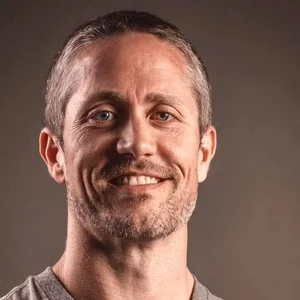
The Mad Scientist's Guide to Strength Training After 40 (Chris Duffin) | Ep 456
Why does lifting start hurting once you hit 40? Is it really age, or is your body compensating for weak links you cannot see?
Chris Duffin joins me to unpack the biomechanics behind strength training longevity, muscle building, and injury prevention. Chris is a world record strength athlete who has squatted and deadlifted over 1,000 pounds while applying engineering principles to human movement.
We talk about why many lifters trying to build muscle and lose fat end up breaking down, especially with strength training over 40. Chris explains how breathing mechanics, foot stability, and movement quality determine whether your body adapts or gets injured.
You’ll learn why poor mechanics “detune” your nervous system, how foot strength influences power and metabolism, and why proper bracing unlocks safer muscle building and hypertrophy.
If you care about body recomp, lifting weights long term, and evidence-based training that supports longevity, this conversation is packed with insights.
Timestamps:
0:00 - Why lifters over 40 get hurt
2:40 - Adaptation and movement quality explained
9:36 - Detuning, breathing, bracing, and core stability
21:57 - Breathing strategy across rep ranges
34:16 - Why foot strength matters for lifting
39:36 - Barefoot training and footwear choices
43:28 - Shoulder and hip power mechanics
46:17 - Regenerative framework for recovery
Episode resources:
Website: enhancedexecutive.com
YouTube: @MadScientistDuffin
Instagram: @mad_scientist_duffin
Facebook: @chrisduffinstrong
-
Why lifters over 40 get hurt
Philip Pape 0:00
Most training advice treats your body like a simple machine. More input, more output, add some weight, follow the program, repeat. And that works fine until you're 45 and your shoulder is clicking, your low back is always sore, and you're spending more time warming up than actually lifting. Is this just your age? Are you lifting too heavy? Or what if the problem is your feet or how you breathe? Or that pain in one area might be connected to other points on your body? Today's guest has over 20 years of applied expertise across engineering, biomechanics, and elite strength performance. And he applies this knowledge to the human body. Oh, and he's also a world record-holding strength athlete who squatted over a thousand pounds at age 42. You are going to learn how to engineer your body so it doesn't break down, why the fix starts in the places you'd never expect, and why the interconnectedness of your biomechanics is far more important than the program you're running. Welcome to Wits and Weights, the show that puts a popular piece of fitness advice under the microscope, finds the hidden reason it doesn't work, and gives you the deceptively simple fix that does. I'm your host, Philip Pape, and today we are talking about your shoulders, your low back, your hips. They're not supposed to hurt every year you train, but for many lifters over 40, we get pain, we get injuries, and we are trying to train for longevity. My guest today is the Chris Duffin, the mad scientist of strength. He was everything from a manufacturing engineer who spent years diagnosing complex systems and why they fail to later becoming a world record-holding strength athlete. He's the only person to have squatted and deadlifted over a thousand pounds for reps in his late 30s and early 40s. He just turned 49. He's still training heavy, still applies principles from engineering and biomechanics and cellular health and all of that we're going to get into today to the human body to help you find that bottleneck and fix the constraint that's limiting your performance. So today we're going to get into training longevity and resilience, the interconnectedness of your body, neurocentric biomechanics, even some surprising things that you need to know about your feet, your breathing, and more to improve how you feel and perform. Plus, maybe a little bit about what Chris does in his own training to keep lifting heavy. Chris, it's an honor to have you on Wits and Weights. Welcome.
Adaptation and movement quality explained
Chris Duffin 2:26
Yeah, thanks. Uh thanks for having me. I've been looking forward to this conversation. And the way you did that opening is exactly why I've been looking forward to it because it's a really great way to frame what we need to discuss. So yeah, I'm looking forward to this.
Philip Pape 2:40
Good. I'm glad we hit the mark, at least as a starting point. And it's funny because just the timing of this, a client of mine recently said, you know, I asked him, what do you want to see more in the fitness industry? And he said, I want to see more people talking about how not to get hurt. I mean, that's the way he put it. He's like, he's 45, I'm 45. And he came up in the world of like starting strength and five by fives and the big compounds and this almost epidemic of older guys now who are into lifting but getting hurt. They're breaking down. Maybe there's aspects of their life that compound that, like executives and busy professionals who have a lot of stress and they feel like their training is maybe too limited or dogmatic, or they're not sure what to do. Yeah. So, like, what's the trend or the culture you're seeing?
Detuning, breathing, bracing, and core stability
Chris Duffin 3:25
There's a lot of pieces to dissect within that. And hopefully we can simplify that because this industry always goes in cycles or waves. And there was a big push for a long time around movement quality and cleaning that up. And I was part of that. And now there's a lot of shift more around like the pain science of this and going, you know, we develop, we acclimate, that's the wrong word, adapt to stress. And so whatever movement that you move in is totally fine. And I think that might be causing some issues, even though that messaging is really on point. We don't want people to be fearful of movement. So being afraid, like I'm gonna do squat, I'm gonna hurt my back, or if if I don't do it exactly perfectly, means that I'm gonna hurt myself. Well, that creates fear, and then people are not pushing themselves, which then means they're not adapting, not growing stronger. And a better word for adaptation. It's just getting stronger, more resilient, right? But this is where context comes in, that little magic word, right? Because if we're not trying to improve the quality of our movement, there's an interesting thing that happens here because we adapt nearly any movement or stress that's imposed upon us, but not all of that adaptation is at the same rate. And we can take the back, for example. Like there's a lot of folks getting into lifting, maybe later in life, and they get strong maybe fairly quick, and then all of a sudden their back starts hurting. And it's like, hey, I read X program, and it says I should be able to train, you know, four days a week doing this. And it's like the research, all these science-based influencers are going through this over and over and over again, like scale back, and like, yes, but that's adaptation to muscular tissue and not the adaptation that needs to happen at a skeletal level for your disc to be able to support that load. Which, if you haven't had years of history of training, that adaptation hasn't happened. In this getting complex into the science of things, this piezoelectric, basically bone welding process that happens. That literally is it. That's how bone forms. That takes about a week. So if you haven't trained heavy in the past for you know decades, you may not have those adaptations and you might need to take it a little bit slower. We see this a lot in like female populations where if somebody gets into a strength sport, they don't have a history, and all of a sudden they're close to world-class levels in a few years and then they're gone because they actually didn't have the time that takes longer to develop that. And it might take longer to do that. Now, that's differences between you know processes in our body and how they adapt. We're talking, you know, skeletal adaptation versus skeletal muscle. But we also have our training reserves. If we think about this, if I move in a poor form, let's say I'm really rounded over while I'm squatting, again, you can adapt to that, but it's going to take you longer to recover from that. So you would not be able to, let's say, move as much load. So if we think about the total cumulative experience of your training over a week, for example, the total amount of repetition and load and all of this that adds up. If I work on improving my quality of movement in that, I'm going to be able to handle more volume, more frequency, and more weight, and still recover because I'm more efficient with the use of the tissues moving that load. Which means the more load that I handle within a given period of time stacked up means I get stronger. So you would get more resilient and develop more strength if you improve the quality of your movement. So don't be afraid of movement. If your technique isn't perfect, you go train. But also at the same time, try to make it a little bit better over time as well. And that's going to help you. And then there's some other things that kind of happen in this process too. Why is it? Why don't we recover as well when we're not using, you know, the materials, our biological materials as efficiently? Like our body responds to these, I call it peripheral inputs, where that load is at in space and where your joint is in relation to it actually sends a signal to the brain. So this soreness that you're feeling from squatting, it's like, oh, I have to do more to fix this because I'm I'm getting tight from all this squatting. My hips are getting tight, my back's getting tight. So I gotta add yoga, I gotta add stretching, I gotta add my foam rolling, I gotta add, add, add, add all this stuff. The body is trying to protect you because it's going, hey, we've got a loss of stability. Maybe our foot is unstable and it's shifting around on the ground because we're on an unstable shoe or an unstable surface, or we've just kind of lacked some motor stability issues and the knees wavering around. The body's response to that is to detune you. And so detuning you, one, it actually makes you weaker immediately. So you're not moving as much load as you really are capable of doing. It's literally how you move like thousands of pounds, for example, is to like really refine those patterns. So you're reducing the detuning that's happening in your system. So like all of a sudden, somebody's like way stronger. And it's like, how did that happen? We didn't add strength in 15 minutes, but we clean this stuff up and the signals are clear, and the body goes, You're safe to move now because we've got that in the right position. But on another level, that's why your hips are tightening up. It's not tightening up because you're squatting, it's tightening up because you're squatting like shit. The body's gonna start protecting that joint, and it's gonna start protecting that joint by tightening the muscles around it and starting to restrict the movement. And so I see this as a classic issue in strength training world is like everything is additive. That's not working. So we got to add because I lift, I have to balance that with doing this other thing, and I have to balance it with doing the other. And it's like, well, let's let's look at what we're doing and seeing what's actually driving that. And it might be that you're training too much, like you have too much load and that too much volume, frequency, all the other stuff. But these are all those variables that create that. And if it's a specific area that's starting to lose mobility, it means something with your training or your movement is amiss there. And if you correct that, that shouldn't happen. But being a thousand-pound squatter on deadlifter without stretching my hips, I can come close to doing the splits as, and that was as a 280-pound, you know, five foot ten male, because my movement through my hips was really clean.
Philip Pape 10:30
If you want to be strong and be able to do this a long time, and you mentioned it, quality of movement equals strength, you know, avoiding this detuning because you've become weaker due to the peripheral inputs. But ultimately, what I'm hearing is the quality of movement and your ability to do this and listen to the signals which are telling you something's off, and fix those things. That's how we simplify this to don't add more, fix that. It'll then lead to you being able to lift more. I guess my next question is when you say quality of movement, uh, we need to define that. And then what do you mean? And go on on all the different branches uh very specifically of what that means.
Chris Duffin 11:06
So listen to the signals that they're sending to you, going, hey, there is a gap here, and there's some areas where I can get more efficient. And the more efficient I get, the stronger and more resilient I can get, because then I can handle more load. But with that, spend some time training in some of those other ranges. Now, there is to some level a definition of good quality movement, and that is having the right balance of length tension relationship of the muscles around a joint. So that is joints that are you know balancing that hip, where if I'm popping my chest way up, like all the muscles that are connected to the front of the spine are in a stretch position, and the ones in the back are in a shortened position. If they're constantly like that, the ones in the back are going to be overworked. They're gonna hold a lot of tension and they're going to be less able to get nutrients in, so substrate material in and waste products out. So you're restricting their ability to recover and they're overfatiguing because they are working all the time. So they have a, you know, a chronic level of fatigue that now when I get capacity, so someone that has overactive, you know, erectors because they're trying to uh compensate for something typically has those fail during a movement because they don't have the resilience because they're already working. Uh again, I've got a lack, uh, a little bit of laxity in the muscles in the front that are in this stretched position all the time. They're not turned on in that balance. And this becomes important when we talk about what we call prime movers, which are the main like drivers of force as versus stabilizing muscles, ones that are kind of creating that balance. So I think of this in a global perspective. So the biggest impact to me is the impact of I hate calling it the core because people misapply that to like tight, you know, rigid abs. And it's not what I'm talking about. It's this ability to manage, well, that region of the body, the diaphragm, it's the area between the diaphragm, so your upper rib cage and your pelvis, and having good alignment with that and being able to balance the processes within that, which is happens from it's cued from the diaphragm. There's a lot of other muscles that happen, but we'll talk about that, which has three essential functions respiration, stabilization, and the sphincter. It's why you can't brace 100% if you're running a marathon. You're still braced, otherwise, you'd flop over. So it's this balance, and it's always somewhere on a continuum. So you can think about this, you know, knob that goes to 10 one direction and 10 the other, and you you can choose. Like you go dial it one way, it's less, you know, as you start dialing more towards respiration, you're having less stabilization as you're dialing the other way. And it's it's always a balance in there of what do you need from a respiratory versus stabilization. But that process right there, that alignment and using those resources and getting everything to stabilize the spine has this huge effect throughout the entire system. So number one is the ability to control and manage the breathing and breathing complex. All right. Number two is the foot and ankle complex. Then number three is the big power generation joints, the shoulder complex and the hip complex. All right, then you can get out into the peripheral. And if you think about things in that sequence of like trying to diagnose what's going wrong, it may be counterintuitive. I'm gonna start with that breathing embracing and that alignment uh component. That may sound weird, but if you are lacking that stable base to fire from, that lat that holds that internal rotation of that shoulder while you're benching doesn't have a stable base and it might be flaring out. Fixing this can fix that. Same thing. That lack of mobility, that protection could be happening because, again, a lack there in that area. And so just focusing on that first, like that's the global perspective. I'm not saying the problem's there, but that's the thought process. We go there first. So it's it's about having a good relationship there. And it doesn't mean you can't like be in another area and space, but when I'm trying to maximize my force output, when I'm trying to get more efficient with some base motor patterns, I'm going to try to make sure that I've got that and I know how to be able to inflate my core 360 degrees. So I should have some expansion in my lower abdominals, in my lower obliques just below the belt line, in my low back just below the rib cage. Like I should be able to just sit there and expand all of that while keeping that diaphragm, so that space at the base of the rib cage in parallel to my pelvis, right? Keeping those two in that same frame, being able to expand there, the equality and ability to control that does a lot of things. And then you can move in different ways in different spaces, as long as you can kind of control that. The ability that diaphragm descending down creates pressure on those organs. And that pressure pushes out all the way around, including down in the pelvis, which causes a co-contraction of all those muscles, which is the thoraciolumbar musculature, the pelvic floor, like all these other things that you could think about doing. The I need to do the valsalva move over, I need to do all these things. It's the real simple way to just focus on one thing and get like those processes, the body to say, it is safe for me to be in this position and elicit force without restriction. That's the signal that you are sending to the body when you do that. So being able to learn to do that without breath, because guess what? There's no actual air in your down there. That's organs. It's just the diaphragm is descending down, making space in the lungs. So doing it through the lungs is a compensatory pattern. You could add a little bit more over the top, um, and you can kind of pulse the diaphragm. So you may hear like people doing kettlebells or other things with this like little burst, like that is they already have good stability and they've got right at the peak of contraction, they're hitting that, which causes this micropulse of intense pressure, more intense pressure. Good posture, and then being able to expand all of that all the way around, checking those points. Boom, that's first step in the process.
Philip Pape 18:00
So I really like this breathing bracing nuance that you're gonna get into because we do simplify it often to the Valsal remover, um, just taking one big breath, holding it. There's no spectrum of how big of a breath, the pulsing or anything like that, from a max one RM to just like doing something for reps, people don't distinguish. And I think there's got to be different ways to approach this across that spectrum. So, some of my questions are now gonna be about like the pressure versus the load, about how does this apply to the actual lift mechanics, you know, and then and then things like lifting belts, which we can add tech on afterward.
Breathing strategy across rep ranges
Chris Duffin 18:38
So you'll notice in there that discussion, I didn't talk about like the contracting of the muscles. Like if you're gonna put a weight on your back or in your hands or throw a punch or do these sorts of things, that outer contraction is gonna happen over the top of it. So you don't have to like consciously do that, or again, consciously think about like the Valsava maneuver. If we just initiate, I try to simplify things down into all right, I'm gonna have that outward expansion in those areas, a few touch points and be in good posture. That's it. Bunch of stuff happens. Now, what is the intensity? What is that very one rep max, three rep max, five rep? Uh, I'm doing kettlebell snatches, you know, for time. How do I manage this? And that's why I mentioned that continuum dial. There is no necessarily perfect answer because it's gonna vary on your particular respiratory needs, but it's going to be that balance. And again, like what is your level of strength in those muscles that are creating that stabilization too? So there's gonna be a balance there, and it is a give and take. So with a max true one max rep, there is no breathing during that process. Everything is stabilization, all right. And let's say I'm doing a five rep max, I'm probably pausing in there somewhere to take a reset and take a breath. Maybe it's after the second rep or the third rep. I'm gonna stop at the top where I'm in a good posture, release, another breath in so I don't pass out from last lack of air. All right. But let's say I'm doing a kettlebell snatch. That's for time. That's gonna be pretty continuous, but it's got some peak forces in there where I'm gonna need to be stable, but I'm probably not doing the breath between reps because there's no time. So I'm doing I'm timing that with it, right? So in a non-contractile phase, you know, I'm letting that air out, then I'm bringing it in, and then I've got a period where I'm not uh taking a breath, and it's in that movement. So it's within that continuum and just understanding all right, where's that balance at with this? Right. And so there's no fixed answer. If I'm doing a 20-rep squat, you know, it's gonna be very different and might start becoming part within the movement, but the stabilization demands are a little less as well. But this is also if we go all the way back to the beginning and you talked about how do I not injure myself. This is problematic in this arena when we're dealing with these core compound movements that people don't think about when they're talking about all right, movement quality doesn't matter. That whole initial discussion, let's tie back to this. We are now using the same process for respiration and stabilization. And if we start fatiguing out because of respiration, and now we don't have the strength to handle the stabilization, and I'm doing a CrossFit circuit with wall balls and squats and all of this, and I've got a core movement in there, and I have fatigued my capacity from an endurance respiratory standpoint. And now I've got 200 pounds on my back, but I'm a 400 pound squatter, but you just can't stabilize enough to protect yourself, and you end up hurting yourself. This is good reason to take. Make movements like that and separate those from they shouldn't be part of a metabolic conditioning program because of the failure mode.
Philip Pape 22:10
Yeah, yeah. I'm laughing because I did I did CrossFit for like eight years and I have the injuries to show for it, the long-term issues that are slowly getting resolved from separating the two. You're right. Because you just you get wiped and you're going for you know grace or what are these wads for reps on deadlifts and you're just killing yourself.
Chris Duffin 22:28
You just you got nothing and you got to the end. And that's not a knock-on CrossFit. You can do CrossFit and program it highly intelligently. Um, and you can do like and you can get strong too, like hit boom. But you're gonna come in and you're gonna like, all right, let's hit a squat session, boom, let's roll up. All right, let's now do a metabolic conditioning piece and just not have a movement like that with load that has that potential within that wild. Like it's that simple.
Philip Pape 22:53
So if you were coaching somebody and they're you're coaching them on the deadlift, people are trying to do a set of five, let's say, or even a set of three. Is there a standard default that you'd recommend in terms of like, do you breathe at the top or bottom? And also how do you do it and when do you take a breath? Like if you said, yeah, it's a pretty good protocol, let's say, for a set of three deadlifts.
Chris Duffin 23:12
So it's not one or the other. That's where the continuum, because they can mix and you can be doing the breathing. It's just a so just quick clarification there. But typically on a squat or deadlift or a base movement like that, I'm gonna do it in a position where I'm not holding the weight. And that it does that sounds funny. I'm like, I'm holding the weight with a squat or deadlift all the time. But you can stand with a weight for a really long time because the postures and everything, you're not actually loading and holding that spinal position uh unless you're leaning slightly forward or back or in the corner.
Philip Pape 23:43
Right, you're totally balanced over midfoot in a vertical line. Yeah, exactly.
Chris Duffin 23:47
That's the time to do that if you're doing one of those movements. Reset.
Philip Pape 23:52
Okay, okay, interesting. So on the deadlift, see that that's a good one, right? Because a lot of people breathe at the bottom of the rep or they take a breath at the bottom.
Chris Duffin 23:59
Yes, do not do not do that.
Philip Pape 24:01
Okay, yeah. See, that's yeah, exactly. That's why I'm bringing it up, right? Because I taught I have my lifting buddies and I would are we sometimes argue about this stuff, and a lot of people come to their own conclusion when they realize doing it at the top seems to be more helpful.
Chris Duffin 24:15
A caveat with that, like if you're doing low load and you're doing repetition based stuff, that may make sense because it doesn't require as much to get that off the floor. But you if you are setting the tension and you're already in that down position, you're literally trying to force like how to explain that. Like, you need to create, if you're moving a heavier load, you need to force that level of tension into the bar. And if you start with no tension whatsoever, because if you've let a breath go, your body is completely relaxed and you don't have tension on the bar. That is it, right? So now I'm gonna rebuild that and I'm rebuilding it all just through that and that slacks in that bar. There's some sort of acceleratory thing to get that bar moving and to get that bar moving without some give in the body, it needs to be really light, or you're compromising position. You've got a little bit of loss in position as you're getting into position. So, like for me, I would set that brace before I went down into the deadlift, and I'm driving my hips into position, and the bar is literally bending up to be able to match to give my hips the highest position possible. Because the higher hip position possible gives me the best diaphragm uh to pelvis relationship and the best strength I can elicit from my hips. If I'm loose, if I've let loose that brace, let loose that tension on that bar, the hips are thus lower. And thus I don't have the same efficient power, like just from a mechanical standpoint, as an engineer, you get this like literally change the lever points, and I have less strength. And I'm going to end up compromising position as I let those hips rise and get into position to where I optimize those strengths, but I've done that by compromising the other positions. So you have to have that rigidness, and that rigidness can be created as you're driving into, but it's got to be done before. So, like for me to set up for a deadlift, there used to have to be 500 pounds on the bar. Because if it was less than 500 pounds, the weight would come off the ground during my setup because I knew where my hip position had to be for that to break off and the bar would be bending so much, I owned that position and I wouldn't start from a lower position because it's a different movement.
Philip Pape 26:40
Another thought that goes through my head is if you just bend over right now, if you're listening to this into a deadlift position and then try to take a big breath, it just feels unnatural.
Chris Duffin 26:50
You're not in a good position for the for all that activity to happen. You're in a poor position. You want to be in good position to set that. You can't do that when you're in that position. I mean, that is it is that is a known fact.
Philip Pape 27:03
Like so, when it comes to the respiration versus stabilization, like when we think of lifting belts and people talking about intra-abdominal pressure and all this stuff, like what's your thought on a belt?
Chris Duffin 27:14
Yeah. So a belt can be a really valuable tool for a couple of reasons, but usually it's completely misapplied. All right. So people are using the belt for support. And so they're cranking this belt on. And in fact, what we want the belt to be, and we need to be able to expand to actually get that contraction to happen the way that we want. So you have to be able to expand out into the belt, but then you reach a point of like, all right, once we've written that, I don't want to, I need a rigid force to expand against. And that's actually that co-contraction of that the thoraciolum bar musculature, the abdominals, like all this stuff is your internal belt, but it's not a hundred percent wholly rigid. So it does have some give to it. And so a belt can be valuable by creating that more rigid for handling that maximum load. And it can also be really valuable for you to just from a cueing mechanism to have the tactile feedback. Like, am I pushing out in all these spaces? And just tactily having that. So I found a lot of effect of just having like an expandable kind of belt that allows you to breathe out into it, uh, but has some restriction because it's creating that reactive neuromuscular training, is the technical term for it. But it's like it teaches you to push into it, like a like a nylon instead of a leather. Yes, exactly. So that's another if I'm using from a tactile, if I'm like trying to, um, so if I'm working with an audience that is, you know, not a maximum performance audience, I would use a rigid belt for them, right? But uh, but if I'm teaching, I really like uh that it is that it's got a few pockets where you can put like uh you know balls in massage balls so you can target like specific areas for people to like, hmm, okay, I'm pushing out into that. So I find that really, really valuable. And that's actually what I use today because I don't train for maximal strength. And I just like that little bit of extra resistance, but not too much. So the way to use a belt properly is to have be able to slide at least two fingers between your belly and the belt before you you're expanded. But it's to have it relatively, but like loose enough that you can still slide those in there. So if you've got it too tight, you're actually sucking that in and you can't expand out into it anymore. So that's where the misapplication that I see over and over again is people are looking, they're cranking, and they're they're using it as a passive structure. It needs to be used in an active manner.
Philip Pape 29:47
Okay, and two more questions about breath. One is can you take too many breaths? And and I say that because again, you alluded to holding your breath for multiple reps, and there's different schools of thought on that as well. So if you're doing like a set of five squats, you know, is there a disadvantage to taking a breath for each rep because of now the respiration overcomes the stabilization in some way or tires you out? Or is it like that's too short of a period for it to matter?
Chris Duffin 30:12
That's too short of a period. Uh, so I wouldn't worry about that too much. So, what does this allow? It allows us to move greater load, right? But it also then allows us to push. If we can maintain our technique and we're not stopping because of respiration, I'm not stopping because my low back's fatiguing. Like it is just pure, like my movement's just freaking maximal solid. And I and I'm failing because my quads just can't give anymore, right? That triggers something at a cellular level. So when you're able to push into a deeper state of fatigue, the deeper you go, it pushes further oxygen desaturation of the muscles, it pushes uh changes lactic threshold, it does a number of things at that level. And that's like if anybody ever gets around uh looking at like blood flow restriction or things like that, that kind of forces that mechanism via a whole different pathway by just depriving the body and putting it in that deeper state uh without the load. But the further you actually improve that, so like changing the load in space got people with a squat bar, it was called the transformer bar, put the diaphragm and the pelvis like perfectly aligned and got people in these amazing squat patterns. And all of a sudden, you could go to that level. So it's another way of tapping into this cellular level biology because when that happens, those triggers things like uh PGC one alpha, it's basically this cellular level response triggering uh adaptation at that muscular at that level. And it's truly, truly fascinating. And that's a lot of my thought process through the years was underlying what is the cellular signaling pathways, which is why you saw me dealing with products that like a flywheel, so the Kratos flywheel, like the load starts dropping as you first push into it, like a dumbbell that changed weights as like you could change the leverage as you went because you could just keep pushing. BFR, I was a big proponent of it. I still am uh education around that same thing. It's another pathway into that same modality. And these are actually triggering those responses at the cell level so we can actually grow stronger, more resilient, drive metabolic changes at that tissue. So it's it's really fascinating stuff.
Philip Pape 32:44
Is it just a function of putting you into more variations that then can reach the deeper and more muscle fibers, just like the conjugate method tries to do with rotation through different lifts? Or when you when you say set cellular signaling, is it really just that, or is there some other mechanism you're you're alluding to?
Why foot strength matters for lifting
Chris Duffin 33:01
Uh well, what I was talking about was just truly in that context was cellular, uh cellular signaling. But it has an effect. I mean, your grip position plays a role in that, for example. Like a lot of people grab super, super tight because it creates all this tightness of the upper back, but there's a disconnect where that upper back isn't tied into this really strong, rigid, stable core. So it feels tight and it's great and it's a great shelf. But once we get closer to fatigue, we'll see that at the thoracic lumbar junction, they'll end up rounding out and failing, right? Does that mean a wider grip's better? No, because they lose that strength. But somewhere in there, there's a grip that allows you to stabilize and now use the lats to connect the shoulder into the core. So actually, the best grip is your pull down grip, but you have to pull down. So when you've got that squat bar on your back, you need to have the shoulder mobility to be able to get into that position and then pretend to be bending that bar over your back and into your core. And now you won't feel as tight in the, you know, the upper area, but that's tied to the core, and now you've got this rigid, solid member, and that won't give out when you're going to squat. But sequence is important here too, because if I tighten those lats beforehand, the lats are gonna throw you into extension, and then you won't be able to get. So you have to set this first, then draw the bar over you.
Philip Pape 34:29
Okay. Well, I also want to get into the other aspects, right? Foot, ankle, as well as shoulder, hips. Is that a logical next? So feet and ankle. And I know you're a big barefoot guy, like guys that you can check out other podcasts that Chris has been on, and he goes all into the foot for like hours. It's it's fantastic content. But like footstands, feet, footwear, ankles, all that stuff definitely is another. I mean, you're contacting the ground there, so that's super important.
Chris Duffin 34:53
Yeah, the biggest point here, and and I don't have to argue this anymore because people used to go, where's the science? Where's the science behind what you're saying? And I went, have you ever heard of exercise science? Because the exercise science is about the specific adaptation to imposed demand. And you're telling me that the foot doesn't respond the way the rest of the body responds and doesn't respond to the specific adaptation to imposed demand. So all I'm saying is you need to use and train your foot. And if you don't, the foot is going to get weak. And if the foot gets weak, it's going to have a loss of blood flow, it's going to have mobility uh restriction issues, and then you're on a weak base, and the body is going to compensate and try to protect around that. So that is just fundamentally my position and has been for a long time. And it was most of our footwear today, and it's not a sizing problem. If you've been wearing traditional footwear your whole life, your foot has been deformed to fit the shoe. So it's not going out today and finding the shoe that fits. But that immediately grab your hand in front of you, grab the four fingers and pull them in. Okay. And immediately you can start seeing them turn a little white. All right. The front of your foot is in the front of that shoe, and you're creating a loss of blood flow with that. It's near immediate. Okay. Some certain things happen if we pull that big toe in immediately, which happens in that shoe, versus pulling it out, as far as their ability to engage the upstream musculature. So simple stuff, and I'll base this off of known research right now. And this is with MRIs, it is with uh X-ray, and I haven't seen the research, but I've talked to the doctors that have done the biopsies. And it is around plantar fasciitis. All right. So, but we'll extrapolate this out. Most everyone thinks that plantar fasciitis is an overuse condition. I've overused the plantar fascia. It's sore, it needs uh a passive support and needs rest. All right. All imaging shows it's at least 96% of all cases are an actual atrophy of muscle tissue due to lack of blood flow and the tendon and ligament tissue basically uh degrading in that process as well. It is weakness, it is atrophy of tissue, it's lack of blood flow like from underuse because you haven't been using your foot because you've learned to passively sit on top of this foot, just like stand on this stump of your foot.
Philip Pape 37:38
Just like a block, just a block in a shape. Just like a block.
Barefoot training and footwear choices
Chris Duffin 37:41
Okay. And so that's like the essence of my argument right there is the problem is we have our feet stuffed in these shoes that is allowing our foot not to be used, and it is becoming weak and creating a lot of dysfunction. It happens to be the base of nearly all sports, other than like, you know, any ground-based sport. Um, not swimming, you know, for example, although we could probably argue that too. But power is generated from that force and then applied to a distal end. And we've got weakness there to start with. And I'm just like, you gotta spend some time using that, right? So having the minimalist level of protection from the environment, right? From heat, like the hot pavement, uh, from germs, you know, that's what you want. The minimalist level that still allows your foot to move and then learn to actively stand, actively build your arch and control that. And then it's just with time. And people are like, Well, I do that, and my foot hurts. Yeah. Do you remember the first time you went to the gym and did a squat? It hurt. What do you do? And this is a well the argument. Well, people put um, yeah, there was the big barefoot running craze, and the company that put those shoes out there got sued because so many people got hurt. Like, do you remember the first time you squatted? Did you go into the gym and taught 220 squat 225 for 50 reps? What would have happened if you tried? Because that's what happened, is they said those shoes are better, and all these runners that run 10, 20 miles a day, you started putting them on and just going out and running that. Guess what? If they had weak feet, detrained feet, well, how do I well what what's the progression? I don't know. I can't tell you what the progression for your squat is. What do you do? Oh, you go to the gym, you do some squats, and if it was a little too much, you don't recover as well, do a little less, then you'll find you can build a little bit more and then build a little bit more. It's the same as the rest of your body. And all I'm suggesting is use it and train it and use the same thought process as the rest of how you would train your bench press. Now, the research has come out because the foot is just like fundamentally used all the time. If you switch to a minimalist style footwear, it does as much as a dedicated foot and ankle strengthening program.
Philip Pape 39:58
Just because of how much you use it, right? Yeah, and everything exactly. You don't even have to like try to like get a foot dumbbell or something, right? Like people are thinking of that.
Chris Duffin 40:06
I used to tell people do both, like because I didn't want to be like pitching, like, oh, just go buy the shoes, but yeah, it is the like just do that. Like, and if you do that, then go try lift, squat some and dead lift some weights, do some stuff. Like uh, if you want to build it further, hey, do some lunges or some split legs with uh half of your foot off of a off of a block. Like do some calf raises without shoes on.
Philip Pape 40:30
It makes sense. I mean, the foot has like um the feet and hands have half your bones and muscles of your body, or at least half your bones. I forgot. I don't know about muscles, but yeah, right. They're so complex.
Chris Duffin 40:40
37, I think. It yeah, it's insane. Your foot is an engineering marvel, so it's got the whole windless uh system built in there where with your stride, we've got this uh, you know, basically really flexible like movement of the foot. But as soon as we go to stride, as that big toe raises up, it winds up this windless mechanism that winds up and creates the stiffness of the arch. So all of a sudden, this structure that is like really pliable and can walk over stuff. As soon as you go to sprint or run or take off, becomes this powerful medium that propels you forward and multiplies your force. Like it just the foot is a beautiful engineering marvel, and it's the base of everything that we do from movement. That's why it is. We're not gonna design something better than what it is.
Philip Pape 41:31
That's interesting, right? Because I talk to people about sprinting all the time. I'm like, get the most minimalist footwear you can, and it's gonna feel amazing. Like, you got to adapt into it. So the controversy, of course, is always squat shoes versus flat shoes versus no shoes, and like, oh, you don't want to drop something on your foot, so there's a safety issue. Is it a function of us, you know, some percentage of certain lifts? Go ahead and do barefoot, and then maybe the rest wear what you want, you know, squat shoes, or you're like just go all out barefoot.
Chris Duffin 41:57
Yeah, you got to think about shoes as a tool. Like it's protect from our environment. Like, if you're a logger, am I gonna tell you to wear a minimalist shoe? No, but I'm gonna tell you to find the most flexible one that allows the best that's gonna support you, like in whatever environment that you're in. So it is a balance of trade-offs. That's what it is. I think it's a crux, and maybe it's a mental crux, but it's in the right tool for the job. If you're gonna do an overhead, you know, movement, like that's a weird lift, a an Olympic lift, uh, you know, the Olympic snatch. That is a sport, and you're going to need to be able to get in position to do the sport. And that is an unnatural to be sitting on your heels with weight overhead for us to be in that type of position. So those ones, yes, that shoe makes sense. For basic squatting and deadlifting, it doesn't make sense. There's no need to do it. But if you're competing and you lift more that way, go ahead and do that. But trust me, you will perform better if you do the majority of your training outside of that shoe and get a stronger foot and then put it into that. But the stronger foot and ankle complex you have within that is going to perform better.
Philip Pape 43:08
Train your foot, enhance it with tools as needed, go back and forth and kind of one works with the other. And I know you yourself, I believe, improved your deadlift barefoot, right? Is that right? Yes.
Shoulder and hip power mechanics
Chris Duffin 43:19
So if you go watch my videos of my squat and deadlift, and at the time it was such a this was such an unusual controversy thing. Like if you read through the comments, you'll see people like comments in there. Oh my god, Andy did it with no shoes. Can you believe what he would do with them? And it's like, no, that was actually a performance enhancement, but you know, it's the other way around, is what you're saying. You're implying. But so people did not get that at that time. It was 2016. I did that. Yeah.
Philip Pape 43:45
Okay, so shoulders and hips, I think, is worth some discussion there because I'm really curious to hear about that. I personally have two rotator cuff surgeries.
Chris Duffin 43:53
So those are the power generating units, and it's just like we don't need to look at those until we've checked the box. On those other things. And if you've got, you know, issues at your elbow or your knee, rarely is it that. It's somewhere, you know, in that train. So at that point, you know, if I've checked those boxes, I'm be looking at the hip and the foot to further down figure out what's going on with the knee or the elbow. I'm going to be looking, you know, at the shoulder. And if you've got those signals correct and you can, you know, put that power forth, it is going to change a lot of that. And then it becomes down to, you know, managing those complexes correctly.
Philip Pape 44:34
All the talk of impingement and overhead work and people's anatomies and all that, there's a lot of misunderstanding there. Like what's your general thought? Yeah.
Chris Duffin 44:43
So yeah, I mean, if we're in poor position and uh we're destabilized, there's three muscles that get tight around that hip and they'll pull that hip board in its capsule and create an you know an impingement and it's there. Uh, I've seen it over and over in the shoulder, and I'm not saying all cases, but if we've got lack of tension where it doesn't need to be around that joint, that joint is going to be in a different position. It's not this fixed thing. And because you've got a lack of space now doesn't mean that there is a lack of space.
Philip Pape 45:15
And is there a bias of pulling versus pushing that you have, or is that an irrelevant variable in terms of your overall volume?
Regenerative framework for recovery
Chris Duffin 45:23
I guess that's a good question. And I would say, yes, it does matter. I don't know I've ever put it in that terms just when building training plans and looking at the overall volume and stuff. Uh yeah, that definitely is applied. So context. Generally, yes, there's more muscles on the back. So there's likely if we're developing that all correctly, but you could end up with somebody with a really underdeveloped front. And you so where what's the developmental need as well? So so there's not a ratio that's absolutely perfect. And I think that you're gonna discover that in the training process and just understanding where the gaps are with your movement. But generally, yes, the lats and the rear delts and the traps and all that add up to a significantly more chunk of space than your pecs and your front delts, right? So, but there's some level of variability. But you could say, yes, roughly that thought process is is correct.
Philip Pape 46:21
Cool, cool. You know, I feel like we barely scratched the surface, but there's a lot of practical stuff in there that I think a lot of lifters listening are not thinking about and now are, and that's hugely beneficial for their health. And I want everybody to just really like take notes again if you if you just like were binging this, like people tend to do when they listen to podcasts and take notes. You know, we didn't get into a whole bunch of other awesome stuff you're doing with like, you know, regenerative protocols and peptides and all that. But is there anything we didn't that I didn't ask you, like one thing you're like, this is worth mentioning that that we didn't cover?
Chris Duffin 46:52
Um, yeah. From a general thought process, understanding the larger perspective of so I think about things in this kind of regenerative, I call it the regenerative amplification uh method or framework. We need to think about this, like we need to be able to have a clean space to send those neurological signals, uh component of that. We talked about cleaning that up from a movement perspective. If we get into a broader health perspective, that might be cleaning up inflammatory signaling like in your diet and other stuff, because that's going to inhibit that mechanisms, right? Once you've cleaned up and have a clean terrain to send those signals on, which comes from, again, diet, light exposure, sleep, like all these kinds of uh supplementation. There's a lot of things that you can do to manage that. But we're talking about cardiovascular disease, diabetes, uh, how you're physically like recovering uh tendons, arthritis development, like all of that, right? Like that's all cellular signaling. Then you can move into you know modalities that actually send those signals. And so we'll get to the training, but that would be uh the use of like uh peptides or other therapies. If you do that, we can actually enhance some of that with like alternative modalities. Where does that fit in? You know, red light therapy, shockwave therapy, things like that. Then there's having making sure you have the right like substrate material to work with. Like, hey, I'm sending a signal to repair collagen, joint tissues, things like that. Like, hey, I'm probably gonna want to have some glycine in there for, you know, like what are the raw materials, like protein, the substrate material. And then we've got to reinforce that with the loading and mechanical signals to build and lock in the resilience and adaptations uh piece of that. And so that was a piece of like improving that, and that's a lot of what I'm known for in that work. So, yeah, people want to know more, check out uh Enhanced Executive. That's where I'm at. And I've got a free forum uh for people if they want to join, tons of articles, all my movement videos, stuff like that is uh on there as well. So you can find that on my website. But it's uh absolutely free, amazing resource uh for folks. And check out my YouTube. I'm producing a lot of content there, and I have tons of lectures and videos on all the things that we talked about.
Philip Pape 49:20
Based on the evidence, uh, there's a lot of you know, quacks out there, especially in some of these newer therapeutic areas. Um, and I love your stuff. We're gonna send people to the forum and your YouTube and your other resources. Um, but definitely check Chris out, follow him, listen to him. Like even myocines and inflammatory signals and like what you can see in lab work and machine learning and AI now, looking at all that stuff is it's just amazing. It's incredible.
Chris Duffin 49:43
Great, yeah, story. So I've been just for the audience, like, yeah, be wary of that space because there is a lot of quacks, a lot of information, a lot of people trying to make a fast buck. It is where I my profession is right now, but you will not find anybody that has 23 years of experience with those regenerative modalities. And I'm the guy behind the scenes that does the consulting for some of the top stem cell therapy clinics and regenerative medicine people in the world. And that's so.
Philip Pape 50:11
And if that's not enough, he's one of the strongest, if not the strongest, doing it. So all right, all right, Chris. It's been a pleasure having you on Wits and Waits. Uh, a lot of fun talking to you. I learned a lot. So thanks again, Chris, for coming on.
Chris Duffin 50:22
Check out barefoot, B E A R. That's uh the shoe and boot brand.
Philip Pape 50:27
Sounds good. Thanks, Chris. Talk soon,